
You are currently browsing the monthly archive for April 2014.
Tuesday night’s tweet chat (splendidly moderated by Kim, who I think it is fair to say has become an expert at herding the kittens of #OzDOC) was all about the ‘what we’re told’ versus the reality of life with diabetes.
We have guidelines, we have evidence, we have best practise. All of these things are important. They provide gold standards.
Then, we have life. And everything gets thrown out the window.
Everyone (diabetes or no diabetes) uses short cuts and life hacks in their day-to-day life. These are accepted and understood to be necessary in cutting through the every day. Saving time and energy makes sense – we’re all busy!
And those of us with diabetes get to add chronic health condition management on top of everything else! We know what the guidelines say; we know what the posters in the waiting rooms tell us; we hear the words our HCPs use about management of diabetes.
But the reality? A lot of the time we ignore it all and do what we can; despite what we know.
Here’s what I know.
- I know how frequently I ‘should’ change my pen needle (if on shots)
- I know how frequently I ‘should’ change my pump line
- I know how frequently I ‘should’ change my lancet
- I know that I ‘should’ eat a low GI breakfast each morning
- I know how frequently I ‘should’ see my HCPs
- I know I ‘should not’ consider chocolate a food group (or Nutella. Or coffee.)
- I know how many times a day I ‘should’ check my BGL
- I know the times throughout the day I ‘should’ check my BGL
- I know I ‘should’ get my HbA1c checked every three months
- I know how many days I ‘should’ leave my CGM sensor in
- I know where I ‘should’ site my pump cannula and sensor
- I know I ‘should’ carry emergency diabetes supplies in case my pump fails
- I know how I ‘should’ treat a low blood sugar.
But here’s what else I know.
There is no place for ‘should’ in diabetes management. There is ‘this is what I do’. And that – THAT – is good enough!
It’s Friday! Check out this great string quartet playing a bit of Vivaldi (and Mozart and Weill).
How often do you ask for help because of your diabetes? Yesterday at work, I had a hypo that just wouldn’t quit. I ate the equivalent of the weight of a tram/rhino in jelly beans. It worked eventually, but for a long time I was hovering around the 3.0mmol/l mark, anxiously checking every 10 minutes to see if there was any increase in my BGL, while at the same time waiting for the inevitable spike (yep – came two hours later in the form of a lovely 26.5mmol/l. #DuckingFiabetes).
So, did I call out to anyone and ask for their help? Did I request someone come and sit with me for a bit – at least for the part where I was seriously wondering if standing was a good idea? Nope. Instead, I fought through, guzzling glucose, sitting in meetings, smiling my way through. Anytime I saw someone and they asked ‘How are you?’ did I say ‘Low, low, low, low’? Nope. I said ‘I’m fine, thanks’ and threw them what I thought was a winning smile, but given my hypo state was most likely a lopsided grimace.
I’m not good at asking for help. The one hypo I’ve had that required an ambulance occurred when I was walking around the park one evening with a dear friend. She noticed me throwing down a handful of the jelly beans I carry with me whenever we walk and casually asked if I was okay. ‘Yep – all good’ I said and we continued powering away. Her concern grew as I started shovelling the jelly beans down and became distracted, but every time she asked if I was okay or if we needed to stop, I’d smile and tell her all was fine and that the glucose would start working shortly. Even as the sweat started to drench me and I felt my legs start to turn to liquid, I swore that all was okay. At no point did I say to her that I was concerned that I was about to pass out. At no point did I tell her that I thought I was not going to make it back to her apartment. ‘I’m fine.’ I said. Over and over and over. Until I wasn’t and the next thing I remember was waking up on her the floor of her apartment with a paramedic about to shove a dextrose IV into my right arm.
On those occasions where I have needed help, I’ve been left feeling beaten. I vow to step things up and not let diabetes win again. But is it a matter of diabetes winning? Perhaps this ridiculous doggedness to insist that ‘I’m fine’ is actually doing more harm than good. Would it have been so terrible if yesterday I had said to a colleague ‘I am having trouble getting my BGLs up. If I have to eat another jelly bean I’m going to vomit. Would you mind at all finding me some juice to drink?’ Would they have thought any less of me; seen me as helpless; decided that I was losing to diabetes?
Of course not. But this isn’t about what others think. I need to feel that I can do this on my own. I don’t want the burden of my condition to become my family’s burden. I don’t want to acknowledge that diabetes is changing and that what worked in the first decade and a half is perhaps not going to now. I need to believe that I am fine; that I’m going to be fine. Really. I’m fine.

On my bedside table
A favourite book of mine is An Equal Music by Vikram Seth. I first read this book back in 2000 when I had not long stopped playing music. The book spoke to me for a number of reasons, but mostly because Seth completely nailed the way that he wrote about musicians. Having been one for a long time, married to one and surrounded by friends who are musicians, I found myself smiling at how right he got some of the nuances. I’ve lived through and participated in detailed discussions about composers – deriding those not as beloved as others, hours upon hours of intricate dissections of performances, passionate debates about the quality of one Shostakovich string quartet over another. And Seth’s version of this was so spot on!
We develop a language when we are part of a community. The music world certainly has one and I consider myself still quite fluent due to the people I am around a lot.
And the diabetes community has one too. The language itself is full of words and abbreviations that only make sense to those who use them on a daily basis. And there are distinctions we insist upon that make others consider us pedants. There are in-jokes that make sense only to those who ‘get it’.
But it is about far more than just the words or the descriptions. It is about the way we talk and the meanings behind the words – often resulting in confusion from those not part of the group. It can be exclusive for this reason, which whilst usually not great, does make us feel that we are part of something distinctive. I’m not necessarily sure that is a good thing when we haven’t actually chosen to join this club, but regardless, I know the way I relate to others with diabetes often employs shorthand to get straight to the point and avoid detailed descriptions and explanations.
Think about it. When you say to someone with diabetes that your BGL is 2.1 (or 21) mmol/l, they will immediately know what that means. Say it to someone who has no connection to diabetes and the will not understand that it means you need to do something. Immediately.
I come back to An Equal Music every year. Sometimes I read it all, other times I skim through, finding passages that are particularly significant to me. I get swept back into the world of chamber music and Beethoven. It was a different time in my life. I feel lucky that I can recapture it – even in just a tiny little way – in the pages of this beautiful book.
 THE GRUMPY PUMPER
No. It’s not the “Bad” Type
No. I don’t have it “Really” bad and that’s why I’m on a pump.
No. If you press that button I won’t die. YOU WILL!!

You can read more from Grumpy at his blog, The Grumpy Pumper and follow him on Twitter here. (He’s actually quite delightful!)
Diabetes Tales is a new thing I’m trying out at Diabetogenic. If you’re interested in taking part, let me know!
Technology in diabetes has come a long way in recent times. In the almost-sixteen years I’ve had diabetes, we’ve seen the advent of ‘smart’ pumps, CGMS and even trials of closed-loop systems that make the artificial pancreas seem a real possibility in the not-too-distant future.
BGL meters are smarter too, with new ones having built-in wizards to help keep track of insulin on board to avoid stacking-induced hypos. Carb to insulin ratios and insulin sensitivity factors can also be programmed to help calculate the amount of insulin required, taking into account how much insulin is still active, the carbs in what you are about to eat as well as your current BGL. These calculations, once the domain of pumps only, can now be used by all people with diabetes with minimal training.
There are aggregate apps that pull together data, make them into pretty graphs and assist with finding patterns, highlighting problems and allowing the user to send the information to their HCPs for online discussions (or follow up at your next face-to-face appointment).
There is data everywhere and we can track, estimate and predict our BGLs, insulin doses, carb intake. It’s all there for the taking.
And it can be overwhelming.
If information is power, then with this much information at our fingertips, we should all be incredibly powerful! But sometimes rather than power, instead I find it’s information overload. I stop responding to the data because there is just too much of it. In the same way that we are bombarded with social media updates so we stop listening, the never-ending data stream become white noise, too hard to distinguish anything of any real meaning.
I mentioned that in an endeavour to keep things simple, I stopped wearing my CGMS. There was no point in attaching an $80 sensor if I wasn’t going to be doing anything with the numbers it was constantly giving me. Instead, it made sense to do whatever BGL checking I felt I could manage and actually respond to the information in a meaningful way.
I’m still enjoying this lower level of data collection and am finding that it has contributed to be staying on track, rather than contributing to a season of burnout. Tailoring the information I can deal with is a smart way for me to ‘cope’ without being the data nerd I am at other times.
You will never hear from me that the technology available in helping manage our diabetes is a bad thing. You will never hear me say that it is a waste of time or pointless or an unnecessary expense. But I will say that I think there needs to be an acknowledgement and understanding that sometimes it’s just too much and can result in feelings of desperation, exhaustion and a sense of it all being just too much!
If you are finding that all the data is excessive and paralysing you into inactivity, think about cutting back the information you are collecting to the basic minimum. This, of course, will be different for everyone and there is no right amount of data for everyone. Being safe, feeling satisfied and being able to cope with what you are getting is key.
It’s Friday! So here are the Pogues.
Also – would you vote for me in the Australian Best Blogs 2014 Competition? Click here to be taken to a short survey and select Diabetogenic (half way down the first page) as your blog of choice. Thank you!!
In last night’s OzDOC tweet chat, this question was asked:
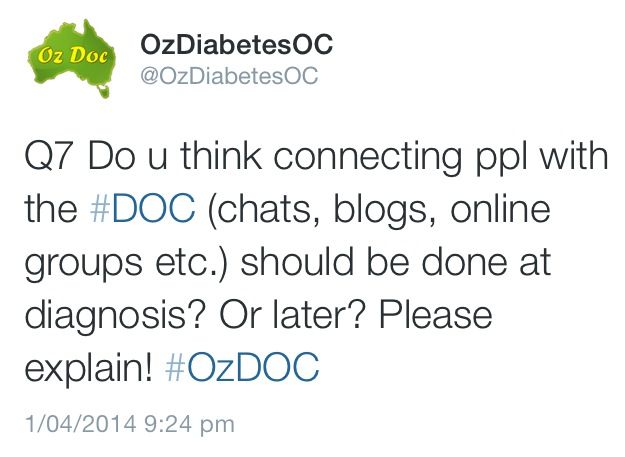
Obviously, I am a huge fan of the diabetes online community. I am honoured and lucky to have met so many amazing people both online and in real life. And many of these people, I truly consider to be friends.
But when I was diagnosed, I certainly had no desire to meet anyone else living with diabetes. Surely having nothing more than a faulty pancreas in common wasn’t the basis for lifelong friendships. And that is the truth. When I look at the people in the DOC who I am friends with, we have far more in common than a need to carb count and inject insulin.
While diabetes may have brought us together, it certainly isn’t what has held us together. The reasons the friendship has developed into something more than exchanges on Twitter include similar attitude to life in general; the same (often questionable) senses of humour; a mutual like of travel; kids the same age (many of my friends and I were planning pregnancies at the same time); sympathetic political views; a love of Nutella.
Today, I wouldn’t be without my friends from the DOC. I have been kept company many nights, unable to sleep, by many of my northern hemisphere friends. Our discussions span far more than diabetes, and the advice, comfort and friendship offered has seen me through difficult times as I feel the embrace of those many thousands of miles away. This community has become my extended family.
We can’t force the DOC onto people. But what we could consider is making sure that people newly diagnosed are at least aware that there is a dynamic and supportive community out there. We can provide the connections and the networks. We can provide the ‘how to’ and allow people to dip their toe in gingerly and remain in the background. But it needs to be up to the individual to decide if and when they want to make the approach. And when they do, we will greet them with open arms and welcome them.
Tomorrow, I’ll be rolling up my sleeves and getting a flu shot as I do each and every year. (And rolling my eyes at colleagues who complain about the needle. Spoon; cement; toughen up!)
Being immunised from contagious diseases is medicine at its best. So why it generates much discussion – half of it rational; the other half madness – is beyond me.
The Australian Vaccination-Skeptics Network (recently forced to change their name from the Australian Vaccination Network) is a group that lives and breathes dangerous rhetoric, ridiculous propaganda and paranoia. And not a shred of evidence. Their tag line is ‘because every issue has two sides’. Sure – let’s go with that. On one side there is science and evidence. On the other there is lunacy. They are the two sides.
This is not an issue for debate.
I am all for people making their own decisions about their health and the health of their children. I really am. If you want to breastfeed your child, go ahead. If you don’t, don’t. Want to give your kids a multi-vitamin with their breakfast? Knock yourself out. Think that seeing a chiropractor eases your back pain? Off you go. Align away.
And when it comes to how you choose to manage your diabetes, you won’t hear any judgement from me. Treat how you want, using the tools you want. Your diabetes; your rules.
Because all of these decisions affect you (or your kids) – not others around you. If you choose to not vaccinate your child against vaccine-preventable diseases, you are putting other people at risk. You are putting me at risk, my family, my friends. It is irresponsible and it is stupid. Because your actions do affect me, I get to make a judgement call here.
Every single myth about how vaccines cause medical conditions has been debunked. There is no evidence – no scientific evidence – that suggests that vaccines cause autism, type 1 diabetes or anything else for that matter. The fruit loops (and I make absolutely no apology for using that term) who claim that vaccines are the root of all evil are dangerous and lying. That’s it. That’s the truth.
There are many aspects to living with a chronic health condition and one of them is the fear I carry each and every day that I have passed on my deficient genetic matter to my daughter. I am terrified that the autoimmune mess that is my, my mother’s and many other family members’ MO has been filtered down to her beautiful DNA.
One day, there will be a vaccine to protect against type 1 diabetes. I wonder if anyone who lives with diabetes (themselves or in their family) would hesitate for a moment to have their loved ones vaccinated.
Vaccines exist for one reason and one reason only. To protect us. There is no agenda by Big Pharma. Health care professionals are not in the pockets of Big Pharma or governments or anyone else for that matter.
If only there was a vaccine for stupid. Then this debate would be over once and for all.
Just in case you need this explained to you in very plain, eloquent and simple terms, click here to understand how vaccines cause autism.





 Diabetogenic