It’s gloomy in Melbourne today. I have tights on for the first time in months and my hair is now frizzing thanks to the rain I was caught in as I ran next door for a coffee. (The silver lining in all of this is that there is fabulous coffee right next door to my new office. Also, extra silver lining is that I can see the weather out of my beautiful window. The not-so-silver-lining is that I am reminded that I am fool, because window = seeing rainy weather and yet I still forgot to take an umbrella…)

So here are some things that are keeping me either amused, happy, annoyed, interested, fascinated and heaps of other things too!

Roses spared and children saved

Today, the Spare A Rose Facebook page announced that 376 children would be benefitting from people’s generous donations this Valentine’s Day.

It’s not too late to make a donation, or even consider making a monthly donation throughout the year. AUD$6 each month equals a month of insulin for a kid who would otherwise not be able to afford it.

While this was the focus of our Valentine’s Day, there was still a lot of baking. Because I love a heart shaped cookie. Or giant brownie. And sprinkles.

IMG_0225

Still the wrong name for this week

I said it last year and I maintain that the Dietitians Association of Australia have got it wrong naming this week ‘Healthy Weight Week’.

I think that the name misses the mark because it focuses on weight and not health. The overall aim of the week is to encourage people to cook more at home to achieve a healthy weight. Here’s just a little of the conversation with the DAA (after they read my post last year) on Twitter:

FullSizeRender

I think that this really does a disservice to the role of dietitians in healthcare. I am of a healthy weight, but have benefitted from the expertise of dietitians in the past.

The name of this week turns me off actually wanting to participate in any way, even though there are some terrific initiatives. What are your thoughts on this one?

In the genes

Why do some people develop diabetes-related complications and others don’t? We’re told that ‘control’ is the reason, but we also know that some people develop complications, despite years of what is considered ‘good control’ while others who struggle to reach targets don’t.

This study’s findings suggests that particular genetic variations are involved in the development of retinopathy and nephropathy.

Things I wish I knew

I learn new things about diabetes each and every day. But how much easier it would have been while navigating this annoying bloody path to have known stuff earlier on. Diabetes UK has released a new book, 100 THINGS I WISH I’D KNOWN ABOUT LIVING WITH DIABETES, which includes information collected from over 1,000 people with diabetes with input from clinicians. The final 100 were selected by people with diabetes, (nice engagement there!), who chose the tips they thought most useful.

Oh – and while talking about Diabetes UK: Happy Birthday! They turn 82 years old this week.

New (to Australia) Tech

Looks like Australia is about to catch up to our friends in the EU who have had access to Freestyle Libre Flash Monitoring. The Flash website went live this week. More details – such as cost and release date – are yet to come, but you can register your interest. Have a look and register your interest.

And while we’re talking new tech in Australia, a couple of weeks ago, the Aussie launch details of the Dexcom G5 were announced. You can download the app (iOS only) which is already available from the App Store, although you won’t be able to use it until you are hooked up to a G5. The App has the ‘Share’ capability which means that you can (just as it says!) share your data with others.

Rock on

Last week, I was sitting at the front of our house, enjoying the sunshine and my day off, and listening to Live Fast, Diabetes, the new song from Adelaide punk/rock band, Grenadiers.

A very crotchety woman walked by, stopped as she heard the music, and scolded me with this nugget of wisdom: ‘You’re too old to be listening to that noise.’

Yeah, we know

Science: ‘Apparently BGLs are lower in warm weather.’

PWD: ‘Ah, yeah. We know. We’ve known for ages….’

Love it when evidence catches up!

And finally….

It’s Tuesday. Do the #OzDOC tweet chat! Tonight at 8.30pm AEDT.

I produce a lot of waste. (There’s a lovely first sentence….) Perhaps I should clarify and say that diabetes produces a lot of waste. And as such, I am very conscious of reusing, recycling and reducing wherever I can, especially in a society where so much is so easily disposable.

Over the weekend, we found ourselves wandering the aisles of our local Officeworks store. The reason for our visit was to buy some cartridges for our (rather old) printer at home. We print virtually nothing. In fact, the only reason that we needed to buy cartridges was because the kidlet is back at school and it’s project time, which means printing things.

What we discovered was not only that the cartridges for our 10 year-old printer were no longer stocked (probably shouldn’t have really been all that surprised!), but that it would be cheaper to buy a whole new printer than it would have cost to replace the two cartridges we had planned to buy.

I was even more horrified when the very helpful sales staff told us that a lot of people simply buy a whole new printer instead of replacing the cartridges when they run out because it is cheaper.

‘But it’s so…so…wasteful,’ I said to him. He nodded. ‘Oh, but we recycle old printers, so you can bring your old one in to us. That’s what most people do.’

I didn’t want to point out that as wonderful as that may be, it still takes a lot of energy and resources to produce a printer in the first place – especially if it is to just be thrown out after a few months, or however long it takes to work through the ink.

I am very conscious of this as (as previously stated) someone who produces a lot of waste – waste that I can’t do anything about because the products with the waste are keeping me alive.

Between pump line and sensor changes, BGL strips that litter like glitter and empty juice boxes and jellybean packets, there is a lot of packaging and used product that winds up in the bin.

The only reason for all this stuff is diabetes. And it annoys me that a lot of it seems superfluous. Every time I open a pump line, there is a little round disc that is meant to be used whenever I disconnect the pump to cover the exposed knob of the infusion set. How many times do I use that disc? Never. As in: not once. In fact, most of the time, it winds up on the floor and the cat plays with it or the puppy chews on it or I step on it in my bare feet and swear. But it is in every single pack.

All this stuff creates (even more) diabetes guilt.

There are things I do try to recycle in some way. When I upgrade my pump, I donate my old pump to either someone who is interested in trying one out or to a clinic (although that is less likely to happen these days because of warranty issues). I don’t take endless BGL meters from device companies or HCPs, just because they are free. And I try to reuse where and when I can. (I refill cartridges in my pump a couple of times and refill strip cartridges with hypo portions and spent pump lines tie up plants in the garden.)

Yes, I know that we can refill the cartridges with ink ourselves. ‘You just need to use a syringe and ink. You’re good at that. You know, drawing things up with a needle and shooting them into things,’ said Aaron helpfully – a suggestion that was rewarded with a look that suggested that was one of those comments best kept to oneself. But no, we won’t be doing that, because: mess. I have, however, looked online to see where I can source cheaper cartridges and will order them.

I also just want to say that I am absolutely not guilt-free when it comes to using throwaway products. I more than happily, and without any shame, used only disposable nappies when the kidlet was little. When someone told me that each nappy took one hundred years to break down and I should consider using cloth nappies, I nodded and said cheerfully, ‘Yep, but if I start having to wash nappies, I reckon it will take me about five minutes to break down. And the baby is kind of expecting me to be functioning enough to feed her. She’s demanding like that. So, disposables it is!’

But somewhere in there, there has to be a happy medium between taking the easier route to save one’s sanity, and throwing out a printer when the ink runs out.

Stigma-definition2

I don’t get to take part in the OzDoc tweet chats as frequently as I would like to anymore, but when I do, I know that I am guaranteed an hour of thoughtful and engaging discussion about real life with diabetes.

This week, I popped in a little late, but in plenty of time to catch a terrific chat a out diabetes stigma – from both within and outside the diabetes community.

Diabetes stigma is real. Have I experienced it? You bet.

Stigma is unsettling, and it comes from a place of ignorance. Is there any real animosity or vitriol? I like to think no, but it pains me that when there have been times of nastiness, it has come from within the community.

I can honestly say that I have never been stigmatised about my diabetes from anyone inside the diabetes community. But then, I have the type of diabetes that I didn’t cause myself. You know, the one that has nothing to do with the sorts of foods that I ate. The one that has nothing to do with me being overweight or inactive or lazy. I have the one that cute kids get – kids who are innocent and have done nothing to ask for this. And I have the tough one – the one that is the worst, the one that can cause death in an instant, the one that no one understands.

These are words that people from within the diabetes community have used when talking about type 2 diabetes. That’s right – by others living with (or living with a child with) diabetes. Perhaps it was in a discussion about the hopeless and insensitive comments made by some silly comedian; or perhaps in response to a diabetes report that doesn’t separate type 1 and type 2 diabetes.

And I am not the only one to have noticed this. The Walk With D campaign was set up because there was a need to acknowledge that … ‘Even within the diabetes community, there are levels of misunderstanding, misrepresentation, and mistaken messaging, often creating a divide where there should be a bridge.’

There have been some studies that also reinforce the idea that there certainly is stigma from within the community.

The ACBRD has been researching diabetes stigma for a couple of years now, starting with a project looking at the stigma experienced by people with type 2 diabetes and following up with a similar study about people with type 1 diabetes.

The second study discussed the perpetuation of type 2 diabetes stigma by people with type 1 diabetes and it’s interesting reading. You can read the full article here, but here are just some of the findings:

  • In general, participants expressed somewhat negative attitudes towards, and beliefs about, people with T2DM. This included stereotypes such as ‘lazy’, ‘fat’, ‘over-consume’, ‘sedentary’, ‘unfit’ and judgment about the intelligence and character of people with T2DM, and blame for ‘bringing it on themselves’.
  • These attitudes and beliefs served to perpetuate, and give voice to, the stigma surrounding T2DM and drove an in-group/out-group (or ‘us vs them’) mentality.
  • It was also evident that there was resentment among people with T1DM toward those with T2DM, which stemmed from two main factors: (1) the perception that people with T2DM are responsible for many of the negative connotations that surround diabetes, and (2) the perception that T2DM, as a largely preventable condition, attracts more attention and therefore gets more resources and support than T1DM.
  • Some participants believed that T1DM was the ‘real’ or ‘serious’ type of diabetes, and was more worthy of research attention and investment of societal resources than T2DM.

That sounds pretty stigmatising to me.

Let me be clear about my position here – there are different types of diabetes and people living with each of those types of diabetes has the right to find support and healthcare that is relevant and specific to their diabetes. A young person living with type 1 diabetes is, of course, going to have different needs to an older adult living with type 2 diabetes.

There are many times that we need to clearly define the different types of diabetes as this is important when it comes to getting the right treatment, seeing the right HCPs and ensuring the person living with diabetes has the right information.

I am not saying that there shouldn’t be specialised and tailored services and activities available to people depending on what they need, or relevant to the type of diabetes they have. I built a program from the ground up that was very specific and targeted in its approach to being only about and for people with type 1 diabetes. I get it!

And you absolute bet that people with type 1 diabetes should have access to support and peer opportunities that are specific. I know that for me the sense of ‘me too’ comes most strongly when I am speaking with other people with T1, usually women around the same age, who are working and have the same sort of technology, caffeine and boot addiction as I do – sometimes there does need to be a ‘sacred space’ for us to discuss the issues that are particular to the challenges presented by our brand of diabetes. And finding the perfect pair of knee-highs.

What I am saying is that I know that the stigma comes from a variety of places. And I believe that we should be advocating for diabetes messaging to be positive and beneficial to people living with diabetes. The challenge of getting that message across to people in the general community who have no idea about diabetes is difficult to manage and sometimes it has not been executed particularly elegantly.

But I am a firm believer in the strength of community and the support that it can offer. And to me, the diabetes community means everyone affected by diabetes – everyone. Stigmatising anyone inside that community does a great disservice to us all.

DISCLAIMERS ALL OVER THE PLACE!!

The ACBRD is a partnership between Diabetes Victoria and Deakin University and until very recently, Diabetes Victoria employed me. Since the ACBRD was established (6 years ago) I have worked with foundation director, Professor Jane Speight and her team on a number of different projects.  

I have not received any funding from the ACBRD for my work with them. I just like to write about them because the work they do is very important and is changing the way that diabetes is perceived. And their work in diabetes and stigma is ground breaking. (Really! The Washington Post published this article in 2014, quoting Dr Jessica Browne from the ACBRD.)

Now, I just happen to share an office with the ACBRD. And this is on my office wall. I have found myself reading it quite a lot this week!

Click for larger image

Click for larger image


Tomorrow is Ash Wednesday, marking the beginning of Lent, and when I was a good Catholic kiddie, I used to do what Sister Mary-Magella expected and give up something for Lent as a form of atonement. Or something. I am a little sketchy on the details.

Inevitably, I would give up chocolate. All the kids gave up chocolate. (I remember once saying that I was going to give up wine, but that didn’t fly with Sister Mary-Magella because I was only about nine years old at the time and she figured that excluding vino from my diet wouldn’t be too much of a sacrifice. Clever nun.)

Here’s what I can tell you about my experiences of giving up something for Lent: I sucked at it.

I would announce that I was giving up chocolate in my 9am religion class and as soon as the words slipped from my lips, it was all I could think about. Suddenly, I wanted chocolate; I needed chocolate. Everything looked like chocolate and everywhere I turned, I saw chocolate. Chocolate. Chocolate.

But here’s the thing. We rarely ate chocolate when I was a kid. In fact, the chance of me actually eating chocolate on that day – a Wednesday – was slim to non-existent.

And yet, it was all I could think of. I couldn’t concentrate on learning about long division for all the thoughts of chocolate running through my mind.

Of course, I never, ever made it the full forty days without eating chocolate because the very next time it was offered to me – as that occasional treat, or at a friend’s place or at a party, I would dive straight in.

I think I learnt pretty early on that restriction is not a good idea.

But giving things up is still a big thing – and you don’t even need Catholic guilt to get in on the game these days. You may know it’s FebFast which is a month-long campaign to give up either alcohol or added sugar.

I understand that the idea of FebFast is to get back on track after the silly season of excess. But to me, I see that there is too much guilt associated with these sorts of campaigns. I don’t like the ‘You have been bad, now do your penance and atone’ attitude behind it.

Or perhaps, it’s just that, clearly, I have no self-discipline or willpower. As was demonstrated when I was nine and tried to give up chocolate for the first time.

Nowadays, I don’t do Lent. In fact the only reason I know that tomorrow is the start of Lent is because I know today is Mardi Gras and I am dreaming of being in New Orleans, eating beignets. And Mardi Gras is also Shrove Tuesday, which means that we will be eating pancakes at some point. Which I will be celebrating with flipping glee!

IMG_0179

Heart-shaped pancake treats, made last week to celebrate World Nutella Day.

The life expectancy for a child diagnosed with diabetes in sub-Sahara Africa is as low as one year. That’s right: one year.

This is a fact for 2016, almost 95 years after the discovery of insulin.

And it is just not good enough.

In The Lancet just last week, this piece was published about the challenges of accessing insulin around the globe. Why is this drug still so unattainable to so many? Why has access to insulin not had a high priority within agencies such as the UN and WHO?

Why are children and adults still dying when there is a medication available?

I am so angry and sad and desperate that this is the situation and while I am pleased that we are starting to increase the conversation about the unfairness of it, it’s just not enough.

Where is the outrage here? We get angry and feel vilified when someone doesn’t understand the difference between type 1 and type 2 diabetes, or because some celebrity dared to say something stupid about diabetes, and we retreat online and complain and bitch and moan. We say that we feel stigmatised and isolated and misunderstood.

And it’s true. Diabetes is stigmatising and isolating. People don’t understand the details. It’s downright, bloody unfair.

But we are not going to die because we can’t get our hands on a bottle of insulin. Perhaps we need to channel some of our oh-so-easy-to-access outrage and frustration at an issue that can actually save some lives.

A diagnosis of type 1 diabetes in some countries is a death sentence, plain and simple. And a quick one at that.

And this isn’t okay.

rose

I’m just going to gently leave this here. Click on the pretty picture. For $6 you can provide insulin to a child. (And even better, send it on to every single person you know.)


You will see a lot about Spare a Rose this week. I am not going to apologise about it. But you may also like to have a look at Type 1 International and the important work they are doing in this space too. 

This morning, I drove my car straight into the tyre shop across the road from work. By the time I had turned off the ignition and stepped out of the car, a kind looking mechanic was standing next to me.

‘Morning, what can we do for you today?’

‘I haven’t made a booking, but I was wondering if you could help out. I need a tyre replaced and, while it’s in here a wheel alignment. Any chance you could do it today?’

‘Not a problem,’ he said. He walked around the car slowly. ‘You know, both those front tyres could do with replacing. Would you be happy for us to do that?’

We had a chat about options – he showed me photos of all the different tyres that would work on the car (all looked the same to me) and discussed the pros and cons of each. After I decided, I walked out of the shop, with the mechanic promising to call if there were any problems.

Service with a smile!

As a customer/client/stakeholder/friend/’insert latest buzz word here’ I like to feel that I am somewhat valued. I like to feel that I am not inconveniencing the person offering the service and I like to feel like my custom is appreciated.

Which was how I felt this morning as I walked out of the tyre shop.

And it’s exactly the opposite of how healthcare frequently makes us feel. It’s a system that is set up to be customer-unfriendly. And it’s what we – the users of the services – have come to expect. And sometimes, to accept.

From trying to get an appointment, to actually walking in the door, to collecting test results, the process can be difficult, convoluted and confusing, with roadblocks at every turn. Here are just a few things that you may come across as a user of healthcare.

  • You need to see a new specialist, so you call to make an appointment. Most likely, the first thing you are told is that there will be a wait before the specialist can get you in. Possibly a long wait. A very long wait. Sometimes, you are told that new patients are not even welcome at this point in time. Sometimes you are told that you cannot actually make an appointment until your referring doctor has faxed (yes, seriously, FAXED!!!) across a referral.
  • If you are lucky enough to actually get an appointment, a barrage of Things You Must Do are read out to you: Referral letter (if you have been allowed to make the appointment without one); get there early to fill in the forms; bring test results; bring x-rays etc. etc.
  • You may be warned that if you do not show up or call within 24 hours (once I was told within a week!), you will still be charged for the service.
  • If you have managed to get through all of that and still decide to go, then once you arrive, you are faced with a frequently unfriendly and unwelcoming receptionist who is there to basically act as a buffer between you and the doctor.

(Side note: I am going to say that I know that this is a thankless job at times. Many people think they are the most important person in the world and these same people think that the doctor should be bending over backwards to accommodate them. However, in my experience, most people do not think that way. I know I certainly don’t. Also, I have had many experiences of wonderful support staff greeting me when I have an appointment. The staff at my endo’s office are friendly, polite and delightful. At my GP, it is touch and go – some are lovely, one in particular makes me start to sweat in fear!)

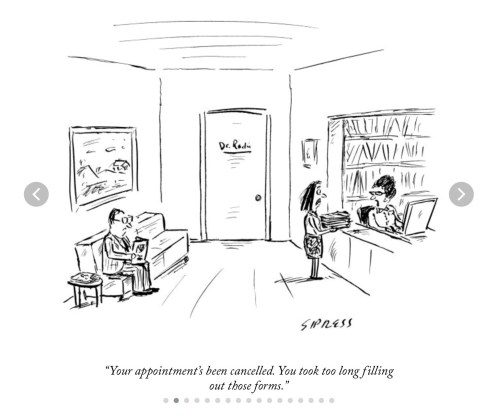
  • At first-time visits, you are given a clipboard with a wad over a paperwork and told to fill it all in. (This is where I weep a little and just wish that a centralised electronic medical system that worked was available and easily accessible so that I could simply write down my details and pass that over and all my information could be magically brought up on a magic computer.)
  • Eventually, after having filled out the forms and provided information about every aspect of my life, the file gets returned to the reception desk and is often greeted with the words: ‘The doctor is running late. About 30 minutes.’ At this point, I sigh and possibly ask (as politely as I can) why I wasn’t told this when I called before going in to make sure that the doctor was running on time – a call that I made only 30 minutes earlier. Steely silence. No answer.

(From this week’s New Yorker’)

So, let’s just recap. It has taken months to get into see this doctor and I wasn’t even granted an appointment until I had jumped through so many hoops that I now also needed to see a physiotherapist because I had put my back out; when I eventually get there, I spend ages filling in information that I know is hardly going to be relevant. And now I am told that after having arrived early so that I could fill in the forms that the doctor is running about 30 minutes late and that I just have to deal with it.

(I’m not going to write about the actual doctor experience, because we know it can be good, it can be bad, it can be disastrous ‘This isn’t going to work, but thanks for your time. I’ll just go pay my bill…..’ which is something that happened when I was interviewing endos a few years back.)

  • You leave with another ream of paper – prescriptions, test requests, perhaps another referral letter and are told to call back in a week’s time to get the results.
  • But a week later when you call, a new dance starts. ‘No, you can’t speak with the doctor,’ you are told, when you say that you are calling – as requested – to get results. ‘The doctor speaks to people between 1 and 1.15 Monday and Thursday. You’ll need to call back then.’
  • You ask if the doctor could either call you back or even email me the results, which gets a response of horror, ‘No we do not correspond via email. The internet is not safe.’ (I at this point, do not say what is going through my head – ‘I do all my banking on the internet and I am not concerned about privacy there. And I am certainly not likely to care who knows what my hand X-ray shows.’ Because there is no point.
  • After about four attempts, you eventually get to speak with the doctor who will probably (hopefully) tell you that all is clear and to make another appointment for 12 months’ time.
  • It seems that every part of the system is designed to keep apart the two people who actually need to be in the same room, looking at each other and truly engaging.

And this is deemed okay?

It’s not. How many of us would return to a shop if we were treated this way. Even if the people we are speaking with are lovely – which is usually the case – the system is ridiculous. It’s broken, seemingly beyond repair. And I can’t think of any other service where the customer is considered an annoyance. Can you think of any other service where the customer is treated this way?

I just had a call from my friendly tyre mechanic. My car is going to be ready an hour later than he thought and he wanted to let me know. I thanked him and commented on how much I appreciated the phone call. I was probably a bit gushy as I am when impressed with the service I’m receiving. ‘Not a problem at all,’ he said. ‘We like happy customers.’

And I like to be a happy customer!


spare a rose

I wrote about Spare a Rose, Save a Child last year. And the year before that. 

I wrote about the easy and logical tie-in with Valentine’s Day.

I wrote about how I would be making a donation and encouraging my Valentine to do the same.

I wrote about how easy it is to support the campaign.

I wrote about how fabulously tangible the campaign is: 1 rose = AUD$6 = 1 month of insulin for a child.

I wrote about how easy it is to get involved. 

I wrote about how no child should die because they cannot access life-saving medication.

I wrote all about it. 

So I won’t do that again.

Instead – have a read! (And make a donation!)

_________________________________

Yesterday, as I sped around the supermarket, the onslaught of the next commercial opportunity hit me fair and square in the face. No, I’m not talking about Easter (I could act all outraged that there are Hot Cross Buns in Woolies, but we bought some and have been eating them, so that would be kind of hypocritical). I am talking about the festival of love – Valentine’s Day.

Valentine’s Day can go one of three ways for people. It can be a day of overt love declarations involving flowers, cards, poems, sky writing, gorilla-grams, stripper-grams (don’t judge), candle light, champagne, walks on the beach; it can be a day of sadness and misery and feeling left out; or it can be a day of complete oblivion where one is confused why there are so many people carrying bunches of balloons with ‘I wuv you, Shnookums’ written on them in glitter.

This year, I say screw that. This year, I say how about you do something that is meaningful that will not only help others, but also make you feel great. This year, it doesn’t matter if you have a Valentine or not. Everyone can play.

I am, of course, speaking of the Spare a Rose Save a Child campaign.

Now, if you have diabetes and/or any links to the diabetes word, you have probably seen and heard about this campaign before. I’ve even written about it here. The general gist is that instead of sending a dozen roses to your Valentine, send eleven instead and with the money that would have bought the extra one (about $6 in Aussie money) make a donation to Life for a Child. Those six bucks will provide insulin to a kid in a developing country for a whole month. Or, give your Valentine ten roses and donate $12.

All good, right?

But I have a little challenge for you.

This is a brilliant campaign because it is so simple. It’s easy to explain and it’s really easy to get involved. So my challenge is this. Let’s get this moving way out of the diabetes world. Let’s get this into the hands and hearts of our friends and family who may not really consider this as an idea for Valentine’s Day.  Let’s tell our workplace HR teams and see if they can encourage it as a work-place wide giving program (there’s even a tool kit to get you started!). Pop in to visit your neighbours and ask them to get involved. Next time you are going for a walk in your local shopping centre, drop in to some of the small businesses and ask them to get involved. Ask your kids if they would like to donate some of their pocket money.

Roses and diamonds and jewellery and books and CDs and vouchers for massages and guitars and DVDs of favourite movies are all lovely and fun for Valentine’s Day and I am not suggesting you complete give up on the idea of sharing gifts. But how about sharing the love a little this year? I know that I certainly will be making a donation and have already strongly suggested to my Valentine that he do the same. (And check out this and this cute card to attach to your gift, telling your Valentine how you’ve shared the love this year.)

So, how about making sure a child has life-saving insulin available to them by donating just a few dollars in your loved one’s – or your – name. Because THAT is a gift of love and I honestly can’t think of anything I would like more this Valentine’s Day.

All the information you need – including the link to the incredibly simple donation page – about the Spare a Rose, Save a Child initiative can be found here.


It’s 7.25pm on Sunday evening. I am battle-scarred from a hypo that hit me like a ten tonne truck. It was 6 hours ago now, but I am still foggy and so fatigued.

We were out – at our local shops picking up a few things. All of a sudden, I felt like I was going to fall over. One of my legs gave way, I was dizzy and I couldn’t find the words I needed. Focusing hard, I looked at the kid and said ‘We need to get out of here.’ I passed her my phone and she called Aaron who was in another shop nearby, asking him to come and find us.

Where had this come from? My CGM started wailing at the moment that Aaron joined us. But when I looked over the previous few hours, I could see that I had been sitting around 4mmol/l for the whole time. Until I dipped – suddenly – and it seemed the CGM trace took a little while to catch up. The wailing continued as I gulped back orange juice and groped for my pump to silence the alarm.

It was almost fifteen minutes later before I was ready to move. As I sat there, I very consciously started to notice the fuzziness in my head, the overwhelming and all-encompassing exhaustion hit. My eyelids began to droop and my eyes were having trouble focusing, my hair was wet at my neck making me shiver, and my hands were shaking a little. The noises around me sounded like they were coming through a tunnel – everything echoed, but sounded muted and fluffy.

Eventually, we got up and got home and I went straight to bed. I took off my shoes, lay down, and was shivering as I fell asleep, almost instantly. And I slept – a deep, heavy, dreamless sleep. Two hours later I woke up and was ready to move again – slowly and gingerly at first.

And now. Six hours later. I am sitting on the couch, and in between writing I stare out the front window onto our street. It’s a gorgeous night – warm, but not too warm, with a gorgeous cool breeze blowing through our open front door. I hear the leaves flutter in the trees in the garden, people walk by, chatting to each other, and the folk across the road are having a band rehearsal. It’s peaceful; it’s Sunday night and I’m starting to think of the week ahead.

And in my thoughts about school lunches, and work schedules, and everything else, I have another thought. I don’t have it often, but when I do, it’s always the same.

I feel a pull at the bottom of my stomach.

My breath catches in my throat.

Tears spring to my eyes.

I wish I didn’t have diabetes.

A couple of weeks ago, I sat in a packed Melbourne Town Hall. And there, on the stage, was Nigella Lawson. It is possible that I have never been so excited in all my life – the original and greatest domestic goddess in all the lands was sitting about five metres from me, sharing the same air! She is every bit as poised and elegant in person as she is on screen and her beauty is startling. I certainly squealed when she walked onto the stage!

So, was the hour or so that Nigella was sitting on the stage worth the time and money? Well yes. And no.

I have been to a number of these ‘in conversation’ events before and they can be hit and miss. Largely their success is dependent on the person asking the questions, or rather, guiding the conversation. And that was the frustration with Nigella’s session. Food writer and restaurant critic, Jill Dupleix, was a little clumsy in her attempts to steer the conversation. It probably didn’t help that she started with a dud question that I am sure was meant to break the ice, but had the complete opposite reaction. Nigella looked positively uncomfortable. Perhaps asking someone who has recently gone through a very public and awful relationship breakup about her sex life wasn’t very well considered.

But even after that, I felt that Dupleix was not a great choice of interviewer. She interrupted and gave her opinion about the audience questions. She was clearly afraid of silences!

Everyone in the room had come to hear from Nigella. We wanted to hear the secrets to her success and about her every day life. For me, I wanted to hear about how she had turned something she was so passionate about into a successful career. I had the kidlet with me, and she was enthralled as Nigella shared stories of how she got her start as a journalist and how she built an empire as a food writer.

When given the chance, the Domestic Goddess, using language in a way that was both beautiful and mesmerising, shared snippets into her life that were amusing and telling. (She keeps condiments such as mustard and soy sauce in little jars on her bedside table for when she is eating in bed so she doesn’t need to climb down the stairs, back to the kitchen, for them. Brilliant!)

Where the discussion worked was when Jill shut up and Nigella could speak, uninterrupted. Unfortunately, too often she was cut off, or the silences – probably where Nigella was trying to formulate her next thought – were cut short and we never got to hear the titbit of information that she was finding the right words to disclose.

I left feeling elated that I had been in the same room as Nigella, but disappointed that I had not heard more. Several people I spoke with afterwards said the same thing.

This is the power of effective communication. Whether it is in a room like that, or as a one on one consultation, the most important person in the room is the one who needs to be heard most, be given the most time to speak, and have the opportunity to set the agenda and direct the conversation. And this is the case in a formal interview, health appointment or even a conversation with a loved one at the kitchen table.

I have really kept this in mind recently. Yesterday was the first day of school and over the last week or so I have frequently checked in with the kidlet about how she is feeling as the holidays come to an end. As with any eleven year old, she moved between being excited and nervous. Some of the things taking up her attention were hilarious (how will I wear my hair on the first day, mum?) but as they were her concerns, they are legitimate. It wasn’t my place to tell her that no one would care if she was wearing a high or low ponytail, and she should be concentrating on important things like revising her times table.

No, my job is to shush and listen and ask gentle questions to get more out of her and then try to make her feel as calm and happy as I can.

It’s the same with the way that diabetes consultations are very frequently criticised for not allowing the PWD the opportunity to use the forum for what they need, instead, going through a tick-box exercise of what the HCP needs and wants. Surely the HCP should shush and listen.

I think that often we like to think that we are the most important person in the room; the our opinions count for more; that our voice should be the loudest; that anything we don’t like should be defended. But most of the time, unless we really are the most important person in the room (i.e. in the case of a HCP consultation, or if we are Nigella in a Town Hall full of people), we need to just shush and listen.

Because if we did that, just imagine how much more we would hear and learn.

Nigella Lawson in Melbourne last week.

Nigella Lawson in Melbourne last week.

I am always interested in seeing the sorts of campaigns other health organisations come up with – especially when trying to adequately express to people what it is like to actually live with whatever condition they represent.

In the diabetes world, we often focus on the debilitating complications when trying to communicate with the broader community, but that is really only one aspect of diabetes. There is so much more that we could talk about – the relentlessness of the condition, the fear we may feel, how our mental health and diabetes are intrinsically linked, the relationship we have with food and the increased rate of eating disorders, how diabetes impacts those around us. So, so much.

But what doesn’t get done all that well, is trying to actually explain the physiological side of living with diabetes. Our invisible illness makes it difficult to point to a bruised arm or a bandaged head to ‘show where we hurt’.

Diabetes is not alone here. Multiple sclerosis is another condition that is complex and has little community understanding. I know I for one have no idea about what living with this particular autoimmune condition would be like. So I was really interested to see how the campaign from MS Australia, which uses an interesting analogy to explain what life with MS, is all about. Have a look at This Bike Has MS:

Now I don’t live with MS, so I can’t say if this is in any way an accurate representation of the physical issues which impact on day-to-day life. Does it provide a true portrayal of some of the problems faced by people living with MS?

I know that I was quite scathing a few years ago when describing what I considered to be a well-meaning, but pretty useless simulation of a hypo. Perhaps people living with MS are echoing my criticism of the hypo simulator, claiming that this ad really doesn’t explain much. There may be ways to try to demonstrate – or even allow someone to experience – some of the physical aspects of a health condition. But they only go a little way to explaining the real life, day-to-day, emotional and psychological pieces that make up chronic health conditions.

But however flawed these attempts may be, I still think that they are important, because they go some way to explaining – or at least illustrating – the condition in a physical way. Getting on that bike will give someone a sense of the physical side of MS, just like the hypo simulator demonstrated some of the physical symptoms that accompany a low.

And any efforts that results in less stigma, more compassion and better understanding of why we need to continually lobby and advocate for more – for better – is a good thing.

Follow Diabetogenic on WordPress.com

Enter your email address to follow this blog and receive notifications of new posts by email.

Read about Renza

Archives