Overdosed on all the carbs!

By the time I walked into the office yesterday, I was ready for the day to be over. Horrendous low on my way in (seriously, I hate the two-hour warm up phase when I put in a new or restart a Dex sensor) and the frenzied, gluttonous consumption of as much glucose as was in my car. (For the record –  two juice boxes and large packet of jelly beans.)

A morning mountain of sugar does not start the day at all well with the overdose of glucose pulsing through my veins turning my muscles to lead and my brain to pulp. And it continued throughout the day, with reminders of the rotten start peppering my day, all the way to bedtime when I found four rogue blood glucose strips stuck to my body. They fluttered like butterflies to the ground when I took off my bra. (That sounds a lot prettier and more delicate than it actually was.)

Hypo mornings are the worst. Especially when they involve the guzzling of the equivalent of my body weight in glucose.

I arrived at work 15 minutes late for a meeting, covered in sweat, hair plastered to my head and my sunglasses skewwhiff on my head. Nothing says ‘I’m-ready-for-the-week-and-to-be-a-smart-sassy-expert-contributor-to-an-important-meeting-with-important-people-and-yes-of-course-I-know-what-I-am-talking-about’ like post-hypo glow.

These days start badly. And don’t end well. I take a ‘begin as I mean to go on, and go on as I began’ approach literally, and figure that if beginning with a carb load suitable for an Olympic marathon runner the day before race day, then I may as well keep it up and compete in my own little Olympic challenge: the carb race.

I mean, why not eat a doughnut or two for breakfast next, right? Or waffles with jam AND syrup AND whipped cream?

And of course, I’ll have morning tea. ‘Biscuits,’ you say? ‘I’ll take six…teen,’ I respond.

Sushi rolls for lunch, because today is not the day to work out how to bolus for white rice and who cares anyway?!

It would be rude to say no to the brownies on the counter of the café next door to the office that I am visiting for the fifth time because caffeine is the only thing that is making me remain upright and remember how to string two words together that actually make sense. (So: ‘Yes, another milky coffee please. And sure, add sugar! All the sugar!’)

Pasta for dinner with more pasta and then add some pasta on the side because carbs, carbs, carbs. And the chocolate chip cookies that the kidlet made over the weekend as treats for her school day lunchbox make excellent treats after dinner for carb-mummy.

And while this is all going on, I am bolusing, bolusing, bolusing; insulin stacking, insulin stacking, insulin stacking. And chasing my tail because of course I end up low and then high and then low.

I know, I know. I didn’t need to keep the high carb day going after my breakfast hypo. But sometimes, when the days starts off going to hell in a handbasket, sometimes, I can’t work out the way (or be bothered) to salvage it. And I wonder what is the point of limiting my carb intake for the rest of the day if the floodgates were jammed open before 9am.

I climbed into bed last night exhausted. Exhausted from the low that started the day, the sluggishness of so much glucose still in my system and a day of peak-and-trough glucose levels that always make me feel listless. I said a silent prayer to the diabetes angels to please, please, please let me sleep through the night and not be up all night weeing out the sugar due to the glucose overdose, or needing to treat a low due to the likely insulin overdose. I pleaded for balance and flat-lines and an absence of alarms.

I woke this morning with the slight hangover the comes from too much sugar and a day on a rollercoaster. Waves of nausea wash lightly over me occasionally, reminding me of the day before. Delicately, I am stepping through the day. Watching my CGM trace, reacting gently, eating cautiously, dosing warily. And cursing diabetes. Completely and utterly inelegantly.
She called me because someone had told her to get in touch. ‘Speak with Renza. She gets it.’ Is what she was told. She we organised a time to meet and over coffee we talked. And she searched my face for reassurance as she told me how scared she was feeling.

When I meet someone who has recently been diagnosed with diabetes, I say very little. I listen. I ask questions and gently try to find out what is going on in their head. I don’t say much about my own diabetes, because I don’t want to imprint my experience in their mind. Everyone feels different at the time of diagnosis and working out exactly what they are feeling needs some time.

I listen and sit there quietly and try to reassure and be positive. I nod a lot, and let them talk and vent and, if they need to, cry. Usually people cry. And I let them know it is okay. I did all of this with the woman who called me. She did cry and she did vent. And then she cried some more. And I said hardly anything.

But this is what I wanted to say:

  • It is okay to feel scared and uncertain. Or angry. Or completely and utterly ambivalent.
  • Because, you see, there is no right way to feel right now – or ever – about living with diabetes. And equally, there is no wrong way to feel.
  • You don’t have to work this all out this week. Or next week. Or next year. In fact, you never have to work it out.
  • But do work out what you can manage today and do that. And whatever it is, it’s enough. It. Is. Enough. And well done you for doing it!
  • Find your tribe. In fact, this is what I want you to know more than anything. Others who are also ‘doing diabetes’ will help you make sense of this new world. You have to be ready to do that, but do be open to the idea. I wish that someone had introduced me to others with diabetes when I was first diagnosed. It took me over three years to meet another PWD and I felt so alone in those three years.
  • And when you do meet people, don’t think that anyone has this diabetes thing worked out completely. Even those who say they do…
  • …because, there is always more to learn, which is daunting and exciting in equal measure.
  • I promise you – whatever you are feeling, whatever you are thinking, someone has had that same feeling and same thought. You are not alone. (Reading diabetes blogs will prove that to you!)
  • Diabetes may feel like it is about to take over your life and it probably will for a little bit. And there may be times that it does again. But it will not define you for the rest of your life or determine who you are. It can be as much or as little of your identity as you choose to let it.
  • You will be okay. You will be okay. You will be okay. (And, yes, I am saying that for your benefit as much as my own!)
  • There will not be a cure in the next five years. Or even ten. I am not saying that to be pessimistic, I just want you to understand that hope is really important in living with diabetes. But unrealistic expectations that won’t come true are not going to give you that hope; they will destroy it.
  • Ask questions. All of them! You may not like the answer (i.e. see previous dot point), but ask anyway. You will be amazed at the things you learn.
  • Your diabetes; your rules. This will become more and more apparent the longer you live with diabetes. You don’t need to explain, apologise or justify anything you do to manage your diabetes. Ever.
  • Anyone who makes you feel crap about your diabetes – whether it be the fact you have diabetes, or how you are living with it – needs to fuck off. (And if you can’t tell them that, find someone in your tribe who can! I am happy to be that person. Truly! I have the mouth of a trucker and I’m not afraid to use it.)
  • Right now, this probably seems like it is the worst thing that will ever happen to you. This may sound odd, but actually, I hope it is. Because I know you can get through it.
  • You will laugh again. And smile and feel light. You will not think about diabetes for every minute of the rest of your life. It will be there, but it does not have to rule your very being. It certainly doesn’t rule mine. You will learn where to place it in your world, and that is where it will sit.
  • You do not need to feel grateful that you have been diagnosed with diabetes and not something else. Because it does suck. It’s good to remember that and say it every now and then. Or shout it out. While drunk.
  • Go buy a new handbag. Trust me! If you want, I can help you to justify it as needing a new bag to cart around all your diabetes crap, but just do it for yourself. And while you’re at it, a new pair of shoes. Just because!
  • Call me. Anytime. If you want. Only if you want. And even if it just to hear me tell you that you will be okay.

But I didn’t say those things. I only said this: You will be okay. I know this to be true because you are strong and resilient and capable. I know this to be true because many others have walked this path and worked out how to make it okay for them. You will do that too. It will be okay for you.

And I hope that was enough. Or, at least, enough to start with.

I was super late for last night’s #OzDOC tweetchat, coming in for the second half of the lively discussion. The questions were about how HCPs can engage on healthcare social media (HCSM), and the answers were to assist physician Dr Kevin Lee who is presenting this very topic at the ADS-ADEA conference on the Gold Coast later this month.

In recent years, I have given and heard many talks about why HCPs might want to consider using SoMe as a tool to engage with PWD (or, more broadly – people with any health conditions), and also how they may find SoMe useful to engage with other diabetes HCPs.

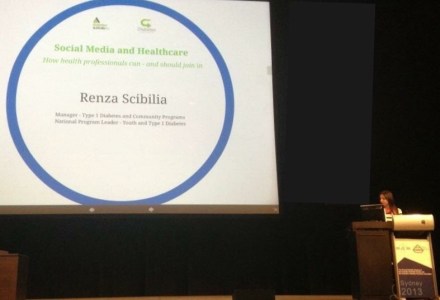
Presenting at the 2013 ADS-ADEA meeting about social media and healthcare.

Maybe it’s just me, but I am bemused that usually these presentations are targeted at such an ‘entry’ level. Social media is not new. Healthcare social media is not new. And yet, the presentations about HCSM at most medical conferences all have a ‘101’ feel to them, as though it is emerging technology and a revolutionary and new way to communicate. It is neither of these!

In fact, communities gathering on social media is just peer support 2.0. (Which is what I wrote here. Three years ago….)

And yet, the anxiety around it is still present.

I suspect that there are several reasons for this nervousness.

Firstly, by its very nature, SoMe is unregulated, and I will fight to the death to say this is a good thing, not something to fear. Its organic, unstructured and unpredictable nature is part of its power.

Even in a facilitated forum, (such as as tweetchat), there is only limited control held by the moderator – and a good moderator knows that their role is sometimes to sit back and watch (and encourage) the flow of, and tangents in, the discussion – that is often where the magic happens!

HCPs considering venturing into the patient-held HCSM space (different from interacting with their peers) need to consider what they plan to do once there. Are they going to be providing advice? Or do they want to engage in discussions?  Perhaps they just want to quietly lurk, using it as a learning experience.

Whatever they choose do to, simply stepping in and having a look around will, hopefully, alleviate many of the concerns and fears they have about HCSM – especially once they understand there is no mystery to this way of communicating.

But I really do think that it is not our role as PWD using HCSM to provide a comfortable space for HCPs. And we shouldn’t feel the need to moderate our discussion for fear of who is listening in.

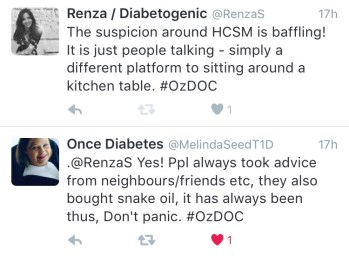
I have always considered social media to simply be a different way for having a conversation. There is no mystery behind it and there is nothing to fear. This thread from last night’s tweetchat sums this up perfectly! (Thanks, @MelindaSeed!)


So this happened….

Yesterday morning, we got up bright and early to join the excited witches, wizards and muggles for the 9.01am launch of the new Harry Potter book.

And as we stood there in Carlton, on the cold Winter weekend morning, memories of the other times we did that flashed through my mind.

I have a lot of Harry Potter themed memories. It was my mother-in-law who first introduced me to the books. She had become hooked after reading the first three, and one long weekend when we were visiting their farm, she suggested I read them. I don’t think I moved from sitting in front of the open fireplace for the rest of the time we were in Mansfield, speeding through the chapters at the rate of knots. Aaron read them as soon as I finished and together, we became hooked on the story of the ‘boy who lived’.

The fourth book had just been released, so as soon as I finished the third book, I bought a copy of that and caught up. And started the count down until the launch of the fifth book, re-reading the already released books in the lead up – a tradition that would precede the big launch day of subsequent instalments.

The launch dates of the remaining books were marked in my diaries and on the day, I’d push little kids out of the way to get my pre-ordered copy, spending the rest of the day cuddled up on the couch ploughing my way through, refusing to even glance online for fear of spoilers!

In November 2001, I counted down until the first movie came out, lining up the opening weekend to see if the film came close to capturing the magic on screen that had leapt from the pages of the books. I loved it, just as I did all the films.

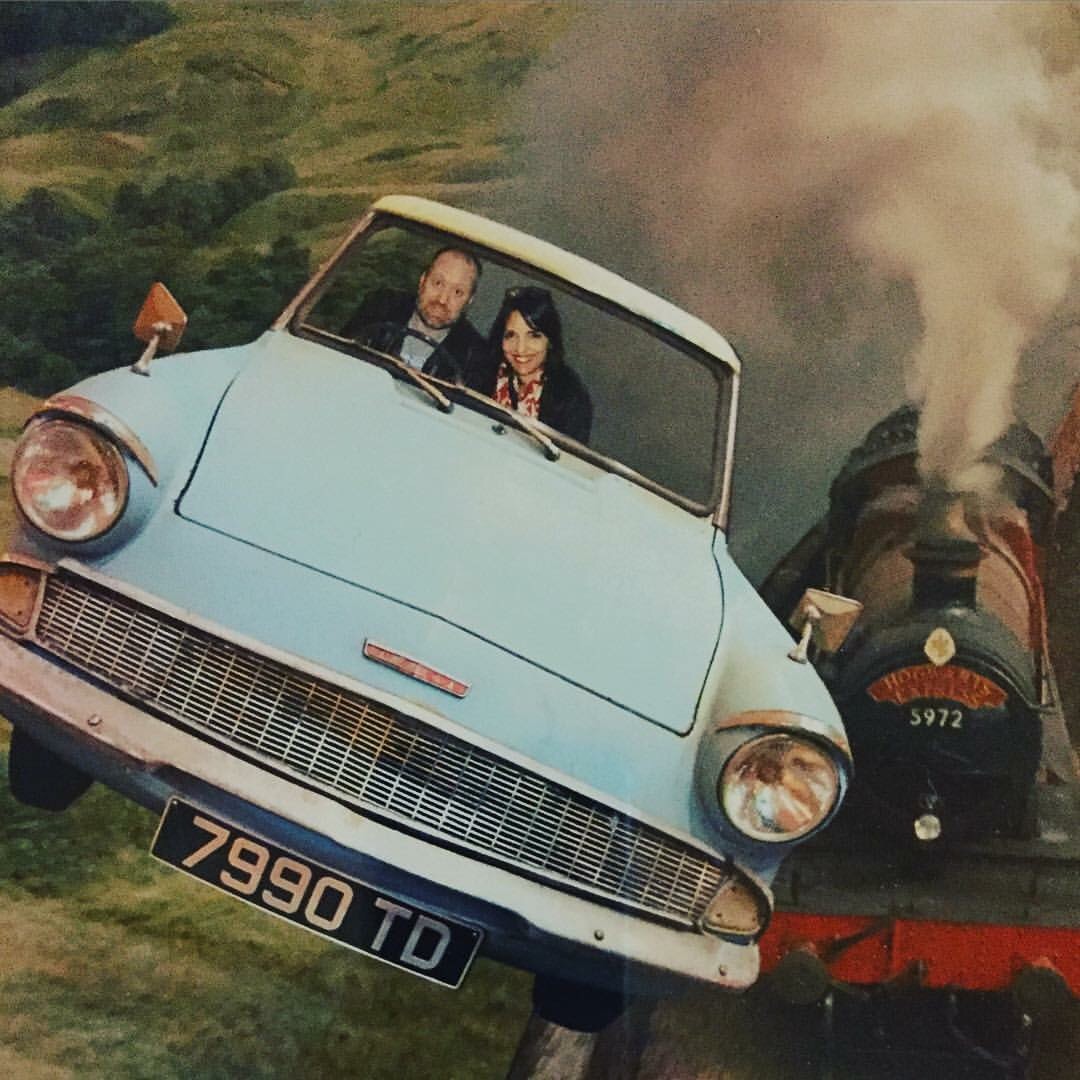
In London a couple of years ago, Aaron and I (without our kid – excellent parents!) spent a day at the Warner Bros Studio where much of the movies had been filmed. I burst into tears as I turned a corner during the tour to be faced with a scaled model of Hogwarts. We drank butter beer, rode broomsticks and flew above the trees in a Ford Anglia.


And then there was the delight and beauty of introducing our daughter to Harry Potter and watching her discover the world into which I had escaped years earlier. We loved seeing her fall in love with the stories and get carried away with the characters. Nights become a battle ground as we caught her reading with a torch under the doona after lights out because she was desperate to keep turning pages…

She loved the movies too when she was old enough to watch them – and after she had already read the books. That’s the rule in our house: books before movies!

She has other Harry Potter memories too – not only the books and the movies, but also dressing up as Hermione during book week when she was Year 1, and a visit to the Wizarding World of Harry Potter at Universal Studios in Orlando last year.

And now she will remember the launch of the eighth book where she was an active participant. She has heard our tales of the excitement of launch events and yesterday, she got into the spirit of the occasion, standing out as the only Bellatrix Lestrange in a sea of Harrys, Hermiones and Rons. (Very proud parenting moment!!)

I love that she has memories of Harry Potter and I wonder if these will be the occasions that stand out in her mind when she grows up and looks back on her childhood.

She has had some pretty incredible experiences that have made for pretty magical memories. Where does mum having diabetes fit in there? She asks me a lot of questions about diabetes that I try to answer as honestly as I can, but there is so much I want to shield from her – or at least, not have her think about.

A while ago, she asked ‘Is diabetes scary?’ and I paused before answering ‘Sometimes, but not too much.’ The truth is that it scares me senseless a lot of the time, but I don’t want her knowing that. I know I am not alone in this. My mum still tries to downplay things if she isn’t feeling great, and I am now over 40 and far less easily fooled by her ‘putting on a good face’ routine. Although, maybe I just tell myself that our 11-year-old can’t see through my lies about how I feel.

When our daughter is an adult and remembering her childhood, I don’t want her to think about diabetes. I don’t want her to think about me having to stop to deal with a ‘diabetes thing’.

I want her to remember the hours we spent reading, watching and talking about Harry Potter and having ridiculous discussions about who we would be if we were characters in the books. (I can tell when she is annoyed with me – then she says I remind her of Dolores Umbridge!)

Diabetes doesn’t get a look into our world of Harry Potter. In that world, there is no diabetes; there is no fear of complications; there are no scary lows or nasty highs. In that world, I don’t think diabetes. Because, those things don’t exist. There is magic. Only magic.

10650022_10152721613320789_2093089107973997779_n

Last night, I was the ‘here’s one we prepared earlier’ on a panel discussing CGM technology. The audience was all healthcare professionals – mostly DEs, but some dietitians, RNs and also a GP-in-training (so much yay to him for coming along!).

I love being in the room for these events! I wrote about my last experience giving the same talk here. I cannot speak highly enough of the two experts on the panel last night. Dr Peter Goss – who spoke at the last one of these events – is what I would call a disrupter in the diabetes healthcare space and, honestly, all the power to him. He may ruffle some feathers with his sometimes unorthodox approach, but it is undeniable that he is a champion for kids and teens (and young adults) with type 1 diabetes. Also on the panel was A/Professor David O’Neal who is best described as a truly awesome endo (I have heard that from every single person I know who sees him as their endo) and an absolutely brilliant mind. His expertise in diabetes tech is second to none and he is genuinely interested in how the technology can safely, efficiently and effectively be incorporated into the lives of people living with diabetes.

I know that all sounds rather effusive. But I need to point out that they are remarkable. And that they are the sorts of HCPs you want on your side if you are a person with diabetes.

Because now I am going to talk about language and why I pulled them up a little bit after we all did our presentations and sat on the stage ready to answer questions from the audience.

As happens frequently when I am in the room with a group of healthcare professionals, the conversation turned to language. Okay, I made that happen. In fact, the words I used were ‘I’m going to hijack this conversation because we really need to talk about language here.

One of my biggest pet peeves is the jokey, and somewhat snide, comments made about people with diabetes making up numbers in their diabetes log books. Because, it’s not a joke. It’s not something for HCPs to roll their eyes over and dismiss as ‘non-compliant’ behaviour.

The word that was used for PWD who make up numbers in their books was ‘fakers’. I cringed the moment I heard the word. And cringed even more at the audience’s response – laughter, heads shaking from side to side and knowing looks. I looked around the room and knew that we would be talking about this later on in the evening!

As I pointed out when the panel was seated on the stage, I absolutely did this. And I was incredibly good at it – different coloured pens, splotches of blood on the pages, dog-eared corners of the book. Once, I even splattered a few drops of juice, because on that particular page, I was having a lot of lows and I thought the juice would make it look more authentic.

Now, let’s all just remember for a moment that I was diagnosed as an adult. This wasn’t insolent teenager behaviour. This was a woman in her mid-twenties who was terrified of disappointing and being judged by the HCP to whom she would be handing the grotty book and its made up numbers.

I told the room my story of this last night and there was laughter – because the way I spoke about it was amusing. It was a cheeky anecdote. But at the time, it wasn’t funny. I was scared, I hated checking my BGL, I was paralysed by numbers that didn’t make sense and I didn’t know what to do about it. So I lied. Of course my HCPs knew that. And I knew my HCP knew.

But the question is about WHY people do this. The discussion needs to stop being about diabetes at that point, because really, managing BGLs and most other diabetes tasks is not the issue here. The issue is distress, anxiety, fear. And, in my case, I felt desperate.

One of the panellists made the point that the reason that he brought it up was because HCPs need to know what to do when someone is ‘faking’ their numbers. He’s right. I completely agree. And then there needs to be understanding of how to approach it, which is likely to be different with each PWD.

For me, it took until I found a HCP who I felt I could trust – one who wouldn’t judge the numbers that were out of range (which one HCP always circled in red pen, making me feel even more like a delinquent adolescent) – and was interested in knowing what was stopping me from feeling able to check my BGL.

When we worked through that, I was better equipped to not only regularly check my BGL, but also to deal with the numbers and act upon them. I came to understand that a number was nothing more than a piece of information that I could use to make a treatment decision – not an indication of me being a good or bad person.

Language does matter. And words count for a lot. Using the word ‘faker’ in this context is loaded with judgement and accusation, and even if that is not the intention, it made me – a person with diabetes – feel very uncomfortable. But mostly, it fails to consider the real problem at hand which is not that a PWD is making up numbers in a book. It is why they feel the need to do that.

On Sunday, I pottered around the front garden, doing a bit of weeding and tidying up and decided to cut a couple of small branches from the beautiful Little Gem magnolia trees we have along the fence-line, doing their best to hide us from the bluestone lane that runs along the side of our house.

I took them inside and arranged them in the largest vase in the house, setting it in the middle of the table in the kitchen. They looked magnificent – the leaves are the most beautiful glossy dark green on one side and a matte brown on the other.

Standing in the kitchen later that day, I said to Aaron ‘Aren’t the magnolia leaves gorgeous?’ ‘Yep,’ he answered. And then added ‘Are they steel magnolias?’

The term steel magnolia is a term used in the US South and refers to a woman who is traditional and feminine (that’s the magnolia part) and strong (that’s the steel part). I didn’t know this until quite recently – it isn’t a term we use here in Australia and for me, it was just the name of a film.

I can remember first watching the film years and years ago when I was babysitting. I can’t remember who I was babysitting, but I know that the kid was in bed and I was looking through the families VHS collection (I said it was a long time ago!) and there on the shelf was Steel Magnolias. I popped the tape in and watched it, and was a completely dishevelled mess of tears by the end of it.

There was no comprehension of what it meant in terms of someone living with diabetes – I had no idea. And yet, a little seed was planted: women with diabetes shouldn’t have babies or they will die. From somewhere, the seed became a huge tree the day I was diagnosed with diabetes, because one of the first questions I asked the endo treating me on 15 April 1998 was ‘Does this mean I can’t have children?’

On Sunday night, as I was flicking through the TV channels, there in front of me was the scene in the hair salon from Steel Magnolias. It was early on in the movie, and the women were discussing Shelby’s wedding (‘My colours are blush and bashful’).

I snapped a photo and snapped off the TV quickly, because I knew watching Julia Roberts have a hypo in a hair salon, and then two hours later die after having just had her beautiful baby was not going to be a good way to end the weekend.

I joke about this movie, I quote this movie, (frequently a juice is accompanied with the comment ‘Drink your juice Shelby’), and I shake my head at how ridiculous it is and how untrue – or at least old-fashioned – it is in its portrayal of diabetes and pregnancy. Most women with diabetes I know have a Steel Magnolias story.

I may mock it. But there is no way that I can watch it. Which is what I said on Facebook when I posted the photo I had just snapped of the TV.


The comments after my photo (and in some private messages) were from friends around the world with diabetes. The impact and consequences of this movie for women with diabetes – many of them having seen it for the first time as children or teens – is far reaching and actually did shape their decisions about having babies.

Yesterday, as I was standing in the kitchen making dinner, I walked over to the leaves on the table and gently rubbed one between my fingers. I thought of how in a few months’ time the trees out the front would be covered in beautiful white flowers that last for days before their beautiful petals drop to the ground. ‘White flowers‘, I thought, and shook my head because I always connect them with babies – my babies – lost.

And then my kid ran into the kitchen to tell me about something that had happened that day. I listened to her and watched her unstack the dishwasher, barely pausing for breath as she told me her funny story. We giggled together and I reached out and gave her a quick hug. And as I do more and more often, I marvelled at her just being there. That movie terrifies me. But not as much as the thought of not having had my baby girl.

I woke up today to feeds full of tech – diabetes tech. Plus I seem to be reading heaps and talking about not-so-new, but still awesome tech-y stuff.

Diabetes technology has been on my mind a lot lately (as well as on my body). Mostly, I have been thinking of the evolution of how dtech moves from being a niche market embraced by only a few, to becoming mainstream.

Back in 2001, those of us using pumps were seen as leaders in the dtech area. Many diabetes HCPs had never even seen a pump and certainly were not comfortable encouraging people to use them. The only reason I started using this technology was because I met someone using one at a diabetes event and asked her. I then spoke with my endocrinologist who was incredibly dismissive, labelling the technology as dangerous. I interviewed for a new HCP team to find people who were more willing to embrace technology.

The same thing happened when CGM was launched here.

And the same with new and different other devices. iBGStar, Libre, diabetes apps – most often, the interest is led my people with diabetes who force the establishment to catch up and get on board.

And I think it is still happening. Here are some things that are being spoken about by patient advocates A LOT. How many of your diabetes HCPs would know about the current state of play in the space? Next time you see them, why don’t you ask?

TANDEM

Makers of very cool (and, frustratingly, unavailable here in Australia) t:slim insulin pump, Tandem Diabetes Care, has joined forces with digital health company, TypeZero Technologies. Yesterday’s announcement explained that the two have entered into an agreement whereby the next generation t:slim pump will integrate TypeZeros’ artificial pancreas technology.

More here.

BIGFOOT

#IBelieveInBigfoot even more after news today from the start-up that they have commenced clinical trials of their smartloop automated insulin delivery system. BigFoot Biomedical is hoping to commercialise their product by 2018. That’s way less than 5 years, folks!

More here from the team at Diabetes Mine and here from the team at ASweetLife.

FDA votes on CGM

Looks like our Dex 5-wearing friends in the US will soon have the same classification on their devices as us here in Australia (and in Europe) with the FDA voting to revise labels to support treatment decisions based on CGM data without confirmatory BGL checks.

The live tweeting from the FDA Panel hearing was interesting with some really valuable and insightful comments from patient advocates. (And can I just say how refreshing it is to see that advocates were given such a huge opportunity to speak here?!)

Some interesting discussions on the interwebs as the vote was announced (and in the lead up too). Not everyone is as excited by this development, or on the same side of the advocacy fence, with some claiming that they don’t have the same faith in the tech and fear that access to BGL strips will be removed.

For what it’s worth, my experience with this technology – and using it as classified – has been nothing but positive. The accuracy of the system is, for me, undeniable and I trust it implicitly to treat both high and low BGLs without doing a confirmatory blood check.

And I have also written before that I have used my CGM ‘off label’ for some time – even before the G5 – and am confident in saying I know I am not the only one. This seems like an example of the regulators finally catching up to the reality. Welcome to the party, guys!

More about the FDA vote here.

GONG FOR ED DAMIANO

Congratulations to Ed Damiano who was awarded Boson University’s Innovator of the Year for 2016.

Ed was recognised for his work in developing the iLet Bionic Pancreas.

More here.

WHAT THE HELL IS #OPENAPS?

Someone asked me this the other day – actually using those exact words. I bumbled my way through an explanation and after about 60 seconds remembered THIS piece by Dana Lewis.

Have you had a discussion about this with your (or any) HCPs? And if so, what have they said? Most HCPs here I have spoken to either do not know about it at all, or are very dismissive of it.

It seems that there are a lot of people in the DOC who have kept across the ‘movement’, but not a whole lot of break-through in more traditional corners.  As is often the case, I suspect that the way, it will be PWD who drive that.

IN MELBOURNE?

Check out this tech event: Translating type 1 diabetes technology into the everyday. It’s free and there is lots on the agenda.


Last night’s OzDoc tweetchat was a beautiful tribute to someone who has been part of the OzDOC community pretty much since it started four years ago. Tony, better known as @EatYourMeter, passed away last week, and Kim from OzDOC knew that we would all like to remember him together in our weekly chat.

I didn’t know Tony all that well. Our interactions took place mostly on Tuesday evenings between 8.30 and 9.30. He always provided a compassionate and thoughtful voice to the discussion. Tony lived with type 2 diabetes, and I learnt so much from him because he frequently reminded us that our type 1 perspective (which is, for the most part, the voice of the online community) did not necessarily mirror his experience.

A couple of times he gently pulled me up on some dismissive comment I made about ‘just eating something and giving insulin to deal with it’, with a reminder that not everyone has the ability to do that – not everyone uses insulin! He was never aggressive about it – there was no SoMe outrage in his approach – just a friendly nod to remembering that we all are navigating this diabetes road in different ways.

Tony was very good at noticing what people were interested in and sharing information that he thought they might like. Early on, he picked up on my word nerd tendencies, particularly my love of collective nouns and every now and then, he would tweet me an obscure collective noun reference that would inevitably delight.

Last night, as a group, we remembered Tony. Kim led us through a gorgeous chat where we shared memories of our on- and offline encounters with Tony.

OzDOC started four years ago after three of us – Kim, me and Simon (@STroyCrow) – decided that it would be a good idea to have an Australian-focused chat because we felt that there were particular issues that were of interest and importance to Aussies with diabetes. That was the idea, anyway.

And we were right. But what has happened is much more than that. The group grew to more than just a group of strangers on Twitter coming together for an hour a week. Friendships were formed and many of these friendships moved outside the world of Twitter.

Simon and I have stepped away from coordination roles, but Kim has taken the group from strength-to-strength and her work has meant that a tight-knit, supportive and respectful network has formed. The term used to describe this is #dlove and #dlove is thrown around generously.

Last night, we said good bye to one of our own. I, for one, am so glad to have known Tony, and am terribly sad that he will no longer be a voice in the OzDOC community. But I know that while we all feel this loss, we will not forget Tony or his compassion. He will always be part of the OzDOC world.

#RIPEatYourMeter

Some people may have seen news reports yesterday about changes to access of blood glucose strips for people with diabetes in Australia. Some reports were a little light on detail (and by ‘light on detail’ I mean ‘incorrect’) and there has been a lot of discussion on SoMe with people trying to get the facts and work out what it means for them.

This information on the Department of Health’s website gives all the details to date.

Following the news piece, quite a few people have been in touch asking me if I can provide some clarification. I have no details other than what has already been announced publicly. When the announcement was made last year, I wrote this piece about it, so for some background of the issue – and my take on it – have a read.

But what does it mean TODAY for people with diabetes in Australia?

  • These changes DO NOT affect people with type 1 diabetes or insulin-treated type 2 diabetes.
  • No one should be denied access to BGL strips today, tomorrow, next week or next month. While the change in policy took effect from 1 July 2016, an initial six-month supply has been automatically granted to all NDSS registrants with non-insulin treated type 2 diabetes. This means the earliest anyone may be affected by the changes is 1 January 2017.
  • Further information will be coming, so keep an eye on the NDSS and Department of Health websites.
  • Speak with your HCP about the changes if you are concerned about how this will affect you and your diabetes management.

I know that many of us are feeling a little confused about diabetes supplies at the moment with the recent changes in how we access our consumables, and this seems to just be another change we need to deal with.

And as with all change, there is often a lot of speculation and misinformation being shared around. The sensationalist nature of yesterday’s reports did nothing to allay any of these concerns and only fuelled the fire of uncertainty. And is yet another example of poor reporting of diabetes in the media.

Follow Diabetogenic on WordPress.com

Enter your email address to follow this blog and receive notifications of new posts by email.

Read about Renza

Archives