You know that old word play about why we should not assume anything? Because ‘assume’ makes an ‘ass’ out of ‘u’ and ‘me’. Yes, it’s lame and I don’t like using ‘u’ for ‘you’ (because I’m a word nerd and don’t do ‘text speak’), but the sentiment is good.

There are so many assumptions that come with diabetes. And almost all of them are destructive.

‘People with diabetes must have eaten too much <insert food/drink type> as a kid.’

‘People get diabetes because they’re fat.’ 

‘People get diabetes because they don’t exercise.’

‘Diabetes means you are sick.’ 

‘People with diabetes could be managing better if they just tried.’

Many of us will have had these sorts of comments made directly at us. Some of us will have heard people say these things. Most of us will have seen these sorts of comment perpetuated in the media and in popular culture anytime diabetes gets a mention.

And they are all wrong.

It’s time that we removed all negative assumptions and replaced it with just this:

Imagine how different things would be if that was the starting point of diabetes discussions. Instead of the judgement and finger pointing that often is associated with a diabetes diagnosis, the first thing that everyone said was ‘And now let’s talk about living well with it.’ Instead of the threats, the attitude was ‘You can thrive with the right treatment’.

Finding out someone has diabetes does not in any way give you a window into their life or an indication into their behaviour. But it does tell you that they have a health condition that requires regular management and the best possible treatment.

Imagine how much easier life with diabetes would be – and how much kinder the conversation would sound – if the next time we told someone we have diabetes, the only thing we heard was ‘Are you getting the healthcare and treatment you need?’

Wouldn’t that be a great place to start the conversation?

There have been many occasions in my daughter’s twelve-and-a-half years that, as we’re about to walk out the front door, we’ve looked at each other and stopped. ‘Well, one of us is going to have to change…’ one of us, usually I, say. There we are, standing there in almost identical outfits.

But despite her affinity for stripes and jeans, and oversized grey cashmere knits, and constant comments about how much we look alike, she is not me. We are different people; we like a lot of different things; she loves ice-cream and I really don’t; we have different things that bother us.

I seemed to forget that in the last couple of days and a gnawing feeling in the pit of my stomach – a problem that is mine – overtook my rational side, and I thrust it upon my girl.

This story isn’t about my kid – I am not here to tell her story. This tale is about how I dealt with my fear of her developing type 1 diabetes.

To set the scene: she has been a little under the weather. Before the end of last term, she had a head cold. Her lips were dry and cracked from having to breathe through her mouth, and she was revoltingly sniffily.

She had two very relaxing weeks at home to mark the break between semesters one and two, and returned to school last week very rested and perfectly well. And came home on day two of term complaining of a sore throat, sore head and dizziness. The next morning, she woke up with a full-blown head cold again, and she said her stomach was also a little sore and upset.

This persisted for the rest of the week and over the weekend, so I decided it was time for her to visit the GP. I made an appointment for the middle of the week and as we waited, she continued to complain of a sore stomach and some nausea. She was tired and generally poorly.

And that was where the gnawing monster started to rear its most ugly head, whispering viciously to me. ‘She’s drinking more. Isn’t she?’ came the first comments. ‘Did you notice how many times she has refilled her glass with water?’ it hissed as I stood in the kitchen throwing together dinner, and she popped in to mention something to me. ‘Didn’t your mum say something about her drinking a lot when they took her to the opera a couple of weeks ago?’ I was reminded. ‘She went straight to the bathroom the second she got home. She’s been doing that lots…’

Suddenly I found myself noting empty glasses in the house and listening out for the loo being flushed. I surreptitiously glanced at her when she walked into a room, assessing if she looked as though she’d lost any weight recently. (She didn’t.)

Eventually, as casually as I could, I asked her if she’d noticed any changes in how she was feeling. ‘Darling,’ I said, as we sat on the couch during a commercial break in Masterchef. ‘Have you noticed that you’re thirstier than usual?’ I scrolled through my phone as I asked her, not really looking at anything blur by and pretending that it was just a passing comment and I hadn’t really stopped breathing as I waited for her response. ‘Nup,’ she answered.

When she came back from the bathroom a little later in the evening, I asked her, in the same (false) off-the-cuff way if she thought she was needing to pee more frequently than usual. ‘No,’ she replied, without hesitation.

As nonchalantly as possible, I said, ‘Sweetie…I feel like…I’ve noticed that you seem to be drinking more…and maybe going to the bathroom a little more than you usually do,’ I hated myself for saying it to her and drawing her into my concern.

No. I haven’t.’ And she told me how many times she remembered going to the bathroom that day. She reminded me that she keeps forgetting to take a drink bottle to school and sometimes doesn’t drink anything until she gets home. (I ignored that bit of information, even though I probably should remind her to do something about that and hydrate regularly…#BadMotherMoment2198756)

I should have let it go. But I didn’t. ‘I’d really like to check your blood sugar. Would you let me do that?’

(I’m going to stop there, because even as I write this I know how I sound. And in an effort to defend my behaviour (mostly to myself rather than anyone reading) I want to point out that I have checked her blood sugar no more than about half a dozen times in her whole life. I don’t whip out a meter and jab her at the first sign of anything out of the ordinary. I just don’t do that and never have. But regardless of that fact, it doesn’t make it right that on this occasion I allowed my anxiety to spill over and start to become hers.)

In what I can only call one of my less excellent parenting moments, I asked her several times, even though she refused, until she eventually stormed from the room telling me that there was no reason for me to be feeling worried about this because she was not drinking more or peeing more.

I’ve not been able to stop thinking about the whole situation. I am horrified at how I allowed my irrational, unfounded fears to flood out of me. I am angry that the worry that is always in the back of my mind was allowed to grow and grow and unleash its full force onto my darling girl.

In the past, I have sought help from a psychologist about these fears and concerns. I know that I am irrational. I also know – of course I know – what the stats are, and the percentage chance that she will get diabetes. I also know that if she does, we are equipped to ensure that she gets the best possible care and the best possible support. I know it will not be the end of the world.

But mostly, I know that my fears are not her fears and never should be.

We went to the GP. My kid outlined her symptoms, and mentioned that I thought that she was going to the loo and drinking more than usual, but denied that was the case. Pleasingly, the GP did a urine test. All was fine.)

One of us had to change. (NYC 2014)

A week away from blogging during what happened to be a super busy week in the diabetes world. Let’s play catch up!

ICYMI #1

Bigfoot Biomedical + Abbott Diabetes Care. Details here. Great commentary from diaTribe here, and Diabetes Mine here.

ICYMI #2

Did you see Adam Browne’s piece on diaTribe about the worst food advice he’s received?

When I was diagnosed I was told ‘Eat as much low GI food as you like’ and I remember at the time that not sitting well with me. It turned out to be a disaster because I wasn’t taught to count carbs, but there was this expectation that I would be eating large quantities of rice, pasta, bread and potatoes to match the insulin dose I was prescribed.

I do wonder how different things would be had I instead been given advice that helped me manage my glucose levels, rather than feel I was constantly scuffling with them!

Vaccine buzz

I’ve always been interested in the research developing vaccinations to prevent T1D. This out of Finland was doing the rounds yesterday.

I for one welcome our new robot doctors

This article from Forbes is all about how robots will be taking on an increased role in healthcare.

#LanguageMatters in the UK

After ADA, I wrote that there was some excitement from the UK about developing a language position statement. This blog post from Rosie Walker (Successful Diabetes) and Anne Cooper got the ball rolling in terms of getting some feedback from people with diabetes with a call out for people to have their say.

(And there is a tweet chat about this very topic, which for those playing at home (i.e. Australia) kicks off on Wednesday morning at 5am. I’m going to try to be there, but seriously, I suspect I’ll read up on it at a decent hour once the coffee kicks in!)

And while we’re talking language

I am interested in language beyond just the diabetes space and was interested to read this piece about US Senator John McCain’s diagnosis of brain cancer and the inevitable rhetoric that followed. Many promised that Senator McCain would survive because he is a ‘fighter’ and a ‘battler’.

I don’t like using this sort of language to discuss health conditions, because in a fight, there is always a winner and a loser. And it suggests that people who do not survive must not have fought or battled hard enough when we know that is absolutely not true.

Why I write…

There was a lot in this piece on Medivizor from Stephanie Zimmerman, where she shares why she writes about healthcare.

Type 1 and the egg

This is a beautiful and so simple metaphor by  Maureen, who tweets as @MumofType1 to explain what living with type 1 is all about for her son.

How much access do you have to your HCP notes?

This study looked into the experiences of healthcare users with reading and providing feedback on their visit notes.

#HelloMyNameIs heading to Sydney

If you are in Sydney on 26 September, you may be interested in this free event about the #HelloMyNameIs campaign which was created by Dr Kate Granger, (I wrote about the campaign here). This week marks the anniversary of Kate’s death, and her husband, Chris Pointon, will speak about the movement. 

And finally something funny…except it’s not

Gwyneth Paltrow is an acteress, so why anyone would seek medical advice from her is a little confusing. But apparently, she has armed herself with a team of healthcare hacks professionals so that she feels that she is more than qualified to sprout wellness rubbish.

In recent times she has faced the wrath of the science community on Twitter because, amongst other absurd ideas, she suggested that women should shove a jade egg up their vaginas to…actually, I’m not really sure why. I’m not going to comment on that (beyond saying: don’t do it) because superhero OB/GYN Dr Jen Gunter has already done that.

But when one of her healthcare hacks starts talking about autoimmune conditions, you bet I’m going to chime in. Especially, when one of them, Dr Steven Gundry, claims this: ‘I have yet to see an autoimmune disease that cannot be cured or put into remission by simple dietary changes and supplementation’ and then goes on to suggest which supplements will cure autoimmune diseases. Stop it!

Gwyneth – I really liked you in that movie about deadly viruses (possibly because you died in the first 15 mins), but you need to really shush now about healthcare. And stop suggesting women shove jade eggs up our vaginas, for god’s sake!


(Settle down, Mum & Dad…)

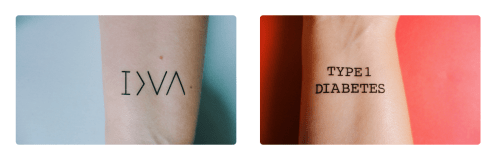
I don’t have any tattoos on my body. And I rarely wear medical ID jewellery. How are these things connected?

Well, a lot of people with diabetes have diabetes tattoos, often on the inside of their wrists. Many say the reason they decided to tattoo their medical condition quite prominently on their body is because they don’t like to wear medical ID jewellery, (or don’t want the hassle of remembering to wear it). A tattoo is as permanent as you can get! Once it’s on, it’s on!

I’ve never really been interested in getting a tattoo, and I certainly have never even entertained the thought of getting a medical ID tattoo. This is obviously a very personal decision and I actually really like a lot of the diabetes tattoos that I’ve seen online. But it’s just not something that is very ‘me’. (And perhaps somewhere in this deeply cynical body of mine, a teeny tiny part of me that things maybe, perhaps, possibly there will be a cure for diabetes in my lifetime. And that unicorns exist.)

I do try to make an effort when I am travelling alone to wear my medical ID bracelet that I bought from a number of years ago. But the truth of the matter is that I very, very rarely do. Call me vain or shallow (guilty, guilty), but I don’t like the look of most medical ID jewellery, and even more, I don’t like looking down seeing a constant reminder of my medical condition staring back at me. I love wearing bracelets, but one that screams ‘chronic health condition’ is not really what I want to see when I am typing away and hear the jingle jangle of my bangles.

Today on my Instagram feed, this came up:

It’s from Pep Me Up Diabetes Blog which is run out of Germany by my friend Steffi. Steffi is awesome. I’ve met her in person a couple of times now as she’s also part of the Roche Bloggers Group. To date, her business has mostly sold very cool stickers for FreeStyle Libre sensors and scanners. She gave me a couple of stickers last year in Munich and I quite enjoyed sporting this one on my arm over the top of my sensor:

Now, Steffi has broadened her business to include temporary tattoos such as the one showcased on her Instagram feed today, as well as a couple of others which are also fabulous. In fact, if I were to get a permanent diabetes tattoo, I suspect that it would look like one of these:


(The first one means ‘I am greater than my high and lows’.)

I can see the merit of using a temporary diabetes tattoo. For me, travelling alone would be the time that I think it would be most appealing. But there are a lot of other situations that would be great too: music concerts and festivals, large sporting events, or even as a ‘try out’ for a more permanent inking!

I really love this idea – well done Steffi – and it is another example of some truly wonderful and fun things that are going on in the diabetes world by people with diabetes. Do support them if you can!

Want your own temporary diabetes tattoo? You can order here. And Steffi ships all over the world. Even Australia!

GIVEAWAY!

Steffi has kindly offered to send me a couple of tattoos for a giveaway. Want one? Click here and tell me when and why you would use one of these tattoos.

Wait – I think I found an alert bracelet I like! As I was scrolling through the Pep Me Up website, I found this and ordered it!

What a week. It’s been a big one. And here are some words I said to wrap it up…

And here’s some further reading..

All the details of this year’s National Diabetes Week 4Ts campaign.

Beyond Type 1’s DKA campaign.

IDF type 1 symtoms and DKA awareness campaign.

The tragic story of Peter Baldwin’s missed type 1 diabetes diagnosis and how his parents have committed to raising awareness of the signs and symptoms of type 1.

Georgie Peter’s type 1 diagnosis story via her blog Lazy Pancreas.

Thoughtful post from Rachel from Yoga for Diabetes about her diagnosis of LADA. Diabetes is so complex…!

See you in a week or so…I’m taking some time off here to catch up on everything else after the busy week. If you have a couple of spare minutes, please consider endorsing my nomination for this years WEGO Health Awards. Just click on this link – it doesn’t take long at all!

For the last sixteen years, I’ve been directly involved in National Diabetes Week (NDW) in some way. Admittedly, I missed a couple because we decided the middle of July is a good time to go to New York to escape the Melbourne Winter. Two years ago I missed half of NDW because I was in Orlando at FFL – I returned just in time for Kellion! Oh, and there was the year I had a little wee lass who I couldn’t stop looking at and cuddling.

But whichever way you look at it, I’ve been involved in NDW for a while. A lot of that was spent very much on the sidelines, because the campaign was type 2 diabetes focused and I was not. Or rather, my role at work was exclusively directed towards type 1 diabetes activities, and campaigns were always about raising awareness of type 2 diabetes.

This year, for the first time, there is an element of the NDW campaign that is exclusively focused on type 1 diabetes and it was launched today. It’s all about the importance of early diagnosis of type 1 diabetes, aiming to reduce the 600-plus hospital admissions each year because the early signs of type 1 diabetes have been missed. I know so many stories of people with diabetes being told they had a virus/urinary tract infection/were run down/growing pains (in the case of kids)/needed a holiday, and sent home with a prescription for antibiotics. Their type 1 diagnosis only came after ending up, very sick, in emergency, many needing ICU attention.

The campaign highlights the 4Ts of type 1 diabetes – Thirst, Toilet, Tired, Thinner.

We leaked a sneak peek of the campaign on Saturday to let everyone know that it was coming. The leaked video, which tells the diagnosis story of 9-year-old Isabelle, has been viewed by tens of thousands of people.

The response to the video and campaign details has been overwhelmingly positive, with people sharing the video widely amongst their networks. And comments have also been encouraging, telling us that the campaign is right in its tone and focus.

Today, the campaign was officially launched in Brisbane and all materials are now available for you to see and share. Here’s the campaign poster:

What can ­YOU do?

As this is a public awareness campaign, we need to get this information out to people outside the diabetes community. Mostly, those of us affected by diabetes now know the early signs of type 1, but that’s not the case for people who don’t have type 1 or know someone living with it.

You can help by sharing the video on all your social networks. Set your shares to public and encourage your friends to watch and share.

Share the poster – both online and off. You could print off a copies and take them to your GP office, school, supermarket and anywhere else with a community notice board. Ask your church or community group, or child’s school if the poster could be shared in newsletters.

Also, I wrote this piece for Mamamia Women’s Network – again as a way of reaching an audience outside the diabetes world. Please read and share this too.

Use the following hashtags: #ItsAboutTime / #NDW2017 / #4Ts

I have probably attended close to twenty Kellion Victory Medal Award Presentations over the years. You might think that they are all the same and to a degree, you would be right. Every ceremony involves people who have lived with diabetes for 50 or more years being given a medal while their story is shared.

And every single award ceremony has been just that. But the stories are rousing, the people are inspiring and learning about managing diabetes when technology was a glass syringe is sometimes mind-blowing! It doesn’t matter how many of these award ceremonies I attend, the overwhelming feeling of hope steadies and enthuses me for another year.

This year, 56 people were awarded medals, including sixteen 60-year recipients, one 70-year recipient and one 80-year recipient.

One of today’s 50-year medal recipients was Jenny Edge. Jenny frequently comments on Diabetogenic, never afraid to tell me when she thinks I’ve missed the mark; always happy to share her story.


I always love listening to Jenny. She’s very direct, and I always appreciate her no-nonsense attitude. There is no sandwiching how she feels with a couple of innocuous comments on either side of what she really wants to say. She gets to the point and gets there quickly. I find her quite brilliant!

Jenny was diagnosed as a young child, and today she told me how she really hated needles at first. ‘I thought they were cow needles,’ she said. ‘And then my dad showed me what cow needles really looked like – we lived on a farm. Suddenly, my insulin needles didn’t seem so scary.’

Although she received a 50-year medal today, Jenny has actually lived with diabetes for 55 years, so she’s only five years from receiving her 60-year medal. I hope to be there for that one too! Congratulations, Jenny!

There’s a type of low I have.

It’s usually the middle of the night. I’m alerted to something not being quite right – this time, my iPhone beeped. This time I caught it before it became a complete white out hypo that I’ve no real memory of the next day. I switched into autopilot and started to do what I needed to do. I don’t know how it happens; it’s as though I am watching from above, telling myself what to do.

Renza, sit upright.

Renza, grab your meter.

Renza, there are no strips remaining in the canister.

Renza, get out of bed and walk to the diabetes cabinet and get new box of strips.

Renza, check blood glucose.

Renza, grab juice box from bedside table.

Renza, stab straw into juice box and drink, drink, drink.

Renza, go to kitchen.

Renza, cut slice of bread from sourdough loaf on kitchen counter.

Renza, slather bread with Nutella.

Renza, sit at kitchen table.

Renza, eat.

I was methodical, my movements slow and deliberate, almost robotic, like Hymie from Get Smart. I could almost feel my brain actually engaging with each body part, telling me what to do: walk, reach, drink, eat, chew.

I don’t know how long I sat at the kitchen table. I remember starting to focus on the pale light in the back garden and the shadowy figures the huge tree from over the back lane making. I heard Cherry the cat meow quietly at one point.

Renza, go back to bed.

I climbed back into bed, Aaron stirred. ‘Are you okay?

‘Hypo. One of those that I often don’t remember. You know – where you would be forcing me to drink pineapple juice and I’d have no memory of it…?

I stopped for a minute and realised I was cold but still needed to order my body parts to do what I wanted:

Renza, use your arms to cover your body with the doona.

I started shivering as I realized my hair and t-shirt were damp. I was tired, but couldn’t sleep. My overactive brain that had been busily directing my body, telling it what to do, wasn’t ready to shut down just yet. It was on high alert, and as often happens in that post-hypo murkiness, with the power to shut down the negativity completely deficient, all the scary thoughts started flying around. I thought about what could have happened; I thought about the times that the lows invaded everything and I couldn’t function at all, not remembering the spent juice boxes, empty wrappers, crumbs in the bed. The fear and darkness of hypoglycaemia threatened to overtake me and I knew that sleep that night would be lost forever unless I acted.

Renza…close your eyes.

Renza…don’t have another low…

Renza…get some sleep…

Max and Hymie

My A1c came back a few weeks ago in my target range. As soon as I saw the number, I said to my endo: ‘It’s because of this,’ and I gently patted my arm where my Dexcom was sitting firmly, doing its thing.

I was right. Wearing CGM fulltime has allowed me to better understand what is going on with my glucose levels and how they responds to a variety of different factors.

Puppy on my lap and CGM on my arm.

But it’s only part of the picture and the more I’ve thought about it, the more I’ve come to realise it. I’ve been using CGM almost fulltime for four years now, yet this A1c was ‘more’ in-range than any other in that time.

It can’t just be the device.

No, it’s when I add the low(er) carb way I’ve been eating to the equation that the improvement starts to make sense.

The most obvious thing I noticed when I started eating lower carb was that my CGM trace stayed far straighter for far more of the time.

Before I started eating this way, I’d see a lot of spikes. Sure, I’d come back into range after an hour or two, but there was a good while there that I was above range while I waited for the insulin to do its thing with the carbs I’d just ingested. Insulin isn’t perfect; its action can be unpredictable.

Eating lower carb means the spikes just don’t happen as they used to. Of course there are other contributing factors that do cause my glucose levels to head out of range, but by eliminating – or rather minimising – the one that is most responsible has resulted in a significant change.

So, what is that change? It’s all about time in range (TIR).

And that is how I now measure my glucose management. It’s not about A1c – I don’t like averages because they conceal a lot of what is going on. The A1c average might be a pretty number, but what is going on outside that number to get there?  But when I look at how much of the day is spent in range, there is less place to hide. It is starkly clear the days that I am within my upper and lower limits.

And there is a flow on effect from more time in range. When I think about how I feel on the days that I am far more in range than out, I feel better – more energised, more focused, more able to just get things done.

CGM data easily provides me with this data (and flash glucose monitoring would as well) so I can see at a glance just how much of each day is actually spent in my target range. This means that I don’t really care about what my A1c is. It may creep up a little bit, but if overall I am spending more time in range, then I’m happy.

This is just another reason that A1c measurements are flawed. It was first recommended as a way to measure diabetes management back in 1976 and a lot has happened in diabetes since then. I’m certainly not suggesting that we throw it out the window. But I am saying that with new (and some not-so-new) tools to provide even more information – more meaningful information – I certainly am not using it as the only way I to track and measure how I am going.

TIR. I’m calling it the new A1c! (And adding yet another acronym to my diabetes lexicon…)

Want more? This great piece about ‘going beyond A1C’ from diaTribe is a must read.

I’m a little cranky this week. At least, that’s how it may seem with some of the ways I’ve been responding to things I’ve seen online.

Yesterday, mice were cured again which was awesome and wonderful if I were a mouse, as suggested in the photo to the right.

Alas, I am not, so I felt the way I usually do when I hear of diabetes disappearing in rodents – ambivalent, as I crabbily pointed out to anyone who would listen. (It was quite timely when this article came across my radar which did a good job explaining how mice and humans are different and therefore what works for a mouse may not work for a Renza…or any other human.)

And then there was Monday’s post about the Twitter discussion about how much power and influence healthcare users have in the healthcare system (spoiler alert: the answer is very, very little…).

But today, I’m writing about an ongoing Twitter discussion that has me shaking my head for different reasons.

I wasn’t around the diabetes world when home blood glucose monitors came onto the market. I was handed a meter the day I was diagnosed in 1998, and I was able to take myself off to an NDSS outlet and pick up strips. Blood glucose monitoring was expected then, and I was easily able to access what I needed to meet the recommended glucose monitoring treatment I was prescribed. I remember being told just how essential it was that I prick my finger and check my glucose levels before meals and before bed – at least. This was the technology that was readily and affordably available to people in Australia and healthcare professionals were very, very in favour of using it.

But it wasn’t always the case.

In the early 1980s, home blood glucose meters started being offered to people with diabetes to take home and use. It was the start of self-monitoring blood glucose (SMBG) – before this, it was all about weeing on a stick and analysing colours. The advent of SMBG is certainly one of those moments on the diabetes timeline that stands out as an important step in diabetes management and improved care.

At the time, there was a lot of criticism of this new-fangled device, with many HCPs believing that it wouldn’t take off, the expense was needless and that there was not enough evidence to support the ongoing subsidisation of such technology. According to a short reflection piece to BMJ in May 1998, the introduction of SMBG had clinicians believing home glucose monitoring ‘a dangerous practice’.

As insulin pumps became more popular, the same attitudes were emerging and in 2001, when I decided I wanted to start on a pump, I had to doctor shop before I could find an endo who would agree to filling out the necessary paperwork. The reasons for refusing my request ranged from ‘You’ve not had diabetes long enough yet,’ (I started on a pump almost three years after diagnosis) to ‘They’re not safe’, and ‘There’s no evidence a pump will improve your A1c’, to which I replied ‘Okay – but will it let me sleep in on a Saturday morning and present more flexible food timings and options? Because my quality of life is seriously impacted on having to freedom to live my life because of the restrictions my current diabetes treatment regimen demands and I am becoming burnout and resentful of it right now.’

I wish I could say that these ideas ceased when I started on a pump, but we still hear today people being refused pump therapy for a litany of reasons that, quite frankly, don’t hold water in most cases.

And then, the arrival of CGM was met with exactly the same reaction. ‘It will make people obsessive,’ and ‘there’s no evidence to suggest that it actually improves clinical outcomes and A1c’ and ‘It’s a gimmick – we have blood glucose monitoring that works just fine,

This, despite a recent talk I attended at ADA where endocrinologist, Steve Edelman from TYOCD declared:

Which brings us to the the Twitter discussion this week which centred around FreeStyle Libre and concerns that there is not enough evidence to warrant subsidy of the product in the UK (following a report on the device from NICE in the UK). Arguments shared in 140 characters or fewer very much centred on the lack of evidence about the Libre.

I understand the arguments: clinicians were calling for randomised control trials (RCTs) to provide the evidence they feel comfortable with before they are willing to recommend a product: they want evidence to support clinical outcomes (i.e. lower A1c).

The problem here is that RCTs are costly, take a lot of time and often don’t measure anything more than clinical outcomes. Plus, they are rarely, if ever, co-designed by the people impacted by whatever is being studied.

It was the same sentiments as when other new tech was released into the market. Often it’s new diabetes tech that provides the user with more information, more data….and more control over how and what they are doing to manage their diabetes.

The pattern repeats itself each time there is something new: clinicians are wary (which, it could be argued is their role), people with diabetes are excited. In the case of Libre, I know of many people who, after years of refusing to measure their blood glucose due to pain and intrusion, have started actively monitoring their glucose and making meaningful treatment decisions due to the ease of Libre. One woman said that it has meant that for the first time in over a decade she feels she actually has some idea of what is going on with her glucose levels which has resulted in her making smarted food choices.

As I read the tweets, I started experiencing very strong feelings of déjà vu. And I also was once again reminded of why so many subscribe to the #WeAreNotWaiting movement. And I ask: Is it any wonder that people are hacking diabetes devices and building their own systems to do what we want them to – what they are capable of doing – now?

P.S. Just a reminder that there is currently a stakeholder engagement underway following a submission to list FreeStyle Libre on the NDSS. You can read all about it here (where you’ll also find the link to take you to the survey).

Follow Diabetogenic on WordPress.com

Enter your email address to follow this blog and receive notifications of new posts by email.

Read about Renza

Archives