I’ve been a little out of sorts for the last week or so and this has translated to me feeling a bit distracted, and not sleeping well. I’d forgotten about not getting a good night’s sleep, because Loop completely and utterly changed the way I sleep. Here’s the thing, though: when I  am not sleeping well, my glucose levels are far less predictable. And then, when my glucose levels are far less predictable, I sleep less. And so, I enter a cat and mouse chase as I step in and try to sort things out when really, I should stop. And try to sleep more.

I’ve thought about this as I skim through posts about raising awareness of diabetes. Because I realised that in the eagerness of doing the very important work of trying to #MakeDiabetesVisible to everyone else, and raise awareness of what living with diabetes is truly like, I am still becoming aware of things myself. It flies in the face of my belief that this month isn’t about those of us who have diabetes – it’s for the people who don’t, so that we can hopefully improve their understanding of the seriousness of diabetes.

But actually, in the last few days, as I’ve been a little more introspective – and awake more –I’ve become aware of the impact of sleep. Or rather, the impact of the lack of sleep.

I talk a lot about how all-encompassing diabetes is: about the burden of diabetes. This is different for everyone, and in the past I have spent a lot of time (some might suggest navel grazing) trying to define the things that contribute most to that burden for me.

Since I started Looping, I regularly say that I feel less burdened than I ever have.

That is true. And when I think about it makes perfect sense. The automation of Loop means doing fewer diabetes tasks, and that means less burden on the physical things I have to do. It has also resulted in significantly reducing swings in glucose levels. These things alone save me a lot of mental energy. And physical energy too. And keeps my mood far more even.

But this last week; a week that I have felt a lot more needed from me emotionally, diabetes has struggled too. Loop is brilliant at chugging away in the background and keeping everything as stable as possible. Night-times are brilliant because there are far fewer of the contributing factors that send our glucose levels into disarray.

However I have spent more time awake, meaning less time for just chugging and more time for needing to fix things. The less I sleep, the more Loop has to do. And sometimes, it doesn’t cope all that well – especially if I step in to try to give it a ‘helping hand’.

Sleep is so important. We talk about food and exercise and medication and how they impact on our glucose levels. We talk more about the result of stress on our diabetes management. We know that when we get right the equations about those factors and our glucose levels are less variable, we feel better. But sleep? I honestly don’t think that anyone has ever spoken with me about sleep.

Sleeping more is a regular issue for me. I get a second wind late at night and suddenly decide that is the time I should really do some work. Plus, having friends around the globe means needing to negotiate time zones. When they are awake, I often should not be, yet marathon message sessions often happen and that delays sleep too. It works both ways. I’m conscious that good times for me to chat are not necessarily ideal for those in a different hemisphere! Oh – and then there is jet lag. Ugh…jet lag.

Adam Brown has devoted a whole chapter of his book ‘Bright Spots and Landmines’ to the issue of sleep and diabetes. I think I need to have a reread. But more broadly, I think we need to better address the issue of sleep for those of us living with diabetes, because once our quantity and quality of sleep starts to affect our glucose levels, the way we feel overall significantly changes.

I’m feeling much more like my usual self today. I slept a little better last night and my CGM trace has been far nicer; Loop has been able to cope much better, and my time in range has returned to what I have become used to. All in all, it adds up to me feeling like I usually do.

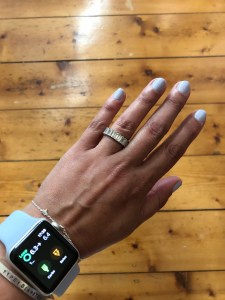
Unfortunately, even with the improved night’s sleep and more time in range, I still wasn’t thinking clearly enough when I chose this colour for my nails. I’ve no idea what to blame for that ill-advised choice, but probably should have learnt by now that awareness raising for diabetes does not need to extend to blue nail varnish. Alas, I have not …

Last weekend, we were in Carlton, waiting to order some lunch in a casual café. We stood there deciding what we wanted, waiting for our turn. We reached the counter and were about to order when the woman behind the counter said something. It took me a moment to realise she was speaking directly to me. ‘Sorry?’I smiled at her, asking her to repeat herself. ‘Your Dexcom,’ she said. ‘How do you find it?’ My smile got wider. ‘Oh, I love it! Wouldn’t be without it.’ I said. ‘Do you use one?’

She rolled up the sleeve on her tee-shirt, turning her body slightly. ‘No, I use Libre,’ she said, pointing to the sensor on her upper arm. ‘But I’ve been wondering about the Dexcom.’

She was young, and was diagnosed about four years ago. ‘It’s hard,’ she said to me, and then asked how long I’ve had type 1. ‘Twenty years,’ I watched her eyes widen. ‘And yes…I know. It can be hard.’

She told me she thought it was really tough being diagnosed as a young adult. ‘I remember not having to think about diabetes. It makes it hard that I have to think differently about things now because of diabetes. Like when I want to go out drinking. I think it would be easier being diagnosed younger so it’s all you know.’

‘I’m not sure there is ever a good age to be diagnosed with diabetes. I think each age would probably have its challenges. I’ve always felt that I maybe was a little lucky missing the teenage years and all that comes with it. But it certainly wasn’t easy being diagnosed at twenty four… it sucks all ‘round!’

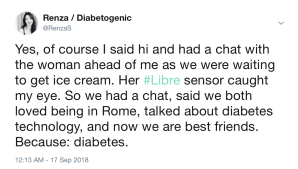
Back in September, in a little street in Rome as we waited to order gelato, I had another ‘diabetes in the wild’ moment. The gorgeous Roman sun meant almost everyone was walking around in tank tops and strappy sundresses. ‘Look,’ said the kidlet, her eyes on the arm of the woman in front of me…and the unmistakable disc of her Libre sensor.

You can guess what I did next:

After introducing myself, we chatted about our diabetes tech. We spoke about funding and how we need the technology to live well, and how much easier it makes travel and negotiating time zones. Oh, and then we talked about the wonderful times we were having in Rome and the delicious food. It’s never all about diabetes!

After last weekend’s encounter, I realised that despite knowing a lot of people with diabetes, I still feel the need to reach out when I see another. And these days, I seem to always ask a version of the same question: ‘Do you know many people with diabetes?’ I guess I’m taking the temperature to see just what their support network looks like when it comes to other people in the know and how linked in they are with other PWDs.

We look to connect with the people whose stories mimic ours because that’s how we make sense of our own diabetes, or the diabetes of someone in our family. The other day when I visited with a family support group, the connection shared between the parents of children and teens with diabetes was clearly on show. One parent told me that until she started spending time with other parents of kids with diabetes she felt so isolated. ‘They’re the only ones who get it,’ she said me and I nodded furiously. Because while I don’t ‘get’ her situation, I certainly do understand what it means to find that connection with others who do.

For me, I do peer support in a very casual way. It is informal. How I have come to know those in my tribe has usually been completely serendipitous and the way we remain connected is too. It’s the occasional phone or Facebook messages, sharing something we’ve seen or checking in after we notice something on their social feeds. It’s the ‘Can we Skype now?’ from a friend in a different time zone looking to find a few minutes to catch up (or, even better, catching up with those in different time zones IRL thanks to my crazy travel schedule!). Or it’s the quickly organised ‘Let’s catch up for a coffee somewhere local’ from those not only in the same time zone, but also the same postcode!

We talk about the value of peer support, and there is increasing evidence to show just how valuable it is.

So for November and Diabetes Awareness Month, one of the things I think we need more awareness of is the value of those connections. ‘Prescribing’ peer support always seems an odd way of thinking about it, but perhaps there is some merit in ensuring that part of HCP training includes introducing the merit of peer support, and providing information about how they can point people with diabetes to others.

My tribe of other people living with diabetes hold me up, hold me together and hold me close. I wish that for everyone.

Everything is turning blue. In the US, today marks the start of Diabetes Awareness Month. Apparently, Diabetes New Zealand are also using November as an awareness opportunity, this year focusing on encouraging Kiwis to ‘Act now to live well with diabetes’. (You can read about their activities here.) 

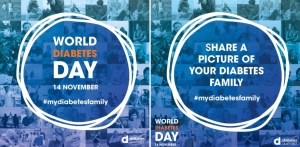
While it’s not Diabetes Awareness Month in Australia, those of us in the Aussie diabetes world cannot escape that there is a lot of diabetes happening. We can choose to get on board or ignore it. Except, of course, on World Diabetes Day where we ring everything in blue circles.

Some years I’m totally gung-ho and all enthusiastic and happy to do the whole month. Other years I’m a little more subdued. This year, I think I’ll have a foot in both camps, which was apparent with my swinging mood this morning. I woke up and my attitude was firmly here:

But, after my shower as I searched for something to wear, almost automatically, I went straight for clothes that were blue. Blue. All blue! Every single thing: blue! (Including my eyeliner.)

Diabetes awareness means different things to different people. I firmly subscribe to the My Diabetes, My Rules philosophy, and that also encompasses the issues that we hold near and dear, and fight for with all the energy we can summon. And those issues will be different for different people.

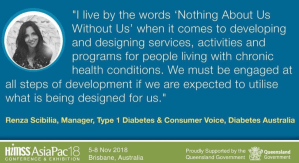
For me, I’ll keep on keeping on throughout November, working on the issues that matter to me.  That includes neat little hashtags like #LanguageMatters and #NothingAboutUsWithoutUs. It also includes acknowledging that diabetes is a self-managed condition that we do ourselves more than 99 per cent of the time. I challenge ideas around consent and autonomy. I fight for us to be able to do diabetes in the way that we want – with the right support system around us, using what we need to be our best. I talk a lot about how diabetes is more than numbers and that screening and consideration of our mental health is just as important as screening and consideration of diabetes-related complications. And while we’re on complications, I have spent a great deal of time this year writing about how blaming and shaming people with diabetes and diabetes-related complications is damaging. I beg, beg, beg that Steel Magnolias not be held up as current case study for diabetes and pregnancy. Perhaps most loudly, I cheer the cause of PWD being represented, present, including, involved and highlighted when diabetes is on the agenda…any agenda! Life for a Child remains a cause very close to my heart and something I am privileged to be able to support. And I promote the value and need for peer support, clearly explaining how it is my friends living with diabetes – my tribe – who I count on most because they unquestionably ‘get it’ and that what we learn from our diabetes peers is absolutely critical.

The list is long and at first, it may look like I need to just settle on one or two things and do those properly rather than the half-baked mess it may appear.

But actually, when it all boils down, I think that the truth is that all those issues can be condensed into four main categories: Access, Respect, Choice, Health.

That’s what November is going to be about for me. I’ll keep banging a drum to what may now be a familiar tune. But there is lots more to do. And this month, I’ll be doing it in blue.

The kid and I have been enjoying some fierce Scrabble battles. At this stage, I am absolutely owning it, and, as a mother who has always subscribed to the tough love approach to parenting, I’m not going easy on her in any way. Plus, I like winning.

I’ve always loved Scrabble. I love the empty board at the beginning and the possibilities of what is about to be laid down. I love turning over the first seven letters and arranging them on the wooden stand, wondering if there is any chance of finding a word that will use them all up as my first turn. I look ahead and try to strategise so that I manage to get the most double and triple world scores. And I play to win. Did I mention that already?

As the board fills up, and letters form different words, I hope for an open board with lots of options to use the letters already in play. I move the tiles around on the stand trying out different arrangements, searching for uncommon words that the kid may never have come across, (because why not use this is a teaching moment?!).

When our game finished the other night, I looked at the words and smiled at the randomness of it all. How did those words all come together; how was that pattern the end result? It was an exercise in haphazardness and chance and, sometimes, a bit of luck.

Just like my twenty years of diabetes. There is no rhyme or reason to most of it; nothing really happened by design. There was (and continues to be) a lot of trial and error. I stumbled on things and added to what I was doing to see if it made anything better. Sometimes, I jackpotted on the equivalent of a triple word score with a J in play. Other times, I called it a day, throwing everything back into the box and starting again. There were times that I looked at what was in front of me and somehow cobbled together something that seemed to work.

If I were to make a Scrabble board of words relevant to my life with diabetes now it would use different words today than when I was first diagnosed, or after five years of living with diabetes, or ten, or fifteen.

Twenty years ago, the words would have been about uncertainty, following what I was told and naivety. There would have been words reflecting the management tools I was first given, and they would have been very different five years later, when ‘pump’ would have replaced ‘pens’ or ‘injections’. Some cynicism and sass would have started to make its way in. Another five years later it would have all been different again, my bolshy attitudes much clearer and on show. Fifteen years of living with diabetes would have seen more technology, words showing how my world had been opened up thanks to online diabetes support networks and more travelling. These days, there would be words like ‘Loop’. And ‘tribe’ to acknowledge those friends with diabetes who have come to be an integral part my story.

There would be words that may be denied in regular Scrabble, but the diabetes version would absolutely approve of words and abbreviations such as DIYAPS, diaversary, Kellion, RileyLink and YDMV.

But undoubtedly, throughout it all, there would be some words that would be played all the time in each game. Words such as fear, anxiety, frustration. And hope. Hope would always be on the board, the first word played at every opportunity. Because it’s always been with me. It’s the thread that has been woven through and held together every part of my diabetes, from that first day to today and every single day in between.

I’m still playing catch up on the goings on at EASD. It was such a busy conference – in general and for me personally – that my head is still lost in a lot of what happened and what I saw. It’s somewhat frustrating for me because diabetes conferences are seen as an opportunity for so many meetings of different groups and projects I’m involved in, and that means I don’t get to anywhere near the number of sessions I would like to. When I can, I make sure I live tweet my way through (that’s how I take notes to do write ups later), but this conference was so busy that there was very limited time for that.

But I still did get to see a lot thanks to the satellite events I was invited to and asked to speak at. Plus, this year at EASD, I was involved in something new that was super exciting.

DZD meets #DEDOC was a novel session combining young researchers and (not necessarily young) people with diabetes to give different perspectives on a variety of current research programs. The event was presented by Deutsches Zentrum für Diabetesforschung.

(My  very limited German (i.e. I sang in St Matthew’s Passionat University – badly – and was in the orchestra for a German-language version of Threepenny Opera, or rather, Die Dreigroschenoper) is apparently good enough to translate that as the Diabetes Centre for Diabetes Research – so, I guess I’m almost bi-lingual now.)

Bastian Hauck hosted the event and was involved in the project to nominate PWD to speak at the event, and encourage other PWD who were at EASD to come along and listen. This was Bastian doing what he does best – facilitate discussion and encourage engagement by different stakeholders. He always manages to ask questions that get people thinking in different ways and did a stellar job again in this event.

The session was not designed as an excuse for PWD to be critical of the research and researchers, or to find fault in what they were doing. It was not to query the merits of the research either. It was to give the researchers an opportunity to speak about their work (in a rapid fire, five minute pitch), and for PWD to engage in that discussion, asking questions and explaining the relevance of the research to actually living with diabetes. While the project may not have actually come directly from PWD, it was a true collaboration where researchers spoke of what drives them, and we shared what we hope from science.

So, what research was on show?

Firstly, we had Dr Stefan Kabisch speaking about research which compared dietary prevention and treatment of type 2 diabetes with two different interventions: one low carb and one low fat. Cathy van de Mortelewas the PWD involved in this segment of the session,  and we couldn’t help but have a little giggle that she had been selected. Those who know Cathy know she is anincredible baker and cook. Her creations are magical and if I lived in Belgium, I would be at her place for dinner three nights a week. But low carb and low fat? Not so much! However, she did give a really useful perspective on the need to remember that different eating plans need to be sustainable and what works for one person may not work for another.

Secondly, Dr Carolin Danielspoke about her research in type 1 diabetes prevention vaccines. Dr Katarina Braune stepped in as the PWD (she is also a researcher and endo) to give her comments on the research. It was interesting hearing Katarina, because she comes from the perspective of a scientist as well as a PWD, so her considerations were different to other PWD who spoke. Her questions and comments incorporated the scientific as much as the ‘real life’, and I loved the way she was able to so succinctly and eloquently translate it all so it made sense to someone like me without a scientific bone in my body!

And finally, Dr Julia Szendrödispoke about diabetes-related complications. While the research was specifically about the mechanisms in the development of complications, as well as looking at potential interventions, I was invited to be the PWD in this discussion to lend my language focus. I highlighted how conversations about diabetes-related complications need to be without judgement and stigma, and that at all times, remember that although a single body part may be in question when speaking about a specific complication, it is attached to a person with a whole body and mind that must also be considered.

To be honest, I felt that my comments were almost redundant because Julia did such a beautiful job in her five minute explanation of her work of ensuring that there was no blaming or shaming. I thanked her for this because the language in pretty much every other discussion of complications I had seen that week was not all that palatable!

I love the idea of including PWD to shape diabetes research. And I loved the discussion at EASD. It was an excellent example of how to include PWD in discussions – even highly scientific discussions. And just how easily it can be done!

This event was the first one, but hopefully the organisers have seen the value of conversation-based sessions including different stakeholders. It would be great for events such as this to attract even more attendees – researchers, HCPs and PWD – although a huge thanks to the German PWD contingent who was there, flying the advocate flag and supporting us – and to see them on the main program of the conference.

DISCLOSURE

I was invited to provide my perspective at the DZD meets #DEDOC presented by Deutsches Zentrum für Diabetesforschung. I did not receive any payment to speak at the session. Thanks to Bastian Hauck from DEDOC (the German Diabetes Online Community) for involving me!

Roche Diabetes Care (Global) covered my (economy) travel and accommodation costs to attend their #DiabetesMeetup Blogger event at #EASD2018 and present at their media event the day before EASD. Roche Diabetes Care also assisted with providing me press registration to attend all areas of the EASD meeting.

Trending on Twitter at the moment is a hashtag that is getting a lot of attention (obviously: it’s trending).

The hashtag is #DoctorsAreDickheads.

Has it got people’s attention? Yep.

Is it inflammatory? You bet.

And it needs to be.

The shitty thing is that sometimes it takes a loud, brash moment like this for people to sit up and listen. Lousy experiences in healthcare are not isolated experiences. Not being listened to; not being believed; being dismissed; being belittled; experiencing doctor bias – these are all real. These happen frequently.

In diabetes, we hear this from the point of (mis)diagnosis right through to people who have lived with diabetes for decades. How many people were sent away from the doctor being told their symptoms where nothing? How many parents were told they were over-reacting when they repeatedly took their thirsty, constantly peeing, losing weight child to the GP? How many of us are blamed instead of helped when we start to develop complications?  Almost every single person with diabetes I have spoken has a terrible tale to share.

Hashtags like this, which often then become ‘movements’, come about for one simple reason: people are hurting and need to be heard. They don’t happen because an individual has a grudge directed at one other person. They happen, and become magnified, because there is clearly a systematic issue somewhere. One single person may start the discussion, but others see their own experiences reflected in what others are saying and join in the discussion.

Also, hashtags like this don’t happen as a first line of attack. Often, people have tried every other angle: they have tried to reason, asked to be heard, searched for someone they hope will be more sympathetic, used the system in place – the system that is meant to protect them, followed protocols for making complaints when things go wrong, written quiet pieces on their own blogs or in closed community groups in a hope that someone – anyone – will listen. They have tried being polite, quiet, compliant.

Yet they don’t feel heard.

Unsurprisingly, there have been parallels drawn between #DoctorsAreDickheads and #MeToo and #BlackLivesMatter. And in exactly as the response to #MeToo became #NotAllMen, and #BlackLivesMatter became #AllLivesMatter, predictably we are seeing #NotAllDoctors.

Suddenly the reason behind the discussion is hijacked. Doctors become defensive; others jump to their defence. And the stories of those who have been hurt, who continue to be hurt, who have sometimes had their lives turned on their head, start to get lost.

The right response to this hashtag is to listen. It is not to turn it around and defend yourself or start to attack those who are sharing their personal stories. It is not to be self-justifying. It is not protect your own interests. It is not to accuse the people sharing their stories as being aggressive, nasty, offensive, attention-seeking or confrontational.

It is to stay silent and listen. It’s to let the discomfort wash over you, surround you, move in and almost suffocate you while you remain quiet and listen.

Listen to the people who have had these horrible experiences. Recognise there is a power imbalance between medical care givers and receivers. Understand how vulnerable some people are when they are sharing their stories – and how vulnerable they were when they were let down by their doctors. And accept that the anger on show is completely and utterly understandable.

Personally, I have had some horrid experiences with doctors. Of course I’ve had some incredibly positive and empowering experiences. I have nothing but the highest regard for my own healthcare team and so many of the HCPs I am lucky to work with as part of my job. I named my kid after my endo because I honestly think that her care and expertise and compassion are part of the reason that I have an amazing teenager accompanying me in my life these days. But this isn’t about celebrating those moments.

It’s about the ones that left me feeling hopeless.

Some I’ve documented on my blog, others I feel I am still too traumatised to talk about. I have felt belittled, delegitimised, stigmatised and made to feel like a fool, a hypochondriac, a trouble maker, an attention seeker by doctors in the past. And I am a confident, educated, Bolshy advocate who understands the system. Imagine for a moment those who don’t, because we’re not hearing from them. Yet.

For every single person using the #DoctorsAreDickheads hashtag on twitter as they share their experience, there are dozens who are not doing that. It is not a loud minority who are being rabble-rousers. What we have seen in the last day or so is just the start.

Could it have been more nuanced? Maybe. Someone suggested that a better option would have been #DoctorsBeBetter, but I guarantee that those who are up in arms about this hashtag would still be crying #NotAllDoctors even if there wasn’t the profanity contained within the current hashtag.

And finally, I have a plea here. Please, do not invoke the #LanguageMatters movement as part of this discussion. Language matters – at least the way that I see it and have been working at for almost a decade now – is about ensuring that the language used when speaking to and about people with diabetes empowers and supports us.

If we want to add a language focus to this discussion it’s this: stop policing the language that ‘patients’ use. In the same way it’s not up to healthcare professionals to tell people with diabetes the language to use when speaking about our own diabetes, it is not for the medical community to tell the ‘patient’ community to tone it down or use different words when we are telling our own stories. We will use the words that resonate with us, within us, amongst us. Because these are our stories. And it’s time, and we deserve, for them – for us – to be heard.

I’ve been working in diabetes organisations for over seventeen years now. When I look back over that time, there are some issues that have been consistent ‘hot topics’.

One of those issues is diabetes in schools.

I have been involved in a number of projects addressing diabetes in schools, starting with the beautiful documentary-like video ‘Diabetes Basics’, and the adaptation of the excellent Diabetes UK schools packs for families of children with diabetes and their schools, firstly in Victoria, and then the subsequent national roll out of this resource. It is called Mastering Diabetes and it still is used today.

It is easy to understand why diabetes and schools is such an important issue. Ensuring that children with diabetes feel safe at school, are able to manage their diabetes in the way that works for them, and are able to fully participate in all school activities is critically important. There is obviously – and necessarily – a lot of emotion tied up in the matter.

But what I have come to know is that, by and large, everyone involved – parents, teachers and school staff – want children and teens with diabetes to be safe in schools and participate in all school and extra-curricular activities just as any other student would. There just seems to be a lot of confusion about rights and responsibilities, which is often the case when there are a number of stakeholders involved.

So, it was great when, just last month, the Federal Government announced six million dollars in funding for a new program to make it easier for teachers to support school children with diabetes, and give parents some peace of mind, knowing that their children will be safe at school.

It will be the first time that Australia has a nationally consistent training program delivered to teachers and school staff at every school with students with type 1 diabetes. The program will cover, (amongst other things), safe administration of insulin, hypo management, and reducing diabetes-related stigma.

This is good news. Great news!

The program is still in development stage and a key part of putting it together is making sure that all involved have a chance to provide input. One of the things I have heard repeatedly over the years from parents is that they feel that they are often left out of conversations about how to best support their child at school.

Parents: now is your chance!

There are workshops being held across the country for parents of primary and secondary aged children. There is also an online consultation for parents here.

Teachers and school staff are also part of this development phase and there are separate workshops being held for this group as well. And there is also an online consultation for for teachers and school staff here.

Now is the time to have your say.

Disappointingly, numbers for workshops has been extraordinarily low – some sessions have had to be cancelled due to low numbers. Considering the constant criticisms I have heard in the past about parents being excluded from discussions about diabetes and schools programs, I’m a little flabbergasted that this is the case.

At the risk of sounding slightly bossy and harrying, I am urging parents of school aged children to please get involved and help shape this important program. You need to show up. You need to register and attend the workshops. And you need to complete the online consultation.

All the details are here. Share them amongst your networks. Encourage parents and teachers of kids with diabetes to have their say. Everyone – everyone!– wants kids with diabetes to feel safe and supported in schools. Help make that happen.

The Diabetes in Schools program is being funded by the Federal Government and will be delivered through the National Diabetes Services Scheme (NDSS). The program is supported by the key national diabetes health professional and consumer organisations in Australia: Diabetes Australia, the Australian Diabetes Educators Association, the Australian Diabetes Society , the Australasian Paediatric Endocrine Group and JDRF Australia.  

I work for Diabetes Australia. I have not been asked to write about this program, however as I am always banging the drum about consumer consultation, it more than makes sense that I am encouraging – and pleading – relevant stakeholders to take the opportunity to be a part of the program consultation.

I may use the latest and greatest in diabetes tech, built my own pancreas, become completely reliant on automated insulin delivery, wear devices that send, read and respond to data 24/7. I can set reminders and alerts and alarms and all the fanciest of fancy bells and whistles to help remind me to do diabetes.

But sometimes, the best way is totally old school!

‘When I hear from and read about you and other adults like you with diabetes, you make me think everything will be okay.’

This comment was made to me recently – and not for the first time. I have heard this more times than I care to remember (directed to me as well as to others with diabetes) from others (often newly diagnosed) with diabetes, as well as loved ones of people with diabetes.

While I believe that it is often said as something that is meant to be complimentary, it has become one of the comments I absolutely dread hearing. It’s not a new thing – I have heard people say things like this and similar for as long as I have had diabetes. And I know that I have, in the past, said things like this too – especially around Kellion medal time each year when I get to meet with PWD who have lived with diabetes for far more years than me.

But in recent times, I have stopped saying it, following a conversation with someone who received a Kellion medal this year and read my post about the ceremony. ‘I have nothing to teach you,’ they said to me, as we were chatting. ‘All I do is live with diabetes. I don’t have a choice. It’s not remarkable. It’s just my life. And I get annoyed at people who want to give me a medal for simply living with diabetes.’ We both then giggled at their choice of words because we were, of course, actually speaking about (Kellion) medals, but I think I understood what they were saying.

And it got me thinking to how we speak about others living with diabetes and other health conditions, and what we are saying when we start to use words like ‘inspirational’, ‘brave’, ‘amazing’, ‘incredible’, ‘magical’, ‘motivating’, ‘heroic’ and all the other syrupy superlatives you can imagine.

I have used every single one of those words at some point when talking about other PWD. And people have used these words when talking about me, and I can tell you all I feel is uncomfortable and like an absolute fraud. I’m none of those things. I’m a bumbling mess most days. So it doesn’t sit well at all if the only reason that someone is using hyperboles to describe me is because of diabetes.

And then when someone goes a step further and starts to say a PWD make them feel better about themselves, their situation, or their (or their kid’s) future, that’s just placing a whole lot more expectations on the shoulders of that person with PWD. Or, when someone says that they want to learn from us, suddenly on top  of everything else, we also have to be teachers? More weight on an already extremely heavy situation.

Of course, there is a darker side to this. Not always are we seen as beacons of inspiration. In fact, sometimes, people want to hold us up as examples of ‘what not to do’. I cringe every time I hear the suggestion that newly diagnosed PWD should meet someone with diabetes-related complications as a warning of what can go wrong. Absolutely no better is the idea that rather than underlining diabetes-complications as a threat, it’s a good idea to look at PWD living with complications as examples of proof that life goes. I’m pretty sure that’s not what anyone is thinking when they get up in the morning and go about living their life with that complication.

Suddenly, alongside the responsibility of doing diabetes and all that comes with it, (complications or no complications) we are also now responsible for making others feel better and more knowledgeable about their own situation? That just seems like another task to add to the endless demands diabetes already places on us.

And it also seems a little unfair.

It’s true – there are days that some of us may be brave; we may be seen as inspiring; we may amaze you. Some days it may even be me who seems to be some of those things. But not if the only reason you see us like that is because we are living with diabetes. Last Friday the fact that I got up and out the door and to the airport before 6am in matching shoes, stockings, lipstick within my lip line, and a pencil dress that wasn’t wrinkled is actually quite remarkable, and I would be grateful for someone to acknowledge that. Oh, and a couple of weeks ago, there was a spider the size of a saucer on the ceiling of our bedroom and I more than capably dealt with it. You may call me brave for that, because: Australian wildlife. But nothing to do with diabetes.

We are people with diabetes and we do what we can to manage that however possible. We are not here to make other people feel better about their own lives, or allay concerns they have about their loved ones with diabetes. We’re not here to be a teaching moment. An equally, we’re not here to be a cautionary tale. We are just here to muddle through with the lives we have; lives that contain diabetes.

I have always loved this song.

ADATS on Friday was a great day of diabetes technology and treatment advancements.

There was a lot about automated insulin delivery (AID) systems, which, when you think about it, is really what is at the cutting edge of available diabetes therapies in 2018. David Burren, the Bionic Wookiee, gave a keynote on his experience using DIYAPS and why it works for him. And smart endocrinologist Dr Barbora Paldus gave what I heard was a fabulous talk about different AID systems, including what is coming onto the commercial market as well as DIY systems, and providing details (using terminology that made sense to everyone!) about the different algorithms. And fuzzy logic. I’m so annoyed I missed her talk, but it was on at the same time as the session I was chairing (and it’s bad form for the chair to leave the room to go to hear other speakers).

Before going any further, let me say this – not as an statement of tokenism, but as absolutely heartfelt and something I believe one hundred percent. We can talk about systems that automate insulin delivery with the aim to improve diabetes outcomes, but until these are affordable, accessible and available for everyone who wants to use them, we must acknowledge that these technologies will not be able to be used by most people with diabetes. Everyone ‘working in diabetes’ has an obligation to work towards improving access and affordability to minimise the ‘haves’ and ‘haves not’ landscape that we are already seeing, and will see even more in the future.

I chaired a session that focused on the current MiniMed 670G system trials underway in Australia and then hijacked the panel discussion in the afternoon about the topic because the consumer rep. had to leave early. So, where are we with approval for this system (and how long before lucky people can get their hands on one)? Well, the pump is now approved through the TGA, however is not being provided to PWD yet. The new sensor has not received approval yet, and the system as a whole has not either. Medtronic Australia is saying that they are hoping it will be available by the end of the year. The approval process is out of their hands, but I know they are working super hard on their end to get this to PWD as soon as they can.

I have spoken with a few people who have done the trial here in Australia. We need to remember that trial conditions are often not ‘real life’ conditions, so what I am writing about today does not necessarily reflect the experiences of people using the 670G every day and outside of trial conditions. (The system has been launched in the US and there are lots of stories online from people who have chosen to use this system and I would encourage anyone thinking about using it to search for and find what they have to say.)

Research guinea pig and 670G study participant, Leanne Foster.

The session last Friday was comprehensive in that it included presentations from HCPs in the private and public sectors, adult and paediatric settings, a dietitian, and (thankfully) a psychologist. For me, the highlight was hearing from self-proclaimed research guinea pig, (and friend for over fifteen years) Leanne Foster, who has been a long time diabetes technology study participant and was involved in the study.

From listening to the details of the study design, this was not trial for the fainthearted! There were significant demands placed on participants, and expectations were high. To be clear, participants were not given the system, provided with a bit of training and sent on their merry way to simply live alongside the device back in their everyday world. There was a lot of logging, counting, device wearing (not just the pump and CGM that make up the 670G system).

I think it is important to mention this, because one of the themes that was repeated by several speakers was that for many participants, their own burden of diabetes – how much they thought about their diabetes and what they were required to do – increased while using the system on the trial.

It is also important to mention that this is a first generation device. The system that will be launched here is likely to be the same as the one in the US, yet there have already been more sophisticated and aggressive algorithms developed and tested as part of this trial.

While possibly unfair, it is impossible to not compare experiences of people using the 670G and DIYAPS, because these systems are endeavouring to do the same thing: automate insulin delivery, increase TIR, reduce what the PWD is required to do.

And there were some things that struck me as really widening the gap between the two systems.

Firstly, the concept of added burden was astounding as my personal diabetes burden is the lowest it has ever been in the twenty years I’ve lived with diabetes. Since Looping, I think about diabetes far less than I did beforehand.

That burden is not only applicable to PWD. Many of the HCPs who presented said that they found themselves required out of hours significantly more with people using the 670G. I have not once called my HPC about any diabetes-related matter in the last 15 months I’ve been Looping. Obviously, I wouldn’t be contacting her if there was an issue with the system, but I’ve not contacted her for any general diabetes trouble-shooting that would result in me making changes to any of the settings on my tech.

There was a lot of talk about the 670G system ‘booting out’ of auto mode, meaning that automated insulin deliver doses stop, instead going back to the fixed basal rates set in the pump. This happened every day for many people; several times and for a number of hours at a time. I can say that in my experience, my system loops continuously. There are extremely rare times where my green circle turns red, and the pump reverts back to delivering what is set as my basals. But I am always able to troubleshoot by following a few basic steps and Loop will inevitably return to green.

One thing that struck me, was the number of times we heard about the system struggling to cope with the day-to-day lives of the trial participants, and the only way around that was for them to amend their behaviour. There was one moment that had me sitting there in disbelief when I heard the example of one trial participant who was having recurrent lows overnight and the only way to remedy that was for them to have 10g of carbs before bed. Suddenly, I was thrown back to 1998, being on Protophane and Act Rapid, and the only way I could keep horrid night-time lows at bay was to have a glass of milk with corn powder before bed. (Anyone else do that?)

The very idea that new devices being developed will require PWD to change their behaviour for said device to ‘cope’ with our real life is astonishing! This is, without a doubt, a step backwards in my mind. I know that my experience of Loop is that it has easily been able to adapt to my incredibly un-predictable life that includes far too much travel to different time zones, a varied and sometimes erratic diet and days where I have walked 30,000 steps with others where I’ve been horizontal for most of the day. I haven’t had to modify my behaviour in any way to please my Loop, and I’m not sure I would be so enamoured by it if I did.

What is definitely not a step backwards however – in fact it’s a monumental leap forward – is the potential of this technology and technology like it. As a convert of automated insulin delivery systems, the idea that people will be able to soon access devices that commercially available, under warranty and supported by the company’s customer service is only a great thing. Not everyone wants to build their own system, not everyone is comfortable using a DIY system, especially if they don’t feel they have complete support of their HCPs. Once the 670G becomes available, many of the concerns PWD have will be alleviated. Adding choice is only ever a good thing.

But perhaps the most telling sentiment about how the technology impacts on real life came from Leanne. She loved the idea and experience of automated so much (even with all the disclaimers of the trial requirements) that when she was forced to hand back the 670G system when she finished her part of the trial, she as having none of it! After begging to keep hold of the system (which she knew simply could not happen), she had everything ready to go to build her own DIYAPS and has happily joined the Loop family for now. The capabilities of the 670G technology – the automation and the results – such as the improved sleep – were too much of a good thing and she was not prepared to go back to what she had beforehand. And THAT is telling.

Automated insulin delivery panel. L-R: David O’Neal, Sue Wyatt, Kerryn Roem; Jane Speight, Tim Jones, Spiros Fourlanos, me, Jane Holmes-Walker, Melinda Mus

Disclosure

My flights from Melbourne to Sydney were covered by the National Association of Diabetes Centres (NADC), the organisers of ADATS. I am on the organising committee for the conference.

I am not involved in the Medtronic MiniMed 670G trial. I have worked with and consulted for Medtronic on other projects.

Follow Diabetogenic on WordPress.com

Enter your email address to follow this blog and receive notifications of new posts by email.

Read about Renza

Archives