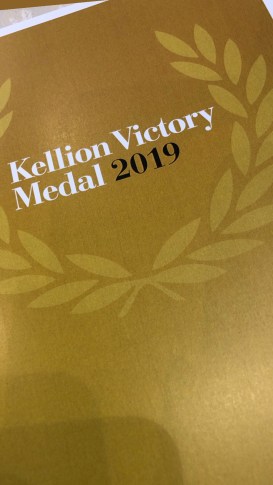
This is an edited version of the first post I ever wrote about my experiences attending the Kellion Victory Medal Award Ceremony. I wrote it back in 2011 (for the old Diabetes Victoria WordPress blog), ten years into working for a diabetes organisation, and already had attended a number of these award ceremonies.

Since this post, I’ve written about other ceremonies I’ve been lucky to attend, and shared the stories of the medal recipients. I love hearing their tips and tricks, and tuck away their words of advice for when I need them. Peer support, I think, as I hear them talking. Their stories are our stories are my stories…

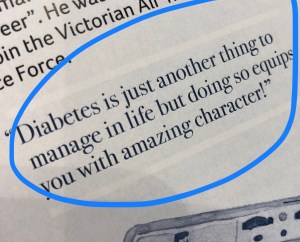
Today, I’m back for this year’s Victorian medal ceremony. I flipped through the program and read the stories of the people receiving their medals. This was my favourite quote for the day. It’s so, so true. 


Today is my favourite day of the work year. It’s the Kellion Victory Medal award celebrations where we acknowledge people who have lived with diabetes for 50, 60, 70 and even 75 years. Just stop for a minute and think about that. Seventy-five years with type 1 diabetes. Now think about what diabetes was like back then: urine was boiled, needles were sharpened. Home blood glucose testing was still about forty years away, modern insulins hadn’t been considered. Insulin pumps, of course, were things of the future.

When I started working at Diabetes Victoria, I had lived with diabetes for just under four years, and in that time I hadn’t met anyone else with type 1. I was still getting used to the new reality that had opened up the day I was told that I had type 1 diabetes. My 27 year-old self had re-written my future, and instead of the life I had imagined, I had reshaped that into one that involved terrifying diabetes complications, probably no children and a reduced life expectancy. I pictured myself unable to take care of myself at a time in my life where I wanted to be travelling and seeing the world. And I saw a life where my still-new husband would have the burden that is a wife with diabetes.

Because that was the picture of diabetes that had been presented to me in the four years since my diagnosis. Time after time, the health professionals I saw delivered news of doom and gloom. And inevitability. Hope was not discussed. Except, strangely, the promise of a cure in five years – although I could tell that even the medicos telling me this didn’t believe it. I felt devoid of hope. Hopeless.

And then I was invited to the Kellion Medal ceremony. I can still remember clearly my apprehension about attending the awards, but I went along to Parliament House to see what it was all about.

It was the best thing I could have done. It wasn’t about living with diabetes for decades. It was about LIVING. I heard tales of travels, raising families, busy and successful working lives. Stories of being pioneers to make sure people with diabetes were not discriminated against. I heard stories of hope.

Kellion medallists are in every way remarkable – not because they are inspirations for living with diabetes. That’s just what they have to do as part of their life. They’re remarkable because they’ve made diabetes just something they do. In learnt that I needed to stop holding them up as some sort of magical unicorns – they were just playing with the cards they’d been dealt. The same way I do.

Each year I walk away from the awards ceremony with an ‘injection’ of motivation and determination. And a booster shot of hope. That’s my response to the day and the medalists – but not their responsibility.

We have a duty to be honest to people newly diagnosed with type 1 diabetes. Promising a life that is full of puppy dogs and bowls of cherries does not accurately paint the picture of what life with diabetes is all about. But neither does scaring people senseless. When people are in that initial fog, where they can’t see beyond the end of the week and they are starting to rewrite their future, that is when they need stories. The positive and real ones. The stories of hope.

If I could find a way for every person newly diagnosed with diabetes; for every parent of a child newly diagnosed; every partner, loved one, sister, brother of someone newly diagnosed with diabetes to attend the Kellion Medal awards, I would.

There is no promise of a cure, no threat of nasty complications, no dread of being a burden. But there is laughing and sharing and amusing stories. And hope. To meet a Kellion Medallist leaves people feeling one way: filled with hope.

DISCLAIMER AT THE BEGINNING TODAY

I work for Diabetes Australia and have been involved in our National Diabetes Week campaign. I am referring to this year’s campaign in this post, as well as previous campaigns (which I have also been involved in). This is a commentary piece on what I think works and what doesn’t. This is all my opinion – thoughts my own and mine alone.


It’s National Diabetes Week in Australia this week, and that means the socials are all in the key of D, with lots of news and stories about that little health condition that many of my friends and I know a little bit about.

And campaigns. There are lots of diabetes campaigns.

The other day, I re-watched a lot of old NDW campaigns from years gone by. It was no secret at the time that I wasn’t all that enamoured by some of them. The campaigns that really concerned me was the ones about complications using graphic images of an eye being operated on, or a heart that was (apparently) seriously damaged, or what a kidney looks like when on dialysis. While some people’s concerns about these ads was on the ‘unintended consequence’ of how people already diagnosed with diabetes might feel when seeing these, mine was that have always struggled with isolating body parts from the whole person living with diabetes. It doesn’t work that way – even if we have a diabetes-related complication in one part of our body, it still remains intact and attached to the rest of us. (I think this piece I wrote with Grumps for diaTribe explains best why this is problematic.)

In recent years, I feel that we have become a lot smarter and more systematic about our campaigns. This is as much about the approach to how we have done things, as well as the actual campaigns themselves. Previously, there was a theme and it was rolled out for a year, and one year only. Each new NDW meant a new campaign theme. And then, as soon as the week was over, we shelved it.

It’s not just diabetes organisations that are guilty of throwing all their energy at ‘their’ health week and building up a big campaign that they yell and shout about for the week and then, in a puff of smoke, it all disappears – often never to be heard of again. It’s as though there is a collective sigh and then everyone ticks a box as if ‘that’ issue has been done and doesn’t need to be done again.

Back in 2016, Diabetes Australia ran a campaign called 4,400 Reasons which addressed diabetes-related preventable amputations. There was clear calls to action behind the campaign and one was to highlight the need to reorientate the Australia health system towards early intervention and the implementation of more foot care teams across the country.

The campaign wasn’t graphic – there were no images of amputated limbs or blaming and shaming those who have had a limb amputated. It had a very clear focus on how the system is letting people down – not that people with diabetes were not looking after themselves.

Since then, we have continued to push the message of this campaign. Screening is important and it needs to happen systematically.

And then yesterday, at the start of another NDW, the federal government made an announcement about a new funding initiative that would start to build a national screening and treatment program called ‘Foot Forward’.

That’s how to do it – find a way to address an issue, make it a focus, keep going, continue to push the same messages, talk to the right people, make it happen. We’re not done, by the way. This is the start of a national screening program, but until we know that preventable amputations are happening far less frequently – or not at all – we keep working at the problem.

For this NDW, we are continuing to promote the importance of early diagnosis of both types 1 and 2 diabetes.

Our T1D campaign is the 4Ts and is a community awareness initiative to increase knowledge of the signs and symptoms of T1D.

Why are we doing it again? Because each year there are well over 600 Australians who are diagnosed with diabetes when they are very, very unwell. Most will have already been to the GP once, twice or even more times and have been misdiagnosed. Type 1 diabetes is fatal if it is not diagnosed in time. That’s the bottom line here. Until this stops happening, we need to teach people the 4Ts.

And when it comes to T2D we need a national screening program that means people are not living up to seven years with type 2 diabetes before they are diagnosed. Early diagnosis equals early treatment and that means better outcomes. That is a goal we keep working towards.

What can we learn about how to put together a meaningful public health campaign?

Time and time again, I hear people say, ‘Why can’t you run a campaign about the difference between the types of diabetes?’I want to ask you if you knew what those differences were before you or a loved one was diagnosed with diabetes. Think about other health conditions and just how much you know about the realities of life with those.

When it comes to health messaging, the airwaves are flooded. We have but a second to grab people’s attention. If we only talked diabetes 101 education to the general community, who do you think is really going to listen to that? I reckon it will be people already affected by diabetes – people who already get it. Do you sit there and watch or read about every other public health campaign for conditions that don’t have anything to do with you or someone you know? I know I certainly don’t.

I know nothing about stroke, however did learn FAST – because it was simple and important to know. Have I bothered to learn about what day to day life with someone who has had a stroke is? Or about the different types of stroke? Not really.

This week, you will see a lot of diabetes out there in traditional and social media. Share what you will and can. We already will share the things that are more relevant to our own experience – that makes sense. I’ll admit my bias and say that I am committed to getting the 4Ts message out that you’ll be seeing a lot of that from me. I have heard too many of my type 1 tribe talk about their horrid diagnosis stories.

I keep saying this – I don’t want or need or expect people to know the intricacies of my life with type 1 diabetes. Honestly – I don’t particularly to know that. But I would like people to be diagnosed with type 1 sooner. I would like them to be diagnosed correctly. I would like HCPs to know the 4Ts and have them front and centre.

I don’t want shock campaigns that scare people into inaction. But equally, I don’t want wishy-washy campaigns that offer nothing and have no call to action. I want more campaigns that deliver. And I think we’ve made great strides in that direction.

With National Diabetes Week launching tomorrow in Australia, I’m resharing this post today.

Once again, Diabetes Australia (disclaimer again – I work there, but sharing this becuase I am choosing to be because it’s so important, not because I’ve been asked) is once again running parallel campaigns about the importance of knowing the signs of type 1 and type 2 diabetes.

I’m really pleased with this year’s campaign, because we’ve gone harder than in the last two years by highlighting that not diagnosing diabetes in time is fatal. I know that sometimes we get nervous using words like that, but the reality is that missed or misdiagnosis of type 1 diabetes is fatal. People have died. And that is not good enough. (Melinda Seed wrote a powerful piece about this just yesterday – please read it.)

I echo Mel’s plea and ask that you will share the poster below with your non-diabetes networks. Do it now, and do it regularly. Sure, share it in your diabetes support groups and with your mates with diabetes. But if that’s all we’re doing, nothing is going to change. 


I am certain that almost all the people who read this blog are in some way affected by diabetes. (Because, really, if you are not, why would you be reading?) It makes sense that the people who want to hear about my real life with diabetes have their own real lives with diabetes.

Most of the blogs I read are to do with diabetes. Most of my interactions online are to do with diabetes (with the occasional detour down avenues of language, Nutella recipes, Effin’ Birds, and idolising Nigella).

It makes sense and there is nothing inherently wrong with focusing on things that we understand, or that is interesting to us personally. Of course we feel a connection when reading stories by others going through similar experiences, and that makes us feel safe and less alone.

This week, however, I am hoping that a lot of what we are talking about is received by people outside the diabetes world. Because #ItsAboutTime that others know and understand the importance of early diagnosis and treatment of diabetes.

It’s National Diabetes Week (#NDW2019) and Diabetes Australia’s campaign this year is building on the 2017 and 2018 campaigns of raising awareness of the signs and symptoms of type 1 diabetes, and the fact that there are 500,000 Australians with undiagnosed type 2 diabetes.  (Disclosure: I work for Diabetes Australia. I am writing about this because it is an important issue, not because I have been asked to.)

These days, my loved ones and I know all about the symptoms of diabetes. And somehow, I knew them just over 21 years ago when I walked into my GPs office and said ‘I’m thirsty all the time, I can’t stop peeing, I’ve lost weight and I’m exhausted. I think I have type 1 diabetes.’

My GP told me that she thought I was being a hypochondriac, so I’m actually not sure if she would have sent me off to pathology for a fasting glucose check as quickly as she did had I not prompted her with my (as it turns out correct) self-diagnosis. (In hindsight, getting me to pee on a stick would have been an even better idea, but I didn’t know that at the time…)

The rest of the story is that a few days later, I was told I had type 1 diabetes. That’s my whole story. It’s utterly, completely, totally uneventful and, quite frankly, I love that it is.

But that’s not the way it is for a lot of people. In fact, each year 640 Australians end up in hospital because the signs of type 1 diabetes have been missed. In many cases, these people have already been to see their GP one, two or more times because they , or their families, have known that there was something not quite right, and they were not checked for type 1 diabetes.

Is that your story?

Here’s the thing: if you have diabetes, or someone you are close to has been diagnosed type 1 diabetes, you know the signs. You may not have known them beforehand – in fact, you may have your own diagnosis story that mirrors those that we are sharing throughout NDW – but you know them now. You are not the target audience for this campaign.

The target audience is people in the community without a connection to diabetes. It’s GPs who are not routinely asking people to pee on a stick so they can quickly and easily check if a person has glucose in their urine.

We need to tell those people. Because we can talk all about this amongst each other all we want, but then all we are doing is adding to the noise in the echo chamber. We need to step outside of the diabetes world and shout from the rooftops 4Ts of type 1 diabetes:

These symptoms need to trigger people – everyone – to automatically think type 1 diabetes.

Share the poster. And ask everyone you know to share it too – including people not affected by diabetes. #ItsAboutTime we ALL knew the 4Ts so that we can diagnose and treat type 1 diabetes sooner

The Diabetes Australia NDW2019 campaign can be found here.

And here’s a Facebook Live video that Grumps and I did yesterday where we speak about the campaign and some other things too.


The other night, I cancelled going to a party – a cousin’s kid’s 18th– at the last minute. I seriously never do this. And I absolutely hated doing it.

But I’d had a couple of hypos during the day (Fiasp is absolutely kicking my arse) and I was feeling exhausted. These hypos weren’t what I’ve become used to dealing with (i.e. Loop hypos for me generally look like an alert telling me I’m going to head low, me ignoring it, alert saying I am really about to be low – but not really low because Loop is doing its thing, me having a couple of fruit pastilles, and that’s it). These were the types of hypos that spin me around, turn me upside down and resettle me feeling completely discombobulated. It had been a while.

After the second one, I was so knocked out that I lay down for a bit and ended up getting an hour’s sleep. It was mid-afternoon and when I woke up, I felt no more refreshed.

I contemplated going to the party – I had a shower and started to put on some make up. I looked fine – no different to how I usually look. If I’d gone, no one would have known any different.

Earlier in the day, after I’d already had the first hypo, Aaron had posted a photo of me online. The next day, when I mentioned to someone that I had cancelled plans the evening before thanks to a lousy diabetes day, said ‘Oh. I saw a photo of you online in the morning and you looked great.’

They didn’t mean this in a nasty way, or that they thought I had just cancelled because I couldn’t be bothered going out. It was just a comment. And they were right – I looked exactly the way I would look any other weekend morning when I was having breakfast with family and friends

The next day I was messaging a friend with diabetes and mentioned I’d cancelled my plans at the last minute the night before. ‘Oh babe,’ she said. ‘How’s the hypo hangover?’ and then she detailed all the things that are the inevitable fallout of nasty (and nasty-ish) lows; the things I’d not mentioned to others who’d asked after me.

I told her she had nailed exactly how I was feeling. I told her what had happened, and I didn’t hold back, and I didn’t minimise it. I knew she wouldn’t worry or be unnecessarily concerned or wonder if it was anything more than what it was. I knew she would know – because those feelings are wound into the DNA of diabetes and the people living with it.

Plus, she would know just how I felt about the last-minute cancellation, and feeling that I’d let people down.

‘So, I bet you’re feeling even more crap about cancelling that about the hypos now, right?’ she said.

I laughed. ‘You know it!’ I said to her

‘Don’t you sometimes wish that when you were having a shitty diabetes day it couldn’t be covered up so easily with lipstick and a smile?’ she said, hitting me right in the guts with that comment.

Because she was so right. Lipstick and a smile. That’s every diabetes day. It’s there when I’m feeling great and all is going well; when diabetes is behaving and not impacting on me much at all. And it’s there when I’m feeling crap and diabetes is casting far too large a shadow over my existence for that day. But for most people, they couldn’t tell the difference.

Managing this hypo with iced coffee…and lipstick and a smile.

Diabetes is a big deal. Most people living with diabetes can talk to that. But are there ways that we can reduce its impact in small ways that may just add up to something meaningful?

I was thinking about this when I saw Dana Lewis tweet an update from her most recent travels. She does this often – a photo and a comment as she has breezed through security, and I love that she does. Dispelling myths that travel with diabetes has to be a logistical nightmare involving routine strip searches and confiscation of devices is only a good thing, and hopefully will show that diabetes shouldn’t be a reason to delay a trip somewhere.

I’ve made it no big deal by never declaring that I have diabetes or that I am carrying diabetes kit, because why the hell draw attention to something unless necessary? If, for any reason, an alarm sounds, or I get asked about what I’m wearing or carrying, I have a clear, polite, stock standard response that usually does the trick.

That doesn’t mean that travel is never going to involve diabetes-related questions, but there are certainly ways that can minimise just how much of an issue it all is – or even stop it starting to begin with! Dozens and dozens of flights, more security check points than I care to think about … and the times there was an issue can be counted on one hand. No big deal.

The longer you live with diabetes, the better you are at finding shortcuts to make life easier. And reducing just how big a deal every day occurrences are is one way to do just that.

For example, being weighed at diabetes consultations (in fact, most consultations) is a no-no for me. I’ve made it clear to my endo why I don’t want to be, the circumstances under which I will agree to it, and why I find it difficult.

By the way – I know that being weighed is actually a big deal for a lot of people, me included. There’s a lot tied up in stepping on scales. I’m certainly not trying to minimise the minefield that is weight and being weighed. I am just trying to explain how I have been able to remove a lot of the angst just by doing something simple and being clear about my wishes.

Apart from a few times where I have had to repeat my position more than once, it’s never been a problem. It’s actually interesting how HCPs respond when you ask why they need to do something. ‘We need it for our records,’ is never a good enough reason for anything as far as I’m concerned – certainly not how much I weigh.

I get the position of privilege I am coming from here, by the way. I know that I am assertive enough to state what I want and expect, back it up if necessary, and having that confidence means I find it easier to navigate the often treacherous waters of diabetes and getting what I want. I am comfortable saying no and holding my ground, and I can’t remember the last time that wasn’t the case.

Diabetes is a huge deal, so working out ways to make things a little less big makes sense to me. I don’t have the time, inclination or energy to waste on things that really can be minimised. What is important and a big deal (or what isn’t) for me, will be different for others, but I do wonder if sometimes we make more out of things that we really don’t need to. Because, really, sometimes it’s good to shrug our shoulders and just think ‘no big deal’.

#TravelWithDiabetes – no big deal

Let’s imagine, just for a moment, that a television program or newspaper claimed that there was a cure or treatment for type 1 diabetes that you could brew in your kitchen with a few pantry items.

It’s not really all that hard to pretend that this scenario is real: almost every week there is something somewhere that claims to be a way to treat diabetes, and sometimes, this mythical treatment is for type 1 diabetes.

What happens when we see this? Well, usually, it starts with some low level ranty outrage from a first responder who caught the piece and feels that they need to share it with the diabetes world (hashtag – DOC).

Then, as it gains momentum, others get onboard, because we all love a little SoMe outrage. Inevitably, there will be some comments about how ‘This might work for type 2 diabetes, but I/my child has type 1 diabetes, and I/they did nothing to cause it and this is the serious type of diabetes so stop it now.’ (Because adding some ‘type wars’ to the discussion is always helpful.)

There will be blog posts written about it (possibly/probably by me) and someone will demand an audience with the reporter, so they stop perpetuating myths about type 1 diabetes.

Right?

The outrage can be exhausting, but I do get it. We don’t want people to simplify our condition, of have people thinking that there is an easy fix. We want people to understand that it is hard work to manage diabetes and that every time there is a claim that it can be easily treated, people move further away from what it is really like. We want people to know that, so we talk about it loudly and everywhere.

So, after watching the ridiculous claims from Medicine or Myth the other night, I turned to Twitter to see what people were saying about the idea that hemp kombucha was miracle cure or to hear the criticisms about the poor study design of the trial.

Was there a barrage of people questioning the idea that simply drinking 100ml of a fermented drink a day could possibly be all it is going to take to treat the incredibly complex health condition that is type 2 diabetes? Or tweet after tweet probing whether the ‘trial’ that decided that we’re on a winner with Kombucha would pass any sort of test? Was there a choir suggesting that this was really all a lot of hocus pocus and it was undermining just how serious type 2 diabetes is – and how hard it is to treat it?

There was now tweet from Jane Speight…

…and that was pretty much it. (It is a very fine tweet, and that #sciencefiction hashtag deserves accolades!)

And there was no one up in arms about the way the merry band of doctors was talking about type 2 diabetes in such sensationalist and stigmatising ways. If they had been talking about type 1 diabetes, our response would have been swift.

What we saw on this program this week is actually dangerous. We can’t dismiss it as yet another ridiculous claim from a nut like Pete Evans, or Sarah Wilson, or the latest footballer’s wife. We can’t attribute it to an Instagram wellness guru. Instead, we saw three qualified healthcare professionals – a neurosurgeon, a GP and an immunologist; healthcare professionals that people trust with medical advice.

And – showing some bias here – perhaps it would have been easier to dismiss and discredit the whole show if it was broadcast on a more traditional tabloid program such as A Current Affair. An SBS show, with three Australian practising HCPs? People will think this is legitimate.

The way Medicine or Myth whitewashed type 2 diabetes was a disgrace. And as diabetes advocates, we should be calling out this sort of garbage, the same way we would ludicrous claims about type 1 diabetes treatments.

Totally unrelated, but I live in the most hipster street in the most hipster suburb of Melbourne and there is a place on my street that brews and sells seventeen different types of kombucha.

I love working out of the same office as Jane Speight. It means that I have a friend just down the corridor, plus I have this idea that being around her and the ACBRD team makes me smarter. (Admittedly, I am the only one who thinks that.)

Jane may not be quite as excited by the working arrangements, especially on the not rare occasions where I appear at her door and go on some rant that she didn’t ask for. (‘Jane! Have you seen <insert latest thing that is pissing me off>? Let me tell you all my thoughts about it right now.’)

So, the other day, when Jane appeared at my door wanting to talk (rant) about hemp kombucha, I was more than ready to sit back and listen. For a change.

Yes…

Hemp kombucha.

There is a television show on SBS in Australia called Medicine or Myth. I’d never seen it, however I did know that Dr Charlie Teo is one of the hosts. Charlie is a well-known and controversial neurosurgeon. He is joined by GP, Dr Ginni Mansberg and associate professor in immunology, Dr Ashraful Haque. They are the trio directing the show, which sees Aussie pitching home-grown treatments for treating all that ails them.

I had not ever come across the other two hosts before, but a Twitter search showed that Ashraful is interested in host-parasite interactions (and guitars). The first bit made no sense, but I like guitars. Ginni also hosts (the horribly named) Embarrassing Bodies Down Under, and is a ‘passionate anti-aging skincare geek’. I don’t know about you, but I generally don’t go to my GP for advice on how to reduce fine lines and wrinkles, but maybe I’m being narrow-minded.

The episode that screened this week featured John Leith who was diagnosed with type 2 diabetes a couple of years ago. And that brings us to hemp kombucha.

Within about thirty seconds of watching the segment I had already dismissed it as complete and utter rubbish. In fact, the second that John referred to hemp as a ‘superfood’ I rolled my eyes so far back into my head that I almost blacked out.

I then grabbed a piece of paper and started making notes of all the misconceptions about diabetes that were being thrown around. I’m not going to list them all here, because I have more important coffee to drink, but if Ginni Mansberg is your GP, find another one now. Her statement that ‘Poorly controlled diabetes will [….] destroy your feet’ followed by saying that an A1c of under 10% is what ‘diabetics should aim for’ was enough to set me off yelling at the computer screen.

But back to John and his magical mystery kombucha. Apparently, it cured his diabetes. That’s right, after five or six weeks of drinking this glucose busting elixir, his glucose levels were back in range. The three experts – and I am now using this term loosely – were astounded, and to make sure we knew that, made acceptable TV astounded noises. In fact, they were so caught up also making acceptable TV astounded faces that not one of them asked if the corresponding reduction of food portions, increased fresh food or boosted exercise plan could have contributed (i.e. caused) the improved glucose numbers John was seeing.

In fact, John’s claims were enough for this merry band of HCPs to send the hemp kombucha off to trial – another term I am now using very loosely. According to the voice-over person narrating the program in a serious voice, trials are run by an independent scientific team experienced in clinical research who recruit carefully selected participants.

According to the next segment, those carefully selected participants included three people: two with type 2 diabetes and one with ‘pre-diabetes’. They all drank 100ml of hemp kombucha a day and then recorded their BGL on day 1, 3 and 7 of the week-long trial.

I know. Robust.

The results were astonishing. Apparently, blood glucose results came down on average 0.8mmol/l, with 75% of participants (out of a total of 3?) reporting improvement in glucose results.

I have so.many.questions.

We were not told if the participants were doing any else to manage their diabetes. Were they taking medication? Were they on a specific eating plan? Were they exercising? Had any of them lost any weight during that week? Why did the trial (really? trial??) only run a week? Is it reasonable to suggest that three data points is really enough to confirm that a treatment is successful?

I can’t answer any of these because none of this was revealed in the program.

However, it was enough for the hosts to claim that they were excited about this as a treatment for type 2 diabetes.

Let’s just think about that for a moment. This ridiculously shambolic and hopeless experiment was enough for three healthcare professionals to suggest that hemp kombucha is something people with diabetes should consider…and that the scientific community should sit up and pay attention. All this without a glance to the fact that John and his n=1 claims are also associated with a hemp kombucha business, and the least vigorous trial I have ever heard.

You know, this really could work for some people. Complementary therapies do have a place in modern medicine. Many have been studied extensively to see how they can augment science-based treatments. However, before any HCP even thinks about mentioning them, they need to be able to point to some evidence. Three people and three blood glucose checks is not evidence. It’s a twenty-minute segment in a sensationalist crappy television program.

Look, I don’t really want to link to this train wreck of a story, but I think that you need to watch it yourself to appreciate just how ridiculous it is. So here you go. (I’m sorry.) 

Belle Gibson has been pretty much universally shamed for her claims that she was able to cure her cancer by ignoring medical treatments, instead using diet and alternative therapies.

We question (as we should) the validity of curing conditions such as autism with specific diets; epilepsy with light therapy, and asthma with reiki.

Anti-vaxxers are called out (although not enough) for their claims that pixie dust and sun-charged crystals will protect their darling, perfect offspring, and that injecting toxic toxins of toxicity is a waste of time that only serves to line the pockets of BigPharma. And Governments, who are in the pockets of BigPharma. (It must be really crowded in those BigPharma pockets…)

(Soon to be former) US Democrat presidential-nominee Marianne Williamson added her voice to the throng of lunatics back in 2009 when she claimed that vaccine-prevented diseases are insignificant, and that god will protect us as long as we pour his love over our immune systems. I’m still trying to work out: 1. Where to get my dose of god’s love (my pharmacy doesn’t seem to have it listed on their website) and 2. How the fuck I’m meant to administer it to my already over-sensitive immune system. It’s likely to self-combust.

Main stream press unfortunately does give voice to these fools, but thankfully, the voices of science – you know, those that actually understand and believe in real science-based evidence – are loud and clear in their condemnation of charlatan claims.

Of course, diabetes isn’t immune (autoimmune?) from these sorts of claims. I still regularly show this ridiculous Khloe Khardashian claim klaim that kumcumbers kure diabetes when explaining how so-called wellness gurus (or reality television stars) infiltrate – and influence – what we know actually works as a treatment for diabetes.

And the delightful cinnamon cure-all gets rolled out at every possible moment.

Marrakech 2013: holding the cure in my hands.

But what happens when there is evidence showing something that challenges what we have long-held to be true means we do need to sit up and listen…but it is being communicated in a way that could potentially be more damaging than beneficial?

We are hearing more and more that there is evidence to support that type 2 diabetes can be ‘cured’ and put into ‘remission’. I am not looking at the science here; I do understand that there is a growing body of evidence to show that for some people, a very strict low-calorie eating plan can mean that people see in range glucose levels.

This is being hailed as positive, but where I start to feel uncomfortable is when this is reported in the mainstream media as a cure, which is often how it is touted. Other words that seem to be bandied about are ‘remission’ and ‘reversal’

But is it a cure? Is type 2 diabetes able to be truly reversed or put into remission? Because that is how I am seeing this presented with very little question.

As ever, language matters. Using the word ‘cure’ suggests that a health condition is fixed, forever gone away. That is not what is happening here.

Remission, when used in the context of cancer, is not an absolute. There are stages to remission. Partial remission suggests that treatment may be ceased as long as the cancer doesn’t grow again. No evidence of cancer in scans and other examinations is referred to as complete remission.

In diabetes, remission and cure are used to suggest that glucose levels return to ‘normal’ levels, (i.e. those seen in people not living with diabetes), usually because something has happened – the person lost weight, changed the way they are eating, increased their exercise etc. And this happens because people followed a treatment plan. What happens if they stop that treatment? And how long will this treatment continue to work this way? Does it mean that they no longer have any of the concerns that occupy the hearts and minds of people with diabetes?

Just as in cancer – and in other conditions – some people respond to treatments better than others do. When the media says type 2 diabetes can be cured or put into remission with these treatments, there is never any nuance to that statement, explaining what that means. No one talks about the non-modifiable risk factors that play a huge part in type 2 diabetes.

The last thing we want to do is for those who don’t see the results promised – cure! remission! – is for them to feel that they have failed. There is already too much of that in diabetes…especially in type 2 diabetes. (This never happens in cancer. If a treatment doesn’t work, the person is not told they have failed.)

The words we use do matter. How we are communicating these new treatments for people with type 2 diabetes is important. We need to remember that these treatments will not work for everyone and it is never okay to make people with type 2 diabetes feel responsible if they don’t work for them, or that they haven’t tried hard enough. Or that they haven’t wanted it hard enough.

If there is one trait that drives me absolutely batty, it’s passive aggressiveness. I suspect part of that is to do with my directness – I am very good at being clear about how I am feeling and what I need. Skirting around an issue or saying things indirectly and being obtuse in the hope that others will understand what is going on just annoys me. Why make people guess when I can just tell them?

And of course, social media provides the most perfect platform to excel at passive aggressive behaviours: ‘vague booking’ and ‘sub-tweeting’ are the habits de jour of those who employ passive aggressive behaviours. I just swear too much and pointedly say pretty much everything that is going on in my head. Without a filter. Have I mentioned recently that I’m a delight?

So, naturally, I have the most passive aggressive of all health conditions possible; the health condition that appears one way, when really there is so much more going on. This is the health condition that likes to leave pathetic little hints as to what is going on, but rarely decides to be direct about anything.

Let me introduce you to diabetes where the passive aggressive comes in different forms.

We see this at diagnosis. Sometimes, there’s shitloads of stuff going on behind the scenes, but nothing outward (hello all the people walking around with undiagnosed type 2 diabetes), or it does give little suggestions, but those symptoms could also be another million other things (hello to all the people who were told their type 1 diabetes was just a cold/UTI/tummy virus etc etc.).

There are rarely super, super visible, really obvious and unmistakeable signs that scream loudly ‘THIS IS DIABETES’, which would be really useful because we know that early diagnosis and treatment means better outcomes.

Also, there’s impaired hypo awareness. For those of us living with this particularly fun type of hypoglycaemia, we have our lows, but diabetes has found a way to hide the symptoms away. That’s right, don’t actually let us know that we’re low (even though previously there were lots of symptoms), just go about letting us believe that everything is okay.

Or those times when we are convinced that we are low and are exhibiting all the classic signs, only to realise that actually, no, right now I am either sitting right in that sweet spot; or high as a freaking kite and downing that juice would really not have been a great idea. At all.

Diabetes complications can give the silent treatment for years, and conversely, there are weird symptoms that mimic the onset of a complications, setting us up for sleepless nights of worry, only to find out that actually, there is nothing sinister there.

But perhaps the most frustrating and maddening way that diabetes exhibits is passive aggressiveness is the way it makes us appear to others. Mostly, we look perfectly fine and good and that all is well I the world, when really, it is doing all it can in the background to make it so that we are not.

Living with a health condition that doesn’t communicate effectively (and deliberately in a wishy-washy manner at times) really is one of the things I like least about it. It’s no wonder that often we don’t realise that there is something wrong, because everything seems okay, or the message we’re getting is that nothing has changed. Being blamed for this is unfair, and yet that’s the way the cards fall.

I don’t really know how to overcome this particular trait of diabetes, but I have been known to silently scream ‘Tell me what you mean’when it seems to be deliberately confusing and not responding the way I would expect. Really, that’s all I’m asking for: clarity, no ambiguity, directness. And a health condition that isn’t trying to drive me to despair by not just telling me what I need to do and responding accordingly. It’s not too much to ask.

Passive aggressiveness is never the answer. However, I do love this cartoon. Because Poe puns are hilarious! (Click for artist details.)


My favourite answer to give when someone asks me how I went at any diabetes-related medical appointment is ‘Nothing to report.’ I love being able to say that things are boring. If there is ever a time in my life that I want to be unexceptional and routine, it is when I am hearing or sharing news about my diabetes.

For as long as I live with diabetes, I want to forever be told ‘It’s nothing,’ or ‘There’s nothing.’ I want there to be nothing there when my eyes are screened; nothing to report when I have my kidney function checked; nothing new, nothing scary, nothing to worry about.

The thing is: to get to nothing, we put in a lot of effort. We push ourselves and do things over and over and over and over. Because we’re told if we do all the things, all the time, nothing will happen.

But sometimes, despite all that effort, it’s not nothing; it’s something.

We have done everything possible – everything we possibly can – and we walk in and expect to hear another nothing. But instead, this time we’re told there’s something and we can’t help but wonder why we didn’t do more.

That’s just how diabetes works. There is no rhyme or reason. There is nothing fair about it. But we keep doing it – whatever we can manage at that particular moment.

And we ask and hope for nothing – absolutely nothing – in return. Except our health.

Which, as it turns out, is absolutely everything.

Hoping for nothing.

Follow Diabetogenic on WordPress.com

Enter your email address to follow this blog and receive notifications of new posts by email.

Read about Renza

Archives