By the weekend, after last Friday’s post expressing the terror I felt reading headlines regarding death rates, diabetes and COVID-19, I’d moved from scared and sad to angry. Diabetes reports in the media are always fraught, and this was no exception.

I took to Twitter, because it’s as good a place as any to scream into the void and lighten my chest from what was weighing heavily on it. You can read that thread here. Or you can just keep reading this post. I wrote about the processes that I have been involved in for getting a story about research from the lab/researcher’s desk out into the general sphere.

So today, I am going to address a number of different stakeholder groups with some ideas for your consideration.

To communication and media teams writing media releases about diabetes research:

I know that you want your story in the press. Many of you have KPIs to meet, and measures of success are how frequently you get a headline in a well-known publication. I know that you often are the ones trying to make dry numbers and statistics compelling enough to get the attention of health writers and journalists.

But please, please don’t tell half stories. Don’t only present the scary stuff without an explanation of how/what that means. And when you provide explanatory information in the hope that the journo you’re pitching to will pick up your story and run, don’t revert to lazy, over-simplistic explanations that have the potential to stigmatise people with diabetes.

To health writers and journalists:

You have a tough job. I get that. Pages need to be filled, angles found and content that will grab the attention of a news-hungry public must be written. But remember, if you are writing about diabetes, it is highly likely that a lot of people reading what you write are people affected by diabetes. Your words are personal to us. When you talk about ‘diabetics dying’, we see ourselves or our loved ones. Please write with sympathy and consideration. Don’t use language that stigmatises. Don’t use words that make the people you are writing about feel hopeless or expendable. Don’t forget that we are real people and we are scared. Are your words going to scare us more?

To anyone asked to comment from an ‘expert’ perspective. (I am not referring to PWD asked to comment from a lived-experience perspective here, because no one gets to tell you how to talk about how you are feeling. Tone policing PWD is never okay, especially when it comes to having a chance to explain how your emotional wellbeing is going…)

Thank you for trying to break down what it is that is being discussed into a way that makes sense to the masses. If you are asked to be the expert quoted in a media release, ask to see drafts and the final version of the release before it goes out. Consider how your words can be used in an article. It’s unlikely that you will be called for clarification of what you have said, or to elaborate, so be clear, concise, non-stigmatising and factual. Also, and I say this delicately, this isn’t about you. You are providing commentary from a professional perspective on a news story about the people who this IS about . The fallout may be tough, and the topic may be contentious, people may not like what you say, but when that becomes a focus, the story shifts away from the people who really matter here. I am begging you to not do that.

I am frequently asked to provide comment for media releases, sometimes as a spokesperson for the organisation where I work, other times from a lived experience perspective. I always insist on seeing the final draft of the release. And yes, this has been my practise since I was burnt with a quote I’d approved being used out of context and painting my response in a different light to how it was intended. I also insist on seeing the words that will be used to describe me. For me personally, that means no use of the words such as suffered, diabetic, victim, but as PWD we can choose those words to suit ourselves.

I am also more than happy to be the bolshy advocate who clearly lays out my expectations about overall language used. I send out language position statements. I know that comms, media and writers don’t always appreciate this, but I don’t really care. It’s my health condition they are writing about, and the readers will not be as nuanced about those affected with diabetes. If they see something, they take it at face value. I want that value to be accurate and non-judgemental!

And finally, a point on language (because, of course I am going here). Many pieces that have been written in the last week have dehumanised diabetes, and people with diabetes.

Words such as fatalities, patients, sufferers, diabetics, ‘the dead’ have all been used to describe the same thing: people with diabetes who have lost their lives. Break that down even further and more simplistically to this: PEOPLE. People who had friends and family and colleagues and pets. People who had lives and loves and who meant something to others and to themselves.

I refuse to reduce the #LanguageMatters movement to the diabetic/person with diabetes debate, but here…here I think it is actually critical. Because perhaps if ‘people with diabetes’ was used by the media (as language position statements around the world suggest), it might be a little more difficult to divorce from the idea that those numbers, those data, those stats being written about are actually about PEOPLE!  (Of course, PWD – call yourself whatever you want. Because: your diabetes, your rules and #LanguageMatters to us in different ways.)

People. That’s the starting, middle and end point here. Every single person with diabetes deserves to be written and spoken about in a way that is respectful. Those who have lost their lives to this terrible virus shouldn’t be reduced to numbers. Data and statistics are important in helping us understand what is going on and how to shape our response, but not at the expense of the people…
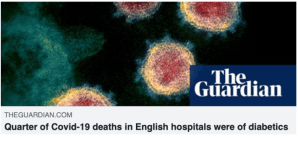
Today, my social media feeds are full of this screaming headline:

(Click for article)

As soon as I saw this, I threw my phone away from me and put my head back under the doona. Aren’t Fridays meant to be about celebrating a week well done and looking forward to the weekend?

Instead, I woke to far too many notifications about diabetes and death – words I really don’t like to see together, especially not so early in the morning.  Fortified with coffee, I took a deep breath and in I went, reading the article from top to bottom.

I’ve had a knot in the pit of my stomach all week. It moved in and made itself comfortable when the Australian PM started talking about easing lockdown restrictions. I’ve spent the last few days trying to work out how I can manage this anxiety in a sensible way, and not do what I really want, which is to build a cellar under our house, stock it with coffee, prosecco and Nutella, and move in there until sometime in 2030.

This article and the subsequent commentary twisted that knot tighter and pushed it in deeper. ‘I live here now,’ it seemed to be saying. And then added, ‘Get better WIFI; it’s patchy in here.’

The fact that the article raises more questions than it actually answers hasn’t helped. More details – details that may help to better understand exactly what is going on – won’t be published until next week. And so, without enough content to provide explanations, advice and information that might help PWD feel that perhaps it’s not all hopeless. Instead, The Guardian offered some throw-away lines about the associations and causes of type 1 and type 2 diabetes:

‘NHS England’s breakdown, published for the first time on Thursday, did not specify how many of the 5,873 diabetics who died had type 1 diabetes, an autoimmune condition not related to lifestyle, and type 2 diabetes, which is closely linked to being overweight. Fuller details will be published in an article in a medical journal next week.’

This just seems like an opportunity for people to appease people with type 1 diabetes, and point the finger and further stigmatise people with type 2 diabetes, instead of acknowledging that people with ALL types of diabetes might possibly find this news confronting. What is the relevance here to being overweight? If there is a correlation, please let us know and does it impact people with type 1 diabetes who are also overweight?

I am not for a moment saying that this sort of information should be hidden away or swept under the carpet. Of course, I want to understand how diabetes and COVID-19 interact. But there has to be a better way to get information to the masses without adding to the anxiety and worry. And definitely in a way that doesn’t sensationalise, point fingers and add to social stigma.

The article goes on to highlight the link between Alzheimer’s disease and deaths due to COVID-19, and as I read the quote from Alzheimer’s Research UK’s director of policy and public affairs, Samantha Benham-Hermetz, I wanted to reach into my MacBook and give her a metaphoric, and therefore socially distant, hug. She said:

‘This shocking news will no doubt bring even more worry and fear to people affected by dementia and their loved ones, during an already challenging time.’

I know that I and so many of my friends living with diabetes, and their loved ones, have been feeling worried and scared since this all started, and this article has the potential to add a lot more. The fact that this response was acknowledged out loud (and I think it’s fair to say that people affected by diabetes would be feeling the same as those affected by dementia) made me feel so grateful and heard.

Statistics are statistics, and data are important; I know that. But sharing data with the masses only works if it is done effectively and communicated in a way that doesn’t leave people feeling hopeless, but rather empowers us to make decisions that contribute to minimising risk.

My heart breaks for my friends with type 2 diabetes, and their families, who not only have to digest this headline and information, but also need to consider how the cavalier and simplistic definition of type 2 diabetes will now be interpreted by the general population who already are so quick to blame and stigmatise.

I live with diabetes, and I understand that I am high risk of complications, and so it seems, death if I get COVID-19. But mostly, more than anything else, I am a person trying to make sense of all of this and stay safe, healthy and sane – just like everyone else.


P.S. Hey – Guardian UK – I fixed this para for you:

‘NHS England’s breakdown, published for the first time on Thursday, did not specify the type of diabetes with which the 5,873 people who died were diagnosed. Fuller details will be published in an article in a medical journal next week.’

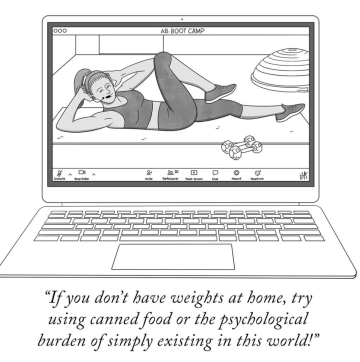
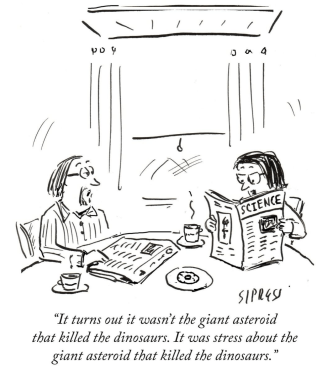
Moving forward, this blog will be nothing more than appreciation of New Yorker cartoons describing what is going on in my head.

(Click for source)

Yesterday, my little vlog touching on how I was feeling about re-entry into some aspects of real life, and the incremental reduction of restrictions was just a few thoughts that I wanted to talk about.

Today, as we’re learning and seeing more about what we have in store for the coming weeks, that low-level anxiety I mused about, has somehow manifested into a monster.

I think that my overall nervousness and anxiety about COVID-19 has been managed and manageable (albeit with an occasional meltdown). Perhaps that is because I started limiting my interactions early, working from home before lockdowns were announced. I was ahead of the curve (bloody curves – it’s all about curves!) when it came to minimising contact and outings. In fact, after I got back from Madrid back at the end of February, social engagements and general being out and about were really quite scarce.

This sense of control seemed to really help me. I felt confident that I was doing all I could to reduce my risk significantly. And then, once the restrictions were announced, it wasn’t just up to me to control my environment – it was being controlled for me. I didn’t need to worry so much about what Aaron and the kid were being exposed to because they were home. My limited exposure became theirs, and that just made me feel a whole lot better.

We didn’t completely isolate. But we made very deliberate choices about what we would do. As I mentioned in yesterday’s vlog, our local café has a service window to order and collect coffee. I felt safe getting my daily caffeine hit because I could remain safely distant from others and not need to touch door handles (or anything else other than a takeaway coffee cup) or breathe the same indoor air as strangers! When that café had a couple of well-deserved days off for their staff, we went to another one nearby. Once. I walked in and there were too many people inside, standing too close, talking too much. I ordered and waited for my coffee outside (why wasn’t everyone doing that?). And didn’t return.

Visits to the supermarket have been sporadic with my spidey senses on high alert. I’m so conscious of how close other people are, what they have touched and what I touched, what they are doing. I get in and out as fast as I can.

This has all become the norm and I don’t know how to move forward. I don’t know what the baby steps look like that would make me feel comfortable. We still have another two weeks before schools starts to return and our little cocoon is compromised by things outside our control. Yesterday, the kid asked me if it would be okay for her to go back to school once that was announced and would I be concerned because

I really hate feeling vulnerable. And that is exactly how I feel right now.

And torn. I feel torn. I miss my family and friends. I am desperate to be able to get back out and be around them and just not worry. But equally… I don’t know where they’ve been! I don’t trust people – which is a terrible thing to say…

So, what is it? Why do I feel this way? I know I’m not alone. I’ve spoken to some of my friends with diabetes from across the globe and many are saying the same thing. Maybe it’s all that talk that was so, so prominent at the beginning of the outbreak, and has continued as a whisper throughout it about high risk populations. While it made me feel overwhelmed at the beginning, now it is actually scaring me. That vulnerability is completely out of my control and combined with less control over my environment, I feel as though I am spiralling.

I know that I can’t stay all cosied up in my home forever more. I know that my family needs to get back out there; that I need to get back out there. But it is going to take a lot before I feel ready. And even more before I feel comfortable.

Actual insight into my thought stream right now from this The New Yorker cartoon. (Click for source)

With restrictions starting to ease – albeit, and thankfully, slowly – how is everyone feeling? I know that I’m not all that sure I’m ready…

Earlier in the week, I woke to a heap of messages highlighting an incident in the UK where a female MP had been told to watch her tone by a male MP. I muttered something about strident women and moved on. ‘Not my monkeys, not my circus’ has become a useful mantra in the time of COVID-19!

Then, later on the same day, I was pointed in the direction of a wonderful (???) social experiment where a bloke on Twitter had changed his avatar to that of a woman (or rather, as he said, a ‘lady avatar’) and could confidently report back to the world that he was treated very differently, and dealt with jerks, annoyances and microaggressions.  And that he received dick picks, which he found violating.

I sighed. ‘Another fucking monkey’, I thought. But this is a circus of which I am very much a part!

Despite daily, actually, hourly if not more frequent, comments on Twitter where women emphasise just how shoddily we get treated by men, it takes a man to pretend for a short period to be a woman to prove (to him, and apparently others) that what we are saying is true.

My response to his experiment was this:

Of course, this little ‘investigation’ (and I use that term loosely) made me immediately think of all the times HCPs have participated in ridiculous simulations of what it is like to be a ‘patient’ so that they can truly understand how difficult it can be, instead of just simply listening to what we say about it. You don’t need to sit in a hypo simulator to appreciate that hypos suck. Or to wear an insulin pump for a few days to know they can be a pain in the arse to wear.

No, you just need to listen to people with diabetes. We can tell you how much hypos suck in a million different ways, using words, images, or interpretive dance. There are poems about it. There are TED talks. There are pages and pages and pages written about it. You can check out all those things. Or just us ask! And then listen.

And also, what gets missed from these short-term experiments is that they are so damn superficial. They barely scratch the surface of what they are pretending to be. The bloke on Twitter had a couple of days of tweets coming his way that he found annoying. But he didn’t feel the threat or fear that women feel when we are being intimidated online. And at the end of his little game, he could go back to being himself. The same goes for anyone pretending to ‘do diabetes’ for a minute of two.

To our social researcher (another term I am using loosely) on Twitter: next time, just listen and believe the women who are living, and talking about this crap every single day. I’d urge HCPs to do the same thing when it comes to listening and believing the people they are working to help.

Oh, and to the tosser who tone policed his colleague: just don’t do that. Ever.

One of the things the diabetes community does best is come together in tough times, and this new initiative from JDRF and Beyond Type 1 is a stellar example of how it can be done. JDRF and Beyond Type 1 formed an alliance last year, and have put together a terrific site providing important, up-to-date information and advise about coronavirus and diabetes.

But this is initiative goes way beyond just two diabetes organisations.  In fact, over one hundred diabetes organisations, charities, and companies are helping to spread the word and share the information via their networks

Charities and diabetes organisations from Australia, USA, Canada, Italy, Chile, Portugal, Mexico, Bulgaria, Germany, India, Cyprus, New Zealand, Spain and other countries too are represented. I’m thrilled that Diabetes Australia is one of the community partners on the ever-growing list!

International organisations such as Life for a Child, ISPAD, IDF, NCD Alliance as well as industry partners have also rallied together, joining the other groups. This is big. Big! Huge!

The information on this new site is simple and clear. And it’s available in English, Spanish and Portuguese.

Plus, the advice is all practical and sensible. We might, in ordinary times, think that practical and sensible is boring, but I know it’s something I’m craving at the moment. And I’m also craving information that cuts through all the overwhelming noise and tells me exactly what I need to know.

This site does that.

Massive, massive kudos to JDRF and Beyond Type 1 for getting this initiative up and running. And well done to all the organisations who have happily supported and shared it. This isn’t about ownership and needing to be the holders of all information. It’s about ensuring people with diabetes have access to what we need to know, and what can help and support us. That’s only a good thing, right?

Click on the image below to be taken straight to the site. And stay safe. That’s really what we all want and are hoping for.

DISCLOSURE

I am employed by Diabetes Australia. I am on the Beyond Type 1 Leadership Council.

I wrote this piece six years ago today when one of the most well-known, and one of my whole family’s long-time favourites – turned 28. Today, Marios is still going strong and has hit thirty-four years of operation. We are still frequent visitors to this cafe. It has become our kid’s choice for weekend brunch – she and I have a standing date their every second Saturday when Aaron is at a rehearsal. And at least one weekend day will see the three of us eating together. And drinking coffee. Yes, Marios is where my kid together with one of the cafe’s namesakes, ganged up on me and broke my ‘no coffee until you are eighteen’ rule, and started drinking coffee when she was just a teenager. 

Marios at home.

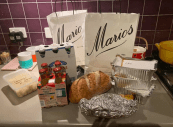
During this time of COVID-19 we have been desperately missing Marios. Even though it’s only ten minutes from where we live, it’s outside the zone of where we have comfortably been travelling for our daily caffeine hits.  But last weekend, we decided we needed a meal of pasta from there – the ultimate in comfort food – so called in an order and went to pick it up. I teared up as I walked into the cafe and was greeted by the gorgeous staff. It had been six weeks since I had last walked in that door and I can’t remember another time (unless travelling) where I have gone that long without paying them a visit. 

As have many other small business, Marios has adapted to the new rules about dining. Takeaway and delivery is available, and they have turned the front of the store into a provedore with tables of dried and fresh (made in house) pasta, sauces, jams, coffee and fresh fruit and veggies. I loaded up a bag with the pantry staples as I chatted with the staff waiting for my pasta to be ready. 

Marios will always – always – have a special place in our heart. And will be back as soon as this is over, making up for lost time. But until then, we’ll get takeaway and support them as we can. I’m sharing this post today (with a couple of edits) because it feels the only thing to do. 

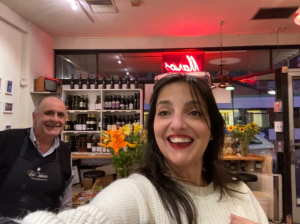
With one of the Marios a couple of weeks ago when I picked up dinner.


Today, my all-time favourite café turns 28 34 years old. Marios café (named for its two owners, Mario Maccarone and Mario De Pasquale, hence no apostrophe) is celebrating its birthday and remains the ultimate in Melbourne café culture. It’s unapologetic (still doesn’t serve skim milk, although did succumb a couple of years ago and started to offer soy) and reliable (never had a bad coffee!).

I’ve been going to Marios for pretty much all of its 28 34 years – first with my parents and then with friends. Once I left school, meeting up with people at Marios was the epitome of cool! Great jazz on the stereo, a gorgeous changing art display showcasing local talent, and the best coffee in Melbourne. Plus tablecloths on the tables, smartly dressed waiters and breakfast served all day. There have been many times that I’ve ordered scrambled eggs or a blueberry bagel at 10pm!

Back in my uni days, it was the location for many first dates and I could always tell if there would be a second date by whether or not the guy knew of Marios when I suggested we meet there. Aaron and I had our first date there, eating cheesecake late at night after seeing a movie. He knew about Marios; there was a second date! In any relationship break up in the division of cafes and pubs and places we’d hung out, I always got Marios!

Marios is where I take overseas friends when I want them to have a truly Melbourne café experience. DOC friends from home and abroad have been taken there and just a couple months ago, a group of us got together to catch up. It’s where I meet up with friends who have moved overseas when they come home for a visit. My beautiful friend Shannon who moved from Melbourne to Hong Kong and then the UK over 15 years ago and I have a standing date any time she’s in town so she can get a fix of Marios lasagne! Recently, I caught up with a long-lost friend and there was no doubt about where we would meet.

There have been many memorable visits to Marios including the night before my daughter was born, where I checked my watch every ten minutes, counting down until the time I would meet her. The day we brought her home from hospital, we took a pit stop to Marios to show her off to the waiters and introduce her to the place she would be spending a lot of time.

I’ve laughed, cried, and had some of the most serious conversations of my life in Marios. I’ve said goodbye to friends and welcomed them back into my life. I’ve met up with people for difficult, heartbreaking chats because it’s always felt safe.

I can still remember my first trip to Marios after I was diagnosed with diabetes. It was only a week or two later and it was the first time I was eating out. It was where I did my first ‘public injection’ and I can remember my heart racing as I pulled my insulin pen out of my bag and tried to jab my stomach secretly. I was sure everyone was watching me, judging me, waiting to jump on me and tell me to put it away. No one noticed and if they did, said nothing. I searched the menu for food that the ridiculously old-school dietitian I had seen would approve of and I wondered if it would be okay for me have chocolate sprinkled on top of my cappuccino. I fought back tears as I asked the waiter for sugar substitute and then explained why I was asking. My coffee was on the house that day.

Now, I don’t hide away my BGL checks or pulling my pump out from under my clothes when I am out, and it was at Marios that I realised that I had nothing to be ashamed about when it came to ‘public displays of diabetes’. Marios normalised eating out with diabetes – the new reality of my life.

I felt safe there. I knew I would not be questioned. I knew that I would still be the old me there and Marios would never change. It felt like it always did. It felt like home.

Dear COVID-19,

Well, aren’t you just the flavour of the month?

It’s been interesting to see some other health issue get all the attention for a bit. Suddenly the conspiracy theorists and alternative medicine wellness gurus are focused on you and that’s meant that some of the pressure has been taken off me. I don’t think I’ve heard one ‘<insert weird root vegetable> cures diabetes’ message in weeks. I’m almost missing it.

I’ve been watching as the usual suspects come out in force, touting all sorts of miracle cures to send you on your way. I’ve rolled my eyes as a veritable feast of different foods, drugs, sunshine and blowing hot air in your face have been offered up as THE cure. And lemon water. Because you know that cures everything, right? Oh, and perineum sunning. Yes, really. (You may not want to look that one up…)

But along with the shaking my head at these ideas, I’ve despaired as healthcare professionals, researchers and public health campaigners have been dragged away from their important and necessary work to have to respond to idiots like Pete Evans and some footballer’s wife and everyone’s Great Aunt Maude. And the US President.

So, who else has been hogging the spotlight during this time of isolation?

The tone deaf have been making a lot of noise, insisting that people embrace this new found simpler way of life, and start an organic no dig herb garden, salute the sun every morning (I think this is different to the perineum sunning, but I’m not sure), begin roasting coffee beans for a real authentic South American caffeine hit, make ricotta from scratch, and train for a marathon by running around your kitchen table, all while starting a cottage business making candles out of the wax collected from the bees you’re now keeping on the roof. This, of course, ignores the fact that most people are struggling to find basic food staples, or can’t afford them if they do find them because they’ve found their hours at work significantly cut. The idea of doing anything that involves getting off the couch is too much for lots of people. And the only reason anyone would be on their roof is because it’s the only place to get away from the family and the dog.

Really, it’s all very well to photograph yourself picking rosemary from the carefully cultivated hedge that surrounds the veggie patch on the perfectly lit balcony of your inner-city apartment, to throw over the home delivered, grass-fed, organic lamb you’ve been slow roasting all day as you’ve worked from your perfectly curated home office, complete with fresh flowers and candles burning. But to suggest that everyone do the same because, really, it’s fresh, quick and easy? Now might be a really good time to check that extreme privilege you have on show on your constantly updated grid.

And the anti-vaxxers have been getting their 15 minutes of fame again. They started by contradicting the stay home rules by suggesting they all hang out together in parks, with their kids. And then shouting ‘in the pockets of big pharma’ to any scientist offering decent data and evidence on how to stay safe. They’ve already started their usual bullshit about any potential future vaccine being made of mercury, asbestos, pig poo, the tears of dictators and waste from Chernobyl and how they’ll be avoiding getting the vaccine like the plague. (Which they won’t get anyway because their immune systems have been super-boosted by lemon water and holding measles parties.)

Sure, COVID-19, you may be new, but I’ve seen all this before. The cures, the anti-vaxxers, the Instagram influencers – they’ve been around for years. They’ve just turned their attention to you now. They’re probably grateful that you’ve given them some new material. I mean, how many photos can the influencer of the moment share of the latest green smoothie or teatox craze, promising that this is the way to stop post-meal insulin spikes (or something)? We were all getting a little tired of that garbage.

Enjoy your moment in the sun (again, I’m not talking perineum sunning), because eventually, there will be a vaccine. That’s right: dictators will have cried enough tears, or whatever the active ingredient will be, and your time will be over. But don’t worry. I’ll still be here, waiting for a Kardashian (or US President) to come up with some other harebrained idea about what can cure me.

Best,

Diabetes

Last Friday night, I sat around with three other women with type 1 diabetes and we had a chat. When I say ‘sat around’ I mean Zoomed, but other than the fact that we were seeing each other through computer screens, it could have been any other time I was meeting up with women with diabetes for a casual chat.

The reason for this gathering was so that I could be interviewed for a new Australian podcast. Mamabetes was launched just last week, and is a project by three amazing Aussie advocates, Ashleigh, Rachel and Carleigh, all who are living with type 1 diabetes.

I was a little surprised when they reached out to me. My kid is fifteen and my experience of pregnancy and diabetes is a little old now. But they wanted to speak with me about stigma and language, and how that can impact on all sorts of diabetes experiences – including pregnancy.

I’d never met any of the women before and other than a short conversation with Ashleigh a couple of days before, the first time we chatted was when Zoom brought their gorgeous faces and happy smiles into my study at home. I’d been sent a brief outline of what they hoped to get from our discussion and a few broad questions for me to consider before we got started. We were going to chat for about fifteen minutes and see where our conversation took us.

I’m sure that we could have stuck to that timeframe if we really wanted, and to the questions I’d been offered as a guide. But an hour later, we were still chatting, and we’d taken off on some wonderful tangents, as happens when people with shared interests and experiences come together.

The podcast episode with our chat dropped this morning and I’ve been listening to it in bits and pieces in between the Zoom existence so many of us seem to be living at the moment. We cover lots, so do have a listen! Click on the image below to go to the podcase, and the Mamabetes other socials are listed for you to follow along.

Asheigh, Rachel and Carleigh are creating something really important here, and providing women with diabetes a place to learn and connect – around an issue that is relevant and important to many. Thanks to these three dynamic women for doing this, and for inviting me to be a part of their second podcast episode.

Go follow…

Mamabetes on Twitter

Mambetes on Facebook

Mamabetes on Instagram

Follow Diabetogenic on WordPress.com

Enter your email address to follow this blog and receive notifications of new posts by email.

Read about Renza

Archives