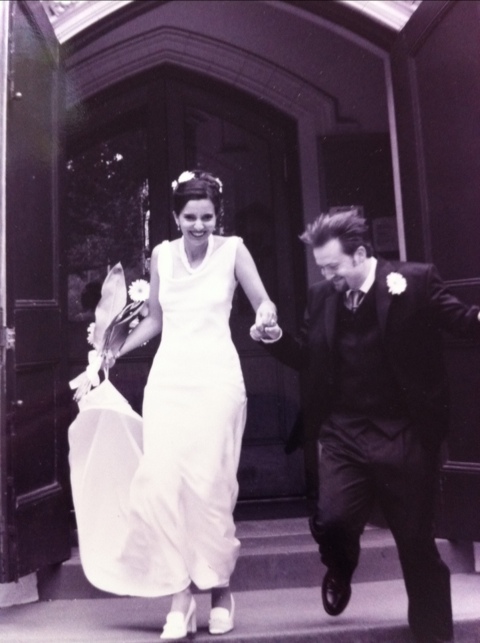
We did it! Running from the church

Today I am celebrating my thirteenth wedding anniversary. And for the first time, I won’t be spending the day with the bloke in the photo. (That would be my husband.) I am in Dubai for the International Diabetes Federation’s world Diabetes Congress. He is not.

This photo is of us running out of the church after we’d said our ‘I dos’. Throughout the brief ceremony, various friends performed gorgeous music including ‘One Hand, One Heart’ and ‘I Have a Love’ from Westside Story and the stunning ‘The Wedding‘ by Abdullah Ibrahim – a song that can take me back to each and every step I took as, on my father’s arm, I walked down the aisle to Aaron.

As this photo was taken, the remnants of a tango written by Aaron was being played. Yep – we tangoed down the aisle before sprinting out into the late afternoon.

It was a blissfully happy day and I love the looks on our faces in this photo. All I see is joy.

Not even ten months prior to our wedding day, I was told I had type 1 diabetes. It rocked my very being and made me change a few key things in my life. For a while it made me wonder if anything that I had been, anything that I had known would ever be the same. And I wondered if Aaron would still want to marry me now that I was so broken; would he still want to come along for the ride that was our life together?

In this photo, it looks like we’re ready to take on anything. And thirteen years later, that’s exactly how we’ve approached things. The ride may have been occasionally difficult (and most of those tough times are because of diabetes) but it’s been a fun ride, too. And we picked up a gorgeous little girl along the way to keep us company and share the love!

Last week, Australian (so-called) comedian Dave ‘Hughsey’ Hughes attracted the wrath of some of the diabetes community with an off-hand joke posted on his Facebook page and Twitter stream. Here is what he said:

@DHughesy I wanna give my mate one of those personalized Coke cans. His name is Diabetes.

A short time later he followed up with:

@DHughesy Should have mentioned his last name is Type 2.

Before long, Hughes’ Facebook page was inundated with comments – a lot from parents of kids with type 1 diabetes.

As soon as I saw the response, I tweeted the following:

@RenzaS Wanna know what happens when @DHughesy gets people with #diabetes mad? Have a look at his FB page.

The reaction from some in the wider diabetes community was swift, angry and, in some cases, aggressive. This was followed by confusion from people outside the diabetes community as to why there was so much anger. From both sides, there was finger pointing, swearing, hostility and opposition. And it got ugly. Very ugly. Five days later, it’s still going on.

But are there are two sides to every argument? Hughes’ comment is in bad taste. But was he being deliberately antagonistic towards the diabetes community?

Personally, I don’t think so. But that actually doesn’t matter. The reason that many within the diabetes community got angry is not because they are humourless and can’t appreciate a joke. It’s because they saw it as yet another incorrect and misinformed comment about diabetes; another time they l need to clarify misinformation. Another comment that is more ammunition for the food police to say ‘should you be eating that?’

Dave Hughes has a huge following – 110,000 plus ‘like’ his Facebook page, and almost 150,000 Twitter followers. That’s a lot of people reading something that isn’t true about diabetes.

There were some brilliant first responses – explanations about why the comment could be damaging. Some with diabetes even offered Hughes first-hand experience of what a ‘day in the life’ looks like by inviting him into their homes.

Of course, for some, one comment wasn’t enough. But do we – the broader diabetes community – do ourselves any favours when we react so aggressively? Because that’s where the accusations started, suggesting that some  people started sounding like the joke police. “Should you be joking about that?”

How often have I said to a friend with diabetes ‘Should you be eating that?’ in jest as I, or a friend with diabetes, dive into our second, third, fourth cupcake? Lots. But I will defend my right as one of the pancreatically-challenged to be  able to laugh about this condition. I spend a lot of time laughing at diabetes. If I didn’t laugh, I’d cry!

I knew what Hughes was trying to do with his thoughtless tweet, and thought he misfired completely. But then,  Hughes’ humour often lacks sophistication and dexterity which, some may consider, is part of its (and his) charm.

So – five days into this, I am looking at it as an opportunity to do some diabetes advocacy. A lot of people on Facebook have been talking about diabetes and that’s a good thing! Advocacy comes in many forms, and perhaps all Hughes really wanted was to do put diabetes on his followers’ radar. I hope so.

Can we laugh at diabetes? When, if ever, is the line crossed and who gets to make that call?

Firstly, a disclaimer. This is my blog and what I say only refers to me. I am putting in this disclaimer because what you are about to read may be against what some of you believe. And that’s fine. But this is my blog. And it’s what I believe.

I love my endocrinologist. There. I’ve said it. Not in an inappropriate way, mind. Just in a ‘she rocks’ kind of way. And I gave my daughter her middle name to show her just how much I ‘she rocks’ love her.

I love her because when I go to her for diabetes information, she gives me what I ask for. About diabetes. If I needed information about how to repair the transmission in my car, she’d send me to my mechanic.

Here’s what I don’t love. People who tell me I should see their naturopath, faith healer, reiki therapist, personal trainer, tarot card reader to help me manage my diabetes. It’s not that I don’t believe these people have a place in the world. Their place, however, is not in curing my diabetes. Just like my endocrinologist’s is not in giving me advice about my car’s transmission.

I don’t care how much I run around a field, how many herbs I take, how hot the yoga room gets, how aligned my chakra becomes. My beta cells are not going to fix themselves. Ever!

So don’t. Don’t tell me that your personal trainer can fix me if only I’d eat three protein bars a day, eschew carbs for the rest of my life and never ever again eat a chocolate bar.

I have a special shout out to a celebrity Australian personal trainer here. I’m not going to name this person, but I’ll refer to them as APT. Here is what I want to say to them: “You are great at what you do – and that is showing people how to exercise. But your pop psychology stuff is crap. You don’t cure people, you are not a dietitian, and when you tell people that they should ‘Just. Stop. Eating. Crap.’ you are not helping. And when you think that you sound smart because you know about non-communicable diseases, but then see fit to claim that ‘diabetes’ is a lifestyle disease that can be stopped if people just lost weight, you get me mad.”

And while I’m at it, can I please send out a direct scream to the people involved in the misleadingly-named Australian Vaccination Network, which is actually an anti-vaccination group. This is not about whether I am pro- or anti-vaccination (pro – for those of you playing at home). But what this is about is the lies, and unsubstantiated and outright wrong claims that some of you are sprouting.

Recently, on the Mamamia website, the very wise (and classy in the way she dealt with the comments after her post was published) Dr Rachael Dunlop wrote a terrific piece called ‘Nine Vaccination Myths Busted. With Science!’ Her writing was brilliant – all facts backed up with evidence and any myth she busted was also supported by medical research, peer reviewed journal articles and, you know, science. Then the nutters came out. And seriously, I don’t have any qualms about using that term. I am all for people having their own opinion (read: disclaimer at beginning of this post), but I was particularly horrified to read many of the over 1,400 comments; especially this one:

I believe the body is complete. ‘Propping it up’ with medications throughout our life – vitamin K, vaccinations, antibiotics, bonjello, blood pressure tablets, anti-inflammatories and cholesterol lowering drugs. Has our body over the last million plus years got it wrong and is modern science the only thing that will save us???? Surely not!!!

It fascinates me that no one has bothered to study our immune systems. And it is not luck, it is good management and a belief in the body’s innate ability to grow, repair and fight disease by giving it real food and without interference. This is the philosophy of Vitalism it is an ancient philosophy.

There is so much wrong with this comment (apart from the ridiculous punctuating, poor grammar and failure to understand basic sentence structure). I was so horrified, I needed to respond:

That has to be some of the most incorrect and downright offensive rhetoric I have ever read. I’m sorry, but the body does not always have an ‘innate ability to grow, repair and fight disease by giving it real food without interference’. Without hourly – actually every minute – ‘interference’ where a pump infuses insulin into my body I would die. A very slow, painful, terrible, horrific death. My own body attacked the insulin-producing cells in my pancreas and the result, 13 years ago, was type 1 diabetes. Nothing I could have done to prevent it and nothing that my body can do to ‘repair’ it.

I am all for people having their own opinions and making decisions for themselves, but you are outright lying to people if you say that there is no need for medication.

Mad? Yep, I really am. Because as long as people subscribe to this ridiculous thinking they will be disappointed. Or even worse, think they can stop medication because they can be healed with a herb, an exercise plan, wearing coloured beads on the second Tuesday of a full moon.

So, here’s what I want (and yes, I know I don’t get everything I want. Otherwise I’d have a pony).

• I want people to stop misrepresenting themselves.
• I want people to stop offering false hope to others.
• I want to stop having to let people down because they got their hopes up seeing some miracle cure sprouted by a faith healer living in the mountains of some remote island.
• I want personal trainers to shout ‘no pain to gain’ to people running around a field – but not promise to fix everything with pop psychology sound bites.

And , I want my mechanic to continue doing the brilliant thing he does. The transmission in my car is dreamlike. (Actually, I have no idea what the transmission is, but my mechanic is brilliant. I love him. And if I’d had a son, I’d have called him Jimmy!)
When someone asks me if I will be doing something I don’t enjoy – say: going for a run, going to the gym, going for a walk, going for…OK, doing anything that has to do with exercise – I often respond with “No – I’d rather stick pins in my eyes”. Well, today I am off to have an eye check. Quite frankly, I’d rather stick pins in my eyes – which is actually why I am terrified of the ophthalmologist.

I’ve written before about how nervous I get when it comes to visiting the ophthalmologist. And here I am again sitting at my desk stressing out because in exactly 3 hours and 14 minutes I will be having my eyes dilated and the pressure tested. Which is done by pushing a pen-like device into my open eye. La-la-la-not-thinking-about-it-la-la-la. And then the back of my eyes will be examined for tell-tale signs of nasty retinopathy caused by even nastier diabetes.

It’s been six months since my last eye check and in that time my eyes seem to be exactly the same. I went out and bought some magnifying glasses from the chemist because, you know, I’m getting older – as my ophthalmologist indelicately put it. But everything else is the same.

The reason that I am on six-monthly visits is because of the two huge, scary cataracts that started forming when I was a mere 28 years old. Yes, for the last almost 10 years, I have what I always considered a nanna eye condition. My grandparents had cataracts removed when they were in their seventies, so how does a 28 year old (and now 37 year old) have them? Just lucky, I guess.

I have a routine now for when I have eye checks. My dad takes me. Yep – like I am a ten year old, I have a parent take me to the doctor. This started under the guise of me not being sure how well I’d be able to see once the dilating drops are put in, but really, apart from some horrific sun glare, I could get on the tram to go home. But, I’ve kept up the charade with dad, asking him to be chauffeur.

The truth – I need him there because he calms me down! On the way to the doctor’s rooms, he promises me that everything will be OK – even though he doesn’t know that for sure. And when we are sitting in the waiting room he tells me I’m brave. And when I walk out of the doctor’s office with a big smile on my face, he says “See, I told you there was nothing to worry about”.

My dad doesn’t have diabetes. He has no idea about what the day-to-day existence of someone living with a chronic condition is all about. But he knows that the eye doctor terrifies me. He knows that telling me I’m being ridiculous and to get over myself is not the way to deal with me in this particular moment. He knows that he needs to accept the drama queen behaviour in this instance and play along.

And I know how lucky I am. I have diabetes support networks coming from everywhere. And my dad, who frustrates me beyond measure when he considers my diabetes as an ‘illness’, no matter how many times I yell “I’m. Not. Sick.” is my hero when it comes to doing the eye stuff. The nasty. Scary. Terrifying. Drama Queen-inducing eye stuff.

My dad. Getting me to the eye doctor on time! (Actually, here he's sitting in a cafe.)

Today I write at the Diabetes Australia – Vic blog about diabetes advocacy during the month of November – in particular the Diabetes Social Media Advocacy Blue Fridays campaign.

Those of us in the diabetes world living in Australia probably know that 14 November is World Diabetes Day. This year marks the twentieth World Diabetes Day, a campaign led by the International Diabetes Federation.

In 2007, World Diabetes Day became an official United Nations Day – diabetes being only the second medical condition to be recognised in this way.

Over the next month you’ll hear and read about what’s going on here in Melbourne and more broadly in Australia. But make sure you also tune into what’s going on globally.   In the US, the whole of November is Diabetes Awareness Month. And as such there are a lot of exciting things happening to raise awareness and advocate for people living with diabetes and their families, and also to promote the importance of type 2 diabetes prevention…..more

I am writing this quickly and won’t be editing it. Because when I stop and think about this I freak out and then want to curl up in a ball in a dark room. I don’t want to verbalise it, I don’t want to think about it. So, I apologise in advance for the typos, the grammatical errors and (Heaven-forbid!) the punctuation problems.

What I want to say is this: I am beyond terrified that my daughter will develop type 1 diabetes. It keeps me awake at night; it gives me nightmares in the day whilst I’m awake. I feel guilt for this thing that may happen. May never happen. But may happen. May. Happen.

I know a lot of women with diabetes who have children. Beautiful, smart, wonderful, fabulous, bright, gorgeous children. And I know statistics. And I know that possibly sooner or later one of our children may be diagnosed with type 1. Some of us speak about it regularly. Others keep it hidden –as if putting thoughts into words will make them come true.

For me, I continue to watch in wonder and amazement as the miracle I know as my daughter continues to grow and grow. But the moments where I think she has visited the bathroom an extra time, or is asking for a drink of water ‘because I’m soooo thirsty, mummy!’ will continue to terrify and paralyse me. And I will continue to fight the urge to do a quick finger prick check – something I’ve only done four times in her nearly-seven years.

For the first time I am starting to ask myself what it is that I fear. Of course, I don’t want her to develop diabetes, but if she did, we would deal with that. It wouldn’t be easy, it wouldn’t be fun. But we’d work through it and aim to surround ourselves with the best health professionals, the best treatment, the most information possible and peer networks to help us through.

I think the thing that I struggle with is how I will start to feel about myself.

Whilst I was pregnant, I worried about what my diabetes was doing to her as she developed from a pea to a person – even with an HbA1c of under 6.5% for the whole pregnancy.

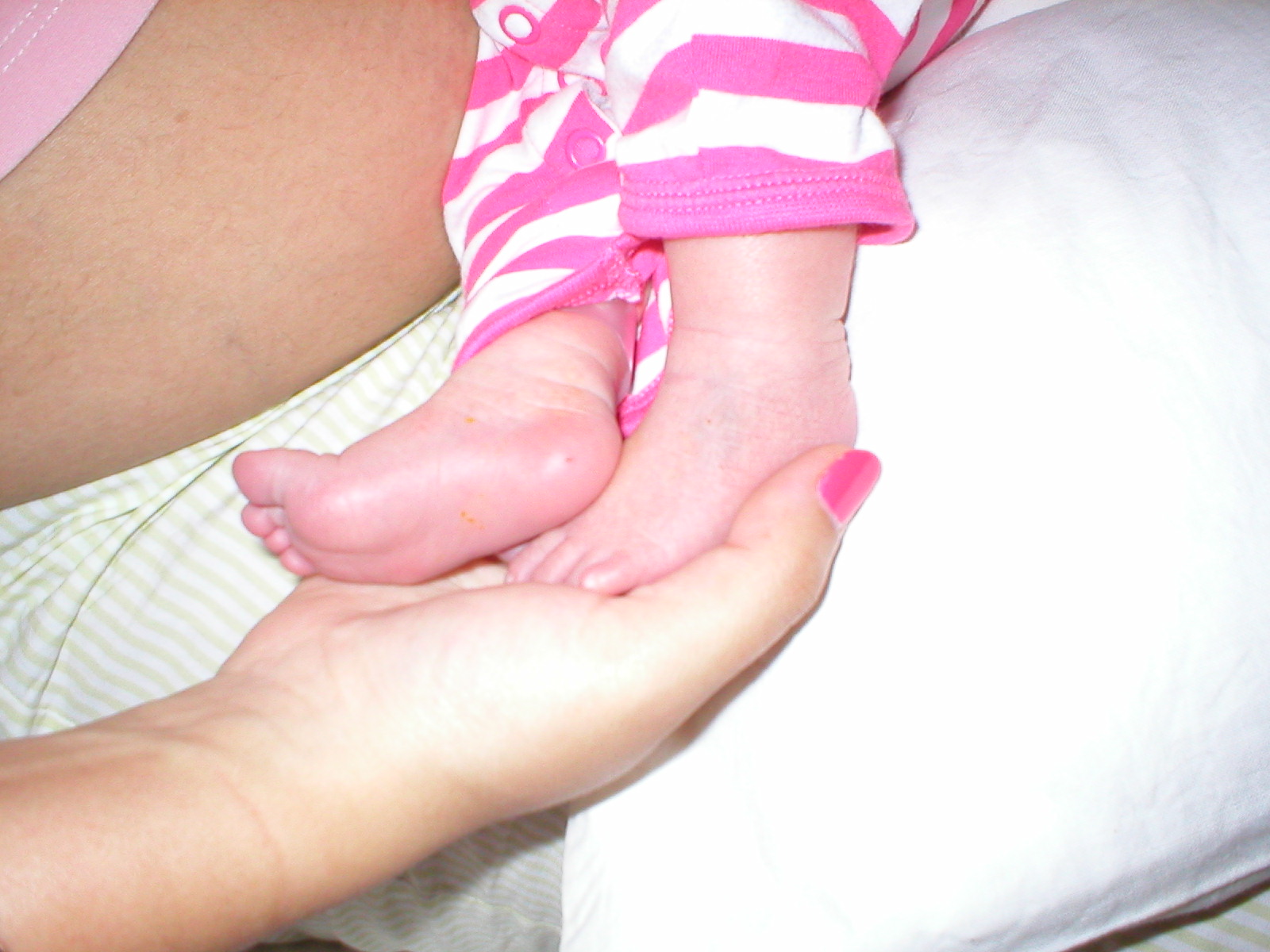
And then when she was delivered amongst the euphoria of meeting my beautiful daughter, I wept with guilt as her heel was pricked repeatedly to check her blood sugar levels. An hour after she was delivered, her BGL plummeted and she was whisked away from me and taken to the Special Care Nursery where the paediatritian tried and tried and tried again to get an IV line into her. An hour into being a father, Aaron was doing all he could to not grab his precious newborn baby and protect her from the pain she was obviously feeling. Her wails could be heard throughout the Nursery. He told me about this weeks after her delivery – he knew the anguish and heart break I would feel.

Tiny feet - a mere two days old.

And this was because her mother has diabetes. Mother guilt starts early with diabetes.

How do we move on from this? How do we be kind to ourselves about what may happen? How do we rationalise that we cannot be held to blame?

I can be a pretty emotional gal. I have been known to cry at Telco ads, and the other day found myself tearing up at my daughter’s school concert. Cute kids singing Aussie classics will do that to me! And I can’t watch the opening scene of Love Actually (the one in the airport) without reaching for a tissue.

So, when I walked into diabetes camp today, it’s not surprising that the warm glow of diabetes love swept over me. OK – I don’t even know what that means – diabetes love? Huh? Maybe diabetes camaraderie is a better term.

Anyway, in the room were about 60 kids aged 12 to 14 years, all with type 1 diabetes. Most hadn’t met before camp check-in three days earlier and for many, it was the first time they’d been away from home since being diagnosed with diabetes. The beyond-amazing volunteer staff, many with type 1 diabetes themselves, were doing a sterling job getting everyone excited about the day’s activities.

There is a connection that people with diabetes have. That doesn’t necessarily mean that we like everyone with diabetes. It isn’t that at all. In fact, I’ve met some people with type 1 that I don’t particularly get along with, and probably wouldn’t have a drink with. And I’m pretty sure that I’m not everyone’s cup of tea either! But undeniably there is something there that connects us.

I never went to diabetes camp. I was diagnosed as a 24 year old and here in Victoria our camps run for four to 17 year olds. This year we ran a camp of 18 to 25 year olds, but it was the first time that it’s been done here.

Whilst I haven’t organised my own camp, I do have regular catch up with friends with diabetes – FWD. I’ve met these people through work, at diabetes information events and in one case at the supermarket.

I know how lucky I am to have FWD. And even luckier that they live nearby, so we can have a quick coffee. I even manage school drop-off and pick up chats with my beautiful friend Jo. Sometimes –most of the time – we don’t talk about diabetes. Sometimes there’s a cursory curse at a late-night hypo or a comment about a recent HbA1c. Sometimes there’s not.

But the understanding, the knowing looks, the complete, utter, total lack of judgment that is there cannot be measured. I find myself drinking it in and leave all encounters with FWD feeling that diabetes is back in its place.

In the last couple of months, I’ve been getting to know more about the Diabetes Online Community (DOC). I have taken incredible delight in uncovering layer after layer of positive interaction and supportive people. My only previous use of an online diabetes forum was negative – it felt cliquey and exclusive and if anyone dared challenge what the core users of the site said, they were attacked. I backed away and decided it wasn’t worth the angst.

But what I have found in the predominantly American DOC is a welcoming and encouraging group who are prepared to reach out. The unselfconscious, frank honesty and sharing is refreshing. Blogs tell stories that are familiar, different and liberating; Facebook groups invite opinion, ask tough questions and provide refreshing answers; and Twitter allows rapid-fire discussions.

Peer support should be a part of diabetes care for everyone diagnosed with this condition. Those six to eight hours a year we get with our HCPs are incredibly important, but being able to share with other PWD provides unlimited possibilities. Unfortunately, a lot of people don’t recognise the value that peer support offers, which means that unless you go looking for it, you won’t have it handed to you.

So go looking! If you are not lucky enough to discover a group of people with diabetes in your suburb, you needn’t consider yourself alone on the diabetes road. Look online, call your local diabetes organisation and see if there is a support group nearby. You may need to do the legwork, but the benefits will be worth it!

My reality involves numbers. All the time. Carbohydrate content, insulin doses, blood sugar levels.

My reality is jabbing a lancet into my fingers several times a day and squeezing blood out.

My reality involves using a spring-loaded device to shoot a needle into me every three days.

My reality has me connected to a pump twenty four hours a day, seven days a week.

My reality means I scrutinise graphs, adjust medication doses and calculate ratios.

My reality has made me good at maths!

My reality is about 8 hours a year with health professionals and the rest of the time I figure it out on my own.

My reality includes times when I am unable to do anything other than shake; or cry; or giggle; or do all of these things at once.

My reality has me surrounded by amazing people who have been forced to learn far too much about a condition of which they would otherwise be ignorant.

My reality means a job where I meet inspirational people who have lived with my condition for decades. And they are still smiling, walking, seeing, loving. Living. Breathing.

My reality is the reason I have encountered incredibly, strong, smart, brilliant people who understand everything I say. Because it’s their reality, too.

My reality sometimes makes me want to curl up in a ball and cry. And not think about it ever again.

My reality makes me stand up in front of hundreds of people to tell them what it’s all about. And how we deserve to be respected, admired, trusted and valued.

My reality has made me an advocate for others sharing this reality. It has made me loud, proud and determined. And, at times, very, very angry.

My reality has made me an expert at something I knew nothing about a mere thirteen years ago.

My reality makes me incredibly proud of some achievements. And resolute to prove wrong people who say ‘you can’t do this’.

My reality makes me feel a part of something bigger than me.

My reality includes miracles.

My reality connects me to people all over the world who let me know they are there and they understand. Using only 140 characters.

My reality makes me celebrate the successes – mine and other peoples. And that makes be a better person.

My reality is only part of who I am.

My reality. Diabetes.

Hour one: 7.30pm – 8.30pm
Bed time reading with the kidlet finished – Oliver Jeffers new book Stuck
Bed time kisses and ritual of “I love you more, I love you most”
Kiss Aaron good bye as he heads out to a gig
Emails checked
Text message from best friend with photo of her two week old baby. Respond with: “gorgeous, gorgeous gorgeous”
BGL now – 5.2mmol/l
Put Poh’s Kitchen on in the background. She’s in Bright with our family friends Patrizia, George and Anthony from Simones
Homemade shortbread and a cup of tea
Bolus accordingly
Twitter, Facebook – up to date!
Feed Cherry (cat) – possibly for the second time
Let Jasper and Bella (dogs) inside for a play
Put Bella out – she’s way too puppy-crazy!
Look at the George Clooney bank ad on YouTube. Again. (Hey – the link has been emailed to me by about 439 friends!)
Set DVR for Gruen Transfer
Yay – Glee starts

Hour two: 3.00am – 4.00am
Wake up needing to pee. Try to locate pump…where is it? How the fruitcake did my pump become dislodged?
Get up, go to the bathroom
Nausea hits
BGL now – 19.4mmol/l
Line change
Correction bolus and temporary basal to 130%
Two glasses of water
Try to get back to sleep, but nausea overrides sleep
Lie on the couch so as to not disturb Aaron
Ice cubes to keep feelings of dehydration under control
BGL now – 19.4mmol/l What??
Bolus again
Start second guessing myself. Should I do another line change? Correct via syringe? Change insulin bottle?
Aaron gets up and sits with me. And gets a bucket – just in time
Glass of water and hope I can keep it down
Curse that I am out of Maxalon
Lie there with the cool face washer Aaron has brought me over my eyes
More ice
Yay – BGL now – 15.3mmol/l. Heading in the right direction

Sometimes, diabetes sits there quietly and….. and other times it doesn’t. Now, tell me how to be compliant?

Today, I write at the Diabetes Australia – Vic blog about the launch of the new position statement called ‘A new language for diabetes’ which now available online.

Today, Diabetes Australia is launching a new position statement about language and diabetes –specifically, how the language health professionals and the media use when talking to and about people with diabetes affects those of us with the condition.

This is exciting me on a number of levels – firstly, because it’s being held at the State Library, and the bookish nerd I am finds this extraordinarily electrifying. And secondly, because I have been asked to provide a consumer perspective on why words are important when speaking to people with diabetes….more

Follow Diabetogenic on WordPress.com

Enter your email address to follow this blog and receive notifications of new posts by email.

Read about Renza

Archives