You can read all about the Youth Transition Survey Report (what it is, who it’s about, why it’s important) at the Diabetes Australia – Vic blog.

It’s where I recognise that I am not a young adult with diabetes. Or without. And use the word ‘whatevs’. Which in my word-nerd way makes me shudder! (It could have been worse. I could have used ‘totes’…instead of totally, not when describing a bag. Oh, whatevs!).

I live in Melbourne, so I’ve been led to believe that the Holy Grail has something to do with winning this:

However, my limited interest in Aussie Rules football (althoughthis may change by September if the Blues start winning, when I’ll suddenly become a die-hard fan) means that for me, the Holy Grail looks more like this:

 or this:

 Whatever!

When it comes to living with type 1 diabetes, what is the Holy Grail? Many would say it’s a cure. The day when we no longer need to medicate, consider the impact of food on our blood sugar, worry about complications and our future. That could be it.

For me, a cure is actually not my Holy Grail. And I say that because in all honesty, I don’t think that in my lifetime there will be cure for this condition. You may call me negative or a pessimist. I call myself a realist.

Someone asked me the other day if I had to choose, where I would want my research money going. The choices? Dedicated cure-focussed research or management-focussed research. Each and every time I would say the latter. I want lots of money and support directed to the people who are working at making the lives of those of us already living with this condition a little easier! 

Think about it. If this sort of research hadn’t been done in the past there wouldn’t be insulin pumps or long-acting insulins or super-fast, super-small BGL meters. We wouldn’t have drugs that can prevent, reverse or halt the progression of complications. CGMS would not exist and no one would be talking about the need for psychosocial interventions when it comes to living with the chronic condition we call diabetes. (Actually, more needs to be done on that last one, but at least we’re talking about it now. Shout out to the Australian Centre for Behavioural Research in Diabetes team.)

Lucky, it’s not an ‘either/or’ situation. There is research into both finding a cure and improving the lives of us living with the condition. And there’s also work being done looking at preventing type 1 diabetes, too.  But for me, I get excited when new technologies are announced – and even more excited when they are available for use. (Counting down the days until I get my hands on an iBGStar!)

I wonder if this is a preservation tactic on my part. Like many, I was assured at diagnosis that a cure was a mere ’five years away’. Well, it’s been over 14 years. Those five years have lapsed almost three times now. I have friends who have had diabetes for over 25 years and they too were promised a cure. And I know this is the rhetoric continuing to be sprouted. The hope this instils in people worries me. I see parents with a newly diagnosed infant who desperately, urgently hold on to that number, counting down the five years. Waiting for that cure. But it isn’t here. And when we look at what’s being done, a cure – an end to diabetes – is not ‘just around the corner’.

But rather than defeat me, it does give me hope. Because I know how much is being done. And I regularly see new advancements that actually help people who are living with diabetes here and now. Those advancements could be a new drug that reduces the risk of retinopathy, it could be a CGM that accurately and without fail can warn you that you are 10 minutes away from a hypo, so TREAT NOW! It could be each step we get closer to the closed loop.

There’s a lot going on. Put all your eggs into the cure basket and I think that you may be disappointed. Do we deserve a cure? Of course we bloody do!  But I’m really, really glad that as clever people are working towards that particular goal, there are a lot of others working towards improved management.

Holy grail? Here’s a bit of Hunters and Collectors for you! I dare you not to dance along!

Last night, I attended the AGM at my daughter’s primary school. The guest speaker was Anne E Stewart, who is a storyteller; not a writer, but a storyteller in the true sense. She told us a couple of stories – the first a challenging, but thought-provoking story about a young Aboriginal woman, and a Scottish Selkie tale. She was incredibly engaging – I was on the edge of my seat as her stories took twists and turns.

But the most powerful part of the evening was when she went around the room asking people to share their own stories; where their family comes from and asking about family folklore. Out came stories of convict histories, migration from far and wider, and memories of growing up in Australia.

The story I told was about my father’s family moving to Australia. My great-grandfather, Luigi, sailed from Calabria in Italy to Australia in 1927 leaving behind my great-grandmother, Catarina, and their children. Catarina was pregnant at the time with their fifth child. The plan was for my Luigi to work and save enough money to bring his family out to the lucky country.

It took 20 years. In 1947, Luigi’s youngest son was one of the first people to fly from Italy to Australia. It took 13 days and when he arrived he met his father for the first time. Over the next two years, the rest of the family arrived slowly.

In 1949, Catarina boarded a ship with her other now-grown children, one of which was my grandmother, Vincenza. Vincenza was married and had two young children with her; an eight year old daughter and a five year old son – my dad.

Reunited – the family was together once again.

The tragedy in this story – the part that breaks my heart – is that four years later, Catarina died.  The family was all together for only four years.

Our stories shape us, they tell where we’ve come from and where we’re going. They make us feel connected to others; they help us feel like we belong.

I struggled a long time about my family background. As I was growing up, I hated having an odd name, hated having olive skin and dark eyes. I remember quite clearly at the age of seven telling my mother I wished I had blonde hair, blue eyes and was called Cindy. I wanted to distance myself from my history; I was pleased that we didn’t speak Italian at home and that most of our friends were not Italian. Assimilation? That’s what I wanted!

It wasn’t until I visited Italy as an adult that I started to understand why I needed to reclaim this history.  And it wasn’t until I took my daughter to Italy – then four years old – that I understood the way that my grandmothers were with me. I stood in a little street in Venice choking back tears as an old woman showered my daughter with the same terms of endearment that my late grandmothers had used with me, my cousins and my daughter. I felt I belonged.

I feel this same connection with people in the diabetes community. The people I met when I started working in diabetes who continue to be some of my closest friends and those who I continue to meet give me strength. And the wonderful people I have met online and in person from the diabetes online community – their stories and my stories have become intertwined and show us as a strong, powerful voice. They make me feel safe.

I love the stories of others in this community. I’ve stopped feeling startled when I hear a story that is so similar to mine; I’ve started to understand how diabetes ties us together in a mysterious way. Diabetes Blog Week was so terrific because so many more stories were put out there. If you haven’t yet, I really urge you to have a read. Make the connections; read the stories; and please, share your own.

I walked out the front door this morning and stopped.  I felt naked. A quick glance southwards assured me I wasn’t. (Result!) But I couldn’t shake the feeling. So I put down my bag and did the pat-down. The pat-down starts at my hips (nothing found), goes to my lower back (nothing found) and then across the middle of my chest (nothing found). That’s a problem – no pump!  I opened the front door, ran down the corridor, turned off the alarm, and headed into the bathroom where my pump was sitting quietly on the bathroom counter having not been reattached after my shower.

Hooked up again, I turned on the alarm, walked down the corridor, locked the front door and started to walk to my car. And stopped. I still felt naked. Pump attached, CGM all secured. What else? I opened my bag and rummaged through the mess pulling out my phone, my iPad, my wallet, business card holder, pens, mints, loose pieces of paper, loose change, a toy unicorn (no idea, really, but it pleased me greatly!), a notebook and several small packets of jelly beans. Looking….looking……looking. And there it was, at the bottom of my bag, my meter case.

I walked to the car, but couldn’t shake the feeling that something wasn’t right and that I’d forgotten something. What could it be?

I grabbed my meter case out of my bag and peeked inside. All good – meter, lancet and strips. OK. Surely I was good to go now. Key in the ignition, car started. And I stopped. Where was my ‘spares’ bag? (That’s my little bag that holds a spare pump line, cannula and syringe as well as a vial of insulin for those days I ignore the ‘Low Reservoir’ warnings on my pump.) More rummaging through my (totally GIANT, Mary Poppins-esque) bag until I located it.

Satisfied that I had all my dia-gear, I started the car and headed to work, ignoring the unsettled feeling in the pit of my stomach that I’d forgotten something.

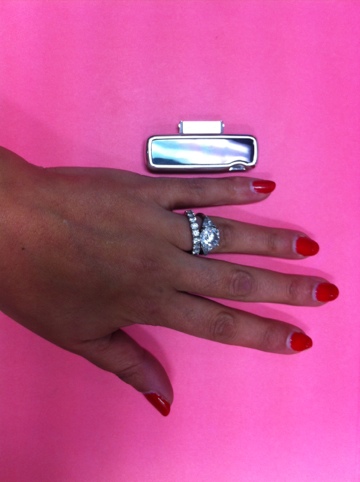
This is the thing with diabetes. There is so much stuff. Why, oh why hasn’t someone tried to tie all this together? I’m more than a little excited at the new (not yet available in Australia) meter that attaches itself to a fruit phone. For years I’ve been dreaming of a phone/meter combination. And if someone could work out a way to tie a few other things together, I’d be thrilled!

So, now it’s 2.13 and I’m just back from lunch. And I just opened my bag looking for lipstick to apply. I turned my bag upside down looking for my bright red lippy, cursing MAC for packaging their products in boring, sleek black. No luck! That’s what has been missing all day. Not diabetes stuff (although, the pump wasn’t connected this morning, so there’s that), it’s the lippy. I’ve said it before; I’ll say it again. Sometimes it’s not diabetes.

Dear Lovely People at MAC. Could you please make your lipstick case match the bright red colour of my favourite lipstick so I can find it in my bag. When I actually remember to put it in there. Thankyouverymuch, Renza

A picture tells a thousand words, but I think the following photos really only say one word: Cupcake.

So why cupcakes? Really – because I can. I have the technology, the sweet tooth and the basic maths to do a little carb counting. With the ‘diabetic diet’ a thing of the past, with insulins that we can better match to the needs of our carbohydrate intake, having a cupcake now and then isn’t a big deal.

Also, this morning over breakfast, I was talking about today’s #DBlogWeek post. I had been thinking along the lines of a photo of my pump, or this morning’s fasting BGL. But as soon as I finished explaining today’s ‘diabetes in a photo’ mission, my husband said ‘cupcake’. So that’s what I did.

Anyone want to ask me if I should be eating that?

20120519-202104.jpg

Magnolia Bakery NYC. We may have visited there once or twice.

20120519-202222.jpg

Red velvet cupcakes are my favourite things in the whole wide world. And that little kid is pretty damn lovely too!

20120519-202336.jpg

On a cold Tuesday night in NYC, we donned our coats, hats and scarves, walked the four blocks to Magnolia Bakery in Bloomingdales and bought cupcakes. And we weren’t cold anymore.

20120519-202431.jpg

Cupcakes for the team. Because it was Thursday. Which is as good a reason as any to have a mini cupcake or three.

20120519-202514.jpg

A giant cupcake birthday cake for a big seven year old. Delight.

20120519-202614.jpg

Nothing says Easter like cupcakes. With Easter eggs on top.

20120519-202658.jpg

These? Not cupcakes. But beautiful jewel coloured macarons from a dear friend. And they make me smile.


So today, we headed to the city to find some cupcakes to photograph because I didn’t have any pictures already (?!?!?)


20120519-202735.jpg

My beautiful family indulged my silliness by being forced to eat chocolate-malted cupcakes. They’ll do anything for me. I’m a lucky gal!

20120519-203017.jpg

A work of art.

20120519-203110.jpg

A half-eaten work of art.

20120519-203137.jpg

All gone. And they were good!

This is my Saturday entry into this year’s Diabetes Blog Week. For information, click here. And I really recommend you do. Over 200 diabetes bloggers from all over the world are participating and it’s a great way to see what others with diabetes are talking about. Come back tomorrow for the final entry.

I’ve spent the morning at a health professional symposium (#HPSymposium) coordinated by two diabetes organisations in Victoria.  The event brought together about 200 health care professionals interested in hearing from some outstanding speakers, including three speakers from the ACBRD.

To have people speaking about diabetes emotional wellbeing front and centre at a health professional conference is a breath of fresh air. And to have three inspirational speakers talking about the importance of measuring emotional wellbeing and providing strategies for interventions gives me hope.

Why? Because finally we’re talking about diabetes in more than just clinical or biomedical ways. We’re acknowledging the ‘living with it’ aspects and asking (demanding?) that these issues are considered.

How do we explain life with diabetes? How do we adequately explain it’s about more than numbers, monitoring, medication, food, attending doctors’ appointments?

We can try to represent this by adding up the number of injections, or BGL checks or pump line changes we do in a week, a year, a lifetime; but does that mean anything to anyone who hasn’t injected themselves daily, checked their BGL or stabbed themselves with an introducer needle to get a pump line in? (A stat from one of  today’s presentations – on average, a person with type 1 diabetes for 40 years will have had 3,500 hypos.)

I am supported by the most incredible family, friends and work colleagues, but do they really understand what living with diabetes means? And is it fair for me to expect them to? The way they show me their love, understanding and unconditional acceptance is perhaps their way. And that is more than enough for me most of the time.

What do I want people to know? It’s simply this: my diabetes is exhausting. But I am living a life of which I am proud. If you need to find a way to measure me – please look at the people in my life, the things I’ve achieved, the places I’ve been and the places I’ll be going. Please don’t look at numbers. They tell you nothing.

This is my Friday entry into this year’s Diabetes Blog Week. For information, click here. And I really recommend you do. Over 200 diabetes bloggers from all over the world are participating and it’s a great way to see what others with diabetes are talking about. Come back tomorrow for Saturday’s entry.

In Fantasy Diabetes (Is)land (you should visit – it’s awesome!), there are wonderful, wonderful things. There are cupcakes stores giving away their baked goods on every corner, little gatherings of the DOC in cafes and everyone’s BGL is 5.5mmol/l ALL THE FREAKING TIME.

OK – there’s no such place. But today, we’re talking about fantasy diabetes devices. Here’s what I want in my diabetes life: I want simplicity and I want streamlining. I want devices to communicate to each other. And above all, I want devices I can trust – accuracy is critical.

My dream device would be a fully integrated pump and CGM that automatically transmits all my data to an App on my smartphone. The CGM wouldn’t need calibrating at all (thus removing any need to jab my fingers with a blunt lancet EVER AGAIN). And at the end of each day, the data would be sent to me in an easy to interpret graph, and the clever boffins living in the App would point out patterns (using previous days’ data) and make suggestions about dose changes.  And tell me what a good job I’m doing, because it knows that back patting is important!

The App would also be able to accurately tell me the carb content of any cupcake (or other food – there is other food. Apparently.) by simply pointing my phone at the plate. And then relay this information to my pump, which would then bolus accordingly.

And finally, this magic App would send me a message to remind when it was time for the weekly DSMA tweet chat. Helpful!

Of course, this would be available to all and would be free, so there wouldn’t be the inequality in health care that makes me angry and sad.

Righty-o. Who do I need to speak with about getting this produced? And now?

This is my Thursday entry into this year’s Diabetes Blog Week. For information, click here. And I really recommend you do. Over 200 diabetes bloggers from all over the world are participating and it’s a great way to see what others with diabetes are talking about. Come back tomorrow for Friday’s entry.

I’m lousy at stopping and I’m lousy at saying no. So when the world gets on top of me the first thing to go is diabetes. Well, something has to, and I certainly can’t stop looking after my beautiful little girl, can’t stop being around my husband, can’t stop coming to work, can’t stop seeing people. They would all ask questions and want to know what’s wrong. But diabetes doesn’t ask. At least, not out loud. Not in words.

So, I bury my head in the sand and pretend it’s not there and suddenly I am not checking my BGL as frequently; not making smart diabetes decisions; not thinking about diabetes.

Just not.

I’m not good at prioritising diabetes. Never have been and fear I never will be.

I need to improve at prioritising diabetes. I need to remember the fact that there is a flow-on effect when it comes to diabetes, and a missed BGL check here could mean a hypo in 30 minutes which will take time to treat. Or a skipped insulin dose after a meal will inevitably result in the brain-freeze that is high blood glucose that means a lack of concentration, general confusion and a wasted morning, or afternoon, or night’s sleep.

I need to improve at prioritising diabetes and the thing I love about the DOC is that you guys remind me to THINK about diabetes and to ‘do’ diabetes. I love being around others with diabetes because someone else checking their BGL will inevitably set off a chain reaction where others do it, too.

I need to improve at prioritising diabetes so that I will be here for a long time, to watch my daughter grow up; to grow old with my husband; to do all the things that we want to do together and that I want to achieve myself.

I need to improve at prioritising diabetes.  I need to be better at it. I must improve.


This is my Wednesday entry into this year’s Diabetes Blog Week. For information, click here. And I really recommend you do. Over 200 diabetes bloggers from all over the world are participating and it’s a great way to see what others with diabetes are talking about. Come back tomorrow for Thursday’s entry

We don’t pat ourselves on the back enough when it comes to diabetes. There’s lots of ‘I should be doing this more’ and ‘I need to do that more’. But not much, ‘Hey! Well done, me!’ or acknowledging that ‘that’ll do’ is actually, ‘that’s brilliant!’

So, today, I’m thinking about what it is that I am most proud when it comes to diabetes.  And I realise that it’s not really the management stuff that makes me puff up with pride. It’s the advocacy stuff.

Perhaps I’m feeling this way after yesterday. It was an important day for diabetes in Australia with the launch of the results from the Diabetes MILES – Australia* study. I was lucky enough to be invited to Sydney to take part in the launch, speaking as a participant in the study.

The launch was held in a diabetes clinic at a Sydney hospital. There was hope that the Minister from the Department of Health and Ageing would be there and the thinking was that launching this report in the ‘real world’ would make it all the more meaningful.

We walked into the clinic and the first thing that drew my attention was a huge poster on the wall about foot care. And there across the top of the poster were graphic photos of feet missing toes, with gangrene and in other states of disrepair. Instinctively, I looked away. And wanted to vomit. Then I got angry.

This is the room that people with diabetes waiting to see a doctor sit – possibly for hours until their name is called. There’s not much else to look at.

My speech was short – only three minutes or so – and really was all about my excitement about MILES and the importance of this research. But, as I stood up to talk, I realised that I couldn’t let the opportunity pass and not mention the horrific images on the wall and how inappropriate they are in this setting.

After the official launch, we had a lovely morning tea. I was chatting to the Director of the Australian Centre for Behavioural Research in Diabetes when a woman from the clinic came up to us. ‘You don’t like our posters?’ She asked me. I was surprised that this is what she wanted to discuss the day that we were launching such an important piece of diabetes research. ‘No. Not at all.’ I said. I wasn’t rude; I was just backing what I’d said earlier. I went on to explain how I felt that scare tactics don’t work, that people with diabetes are aware of our risks of complications and that being hit over the head with graphic images does nothing for us.

‘Oh, that may be the case for some people – particularly people with type 1 diabetes – but people with type 2 diabetes who are not looking after themselves need reminders.’ I gulped back my response (I actually do try to keep myself nice!) and repeated that I really don’t think that scare tactics work for anyone and suggested that they only encourage people to bury their heads in the sand.  

It’s not the first time that I’ve found myself in an argument with a health professional about this issue. And it certainly won’t be the last.  We need to stand up and say when things are not helping us, and I’m fully aware that not everyone has the ability or the desire to do that. But if I see an opportunity, I will always take it. And I’m pretty proud of myself for doing that!

What’s Diabetes MILES – Australia? I’m glad you asked! MILES stands for Management and Impact for Long-term Empowerment and Success and it’s Australia’s first study to assess the psychological AND physical health of people with Australia. The study was conducted by the  Australian Centre for Behavioural Research in Diabetes. You can read the full study report here and you can read my blog post about it on the Diabetes Australia – Vic blog here.

This is my Tuesday entry into this year’s Diabetes Blog Week. For information, click here. And I really recommend you do. Around 150 diabetes bloggers from all over the world are participating and it’s a great way to see what others with diabetes are talking about. Come back tomorrow for Wednesday’s entry.

Seven and a half years ago whilst pregnant, I kept an online diary, which I guess was an early version of a diabetes blog. It was housed on a now-defunct website, but until last year, it was up there for all to see. Week in, week out, I wrote about my pregnancy, and others could comment on what I’d written. Hearing from the readers was a huge source of support for me as I was negotiating diabetes and pregnancy and, from what others have told me, some people found my journal useful to them. (I am about to post my pregnancy diary on Diabetogenic.)

It was a long time between drinks! Last year, when I dipped my toe into the Diabetes Online Community (DOC) and diabetes blogs, I was overwhelmed by just how many blogs are out there! Who knew? In fact, I didn’t even know the DOC was ‘a thing’.

I thought I’d be a little patriotic today when offering the names of two d-blogs that others may not know about. So please excuse my chants of ‘Aussie, Aussie, Aussie’! The difficulty is that, really, there are not that many here. I’m not sure if it’s that we feel that we get our peer support in other ways. Or perhaps we are content to read others’ stories rather than share our own. Or it could just be that we are a little slow off the mark.

I’m going to give a shout out to the Diabetes Australia – Vic blog. I have worked at DA-Vic for ten-and-a-half years and have written quite a few posts for the blog. But the reason that I think others may like it is because it is a diverse blog which invites stories from people living with all types of diabetes, parents of kids with diabetes and health professionals.

I also want to mention the wonderful Helen Edwards and her incredibly honest and beautiful blog. Helen is the founder of an terribly important online service – Diabetes Counselling Online – which, just as its name suggests, provides online counselling for people with diabetes. Helen started this organisation over ten years ago. Her blog has been going for about a year and it’s a terrific addition to the service. Please have a read!

I hope that you’ll agree that while the number of Australian blogs may be thin on the ground, the quality of the ones out there are terrific. And I hope you enjoy exploring!

This is my Monday entry into this year’s Diabetes Blog Week. For information, click here. And I really recommend you do. Around 150 diabetes bloggers from all over the world are participating and it’s a great way to see what others with diabetes are talking about. Come back tomorrow for Tuesday’s entry.

20120514-120705.jpg

Follow Diabetogenic on WordPress.com

Enter your email address to follow this blog and receive notifications of new posts by email.

Read about Renza

Archives