On Saturday, we hosted our latest Type 1 in the City event which covered one of the almost-taboo topics of diabetes – complications. As a diabetes organisation, we seem to at times be scared of speaking about this issue and when we do it’s in hushed tones. Despite being one of the most requested topics on our event feedback forms, we’re reluctant to put it on our ever-growing calendar of events.

As a person living with diabetes, I don’t like talking complications.  In a stupidly superstitious way, I feel that if I do I’ll make them come true. (Yep – me and logic. Best friends!) But after 15 years of living with diabetes, I am, for the first time, having to face complications head on. The cataracts that have been threatening to cause vision problems are now at the point where I can no longer ignore them. At my six-monthly ophthalmologist check-up last week, I decided it was time to bite the bullet and schedule the surgery to have them removed.

I’m not okay with this and it’s more than just being a complete and utter wuss when it comes to eye things. Although it’s likely that I was going to develop cataracts, my diabetes is probably the reason why they first appeared when I was 28 year old and that I will be having surgery for them at 40.

I believe that at Diabetes Australia – Vic (where I manage Community Programs) we have a responsibility to put discussions about diabetes-related complications on the table. We should be talking about them. As soon as a topic becomes taboo, there is shame and stigma associated with it. And that shouldn’t be the case. For many living with diabetes, complications are a reality. We should be providing not only information about how to reduce the risk of developing complications, but also information about continuing to live well if complications do eventuate. And we should be doing this in a safe way that doesn’t cause shame or feelings of failure.

Maybe we need to start to rethink the way we speak about complications. Time and time again we hear that if we ‘take care of ourselves’ we won’t get complications. But we know that is not the case. It suggests failure on our part if we do get complications. Sometimes people do their very best with what they have access to, and complications still happen. If we reframe the discussion and make sure we consider the role luck or genetics may play, will that mean that people are less inclined to ‘do the right things’ because they think the result is pre-determined? Or will people actually feel better knowing that, if they do develop complications, they feel confident they’ve done the best they can with the tools available to them and the capacity they have.

My dear friend who does live with some diabetes complications is my go-to person when I want to ask questions about living with such challenges. She has some really strong and valid views about how we should be discussing diabetes complications. She says, ‘Discussions about complications shouldn’t be used as a threat. We don’t need to be showing the horror stories, but we do need to have available real, factual information about complications for those who would like to find it.

‘Also we need to make people aware that complications are not the end of the world. There are lots of people walking around with complications, living their lives. I work with others with diabetes and I don’t want to be the constant, visual reminder of what ‘can happen’. But I hope that they see that even with complications life can go on.’

One of the things that my friend mentions is that at times she doesn’t feel connected to the diabetes blogs she reads.

‘Sometimes when I read blogs like yours I think that you are doing it easy. It seems like you are doing really well with it.  I don’t mean that with any disrespect, but my experiences are really different to yours. I’ve never read any blogs about people with diabetes who have had the same experiences as me.’

So what do we need when we are talking to people who have complications?

‘We need peer support – whether in a group situation or one on one or on the phone or online. While having treatment for complications, I was not given any offer of support like this and I think perhaps it would have been good for me.’

I feel incredibly lucky to have this particular friend in my life. I know that she worries that hearing about her diabetes life may scare me, it does the exact opposite. I know diabetes complications may occur – they were shown to me in all their gory detail the very day I was told I had type 1 diabetes and I was terrified. But speaking to her, watching her live a rich, full life (despite being a Collingwood supporter) doesn’t terrify me. It reassures me. It helps me understand that if complications are part of my diabetes future, they don’t signal the end. And that has given me hope. She’s pretty damn amazing!
It’s a gorgeous day in Melbourne today; my BGLs are sitting pretty and there is a nice straight line on my CGM. Sometimes, it feels easier to live in hope…..

Hope street sign

Over the last three years, I’ve done quite a bit of travel. A lot of it has been for fun, but much has been for work. Fortunately, a lot of the work stuff has coincided with school holidays, which has meant the family has travelled with me. It’s always lovely being able to add some family time at the end of conference time! But some of the travel has been on my own.

Just over two years ago when I went to Dubai for the IDF World Diabetes Congress, I didn’t even think twice about going alone. Of course there would be people I knew at the conference, but I was travelling solo. This was not a new thing for me: frequent interstate overnight trips for various meetings and conferences are all done solo.

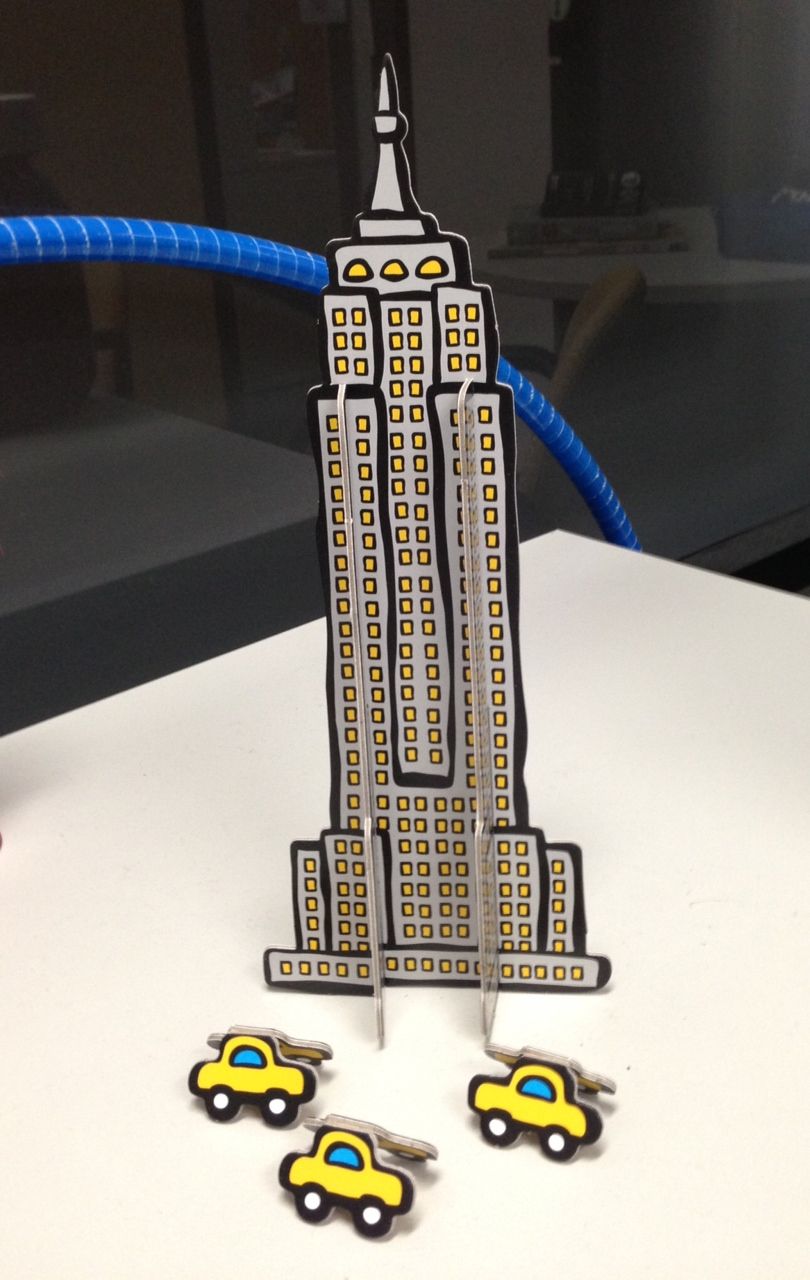
Empire State Building on my desk

New York State of Mind.

In all honesty, this works really well for our family. There is no need to think about childcare and babysitting because Aaron is home with our daughter for the few days that I’m away. Even the two-day trip to Perth in October last year that involved a 5.30am flight out and a midnight flight back in wasn’t a problem when it came to kiddo arrangements, although the nightly Skype catch-ups were a nightmare with the time-zone changes!

Really, the biggest challenge for me when it comes to overnight travel used to be missing the family. Until recently, that is.

This year, I’ve had some hypos that have been pretty scary: a couple of white outs and another that resulted in paramedics being called (which I will write about soon). And these have made me a little nervous about being away overnight alone.  I presented at a conference in Paris in June and headed there to do that before joining my family for the rest of our break. That was the first time that I was concerned about being on my own while away.

I put in place a few things to make me (and the family I was leaving back home) a little happier. Fortunately, a wonderful friend was presenting at the same conference and staying at the same hotel. We had adjoining rooms and she kept an eye out for me. I did extra BGL checks and set a slightly higher BGL target for before bed and overnight.

Later this week I’m going to EASD in Barcelona, specifically to attend a summit for diabetes bloggers. When discussions about this started a couple of months ago, I was reluctant to commit until I knew that I wouldn’t be travelling alone.

I know that it is not reasonable for me to expect that I can be chaperoned every time I need to be away overnight and I am working on strategies to feel safe and secure when travelling alone.  Diabetes is a pain in the arse a lot of the time, but I am usually pretty good at just accepting it and getting on with things. But when there is fear and uncertainty, I absolutely hate and resent living with this condition. Feeling scared about something that ‘might’ happen frustrates me; it sends my imagination into overdrive as ‘what if’ scenarios play out in my mind.

Regardless, the travel bug has a much stronger hold on me than the hypo bug. So, I’ll keep planning and travelling and attending conferences. It’s part of my job and a passion as well. And that is reason enough to keep doing it.

ruokToday is R U OK Day. You can read all about it here and read Michael Goldman’s first post for the Diabetes Australia – Vic blog and his take on this important day.

I love this initiative because it gets us thinking about how people are feeling and gets us talking about mental health. There is still so much stigma associated with mental health issues. And add diabetes to the mix and its associated stigma and you have a double whammy.

I also love it because it’s not only about today. This may be the ‘flagship’ day, but the real aim of the R U OK Foundation is to remind people that checking in with our loved ones on a regular basis is a good thing to do. And I can’t emphasise enough how important it is to check in on loved ones with diabetes.

Diabetes is known as an ‘invisible illness’ and I can’t think of a better way to describe the everyday life with this condition. There is no outwardly obvious sign that I have diabetes. Unless you see me pull out my pump or check my BGL you wouldn’t know that I have a condition that requires regular monitoring and medicating.

If you look at me today, I seem pretty okay. I’m up and dressed and am wearing my regular red lippy. Thanks to a couple of coffees, I can string two words together. I look okay. And in all honesty, that’s how I am most days. But sometimes what you see doesn’t tell the whole story.

So often, when we hear about diabetes, we hear about the extremes. Whether we’re talking about complications or the horrific hypos it’s the extreme. But my life with diabetes isn’t actually about the extremes. Yes, I may have some minor retinopathy. Yes, I had a hypo a few months ago that resulted in me needing paramedics. Yes, all these things are scary. But people SEE these things; they know about them. And when people see things, they ask the question: ‘are you okay?’

Diabetes isn’t necessarily about the things you see. It’s about the everyday.

How many of us have heard at some time or another ‘Oh, I know someone with diabetes. It hasn’t stopped them doing anything?’ It’s great that may be the case. I am pretty sure that people I know say that about me ‘My friend Renza has diabetes. She’s fine – she works, has a kid, travels heaps, has a great boot collection, spends hours in cafes, bakes all the time etc.’ And all these things are completely true.

But there are days that even though I look fine, I’m not okay. The hypo I had at 2am means that I didn’t get back to sleep and I’m exhausted. And I lay awake stressing about my next ophthalmologist appointment and the terror of the inevitable cataract surgery looms in my mind.  Or, as I sit at my desk, I suddenly realise that I’ve been mainlining water all day so I check my BGL and it’s 22.5 and I have no idea why or the capacity to troubleshoot to try and find the reason. Or I’m just. Over. It.

And yet I look okay.

If you have a look at the resources on the R U OK site, there are great suggestions for starting conversations and the things to ask and look out for. I know it’s not easy. We’re afraid of what people will say or that we won’t know how to respond. We’re scared that the response to the question won’t be ‘Yep – all good’. We’re scared that we won’t be able to fix the problem.

But it’s not about offering solutions. Opening up lines of communication and giving others permission to really say how they are feeling is the aim of RUOK Day. For me, if things aren’t okay and I communicate that to you when you ask me how I am going, I don’t want you to fix it; I don’t want solutions. I just want someone to listen to me.

Ask the question. And ask again. Tomorrow, or next week or next month. Ask the question. Are you okay?

A couple of weeks ago at the ADS ADEA conference, I spoke at one of the Symposia about how healthcare professionals can get involved with diabetes social media. Today, social media has the ability to connect people like never before and is something about which I am passionate. I speak and write regularly about the power of the diabetes online community (DOC) as a way to bring together peers; my presentation at the Doctors 2.0 and You conference in Paris back in June discussed how social media can be used to connect four of the players in healthcare – patients, healthcare professionals, healthcare organisations and industry.

I was a little nervous about discussing this topic because I know how reticent a lot of HCPs are when it comes to social media and its value to people living with diabetes. Because of its very nature, social media is unregulated. There is just so much out there; how is anyone meant to know where to direct people? And equally, what should be given a very wide berth? (For the record – anything claiming that cinnamon cures diabetes is a crock and should be ignored!)

cinnamon cure

With thanks to the clever people at Diabetes.Daily.com

But actually, that wasn’t what my talk was about. My talk was about why people with diabetes turn to social media; what (and who) we look for and what we get from an online community of peers that we can’t necessarily get from our HCPs. I then moved to discuss how HCPs can engage with the very same things we are using.

My presentation was gentle – a lot of the people in the room had never considered using Facebook as a tool to provide support and connect with others living with diabetes. Whilst there is a general understanding about the value of peer support, that view is often out-dated and focuses on a more traditional picture – face-to-face support groups.

I discussed how health professionals around the world use social media as a mechanism to connect with other health professionals and how crowdsourcing diagnoses works. I suggested the audience look up Bertalan (Berci) Meskó and consider enrolling in his online Social MEDia course.

I explained how Twitter is about far more than finding out what Kim Kardashian ate for breakfast and discussed weekly diabetes tweetchats, urging the HCPs to check in, lurk for a week or two and then take part.

Social media works for people with diabetes because it feels like a safe place. I know that idea is completely contrary to what many HCPs believe – they see it as anything but safe!  But I know that I can log on to Twitter or Facebook at any time of the day or night and there will be someone there who can say to me ‘I know how you feel’. There will never be judgement; there will never be accusations of not trying hard enough. But there will be support.

And I guess that’s the crux of this. We know our community and we feel safe there. In his TED talk, Berci Meskó discusses how crowdsourcing works when you know your audience and your social media networks.

The final thing I discussed was diabetes blogs. There are two ways HCPs can use blogs. The first is for themselves; they can read them; they can take in what people are saying. Because it’s by reading the blogs of people living with diabetes that the real-life stuff comes through. It’s a way for them to get a good understanding of the things that we don’t talk about in our appointments with them, but the things that are important and impact on how we manage not only our diabetes, but our every day lives.

Also, they can use them for their patients. If ever a patient says ‘I feel so alone’, I suggested that they direct them to a well-known diabetes blog. There will probably be a post somewhere in the diabetes blogosphere that will address the same issues the PWD are experiencing.

The diabetes social media world does not need to be scary and regarded with suspicion. The role of HCPs is not under threat because PWD are using social media – that’s not what it’s for. It is just the 2.0 version of peer support.

OzDoc_01

Don’t forget – weekly #OzDOC Twitter chats are on Tuesday at 8.30pm (eastern time).


DISCLAIMER

The Can Technology Cure Healthcare’s Future symposium was sponsored by Sanofi. My travel costs were covered by Sanofi, however I did not receive any payment from them. Sanofi had no input into my presentation. Good on them for supporting such an important topic!

There are times that I am dismayed at what I read on Facebook about people navigating diabetes care for themselves or their child. Today, I was asked for my comment on a situation where a child with type 1 was being threatened with the removal of her pump because her HbA1c was higher than target.

This really gets my blood boiling for a number of reasons. Let me count the ways!

  • A pump is not a luxury. It is a way of delivering insulin. Let’s be clear about that. It is a tool that we use in the management of our diabetes.
  • The only person who has the right to determine how their diabetes will be managed is the person with the faulty pancreas (or their parents in the case of young children).
  • HCPs are there to work with us and be guided by what we need and what we are asking for. Equally, we look to them for support, education, advice and information about our diabetes management. We do not look to them to be told off or judged.
  • Punishing a PWD by removing a management tool is just plain stupid. Like it or not, I need to give myself insulin and I choose to use a pump to do that. If I’m feeling a little unmotivated and don’t have the capacity to be checking my BGLs, taking away my pump is not suddenly going to give me an injection (bad, bad pun) of motivation.
  • Scare tactics DO NOT WORK. I’m going to say that again. Scare tactics DO NOT WORK. Also, scare tactics DO NOT WORK.
  • The person in charge at all times is the person with diabetes. Let’s be clear about that too. The PWD is up front, directing traffic. HCPs, diabetes organisations, friends and family are there to support the person in charge.
  • This is going to sound crass, and I don’t mean it to, but HCPs need to remember that they are being paid to do our bidding. They are providing us with a service. And that means, if we don’t like the service, they get sacked and we find someone who will give us the service we need.
  • Threatening to remove a pump is bullying behaviour and it absolves the HCP of any responsibility in the management of their patient. I will never blame my HCP if my A1c is out of range or I am not checking my BGL. I would ask that they don’t blame me and threaten me.
  • Deciding to take away a pump because HbA1c is too high is placing far too much importance on the value of the HbA1c! It’s just a number that gives an average. But not much more.
  • Also, by using results of an HbA1c check as a reason to threaten to remove someone’s pump is forgetting about the considerable emotional impact of diabetes. Just as an out of target A1c is not a reason to rap someone over he knuckles, an in-target A1c is not necessarily an indication that everything is A-okay.

I know that it is not always easy to be your own advocate, but it’s times like this that you really need to be able to stand up for yourself (or your child), or bring along someone who can. Being clear about what you want and need is important – and that includes being clear about what you won’t accept.

I attended the ADS/ADEA conference last week in Sydney just for one day to present at a technology and healthcare symposium (more on that soon).

It was one of those crazy days that started long before the sun rose. I can’t be chipper at 6.30am as my travel companion realised as he greeted me in a very cheery manner only to be met with a steely gaze and pronouncement of ‘I’m yet to have coffee’. It sounded like a threat!

After my presentation, I made the most of a couple of hours at the conference and caught up with as many people as possible. I’d arranged about eight ‘we’ll chat at the conference’ meetings and ended up seeing four people.

I only made it to one session apart from my Symposium and it was a debate.

I love a bit of debating. Those who know me won’t be surprised to know that I was in the debating team when I was at school (Renza nerd fact #3569). But the topic at the conference made me a little uncomfortable and that was before anyone even opened their mouths!

‘It’s our fault if our patients’ HbA1cs are too high’

I don’t like the word ‘fault’. Blaming people for being outside their diabetes targets rarely does anyone any good. As the people living with diabetes, we don’t like to be blamed or told off if we’re not meeting targets, so blaming our HCPs doesn’t make much sense to me either.

Nonetheless, I went along to see what was said.

First up for the affirmative – Cheryl Steele. Now, as far as I’m concerned, Cheryl Steele is wonderful. She was one of the first people I saw present about diabetes when I was first diagnosed with diabetes and she has inspired me ever since. She is a favourite speaker of the T1 Team at DA-Vic, not only because she does a brilliant presentation EVERY SINGLE TIME, but also because of her tell-it-like-it-is manner. And the fact that she is living with type 1 makes her even more awesome!  She changed hats a few times yesterday whilst giving her presentation –sometimes speaking as a CDNE and other times as a PWD. And the confusion about anagrams was one of her points.

The affirmative team’s argument was that until HCPs stopped moving the goal posts, provided better tools for management and stopped disagreeing on what they were telling people with diabetes, then yes, they had to consider taking the blame for their patients higher than target BGLs.

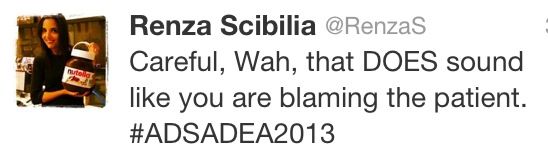
The negative said there was no way that HCPs could be blamed – and were at great pains to point out that they weren’t blaming the PWD. Except there were times that they came pretty damn close – as evidenced by this tweet:

tweet1


I felt a little uncomfortable at times during the debate. Although it was very tongue in cheek and there was great spirit throughout the session, there were moments that I wondered just how much truth was in the silliness.  It is a little like the ‘oh-we’re-just-joking’ comments about patients lying about filling in BGL record books.

I know that by and large the HCPs in the room are there for the PWD (I was sitting next to my endo and I know that’s definitely the case with her), but I do get a little concerned at the lack of understanding about what life with diabetes is all about when the negative team thought that dealing with a life-long chronic health condition is kinda like taking a course of antibiotics.

tweet2

Was I being a little too sensitive? Possibly. Am I expecting HCPs to get it wrong? Again, possibly. But as a consumer advocate, I am on heightened alert to make sure that there is compassion, understanding and respect being directed towards PWD at all times. I’m not sure that was necessarily the case throughout the debate last week.

Next time, I’d love to see a debate between HCPs and PWD. Now THAT would be worth paying money to see!

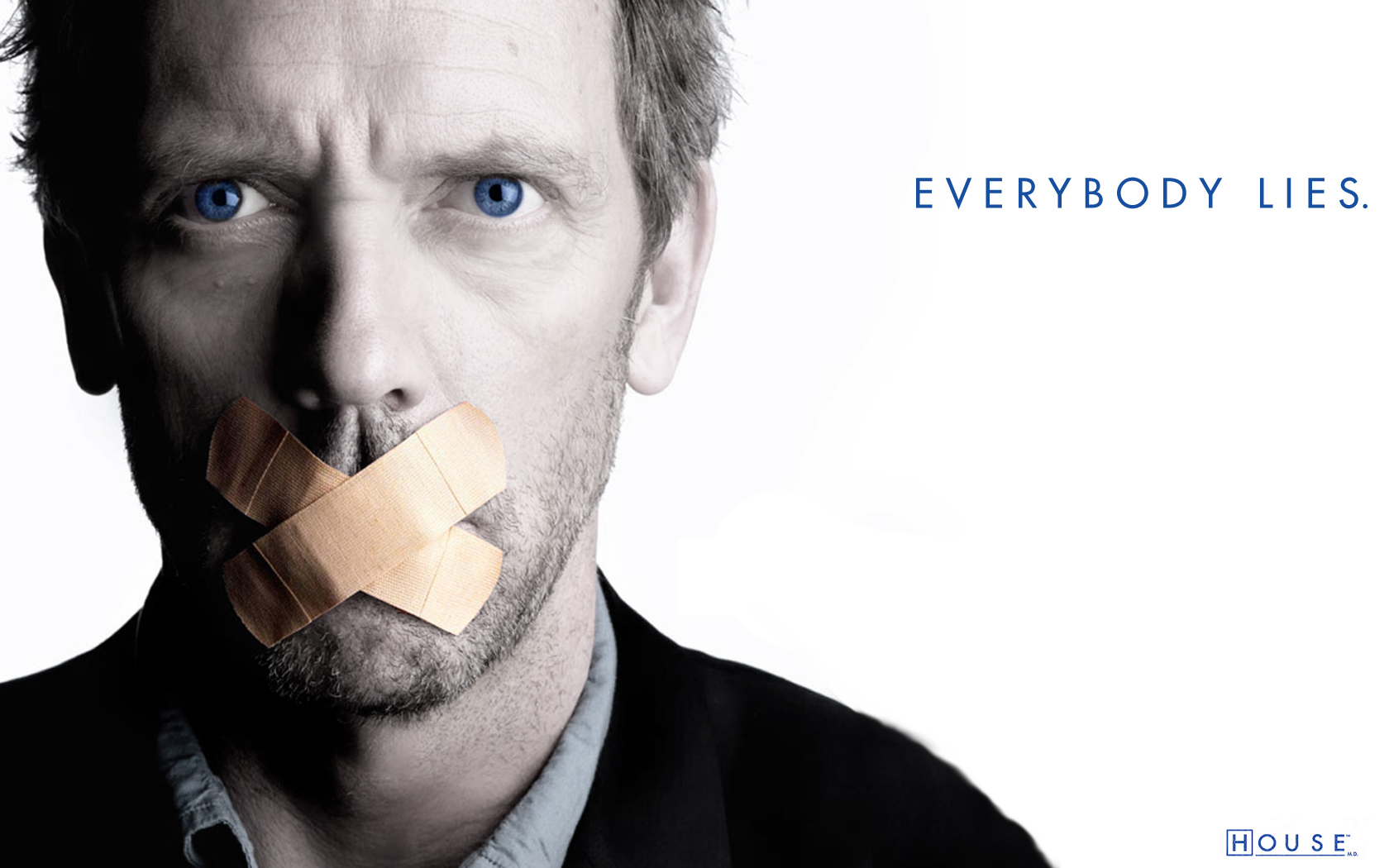
TV’s Dr Gregory House repeatedly says ‘Everybody lies’. He believes that doctors can’t and shouldn’t believe what their patients are telling them because they will omit key points about their health – intentionally or not. Diabetes makes us liars. Not big liars, but it’s easy to tell a white lie here and there.

‘I have NO idea why my BGL is 32.5’ (conveniently forgetting two serves of cheesecake)

‘My last A1c was 7.3%’ (actually, it was 8.3%, but what’s one percentage point between friends?)

‘Of course I bolused for lunch!’

….. etc etc etc

These are small lies and in the scheme of things, really don’t matter. But we do need to ask ourselves, who are we really lying to and why do we feel the need to bend the truth?

I have been seeing the same endo for almost 12 years. After three and a half years of endo-hopping and endo-shopping, I finally found ‘the one’. I admit – the not-so-great relationships with the previous endos where partly my fault. I found them judgemental and I dealt with that by not being completely honest. I didn’t want the admonishing looks or the exasperated sighs from them when they saw my above target numbers.

So, I made things up.

This did me no favours and did nothing to foster a relationship based on trust with them. The relationships were doomed from the start when I think about it. I’m sure they knew that I was lying (they were pretty stupid if they didn’t!) and it was pretty disrespectful of me to think that they were dumb enough to believe what I was saying.

When I started seeing my current endo I made a promise to myself: I would tell her the truth. Now, the fact that she isn’t at all judgemental, is kind and caring and has the best communication skills of any health professional I’ve ever met certainly has helped me keep that promise. Her response to me saying ‘I’m over this and really don’t care about diabetes anymore’ is not head shaking, tut-tutting and telling me off. She wants to know why, how she can help and to know what I believe I can manage to do that will make ME happy. She makes me want to be honest and tell it like it is.

And I hope that because it’s always been that way that she doesn’t doubt what I am saying. I hope she knows that it’s the truth when I say things have been tough, or that I really don’t know why my sugars have been all over the place, or that I really have been checking my BGLs six times a day. I hope that because our relationship started with honesty she knows she can trust what I say as the truth and never doubts me.

A relationship with your health professional that is based on trust, honesty and just telling the bloody truth is rewarding. Starting off that way is critically important. I think that when you feel you can be that way – and it does open you up to feeling vulnerable – that you have found the right match.

But if you start with lies, there is probably no chance that either of you will be getting what you need from the relationship. If you feel you need to lie to them, ask yourself why. Equally, if they know that you are not being honest with them, they need to wonder why that’s the case. No one wins when we are dishonest about our diabetes.

Dr House may believe that everybody lies, but I believe we can start with honesty. My relationship with my endo is rewarding for me because that is how we started. I trust her implicitly and she has no reason to doubt me. It was a good starting point 12 years ago. And it’s still working today.

House

I’ll take any excuse to look at Hugh Laurie!

Follow Diabetogenic on WordPress.com

Enter your email address to follow this blog and receive notifications of new posts by email.

Read about Renza

Archives