
You are currently browsing the category archive for the ‘Social media’ category.
I’m in London for a couple of days of meetings before flying to Copenhagen….for another couple of days of more meetings. But I was smart this time, managing to set aside a whole day before the meetings start to do this:

These three women – these wonderful women – are part of the lifeline I have to help me manage diabetes. It may have been faulty pancreaes that brought us together, but what ties us together is support, friendship and love.
Thank you Annie, Georgie and Izzy for coming to meet me in my jet-lagged state in London. Thank you for building me up, and filling my jar. I couldn’t do this diabetes shit without you all.
I woke yesterday morning to a shit storm on Twitter. I had dozens and dozens of notifications where I had either been retweeted, mentioned or @-ed. (And yes, sorry, I did just turn the @ symbol into a verb). I was hoping that someone was sharing news with me that in the eight hours I’d been asleep, diabetes had been cured, JK Rowling had released a new Harry Potter book, or Nutella would be sponsoring me to…well, eat Nutella.
Alas…it was none of these. No; it was not.
I slipped down the rabbit hole of people replying to a tweet where I’d shared an awesome blog post by my mate and all ‘round wonderful human, Georgie Peters. Georgie was commenting on the recent study which has been widely shared (and written up in the NY Times) about type 1 diabetes and LC diets. (If you’ve not read the NY Times article, do! The study is really interesting and as someone who predominantly follows LC it all makes perfect sense to me…and makes my CGM trace devoid of roller coasters lines.)
Georgie’s piece was not demonising LC. In fact, quite the opposite. She was suggesting that it is absolutely a valid way of eating for some people, just as eating moderate to high carbs might be.
Distilled into one word, Georgie’s post was about CHOICE.
In more than one word, Georgie was warning that diets that are inherently restrictive in nature could lead to an increased risk in eating disorders. Georgie was specifically referring to children on LC diets who are not given a choice in the way they are eating, or as she far more eloquently puts it: ‘…the food choices of children and their right to bodily autonomy.’
Choice. It all comes down to choice.
Apparently, that was completely lost on the people challenging what Georgie was saying. One person was somehow trying to say that the idea that a diet restricting carbs was no different to a kosher diet, and does that mean that people following a kosher way of eating have an increased rate of eating disorders? (If you can join the dots to make something that even remotely makes sense, please do so for me, because I have tried and keep coming up with a massive question mark.)
Another doctor claimed that she insists all her surgical patients go on a low carb diet (pre-surgery), and that they have no choice in the matter. Two things: type 1 diabetes isn’t the same as prepping for surgery. And any doctor who even suggestedthere being no choice in anyaspect of my diabetes management would be given the sack very quickly. (I’ve no idea about pre-surgery diets, because that’s not my thing. Diabetes is. Georgie’s post was about diabetes, not about pre-surgery diets. The surgeon’s comments added to my confusion, because: apples and oranges…which are probably banned on her LC diet. And further down the rabbit hole we go.)
The food we eat; the diet we follow, are inherently personal choices. No one has the right to insist that there is only one way of eating. One of the frustrations that some of us who do want to follow a LC diet have is that there are some HCPs who refuse to even acknowledge that it could possibly be a positive and useful diet for people with diabetes, some going so far to say it is harmful.
The other day as many of my friends shared the NY Times article, I saw them plead for others to open their minds. I want that, too! I want people to have the information about how LC might work as a diabetes management strategy and be open to the idea. But more than that, I want people to then choose what works for them.
And when it comes to parenting (and I know that I don’t have a kid with diabetes, but I am a parent), I know this to be true: we all want what is best for our children. The thirteen-year-old in our house doesn’t have complete autonomy over food choices, because I do ninety percent of the shopping for food and cooking. I like it that way, because I get to eat what I want, and don’t have to do any of the cleaning up after I’ve messed up the kitchen! Win, win!
While she doesn’t have a choice in what is served up at the dinner table, she does get to decide what of it she eats. I know she doesn’t have diabetes, so when it comes to thinking about food, she doesn’t have to consider her glucose levels. But there is far more to health than that.
I am doing all I can to inform and educate her on what makes for a healthy, balanced diet. I have to trust that what I am doing is enough to result in her making healthy choices most of the time.
Choice – that’s what Georgie was writing about. Is it really that hard to understand?
In kind of related, but really, just that I want to share something: this nut and seed bread is incredible:

It’s low carb (at least, it is the way I make it, because I swap the oats for coarsely ground hazelnuts) and, quite frankly, is the best thing I have ever eaten. (To make it decidedly not low carb, slather in Nutella…!)
I don’t know where I would be if it wasn’t for the support, love, friendship and sustenance I get from my peers with diabetes. A long time ago, I wrote that the two most powerful words in the English language are ‘me too’. Realising that others understand, have experienced and know what I am going through means that I never feel truly alone. It doesn’t matter what time of the day it is, I know I can always find someone – a diabetes peer – to talk to and help me through.
I wish I knew this from when I was diagnosed. I felt really alone for the first few years I lived with diabetes. To be honest, I don’t think I necessarily wanted to meet anyone with diabetes as soon as I was diagnosed, but I certainly did a short time later, once I realised that diabetes wasn’t just for Easter (when I was diagnosed)…it was for life.
Today, I couldn’t be without those I have come to know because of our shared lazy pancreases. I am so lucky to have them in my life.
- What this tweet says:

- At diagnosis, being made aware of peer support is a really good idea and I so wish that I had been told how to find other people like me when I was diagnosed and felt so alone.
- There is no right way to do peer support. Whatever works for your – that’s your peer support model!
- Peer support may be catching up with a mate for a coffee or a beer, or it could be sitting in a room while someone speaks to you. Or a walking group, or a sports group (allegedly). Or a diabetes camp. It can be a formal structure or something more akin to a casual book group. For my money, I’m all about the informal, unstructured model. That is what works best for me. But just as with everything to do with diabetes, there is no one size fits all and it’s important that all options are available so people can find out what works best.
- So, yes – this works when it comes to peer support too.
- I promise you – what you learn from your peers will be as important, if not more important, than anything you will ever learn from a diabetes healthcare professionals. It will probably be more relevant and practical too.
- You don’t need to love everyone you meet – just because they have diabetes. Dodgy beta cells can’t be the only thing you have in common.
- The connection you find with the people you do ‘click’ with and love could be to do with your life stage, personal experiences, philosophy about living with diabetes or mutual love of Effin’ Birds.
- AKA:

- There is an undeniable feeling of luck, love and gratitude when meeting someone that is in your tribe. And that extends to when you introduce their family to yours and you realise that you have made family friends forever. AKA: This time in New York City.
- Sometimes, there is no need for words. Support, love and encouragement can all be said in one glance.
- I have found some of my closest diabetes friends online. The DOC is a diverse and varied community. You just need to work out the people and activities that work for you!
- Online peer support can be just as valuable – and sometimes more so – that face-to-face peer support. There is nothing scary about meeting diabetes friends online.
- So with that in mind, be open to meeting new people. You can easily get stuck in a peer support rut with people you once really connected with, but, for whatever reason, are ready to meet new people. That’s okay.
- And with THAT in mind, remember that involvement in peer support can be transient. Just because your ideal peer support model looks one way today, doesn’t mean you need to do it the same way forever.
- There may be times that really, you’re not interested in speaking with others with diabetes, or feel you don’t need support from other panreatically-challenged folk. That’s okay too. (You can always come back if and when you are ready.
- For peer support to work and be truly effective, it needs to be a safe, judgement free environment. (Which is pretty much how everything to do with diabetes needs to be for it to work…)
- Linking and connecting with other people with diabetes can be life changing and life saving. Search Simonpalooza in Google to see what I mean. Or read the Pumpless in Vienna story here.
- Peer-led support groups are most successful when the person doing the leading clearly has no agenda other than wanting to build a community. If you want to look at a beacon of someone who is all about community, building people up and being nothing other than inclusive, look no further than Cherise Shockley who started and continues to oversee the first diabetes tweetchat!
- Peer support can happen anywhere. Diabetes in the wild moments often provide the most incredible opportunities to connect. Just remember though, not everyone is necessarily open to sharing all their diabetes tales with a complete stranger you meet while waiting for a coffee. (That last point is mostly for me.)

Peers.
The three most important women in my life are forces of nature: My mother, president of union, has instilled in me a desire to do work that helps others. My sister, the fiercest, feistiest, smartest person I know, who constantly challenges me to think outside my comfort zone. And my daughter – my amazing, miracle kid, (and kids like her) – is why I feel that the world is actually going to be okay.
The supporting cast of close family – mother-in-law who just happens to be an Australian aviation pioneer, my sister-in-law, aunts, cousins – and friends means that I am constantly surrounded by brilliant women doing brilliant things. I am astounded, daily, at the challenges they overcome, their triumphs, the lives they change, the impact they are making.
And in my diabetes life it is women – the incredible women – who keep me going and keep me motivated. My diabetes healthcare team is made up exclusively of women who truly breathe the whole person-centred care belief system, building me up and then supporting me as I do the best I can with diabetes. The women I have worked with, and continue to work with, in diabetes organisations who champion those who would otherwise be forgotten have become friends, mentors and daily cheerleaders.
It is people like Cherise Shockley, founder of DSMA; Dana Lewis, creator of Open APS; Susan Alberti, philanthropist; Jane Speight, diabetes language forerunner; Taryn Black, Diabetes Australia policy director and champion for having the voice of PWD heard; Riva Greenburg, journalist, changing the way we see people living with diabetes; Annie Astle, advocate and speaker, and the person I am most grateful to have come to know because of diabetes; Monique Hanley, cycling legend; Christel Marchand Aprigliano, advocate leader; Cheryl Steele, CDE extraordinaire and leader in diabetes technology education; Kerri Sparling, author, blogger and incredible advocate; Anna Norton, Sarah Mart and Karen Graffeo, the women behind Diabetes Sisters; Melissa Lee, incredible communicator, singer, former leader of DHF and now at Bigfoot Biomedical; Kelly Close, founder of diaTribe and Close Concerns; Georgie Peters, speaker, blogger, diabetes and eating disorders advocate…
And you know what? I haven’t even scratched the surface. The diabetes world is shaped by women, built by women, sustained by women. Advocacy efforts are often the brainchild and then led through the blood sweat and tears of women. And how lucky the world is!
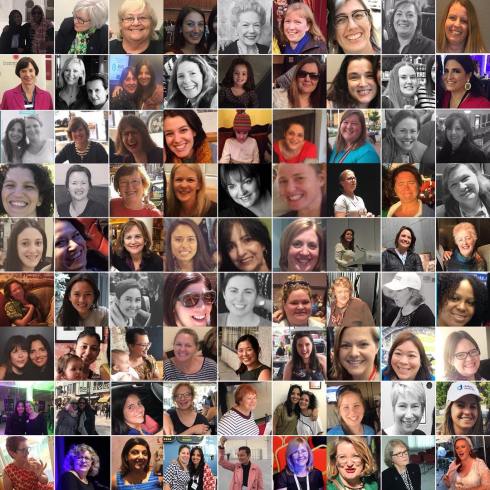
I celebrate these women today and every day!
More writing about women and diabetes, and women’s health.
This is what Diabetes Privilege Looks Like
One Foot in Front of the Other
Have you been thinking about making a donation to Spare a Rose; Save a Child, but just haven’t managed to do it yet? Did you think that because Valentine’s Day is over that it’s too late? Watch this and find out why your donation is still greatly needed.
Donate now to have your donation added to the 2018 Spare a Rose tally. Just click on the image below.

New year, new jumble. And lots of saved links from the last few weeks to share.
#OzDOC 2.0
Did you know that after OzDOC had it’s ‘final’ tweetchat at the beginning of December last year, it’s had a reboot and is now continuing to go at a great rate. David Burren (AKA Bionic Wookiee) kicked off the chat but is looking for people to volunteer to the moderators’ roster. There’s a brand new Twitter account to follow (@OzDOC_host), but the #OzDOC hashtag continues to shine brightly.
Same #OzDOC time, same #OzDOC channel. (i.e. Tuesdays at 8.30pm AEDT)
And while we’re talking tweetchats…
…make sure you keep an eye out on the #GBDOC tweetchats, which also had a bit of a restart last year and are going absolutely brilliantly. Follow @GbdocTChost for topics and moderators.
Now is a great time for Aussies to participate in #GBDOC because with the time zone difference, the chat is on Thursday 8am AEDT…which is actually quite pleasant. (It all goes to pot and becomes more difficult when daylight saving kicks in/out in respective hemispheres in coming months, but for now, it’s certainly manageable!)
Jane’s profile
It’s no secret that I’m a huge fan of Professor Jane Speight and I make no apologies for mentioning her so frequently on this blog. She is truly a champion for and of people with diabetes and her pioneering work on diabetes and #LanguageMatters, and social stigma are changing the landscape for those of us living with diabetes.
Last week, a profile of Jane and her work was published in The Lancet. Congrats, Jane. I can’t imagine a more worthy recipient of this attention. Please keep on keeping on. I for one am very grateful to have you on our side!
Read the article here – it’s free, but you will need to register/log in to access it.

(Click photo for source)
Dear ‘patient’
I was really interested to read this BMJ Opinion piece about medical letters, with the writers suggesting that instead of addressing ‘report letters’ to referring (and other) doctors and HCPs, that they should be addressed directly to the person, CCing in the doctor who would ordinarily have been sent the letter.
I love that idea! My endo generally copies me in on anything she sends out to my other HCPs to keep me in the loop, but I think that actually writing directly to me is even better.
HCPs would need to completely reconsider the language they adopt, the terminology they use and the overall tone of the communication, and I believe that there is nothing that should be shared with another HCP about me that shouldn’t be shared directly with me.
Interesting idea. And interesting to see if it has legs…
Writing for Grumps
After writing for me a few weeks ago, I returned the favour and wrote a post for The Grumpy Pumper. (I think the deal he made was something like ‘I’ll show you mine if you show me yours’, so I had to come up with the goods.)
This is all part of Grumps’ attempts to get people with diabetes speaking about #TalkAboutComplications in an open and honest way to help reduce the shame that seem to go hand in hand with a complications diagnosis.
Get ready for Spare a Rose spam
This year’s campaign is about to kick off. And if you want to know why I support this campaign, here’s just one reason.
Hospital admissions and T1D study
Rebecca Munt from Flinders University is currently enrolled in a PhD at Flinders University and is looking for participants in her research.
The focus of her study is to explore the experiences of self-management for adults with type 1 diabetes in the hospital setting (when T1D is not the primary admission diagnosis). If you’re interested in participating in Rebecca’s study, have type 1 diabetes, are over 18 years of age and have been admitted to hospital within the last two to five years (not for diabetes), please call Rebecca on (08) 8201 5749 or email rebecca.munt@flinders.edu.au
(The project has Social Behavioural Research Ethics Committee approval from Flinders University.)
Future of medical conferences
I have been very vocal in recent years about the shortcomings of diabetes conferences, specifically the lack of involvement and engagement of people with diabetes as part of the planning, running and presenting of the conference. So this piece really resonated about why medical meetings need a revamp, and some ideas for what could be done differently.
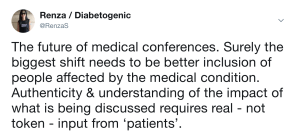
(Click for original tweet)
Because #NothingAboutUsWithoutUs.
Does the story we know and love about Banting need a rewrite?
I was fascinated to watch the short documentary shared in this story which suggests that the frequently-told story of the discovery of insulin is missing out a critical part.
It was the best of times, it was the worst of times…
This blog post by Sue Robins detailing two vastly different medical appointments is compelling – and quite heartbreaking –reading.
More D Merch
Totally true!
Click image to get your own!
Towards the end of last year, I wrote about some things happening online trying to encourage people to openly and freely speak about being diagnosed and living with diabetes-related complications.
When conversations about diabetes complications are brought into the public domain, often two things happen.
Firstly, people start to talk. That whole cornerstone of peer support – reducing isolation and sharing stories – flings doors and windows wide open, and people, often gingerly at first, start to offer their own experiences. Inevitably, someone will say that they don’t speak about their complications because they fear the judgement that will follow. Or that they believe they are the only one their age facing complications because they have never met another person, or read a blog post from another person sharing a similar experience.
Secondly – and most damagingly – there is judgement. And it comes in spades, often sending some of those who had started to open up retreating back into the depths of diabetes taboos. This is not helpful for anyone.
So I wasn’t surprised when, during a useful discussion starting online about living with diabetes related complications – which resulted in some people willingly talking about their own experiences – the horribly judgemental comments started infiltrating the conversation.
I shared this post that I wrote almost five years ago about why we need to reconsider the way we speak about diabetes complications as I thought it was relevant to the current online conversation. In fact, everything I wrote in that post was still true because diabetes continues to be a terribly stigmatised condition and, within that, those of us living with complications seem to face additional stigma and judgement.
If for one second anyone doesn’t believe that statement, here are just some of the comments that I received (on LinkedIn and Twitter) after sharing the post:
‘If considering that many people who are type 2 diabetic quite simply exercise too little and eat too much fat…… which has immense financial consequences for the provision of healthcare…….. how else do you propose to get these people to lose weight and stop emburdening (sic) themselves on our NHS? If you take away the need to shame them you take away the most powerful way of making them take responsibility for their health.’
‘Sorry Renza but if we get complications of diabetes then we have failed. We are each responsible for own health and must try to maintain it at all cost.’
‘Diabetic complications do not happen with ‘perfect’ blood sugars. I agree that we must be supportive and sympathetic and the insulins available don’t help but it’s still the patient’s responsibility and not the doctors. Sorry if this doesn’t bode well with you.’
Is it any wonder that people are reticent to speak about developing complications if people are thinking like this?
I have written before that I believe diabetes has an image problem, because I can’t think of any other health condition that, if a treatment does not get the desired outcome, the person living with that condition is blamed. I have never heard someone being blamed if the cancer for which they are being treated does not end up in remission. I don’t know of anyone with rheumatoid arthritis who is blamed if their pain increases or their mobility decreases. I’ve not heard of someone with psoriasis being accused of not caring for themselves if their skin flares up.
But all bets are off when it comes to diabetes and fingers are pointed fairly and squarely in the face of the person living with diabetes if they develop complications.
Diabetes complications happen. It is, unfortunately, a reality for many people living with diabetes. I’m not trying to be negative or scare people, but we know that the longer we live with diabetes, the more likely we are to develop complications.
In this post, The Grumpy Pumper says: ‘Complications are a hazard of what we have. Not a failing of what we do.’ Maybe if we take that as the starting point we can take away the blame. And maybe if we take away the blame, we break down the stigma. And maybe if we break down the stigma, we can start having a real discussion about how we treat complications if they develop, and get to treating them.
And maybe if we stop thinking that developing diabetes and anything that happens after living with it is a shortcoming we can stop feeling so judged and shamed, because others will stop judging and shaming us. More to read on this topic:
Riva Greenberg shared this one.
Sarah K from Sugarbetic wrote this.
It’s 42 degrees Celsius today – or about a million and a half degrees Fahrenheit. We can all agree that it is hot.
So, obviously, it’s a great day to move offices.
As I have unpacked and started to set up my new space I’ve been piling together bits and pieces collected from DOC get togethers. Which means that as I sit here in my office overlooking the city skyline, I actually have around me friends from all over the globe.
And my world once again feels that little bit smaller. And I, in my corner of Melbourne, feel part of something so much bigger.

I was thrilled and honoured to speak in the symposium at #IDF2017 all about peer support. I shared the program with Chris Aldred, better known to all as The Grumpy Pumper, and advocate Dr Phylissa Deroze (you can – and should – find her as @not_defeated on Twitter).

Speakers in the peer support symposium at #IDF2017
When we were putting together the program for the symposium, the idea was that it would offer an overview of what peer support can look like, beginning with how diabetes organisations and community health groups can facilitate and offer a variety of peer support options, and rounding up with the perspectives of people with diabetes who provide and participate in peer support.
I spoke about how diabetes organisations in Australia, through the NDSS, offer a suite of peer support choices, urging the audience to think beyond the usual face-to-face or, increasingly, online peer support group. Activities such as camps for children and adolescents with diabetes, information events, education sessions (such as DAFNE) are all avenues for peer support. Peer support need not only take the form of a group of people sitting in a (real or virtual) room talking about diabetes in a structured or unstructured way. It can happen just by putting people with diabetes in the same space.
I’d never met Phylissa before, but I quickly learnt she is the definition of the word determined. She spoke eloquently about her own type 2 diabetes diagnosis which was anything but ideal. Instead of feeling beaten and overcome by how she had been let down by the healthcare system, she turned to her peers, finding a group that not only helped her diabetes management, but also gave her confidence to live well with diabetes.
Phylissa now facilitates an in-person support group for women with diabetes in Al Ain in the UAE, and is a huge supporter of, and believer in, the power and importance of peer to peer engagement and support in diabetes management. You can read more about Phylissa’s work on her website here.
Grumps, in true Grumps style, gave a talk about how his approach to peer support is more organic and certainly not especially structured. Although involved in some more planned peer support, he believes the most effective way he can support others with diabetes is on an individual, more informal way. Kind of like this:

Click image to see tweet.
And as if putting into practise his talk at the Congress, last week he started a conversation on Twitter about his own recent experiences of being diagnosed with an ulcer in his foot opening the door for people to speak about diabetes complications.

Click image to see tweet.
The way we speak about diabetes-related complications is often flawed. The first we hear of them is around diagnosis and they are held over us as a threat of the bad things to come if we don’t do as we are told. They are also presented to us with the equation of: Well-managed-diabetes + doing-what-the-doctors-say = no complications.
Unfortunately, it’s not that easy.
From then on, complications are spoken of in hushed-voices or accusations. Blame is apportioned to those who develop them: obviously, they failed to take care of themselves.
And because of this, for many people, the diagnosis of a diabetes-related complication is accompanied by guilt, shame and feelings of failure when really, the response should be offers of support, the best care possible and links to others going through the same thing. Peer support.
Back to Grumps’ raising diabetes complications on Twitter. After sharing his own story, suggested that we should not be ashamed to talk about complications.
That was the catalyst others needed to begin volunteering their own stories of complications diagnoses. Suddenly, people were openly speaking about diabetes complications in a matter-of-fact, open way – almost as if speaking about the weather. Some offered heartfelt sympathies, others shared tips and tricks that help them. But the overall sentiments were those of support and camaraderie.
The recurring theme of the peer support symposium at the Congress was that we need to find others we can connect with in a safe space so we can speak about the things that matter to us. It’s not the role of any organisation or HCP to set the agenda – the agenda needs to be fluid and follow whatever people with diabetes need.
END NOTE
While we’re talking peer support, how great is it to see that the weekly OzDOC tweetchat is getting a reprise this week, with Bionic Wookiee, David Burren at the helm. Drop by if you are free at the usual time: Tuesday evening at 8.30pm (AEDT). I’ll be there!
Disclosure
I was the Deputy Lead for the Living with Diabetes Stream, and an invited speaker at the 2017 IDF Congress. The International Diabetes Federation covered my travel and accommodation costs and provided me with registration to attend the Congress.
Last week, I received an email informing me that the weekly #OzDOC tweet chats would be coming to a close. Obviously, I thought of it as a sad announcement, but what a fantastic five years and five months of weekly conversations and support!
It takes a lot of dedication to run a diabetes support group, and the regular tweet chat format of #OzDOC meant that it was a once-a-week commitment, requiring a roster of interesting and engaging topics, and someone to direct the conversation and make sure that there was someone welcoming anyone who wanted to participate each and every week.
It takes work, time and effort, and, in most cases, support groups are run by volunteers who already have jobs and busy lives and families. The support group administration and activities are run in someone’s own time.
But despite what it takes – the planning, the commitment and the energy – there has been someone there since the beginning, taking responsibility to make sure that the #OzDOC tweet chat bus kept going. And that person is Kim Henshaw.

Kim talking #OzDOC at last year’s #MayoInOz meeting.
When the #OzDOC tweet chats started, there were three of us involved: Kim, Simon and me. We took it in turns each week to moderate the chat, come up with the questions and run ideas by each other. But circumstances change, and first I, then Simon needed to step back from being part of the moderating team.
Kim stayed on and has been the one responsible for herding the #OzDOC kittens and creating a safe, fun, supportive, reassuring online space for people in the Australian diabetes community to come together on Twitter each week. With a team of moderators, the chats continued.
Kim’s commitment to #OzDOC could never be questioned. In the very first tweet chat, back in July 2012, she was sent to Twitter jail for tweeting and retweeting too many times in the hour! She wanted to share as widely as she could, acknowledge as many comments from others as possible and encourage conversation at every turn. Until she was cut off from Twitter:

Oops…
Kim never wavered from her pledge to build and support the community. I shared the power of #OzDOC every chance I had – any time I was speaking about diabetes peer support, #OzDOC got a mention; I’ve written about it here over and over and over again. And I defended online channels and Twitter as a support platform, using #OzDOC as an example of just how a community could be developed.
But times change, and with Kim stepping aside and no one else available to take on the coordination of the group, next week will be the final time that the @OzDiabetesOC account is used for the #OzDOC hour of power.
I wanted to say a huge thank you to everyone who has been involved in the OzDOC tweet chats for the last (almost) five and a half years. I have met some incredible people through the chats, made some wonderful friends and learnt so, so much.
And mostly, I wanted to say thank you to Kim for delicately, dedicatedly and devotedly running the group. What a wonderful thing you created, Kim. Well done! Enjoy your quiet Tuesday nights – you deserve it!





 Diabetogenic