
You are currently browsing the category archive for the ‘Real life’ category.
I have just returned from two days of meetings for the HypoRESOLVE project for which I am a member of the Patient Advisory Committee (PAC). Read more about this project here (and watch the short video at the end of today’s post).
This is a huge project. Sometimes its scope hurts my little brain, but at the same time I love some of the almost audacious objectives and goals that have been set.
I left the two days of meetings with a similar feeling that I’ve felt after the previous meetings. And that is just how little we know and understand about hypoglycaemia.
This is one of the challenges when trying to define exactly what hypo is. Putting rings around something that is so personal, so diverse, so complex and so difficult to define for different people with diabetes is almost impossible. Our current classifications seem clunky at best; dismissive at worst.
I am one person with diabetes, but my own experiences of lows is inconsistent. I used to have lows that lasted for hours and hours and hours. But that doesn’t necessarily mean that they were the times I clocked the lowest reading on my CGM or BG meter. Those numbers could have just been sitting at or around the low threes for those couple of hours, not trending up – no matter how much glucose I inhaled – but, thankfully, not trending downwards either.
And then there are the lows that would send me into full overdrive of shaking and sweating and a pounding heartrate, but there may not have been consistency with the number. I could have felt like that at 3.3mmol/l or when my meter was not registering a number other than LOW.
I understand that classifications use numbers because when glucose hits certain levels, we can measure things such as cognitive impact or physiological responses. But numbers when it comes to hypoglycaemia – and all aspects of diabetes – are only a small part of the picture.
Sometimes I feel that the more I learn about diabetes, the less I know. And I have also come to learn that the allocation of numbers is sometimes almost arbitrary. They may make sense to researchers or regulators. But the reality is very, very different.
The problem with this is that there is no way ever that diabetes is going to be able to be classified by fixed numbers. There needs to be wriggle room and agility in interpretation.
I love that HypoResolve is trying to come up with innovative ways to satisfy all groups. Regulators need clear definitions to use as guides when considering new and different therapies. Clinicians and researchers need thresholds to point to. And people with diabetes? Well, we need to understand those definitions and the apply them to our own particular brand of diabetes…and how it may shift and change over time.
And that’s where the PAC comes in. Our role is to make sure the real life perspective is front of mind all the time, and to remind everyone else on the project that there is nothing static or simple about living with hypoglycaemia.
My health condition may be invisible, but it absolutely isn’t silent.
Going through security at an airport the other day (I can’t remember if it was Singapore of Heathrow), I set off the metal detector, a loud buzzing sound alerting security that they better check me out.
As I was getting a full body pat down, my handbag, patiently sitting next to me waiting for its own inspection, started squealing. Running through the airport at speed had caused the fall rate alarm on my Dex app to sound. Thankfully I’d already explained that to the security guard who was swabbing my insulin pump at the exact moment it elicited three short beeps. ‘Temp basal rate,’ I explained, knowing full well that would make no sense to anyone. ‘Also – diabetes is quite noisy, isn’t it?’
She smiled at me as her own machine, which had finished analysing the swab announced that I was safe, and not a danger to anyone other than myself when near a handbag store at any airport. ‘You’re good to go.’
I’ve customised my Dex alerts to vibrate rather than ring out – except for the fall rate alert (as it is a brilliant way to help prevent lows), and the urgent low alarm, which cannot be turned off or set to vibrate. But even with the vibrate settings activated, there is still noise. And while the urgent low alarm very rarely makes an appearance these days (reason I love Loop #2,394,821), when it does, it’s piercing!
I quite like the comfort of my pump alerting to let me know when Loop has activated a temp basal rate (pretty much most of the time….). It’s not a loud and intrusive alarm, so the three beeps are very much background.
There are the constant sounds of diabetes that have become very much the soundtrack to my life: the gentle clunk of my lancet device; the pop when I open a box of strips and the sharp snap as I close it; the clicks as I push a CGM sensor into my arm, retract the needle, and then place the transmitter into the sensor; the beeps indicating my pump line is priming. There’s the sound of lows: a straw being pushed into a juice box after being released from its plastic wrap, and the subsequent quick slurping; the ripping of paper being unwound from around a tube of fruit pastilles,
I’ve just spent a couple of days with friends with diabetes, and there’s something undeniably comforting about hearing others’ sounds of diabetes. Even more comforting is the way we all generally ignore those sounds. No one ever jumps when we hear the low alarm from someone else’s Dex. We trusting that they’ll deal with it in their own time and way (and also know that the last thing they would want is someone treating them like a child and fussing). We just hear it, maybe look up, maybe not. Although sometimes…
‘Is that you or me?’ one of us will say when we hear a CGM alarm.
‘That’s definitely not me…Is that you? What is that?’ we’ll say when hearing an unfamiliar alert from a device that’s different to our own.
‘That’s not you, or me…’ I said the other night whilst sitting in a restaurant, knowing it wasn’t coming from our table. ‘Does someone else in here have diabetes?’
Often we become immune to the sounds of our own diabetes. Those sounds that are there to alert us to a low battery or the need for more insulin in our pumps easily get ignored, until the urgent wailing which indicates that our portable pancreas needs more juice (of the battery or insulin kind) NOW, and the only way we can stop it is to respond.
I used to sleep through hours of low alarms, only realising they would have been ringing out the following morning when I checked my Dex trace. And Aaron too had become impervious to them after a while, and stopped waking…and then waking me…when I was low at night.
There have been times that I have been going along doing my thing and it’s taken someone to say ‘Do you need to do something about whatever is beeping?’ to even realise that diabetes was talking to me.
And sometimes, it takes hearing another PWD’s sounds of diabetes to acknowledge and respond to our own. (Another benefit of peer support!)
But even if it seems that we stop hearing the sounds of diabetes, it’s indisputable that it is a noisy beast. Which I guess makes sense. Because exactly in the same way that our condition is never really invisible to those of us living with it, it is never silent either.

Shush now.
I’ve been thinking about resilience. Mostly because recently, I had a few days where mine had gone a little AWOL.
My resilience levels affect a lot of what is going on in my life. When I am feeling super hardy, I think clearly, I am logical and common sense prevails. When faced with a situation, I pause, reflect on different options, try harder to consider others’ points of view and make calculated and deliberate choices. I make less impulsive decisions; I regret less; I feel more buoyant and sure of myself, and confident in how I decide to solve what lies ahead.
When resilience slips, I act without considering all options or potential consequences. And I stop doing a lot of the self-care that usually I do without too much thought. I sleep less; I eat less well. I become less risk-averse, realising – often too late – that the way I acted was not the smartest way, or I do something that I may regret later. Sometimes I catch myself before it happens, sometimes I don’t.
And it spirals. Because then the worry and concern about the way I reacted starts to play on my mind. And I stop doing what is best for me. I read things into the situation that aren’t there. I second guess myself. Spiral, spiral, spiral…
In diabetes, that reduced resilience plays out in the same ways, just with a diabetes-specific bent. I become a little reckless in the way I bolus – leaving it too late, making guesstimates that I hope won’t cause too many problems, of just plain forget. I ignore alerts and alarms, or silence them by making a quick, but not necessarily smart move. I don’t stop and think and try to understand the situation – I just act. Or I don’t act…I do nothing.
And, of course, in the way of diabetes, that spirals too. Rollercoaster glucose levels prevail as I can do nothing more than chase the impulsive decisions I’ve been making. I stop thinking about the overall picture, instead dealing with the immediate situation at hand.
All of this because I don’t have the resilience stores – the energy, the clarity, the right state of mind – to help guide me through the necessary process, but I need or want to do something … just for the sake of doing something.
I have a wise friend who has provided me counsel during these periods – including this most recent one. As I was jumping in from every which way trying to resolve a situation, she listened, and then gently suggested I take a breath, take a pause and take a step back. ‘Let it marinate. Don’t do anything right now. Just wait a bit.’
This is always great advice. We have all responded angrily to something, wishing that we had taken a few breaths, a few moments and a walk around the block before lashing out; or sent that email that perhaps could have done with the benefit of time, and a bit of editing.
…Or bolused for that high glucose number even though there’s a shedload of insulin on board, and all it needs is some time to work.
The best thing to do in all those cases would have been to stop. Just stop. And wait.
High resilience makes me work smarter, play smarter, sleep smarter and diabetes smarter. The trick is not only maintaining those levels to a point where I make smart choices, but to stop for a moment and try to identify when things start to slip, recognising triggers…and then work out how to remove those triggers for good.

Stop. Wait. And tea.
This year for World Diabetes Day, the International Diabetes Federation has decided on the theme ‘Diabetes Concerns Every Family’. According to the WDD website, the aim of the campaign is ‘…is to raise awareness of the impact that diabetes has on the family and to promote the role of the family in the management, care, prevention and education of the condition.’
I get that. I have said it on numerous occasions: it takes a village to live with diabetes.
I was a little nervous when I first saw some of the materials from the campaign, because I was worried that it may focus too much on the negative effects of diabetes and how it burdens the families of those living with diabetes. I know how diabetes impacts my family and I feel enormous responsibility already about that. I don’t need to be reminded of it, and I certainly don’t need to be guilted into being told that if I am not managing my diabetes properly I am doing a disservice to my family.
Although there have been a few little things that hint at those ideas, mostly, what I’ve seen has been positive and focused on celebrating and acknowledging those villagers who help us live with diabetes.
Diabetes Australia has decided on the campaign of #MyDiabetesFamily to highlight the idea of the village, and acknowledge that ‘family’ looks different to a lot of people. For some people with diabetes, it will be their immediate family – parents, partners, kids etc – who are their main cheer-squad and supporters; for others it will be their friends, work colleagues or maybe gym partner. Someone the other day told me that their dog is their most important diabetes supporter, providing them with comfort – and alerting them to lows.
I was asked to put together a collage of the people who I would refer to as #MyDiabetesFamily. This is it:

#MyDiabetesFamily
Obviously, and most importantly, Aaron and the kidlet feature. They know my diabetes in a way that no one else does because they see it most. They see the difficult days, the frustrations and how overwhelmed I can get, but they also see my celebrate the positives. And they have seen how much my diabetes – and my attitude to it – has changed in the last 12 months. In some ways, they benefit from Loop, too because my diabetes intrudes a lot less into our family’s life.
My parents and my sister are on there too – another obvious inclusion. Their support is never ending.
My gratitude for my family – in the more traditional sense of the word – is unending. They may not have diabetes, but they deal with it in different ways. While they may not understand that feeling of unquenchable thirst that comes from high glucose levels, or the panic of an ‘eat the kitchen’ low, they do know what it is like to be spectator to it all and I know that they all wish that I didn’t have to deal with those things – and everything else diabetes has to offer.
And the photo at the top shows just some of my friends with diabetes. As it turns out, this was the first photo on my phone with a group of diabetes friends, and these fab people are just a tiny number who also make up #MyDiabetesFamily; I am lucky to say that there are so, so many more.
These are the people whose islet cells are as absent as my own; these are the people who ‘get it’; these are the people who intrinsically understand what diabetes feels like – even if each of us have different experiences, and we use different words to explain it, and come from and with different perspectives. These are the ‘us’ in #NothingAboutUsWithoutUs; they are the ‘tribe’ in ‘Find your tribe, and love them hard’.
And in the middle? Well, that would be me. Because I am the one who is so grateful to have them all there as part of my life, helping and supporting me.
Want to get involved and celebrate your own diabetes family?
Have a look at the Diabetes Australia Facebook page (click on the image below to be taken there) to find out how.

DISCLOSURE (because they matter and I always disclose. ALWAYS.)
I work at Diabetes Australia, and had some involvement in the development of this campaign. I am writing about the campaign because I think it is a truly important one – not because I was asked to by any Diabetes Australia staff. Plus – I’ll take any opportunity to highlight the folks who make living with diabetes easier!
I’ve been a little out of sorts for the last week or so and this has translated to me feeling a bit distracted, and not sleeping well. I’d forgotten about not getting a good night’s sleep, because Loop completely and utterly changed the way I sleep. Here’s the thing, though: when I am not sleeping well, my glucose levels are far less predictable. And then, when my glucose levels are far less predictable, I sleep less. And so, I enter a cat and mouse chase as I step in and try to sort things out when really, I should stop. And try to sleep more.
I’ve thought about this as I skim through posts about raising awareness of diabetes. Because I realised that in the eagerness of doing the very important work of trying to #MakeDiabetesVisible to everyone else, and raise awareness of what living with diabetes is truly like, I am still becoming aware of things myself. It flies in the face of my belief that this month isn’t about those of us who have diabetes – it’s for the people who don’t, so that we can hopefully improve their understanding of the seriousness of diabetes.
But actually, in the last few days, as I’ve been a little more introspective – and awake more –I’ve become aware of the impact of sleep. Or rather, the impact of the lack of sleep.
I talk a lot about how all-encompassing diabetes is: about the burden of diabetes. This is different for everyone, and in the past I have spent a lot of time (some might suggest navel grazing) trying to define the things that contribute most to that burden for me.
Since I started Looping, I regularly say that I feel less burdened than I ever have.
That is true. And when I think about it makes perfect sense. The automation of Loop means doing fewer diabetes tasks, and that means less burden on the physical things I have to do. It has also resulted in significantly reducing swings in glucose levels. These things alone save me a lot of mental energy. And physical energy too. And keeps my mood far more even.
But this last week; a week that I have felt a lot more needed from me emotionally, diabetes has struggled too. Loop is brilliant at chugging away in the background and keeping everything as stable as possible. Night-times are brilliant because there are far fewer of the contributing factors that send our glucose levels into disarray.
However I have spent more time awake, meaning less time for just chugging and more time for needing to fix things. The less I sleep, the more Loop has to do. And sometimes, it doesn’t cope all that well – especially if I step in to try to give it a ‘helping hand’.
Sleep is so important. We talk about food and exercise and medication and how they impact on our glucose levels. We talk more about the result of stress on our diabetes management. We know that when we get right the equations about those factors and our glucose levels are less variable, we feel better. But sleep? I honestly don’t think that anyone has ever spoken with me about sleep.
Sleeping more is a regular issue for me. I get a second wind late at night and suddenly decide that is the time I should really do some work. Plus, having friends around the globe means needing to negotiate time zones. When they are awake, I often should not be, yet marathon message sessions often happen and that delays sleep too. It works both ways. I’m conscious that good times for me to chat are not necessarily ideal for those in a different hemisphere! Oh – and then there is jet lag. Ugh…jet lag.
Adam Brown has devoted a whole chapter of his book ‘Bright Spots and Landmines’ to the issue of sleep and diabetes. I think I need to have a reread. But more broadly, I think we need to better address the issue of sleep for those of us living with diabetes, because once our quantity and quality of sleep starts to affect our glucose levels, the way we feel overall significantly changes.
I’m feeling much more like my usual self today. I slept a little better last night and my CGM trace has been far nicer; Loop has been able to cope much better, and my time in range has returned to what I have become used to. All in all, it adds up to me feeling like I usually do.
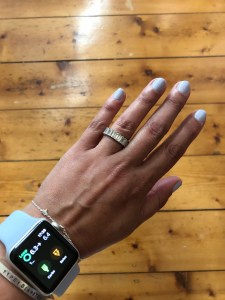
Unfortunately, even with the improved night’s sleep and more time in range, I still wasn’t thinking clearly enough when I chose this colour for my nails. I’ve no idea what to blame for that ill-advised choice, but probably should have learnt by now that awareness raising for diabetes does not need to extend to blue nail varnish. Alas, I have not …
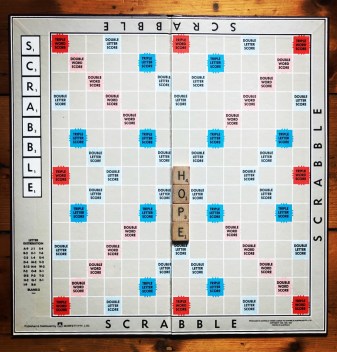
The kid and I have been enjoying some fierce Scrabble battles. At this stage, I am absolutely owning it, and, as a mother who has always subscribed to the tough love approach to parenting, I’m not going easy on her in any way. Plus, I like winning.
I’ve always loved Scrabble. I love the empty board at the beginning and the possibilities of what is about to be laid down. I love turning over the first seven letters and arranging them on the wooden stand, wondering if there is any chance of finding a word that will use them all up as my first turn. I look ahead and try to strategise so that I manage to get the most double and triple world scores. And I play to win. Did I mention that already?
As the board fills up, and letters form different words, I hope for an open board with lots of options to use the letters already in play. I move the tiles around on the stand trying out different arrangements, searching for uncommon words that the kid may never have come across, (because why not use this is a teaching moment?!).
When our game finished the other night, I looked at the words and smiled at the randomness of it all. How did those words all come together; how was that pattern the end result? It was an exercise in haphazardness and chance and, sometimes, a bit of luck.
Just like my twenty years of diabetes. There is no rhyme or reason to most of it; nothing really happened by design. There was (and continues to be) a lot of trial and error. I stumbled on things and added to what I was doing to see if it made anything better. Sometimes, I jackpotted on the equivalent of a triple word score with a J in play. Other times, I called it a day, throwing everything back into the box and starting again. There were times that I looked at what was in front of me and somehow cobbled together something that seemed to work.
If I were to make a Scrabble board of words relevant to my life with diabetes now it would use different words today than when I was first diagnosed, or after five years of living with diabetes, or ten, or fifteen.
Twenty years ago, the words would have been about uncertainty, following what I was told and naivety. There would have been words reflecting the management tools I was first given, and they would have been very different five years later, when ‘pump’ would have replaced ‘pens’ or ‘injections’. Some cynicism and sass would have started to make its way in. Another five years later it would have all been different again, my bolshy attitudes much clearer and on show. Fifteen years of living with diabetes would have seen more technology, words showing how my world had been opened up thanks to online diabetes support networks and more travelling. These days, there would be words like ‘Loop’. And ‘tribe’ to acknowledge those friends with diabetes who have come to be an integral part my story.
There would be words that may be denied in regular Scrabble, but the diabetes version would absolutely approve of words and abbreviations such as DIYAPS, diaversary, Kellion, RileyLink and YDMV.
But undoubtedly, throughout it all, there would be some words that would be played all the time in each game. Words such as fear, anxiety, frustration. And hope. Hope would always be on the board, the first word played at every opportunity. Because it’s always been with me. It’s the thread that has been woven through and held together every part of my diabetes, from that first day to today and every single day in between.
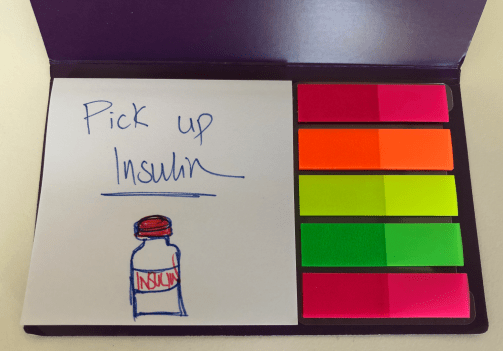
I may use the latest and greatest in diabetes tech, built my own pancreas, become completely reliant on automated insulin delivery, wear devices that send, read and respond to data 24/7. I can set reminders and alerts and alarms and all the fanciest of fancy bells and whistles to help remind me to do diabetes.
But sometimes, the best way is totally old school!
‘When I hear from and read about you and other adults like you with diabetes, you make me think everything will be okay.’
This comment was made to me recently – and not for the first time. I have heard this more times than I care to remember (directed to me as well as to others with diabetes) from others (often newly diagnosed) with diabetes, as well as loved ones of people with diabetes.
While I believe that it is often said as something that is meant to be complimentary, it has become one of the comments I absolutely dread hearing. It’s not a new thing – I have heard people say things like this and similar for as long as I have had diabetes. And I know that I have, in the past, said things like this too – especially around Kellion medal time each year when I get to meet with PWD who have lived with diabetes for far more years than me.
But in recent times, I have stopped saying it, following a conversation with someone who received a Kellion medal this year and read my post about the ceremony. ‘I have nothing to teach you,’ they said to me, as we were chatting. ‘All I do is live with diabetes. I don’t have a choice. It’s not remarkable. It’s just my life. And I get annoyed at people who want to give me a medal for simply living with diabetes.’ We both then giggled at their choice of words because we were, of course, actually speaking about (Kellion) medals, but I think I understood what they were saying.
And it got me thinking to how we speak about others living with diabetes and other health conditions, and what we are saying when we start to use words like ‘inspirational’, ‘brave’, ‘amazing’, ‘incredible’, ‘magical’, ‘motivating’, ‘heroic’ and all the other syrupy superlatives you can imagine.
I have used every single one of those words at some point when talking about other PWD. And people have used these words when talking about me, and I can tell you all I feel is uncomfortable and like an absolute fraud. I’m none of those things. I’m a bumbling mess most days. So it doesn’t sit well at all if the only reason that someone is using hyperboles to describe me is because of diabetes.
And then when someone goes a step further and starts to say a PWD make them feel better about themselves, their situation, or their (or their kid’s) future, that’s just placing a whole lot more expectations on the shoulders of that person with PWD. Or, when someone says that they want to learn from us, suddenly on top of everything else, we also have to be teachers? More weight on an already extremely heavy situation.
Of course, there is a darker side to this. Not always are we seen as beacons of inspiration. In fact, sometimes, people want to hold us up as examples of ‘what not to do’. I cringe every time I hear the suggestion that newly diagnosed PWD should meet someone with diabetes-related complications as a warning of what can go wrong. Absolutely no better is the idea that rather than underlining diabetes-complications as a threat, it’s a good idea to look at PWD living with complications as examples of proof that life goes. I’m pretty sure that’s not what anyone is thinking when they get up in the morning and go about living their life with that complication.
Suddenly, alongside the responsibility of doing diabetes and all that comes with it, (complications or no complications) we are also now responsible for making others feel better and more knowledgeable about their own situation? That just seems like another task to add to the endless demands diabetes already places on us.
And it also seems a little unfair.
It’s true – there are days that some of us may be brave; we may be seen as inspiring; we may amaze you. Some days it may even be me who seems to be some of those things. But not if the only reason you see us like that is because we are living with diabetes. Last Friday the fact that I got up and out the door and to the airport before 6am in matching shoes, stockings, lipstick within my lip line, and a pencil dress that wasn’t wrinkled is actually quite remarkable, and I would be grateful for someone to acknowledge that. Oh, and a couple of weeks ago, there was a spider the size of a saucer on the ceiling of our bedroom and I more than capably dealt with it. You may call me brave for that, because: Australian wildlife. But nothing to do with diabetes.
We are people with diabetes and we do what we can to manage that however possible. We are not here to make other people feel better about their own lives, or allay concerns they have about their loved ones with diabetes. We’re not here to be a teaching moment. An equally, we’re not here to be a cautionary tale. We are just here to muddle through with the lives we have; lives that contain diabetes.
I have always loved this song.

I’m heading to Sydney this morning (it’s early…too early) for the Australasian Diabetes Advancements and Technologies Summit – ADATS, (follow along at #ADATS2018), which had me thinking about the conference last year where I spoke about Loop, scared a shitload of HCPs, was almost traumatised into never speaking again in public (almost – didn’t happen) and was happy to be branded non-compliant.
Today will be a far gentler experience – my role is as a member of the organising committee, and as a session chair. Surely no one will want to sue me for that. Right?
As I ponder that, and reminisce about last year’s talk, here are some links. So many links that I have been wanting to share. So, have a cuppa, have a read, and share stuff.
Also, being deliberately non-compliant is kind of fun…

(Disclosure first: My flights from Melbourne to Sydney are being covered by the National Association of Diabetes Centres (NADC), the organisers of ADATS. I am on the organising committee for the conference.)
_________________________________________
Finally DIYAPS makes it to the mainstream media in Aus
I’d heard of The Saturday Paper, (which was a surprise to the journalist who interviewed me), but apparently not all that many people have. It’s a weekly newspaper (somewhat unimaginatively named – it’s a paper and comes out each Saturday) with long-form articles. One of those articles was about DIYAPS and came about after journalist Michele Tyde heard about the Diabetes Australia DIYAPS Position Statement.
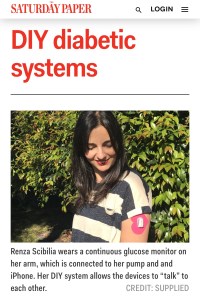
Read the DIYAPS Position Statement here.
The body part is connected to the PWD
‘Talking about the “diabetic foot,” the “diabetic kidney,” or the “diabetic eye” suggests they are somehow separate from the person whose body actually hosts the diabetes. This language suggests the diabetes-complicated body part is more like a malfunctioning car part that needs service – if only we could be provided with a courtesy foot, eye, or kidney to use until our own is better!’
The language at ADA this year (all the way back in June…all the way over in Orlando) didn’t really set off too many alarm bells. Until we had a good look at the program. I wrote this piece with The Grumpy Pumper for diaTribe about how it seems that #LanguageMatters a whole load less when talking about diabetes-related complications…and that needs to change.
Conference blogs
It’s great to see the Ascensia Diabetes Care team continue to support diabetes bloggers by inviting them to write up their thoughts on diabetes conferences. The latest contribution is from Sascha Stiefeling (who blogs at Sugar Tweaks) where he gives some insights into the start of EASD. (It was written in German and translated into English.)
Oh – and here’s the post I wrote for them about the Australasian Diabetes Congress a couple of months ago. (I was not paid to write this, or supported by Ascensia to attend, but I did work with them on their Social Media Summit.)

No weakness at all
On Mental Health Awareness Day this year, UK writer and poet David Gilbert wrote this beautiful post about the strength – not weakness – of living with mental illness.
How we are wrong about obesity
This piece about obesity is a must read. It talks about how weight bias from healthcare professionals and stigma often results in higher weight people avoiding going to the doctor because they fear discrimination, not being believed and being shamed.
More on weight stigma
And read this piece (also on diaTribe) about how weight stigma hurts people and affects health outcomes.
Keep Sight
This week, Diabetes Australia officially launched the first ever national eye screening program, Keep Sight. The program will make it easier for Aussies with diabetes to get their eyes checked. You can read about the program here (from when it was announced back in July).
Disclosure: I work at Diabetes Australia, but was not asked to write about this program. I’m doing so because it is important.

Your story is important
True champion of listening to ‘the patient’, Marie Ennis-O’Connor wrote this wonderful piece about the power of storytelling in healthcare.
Always be kind
I’m always fascinated to read stories from HCPs who write about their experiences on the other side of healthcare. Moving from care-giver to the one needing care can be life-changing. In this BMJ Opinion piece, health researcher Maria Kristiansen writes about how important compassion and kindness from healthcare professionals were for her and her family during her young son’s illness and death.
More on kindness (because we can never have enough)
The first sentence of this article in BMJ by Dr John Launer had me hooked: ‘I’m not a clever doctor, but I’m a kind one’. Have a read.
Diabetes in hospital
I know I’m not the only one to be terrified of needing to go into hospital, worrying about a lack of knowledge about type 1 diabetes treatment and my technology, and having to fight to maintain ownership of my own diabetes care. Adam Brown at diaTribe has written about his recent trip to A&E, surgery and subsequent recovery after his appendix ruptured. Lots of great tips for anyone who may wind up in hospital.
Digital diabetes
How can digital medicine and research, and artificial intelligence transform diabetes? That’s the question research scientist in diabetes, Dr Guy Fagherazzi, asks in his (open source) review in Science Direct that you can read here.
Bake these!
And finally…It’s nearly the weekend and if you have a spare 20 minutes, you really, really should think about baking these! They are crackled parcels of molasses, spice and all things nice and are, quite possibly, one of the best things I’ve ever baked.





 Diabetogenic