
You are currently browsing the category archive for the ‘Pumps’ category.
This week, I find that I have been using an insulin pump for fifteen years. That is just under 5,500 days and over a third of my life. I can’t imagine my life without this technology and the thought of not having an external pancreas is a little scary.
I have spent a bit of time in the last week or so thinking about how far technology has come in the last fifteen years.
Back in February 2001 when I was admitted as an overnight patient into the Epworth Hospital in Melbourne, there really wasn’t much choice when it came to insulin pumps. In fact, there were two and two only – the Medtronic 507C and the Disetronic D-Tron. There were pros and cons to both of them – I had done a lot of research – and I decided that the smaller size of the Medtronic would suit me more, so that is what I used.
This was before the advent of ‘smart pumps’. There was no such thing as a bolus calculator and there was no capacity to even enter BGLs into the pump. It was simply a device that delivered insulin. (Kind of like old mobile phones that did nothing other than make a phone call. Ah, they were the days…Life seemed so much simpler then…)
My second pump was a Deltec Cozmo and this was my first foray into the ‘smart pump’ zone. It was a great little pump and the new bolus wizard technology was terrific. Having said that, I was always pleased that I actually knew and completely understood how to count carbs, and this was particularly important to me at first, or at least until I trusted the technology.
Today, I use a sensor-augmented pump – it’s the latest technology available and it makes my diabetes manageable, more so than any other way I know.
In fifteen years, I’ve never taken a pump holiday. I’ve never even considered it. There have been maybe a couple of times that accommodating the pump has been a pain, but I have managed it with a little lateral thinking. It’s possible that the reason I haven’t switched back to injections when it may have been easier is because I am lazy and the thought of trying to work out long-acting insulin made me weep inside.
(Speaking of long-acting insulin, I have always had some in the fridge, or with me when travelling, in case of pump malfunction. This diligence has resulted in regularly having dispose out-of-date insulin.)
So, when I started on a pump, did I think that I would still be using the same technology – albeit a little more sophisticated – fifteen years later? Probably not. There was no cure back in 2001 and there isn’t one today in 2016. Am I upset about that? Well, I guess that I would really like to not have to think about diabetes as much as I do, (or at all). But no. And not really surprised either.
I see my pump as being as much a part of me as my arm or my leg. It is a pseudo-organ. It keeps me going, it keeps me alive. I’d be lost without it. Is it perfect? No, (as evidenced by my current CGM stream that resembles a rather scary mountain range). Is it what works for me? Yes. At least for now.

Happy pumpiversary!
‘Oh, it’s beautiful.’ These were the words the followed the sharp intake of breath as I saw the Kaleido pump stand at EASD last week. I didn’t say it to anyone in particular – I was wandering the expansive expo hall alone at the time. It was completely involuntary. The stand was a rainbow – I may have said to someone that it looked like a unicorn had thrown up in there.

You can read all about the Kaleido here. This is where you get to read about the specs and the details all tied up in the usual marketing spin that is inevitable when it comes to diabetes devices.
 My take on it – after a long chat with one of the developers – is that this is a nifty little pump. It is simple – really simple – with far fewer bells and whistles than available on other pumps. There is no CGM compatibility. At this point there is no bolus wizard calculator, however, following feedback from customers, the company is developing one.
The simplicity is actually part of the beauty in a lot of ways. Those of us experiencing data burnout might find some relief in a pump that is loud and proud in its claims to be a delivery device. Full stop.
 Enough about all that. What I want to talk about is how it looks. This could be because I am shallow – let’s start with that – but I think there is more to explore in here.
There was a lot of excitement from diabetes people at the event. There were a number of times that in conversations with fellow PWDs the Kaleido came up. Photos were instagrammed and tweeted, with a lot of attention being given to the gorgeous design and kaleidoscope of colours available. (Get it? Kaleidoscope…)
And inevitably, there were comments from people asking if colour is really something to be getting so excited about.
My answer to that is: actually yes.
At the moment, there are people around the world deciding what colour their next iPhone will be. Apple recently announced a rose gold case to accompany the grey and gold already available. People make decisions based on how it looks, the emotional pull, how it will look with what they are wearing.
 So why is it perfectly acceptable for decisions about other tech to be about how it looks and how it makes us feel, but it’s not okay for us to take this into consideration when thinking about which insulin pump we want to use?
Obviously, we need to feel confident that it will deliver insulin accurately, that it won’t malfunction if you look at it the wrong way, or that, if something does go wrong, there is good customer service. Of course all of these things are important.
But if we can assume that it will pass the accuracy test (approval processes are tough!) and that, being a new company, they will be doing their utmost to get their customer service game right, then how it looks and makes us feel is an absolutely reasonable and rational thing for us to consider when making a decision.
The first time I went to EASD (back in 2012), I met Fredrik Debong from MySugr and he said we need to make diabetes sexy. I agree. This is a condition with a serious image problem. MySugr is all about injecting some appeal and fun into diabetes, while producing a product (a kickass app) that people love and use because the functionality is brilliant.
Funking it up a little is a good thing. And this little pump is a step in the right direction!
No – I am not funded by Kaleido. No I did not receive any product. Yes, I did ask when it is coming to the Australian market. There is no official word on that yet, but we are certainly in their plan. The launch markets will be in Europe.

A couple of years ago, when CGM was first launched into Australia, the typical thing happened. The device company took their shiny new product to health professionals around the country, showing off their wares. There were dinners and events and showcases, all highlighting the new technology.
Now, obviously with a product like CGM which requires HCP initiation, it is important to promote the product to the people who will be getting consumers hooked up. I understand that.
Nonetheless, it was with much envy that I saw HCPs being given a trial of the product. They were connected to a CGM and given an empty pump for four days – the number of days a sensor was meant to be worn.
I was desperate to get my grubby hands on one of these. I had read all about CGM and how much people with diabetes living overseas loved it. I read about how it made people feel safer and less frightened about hypos. I learnt that it helped to level out …well…levels. It sounded exciting. I wanted to try it myself.
The HCPs on the trial I spoke to were incredibly dismissive about this technology. Over the few days they were wearing it, I heard comments such as ‘It’s making me obsessive’ or ‘I can’t stop looking at the pump and watching what’s going on’ or ‘When I calibrate it, the numbers don’t match exactly’ or ‘The infusion set insertion process is terrible. I bled everywhere!’
I heard them say repeatedly that the technology was rubbish, that it wasn’t worth the cost, and that all it would do for people with diabetes is make them more distressed and anxious about their diabetes. Plus, it hurt.
Not one of them had diabetes themselves.
I started to get annoyed. I recall sitting with one of them after hearing this pronouncement yet again, feeling quite angry. ‘You know,’ I said. ‘You don’t get to say these things. You don’t get to write off this technology after a few days of wearing it, making claims that it is pointless. This is the latest technology that we have to manage our diabetes. It’s first generation so of course it’s not perfect. The second, third and probably even fourth gen products probably won’t be perfect either. But it is a new and worthwhile tool to help us manage our condition. It is exciting. We are hopeful. You don’t get to trash it.’
I remembered this whilst siting in a session on the first day here at the American Diabetes Association Scientific Meeting. It was a ‘Meet the Expert’ session and the topic was about personal experiences of the artificial pancreas.
Kelly Close (she’s amazing – read all about her here) was talking about her experiences of being involved in trials for a couple of different artificial pancreas projects. It was fascinating hearing about the AP and her excitement about the current technology being trialled – and about what is still coming.
Her enthusiasm was obvious. In fact she actually commented on why enthusiasm and excitement need to be employed when talking about advances in technology. We need to create a buzz and have people talking and asking questions and going on trials and writing (and blogging) about our experiences.
On the panel with Kelly was Chris Aldred (better known as The Grumpy Pumper) whose role in the session was to be the one challenging all the hype. He immediately explained that he had not used the AP, and had some questions. He was skeptical about a few things.
Being skeptical is absolutely okay. We shouldn’t ever blindly accept any new treatment without asking questions, but that actually adds to the buzz. It forces people who have experience with the device to talk about the good things and its limitations. It also helps alleviate a lot of the concerns people may have.
I thought back to my experience with the launch of CGM back home. When the HCPs who were privileged to try the then-new tech were trashing the product, I wish that there had been a voice to be able to respond to those concerns. I wish that the trial of the product had been extended to people with diabetes who could see it for what it was and how its application worked in the real world. And who could share their experiences – absolutely the good and the bad – with other PWD.
That’s exactly what I did when I finally got to try CGM. You bet the first gen was clunky. It did have accuracy problems and I did bleed a little most times the sensor was inserted. But whoa! It was amazing technology for the time and made a huge difference to me. When I understood how the trends worked, I knew how to respond to them. I could address things before they became problems.
I left the AP session on the first day pretty excited and inspired. And wanting to be part of the buzz – either as a trial participant or as someone on the periphery talking about it, reading about it, hearing people speak about it.
Read more at diaTribe where Kelly shares her AP trial experiences.
Last night, I rather smugly put this picture up on my Instagram:
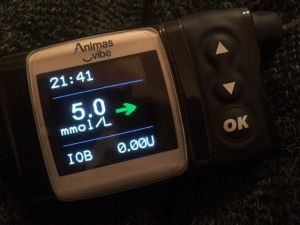
‘Look at me,’ the picture screams. ‘I am winning at diabetes!’
And then, this morning, after eight hours of uninterrupted sleep, this was how my pump screen looked:

W.I.N.N.I.N.G.
So, riddle me this, why did I wake – after eight hours of uninterrupted sleep – feeling so completely and utterly exhausted? I wasn’t up overnight to go to the loo or let the dog out or deal with a low blood sugar. I just slept. Peacefully.
There was no explanation.
Until I looked at this:
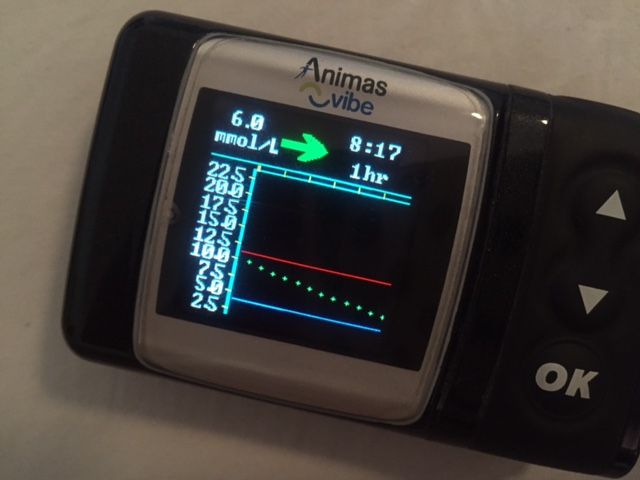
And this:
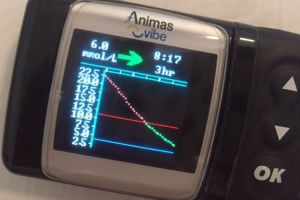
And this:

And then it all made sense. Except it didn’t. How had that happened? Had I sleep-walked into the kitchen, sleep-baked a pavlova and sleep-eaten it? Had I reached over in my sleep and eaten some of the jelly snakes on my bedside table?
The answer is no. All I had done in those eight hours was sleep.
Without my CGM on, I would have had that pre-bed BGL and the morning BGL as the only pieces of information. And it would have looked damn pretty. I would have spent all day thinking about how lovely and pretty and stable by BGLs had been overnight.
But with my CGM on, I know a lot more.
Which is great, except I’m not sure that I want to know. Because now I feel like I have to do something about it and quite frankly, I am still not in the headspace to be analysing glucose levels and making basal changes and being all diabetes-smart.
My CGM is on this week as a security measure. I really didn’t feel like putting it in, but I knew that I needed to. I am counting down until I can rip it out on Friday morning, which is a far cry from trying to get as many days as possible out of each sensor as a cost-saving measure.
I now know why I am not feeling particularly rested, but I feel even less rested with all this information at hand. THIS is when data is paralyising – when we just don’t have the ability – for whatever reason – to do anything with it and all it does is overwhelm us. Ever more.
I was sitting on the bed in my underwear, a towel wrapped around my wet hair, doing a full set change on my pump.
Mornings are a little hectic around our place. I am a pretty organised person but despite best laid plans, mornings still have the potential to head into a disordered mess. I blame the dogs – especially the puppy – who in their cute four-legged way have the potential to derail the morning routine.
But today, everyone was calm and just getting on with the job of getting themselves sorted and out of the house at the right time. Even Sooty was minding her own business, quietly chewing on a pair of Aaron’s socks in a corner.
The kidlet climbed onto the bed next to me to speak about something that was happening at school that day, talking a million miles an hour and brushing her hair at the same time. Excellent multi-skilling!
Without missing a beat in her commentary (or grooming), she watched me draw insulin into a new cartridge, flick the outside of the syringe with my finger and push a few tiny air bubbles out, a little spray of insulin heading into the air. I inhaled, thinking what I always do when I smell insulin, ‘The smell that keeps you alive’.
I connected a new line, loaded the cartridge into my pump, tightened the cap and primed. A couple of drops of insulin fell onto my bare legs.
And then, I peeled away the tape, pulled off the blue cap and pushed the cannula into my skin, quickly pulling out the introducer needle.
At that point the kidlet stopped speaking to me about school, her hairbrush poised mid-air.
‘Ouch,’ she said. ‘How can you do that and say it doesn’t hurt?’
‘It doesn’t,’ I said simply. ‘At least, not much. And that one really didn’t hurt.’
I feel that diabetes has desensitised me to so much. I have become more accepting of my own mortality and, even though I don’t like to think about it, I am resigned to a shortened life span. As I age, I expect limiting complications. I accept pain more readily. I know that my health cannot be taken for granted and that my immune system has the potential, at any given moment, to do something stupid. There are days that I feel an exhaustion that I am sure is connected to diabetes, but deal with it by simply getting on with things. I wear robot parts on my body and no longer even bat an eyelid when I catch a glimpse of them taped to my skin.
And I don’t feel the pain of needles anymore.
I looked at our beautiful daughter. ‘You would be surprised at what your body and mind are capable of, darling,’ I told her. ‘These things keep me healthy. I’ll do pretty much anything for that.’
She hopped off the bed and headed into the kitchen for her breakfast. I threw on my clothes for the day, gathered up the rubbish – the used pump line and cartridge, and packaging from the new ones – and followed her into the kitchen.
The smell of insulin lingered in the room.
Last week, Australian social and mainstream media was abuzz with exciting news of a diabetes breakthrough. This filtered through to international media.
Labelled as an artificial pancreas, the new device was covered in online and print newspapers, as well as television news bulletins. The reason for the excitement at home was because Australia is the launch market for this new technology.
Exciting stuff!
Well, yes and no.
The device in question was not really an artificial pancreas. Rather, it is the next generation integrated pump/CGM system to be launched globally.
Technology advances are really important and we should get excited about them, and their promise of improving the lives of people with diabetes.
But reporting honestly and correctly is also really important.
Let’s be clear about the device that was launched last week. It is a pump with a CGM. The real advance is that together they have the potential to predict hypos and turn off insulin delivery, thus (hopefully) preventing hypos.
This is, indeed, an advance in technology.
This is not, however, an artificial pancreas.
There are a number of problems when diabetes advancements are not communicated effectively and correctly. Firstly, the way the reports read last week, this technology would eradicate hypos completely. As far as hopes for diabetes go, living hypo-free is surely something we would all dearly love.
But while this tech MAY help in reducing hypos, it’s certainly not going to eradicate them.
There are still problems with sensor accuracy that need to be addressed before we can be comfortable in saying that CGM technology (whether purely as a ‘warning system’ for impending hypos or being combined with a pump that will switch of insulin administration) removes the risk (and associated fear) of low blood sugar.
Whilst this technology is a step in the right direction, it is not an artificial pancreas. It is not the holy grail.
Diabetes still needs attention, still needs research, still needs funding, still needs donations. We are not there yet, and any report that even suggests that is, I believe, detrimental to continued efforts looking to further improve diabetes management.
All of us who are communicating in any way about diabetes have a responsibility to be truthful, honest and, as much as possible, devoid of sensationalism.
Get it right when we are taking about it and hopefully the mainstream media – who, let’s be honest, have an incredibly rudimentary knowledge base when it comes to diabetes – will hopefully follow suit.
I am really excited about the potential of this new pump and GGM combination and I am fully aware that it may be of significant benefit to many people living with diabetes. I know just how beneficial CGM technology is.
But tell it like it is. Report responsibly. And keep the understanding of what living with diabetes – and the technology we use – real.
This is just so beautiful! Enjoy for your Friday and have a great weekend.
I got a new car a couple of years ago and in pure German auto-engineering genius, there are alerts and alarms and warnings for absolutely everything! I thought that this was wonderful and a sure sign that I was driving the world’s safest car.
Until the alarms started. The car has front, rear and side sensors. This is ostensibly to assist with parking. Now, I’m a great parker – I’ve lived in inner-Melbourne for a long time. I can negotiate a tight parking space incredibly well and love to prove people wrong when they dismissively pronounce ‘You can’t fit in there.’ ‘Oh yes I can, ye of little faith! Just watch me!’
Despite my superior parking abilities, I was more than happy to have a bit of technology to help out and make things even easier. I got used to the lights that flashed like a Christmas tree when I was getting too close to the car in front and the gentle beeping that became more and more persistent as I approached any object.
After two days of driving, I called the dealer, asked to be put through to their service centre, asked to speak to the senior mechanic and said ‘turn those effing sensors off.’ ‘Ha ha’, he laughed in a German accent. ‘Not possible!’
The problem wasn’t that the sensors weren’t helpful when I was parking; actually, they were great. The problem was that they went off when I didn’t need them to.
Sitting at a red light, the front sensors would sound if someone walked too close to the bonnet of the car. If a bike came too close to the rear or side, the sensors would go off too. Why? If I am stationary and someone is walking too close to my car, surely the alarm should be for them, not me.
It turns out, that there was no way that I was going to be able to have the alerts turned off.
My insulin pump has been designed by someone trained in German auto-engineering sadism genius. Again, there are alerts and alarms for everything. Connect it to my CGM and it makes vibrating sounds all the freaking time. The soundtrack to my life is a buzzing, beeping little box.
Now generally, these alarms are great – especially the ones that alert me to rapidly falling BGLs BEFORE it becomes a hypo problem.
But some of the others drive me nuts.
The YOUR BLOOD SUGAR IS ABOVE 14. DO SOMETHING NOW. DO SOMETHING NOW. DO SOMETHING NOW alarm is unhelpful to say the least. This one comes up when I am entering my BGL meter result into my pump to give myself a correction bolus. This frustrates me no end and usually results in me having this conversation with my pump (we will workshop that last statement another day):
Firstly, I know my BGL is above 14, you judgemental little pump, because I just did a BGL check on my meter and it told me (in a significantly LESS judgemental way). I am entering it into your system, you judgemental little pump, so again, I know what the number is. Also, I am plugging it into your correction bolus wizard so you can do some clever maths and tell my how much insulin I need in order to stop being so high. So quite frankly, you and this particular little alert can shove it up your judgemental little pump-ass.
This alarm cannot be turned off.
The problem with all the alarms and alerts (and bells and whistles) is that we stop responding to them. I know that I almost never wake up anymore when my pump alarms. Sometimes, it’s just telling me that the battery is getting low and I should change it. That’s an alarm that can wait until morning, rather than causing pump-alert-anger in others woken by the incessant noise.
I understand that the main reason for these alarms is safety. I really do get that what the pump company (and car designers) are trying to do is alert to and reduce risky situations.
But when there are so many alerts and alarms and warnings, having to deal with the ones that are less important to us means that we can stop paying attention to all of them – including the really useful ones! I know that’s what I do.
In my perfect world, my perfect pump will be completely customisable and only warn me of things I really need to know. Actually, in my perfect world, I won’t have diabetes. But for the sake of this, in my perfect world, I have perfect diabetes that is managed by my perfect pump. Perfect.
I’m in Canberra today, at Parliament House, for a lunch event focussing on diabetes technology. As usual, I’m surrounded by a group of smart people such as Professor Jane Speight and Professor Alicia Jenkins. Me, in my role as a non-professor, is to provide the consumer perspective about why freedom and choice when it comes to  diabetes technology is something that should be supported by government.
Today, Diabetes Australia is launching an important new report about insulin pump therapy in Australia. It provides recommendations and the case for action, and gives a snapshot of the current situation – not only of pump therapy, but other technologies such as continuous glucose monitors. Pleasingly, and with a nod to the future, emerging technologies such as the ‘bionic pancreas’ are also mentioned.
The report highlights the inequality of current pathways to access pump therapy. If you are unable to afford private health insurance, or not under 18 years of age and meet the eligibility criteria of the Government funded Insulin Pump Program, you are left to self-fund the purchase of a pump. At around $9000 that’s a lot of loose change to have lying around under the sofa cushions.
Sensor technology is not funded at all, leaving people with diabetes to find the dollars themselves. For me – and many others – being able to use a sensor-augmented pump gives incredible peace of mind, and reduces diabetes distress. It is not fair that this technology is out of reach for most people.
I’m really honoured to have been asked to tell my story to the group of MPs who will be at the lunch. In my time doing this job, it has become more and more apparent that having people hear and understand how living with diabetes impacts us on a day to day basis helps to bring the message home about life with a chronic health condition.
Living with diabetes cannot be tied up neatly in a box – it is complex, changes all the time and is different for everyone. Being able to manage our condition should be a matter of choice – not finances. Hopefully today the group of politicians hearing us will understand that a little bit more and start working towards developing an approach to pump therapy (and related technologies) for all Australians with diabetes.
DISCLAIMER
I work for Diabetes Australia – Vic and have been involved in the development of the resource being launched today.
One evening last week, I was in bayside St Kilda and I looked up, expecting to hear screams. But Luna Park was dark and closed for the night. The rollercoaster was still.
How I wish I could close down the rollercoaster of diabetes – even for just one night.
After the deliciously weird hypo I had early Sunday morning, I thought that I’d bought a bit of time off the rollercoaster. It wasn’t to be.
I woke early Monday morning, this time feeling revoltingly high. I jumped up and made it to the bathroom in time to throw up. My BGLs were in the mid-20s and I had mild ketones. Where the hell had that come from? I was perfectly fine when I went to sleep around 11pm.
I had done a set change yesterday afternoon and wondered if that could be the culprit. Not wanting to wait around to see if the correction dose I was about to bolus would work, I ripped out the site and sure enough, a nasty kink in the end of the cannula. That thing wasn’t delivering anything.
I inserted a new line, bolused, set a temporary basal rate and drank a litre of water.
By the morning when my alarm went off, my BGL was a far more respectable 8mmol/l and the ketones had all but disappeared.
I got ready for work and felt like my whole body was wrapped in cottonwool. I felt fuzzy and everything sounded a little muffled. It took until midday (and three cups of coffee) to stop feeling that I was listening to everything in a tunnel.
Two consecutive nights on the diabetes rollercoaster equals exhaustion. And frustration. And feeling overwhelmed.
Last night, I climbed into bed quite early and fell asleep pretty much straight away. And slept through. The rollercoaster was indeed closed last night.
The day after I was diagnosed with diabetes, I was sent to see a dietitian. It was over 16 years ago and yet I can still remember so much in such clear detail. ‘You need to eat this amount of carbs,’ she told me, throwing down a rubber food model of what was meant to represent mashed potato, but really looked like a fake vomit toy that you might find in a novelty show bag. ‘In a year?’ I asked her incredulously, calculating that there would have been the equivalent of at least four huge potatoes in the model. ‘No. Each meal.’ She said.
This was pre-DAFNE, pre-Lantus and, for me, pre-pump. But despite understanding that I was going to need to make some changes to the way that I was eating, I was also sensible enough to know that there was no way that I could eat that quantity of anything in one sitting.
‘Well, you have to!’ She said. As you can imagine, I really wasn’t enjoying where this consultation was going. ‘You’re taking insulin and you need to eat that much carbohydrate.’
‘Okay. Perhaps I could take less insulin then so I wouldn’t have to eat as much?’ I asked. She looked at me as though I was stupid.
After three years of living with diabetes – trying to manage force-feeding myself enough carbs to not hypo – I started using a pump. There were many reasons behind this and one of them was that I craved the spontaneity and flexibility that I seemed to have lost since being diagnosed. I was sick of having to eat what seemed the equivalent of a loaf of bread every time I sat down to eat. I was sick of having to eat snacks of carbs in between each meal of carbs. And I was sick of drinking corn-flour milk before bed to avoid a crashing hypo, or waking ridiculously high, which was pretty much all that Protophane could manage.
A week or so into using my pump, I remember feeling slightly weird. ‘What’s that feeling? I must be low.’ Nope – BGL check was fine. I couldn’t work out what it was.
And then I realised. It was hunger. I’d not felt hungry for three years because I had been eating to the clock. My body never had time to actually feel like I wanted or needed to eat.
Today, I eat as many or as few carbs as I want. There are days where barely a carb would pass my lips. And then there are days that end with a late night piece of cheesecake and Italian hot chocolate. I simply bolus (or don’t) as required for whatever I feel like eating.
Many people within the diabetes community are huge advocates for low carb eating believing that such diets provide more stable BGLs. I concur with that – the days that I eat sashimi for lunch and a low carb meal for dinner generally result in a level graph on my CGM with few spikes – and fewer dips too. But I am not committed enough to dedicate myself to a purely low carb existence.
Perhaps it’s because I don’t want to simply replace the inflexibility of needing to eat carbs with the inflexibility of never eating carbs. I love food too much to subscribe to any plan that does not allow me to eat whatever I want. Such as doughnuts! Nutella doughnuts need to feature whenever I feel like it. Buon appetite!





 Diabetogenic