
You are currently browsing the category archive for the ‘Healthcare team’ category.
The other night, I drove through the pouring rain to Geelong to speak at an information session for healthcare professionals about CGM technology. The event was run by AMSL, the distributors of Dexcom here in Australia (the disclosure song and dance can be found at the end of this post).
I sat on the panel with Dr Natalie Harrison, a terrific local endocrinologist (oh – how’s THIS for a bit of disclosure – we went to kindergarten together!!) and paediatrician and diabetes technology champion, Dr Peter Goss. I was there to bring the overall IQ of the panel down, share the ‘living with CGM’ story and be the point of difference between the glossy information presented by the CGM company.

On the left – the numbers of all readings in the glossy propaganda (it’s about 6.2 in our language). On the right – real life.
Both presentations by the doctors on the panel were enlightening. They clearly showed how CGM could be used in a number of different scenarios. The thing I particularly enjoyed was how both speakers are using this tech as tools of empowerment for the adult or child with diabetes – not for any other reason. Both repeatedly said that although in most of the cases they presented, there was a reduction in HbA1c, the biggest benefits to the PWD was improved quality of life. (I may have done a little fist pump each time they mentioned that!)
Examples included shift workers, tradies working on construction sights, exercise nuts, kids, adults, teens – demonstrating a terrific cross section of the diabetes community who may – and indeed have – benefitted from the technology. There was also a discussion about how CGM is useful in specific target groups and situations, with a considerable time of the discussion being about low carb diets and CGM. (And can I say just how refreshing it was to have this discussed with little judgement from the speakers. Too often LCHF or just LC is dismissed by healthcare professionals without any willingness to accept that there are many people who are using this as part of their diabetes management and achieving excellent results.)
Dr Goss also mentioned how useful CGM tech can be for families where ‘dead in bed’ is a real concern because it can show families just how stable glucose levels usually are overnight, and therefore may help reduce a lot of the anxiety parents feel. (There was also a discussion about the significant emotion around DIB and how it is frequently overplayed. This is really important because while one person dying from DIB is one person too many, it is thankfully a very, very rare occurrence (as shown in all local and international literature). The fear and the risks need to be in perspective and unfortunately, that is not the case at all times, and the anxiety it is causing is unnecessary.)
After the official, smart speakers finished, I stood up. At this stage, the AV equipment had called it a night, so I put aside the few slides I had developed, and shared a few things.
I spoke about why I love this technology and why I choose to use it pretty much all the time. But I also spoke about its limitations – specifically the emotional and psychological barriers that are of concern. I raised the point that reluctance to use CGM by PWD could be for myriad reasons and to never assume what that reason is (this was in direct response to the suggestion from one of the speakers that often PWD refusing to wear CGM have something to hide). I suggested that for some, it is a huge step to agree to wear something attached to one’s body all the time – something that provides a lot of confronting information, beeps, alarms and can be downright annoying. This is not a small consideration – it is big!
I also spoke about the necessity to customise just how PWD use the technology. I explained how I turn alerts on and off, depending on how engaged I am with my care. I could see that didn’t sit well with everyone so I tried to explain that being able to deal with – and respond to – a couple of alerts, is better than having the all on and doing nothing because it is too overwhelming. Or simply not wearing the technology at all.
And I also spoke about how what I do to make CGM work for me, even if it is against the direct advice of the company – and HCPs. Case in point, my sensor and transmitter are on my arm at the moment. I have found that recently, I get better readings and the sensors last longer if that’s where I site them. I also leave the sensors in for a lot longer than the suggested 7 days. (Peter Goss concurred with both those statements saying that most of the children and adolescents he sees prefer to wear sensors on the upper arm. And there was a bit of a ‘who leaves their sensor in the longest’ discussion, with Dr Goss sharing that the record in his clinic is 26 days. I did disclose that while I have a mental block about going beyond 21 days, I know people who have doubled that!)
This is why it is important to hear directly from people who use the technology. While both doctors shared case studies, the focus was really on how CGM helped smooth out glucose lines. And of course that’s important. But equally important is the way we manage the technology in our life, because if we can’t find a way to get it to work for us, we won’t wear it. After the presentations, a couple of HCPs thanked me for being there and said that I had raised a number of things that they just had not considered before – all things that are usually missed when a PWD is not part of the discussion.
And it served as a reminder again that even though it is terrific to have people with diabetes represented in some ways in presentations at these sorts of events (or conferences, meetings etc.), the only way to hear the real story is to hear it from someone living it.
Thanks to AMSL for inviting me to speak, but more so, for putting a person with diabetes up there on the panel. We belong there.
Disclosure
I was invited to speak at this event by AMSL Diabetes, Australian importers and distributors of Animas and Dexcom. I was provided with product to speak at this event…. The team from AMSL did not hear or see my presetantio prior to the evening and the only direction I was given was to share my experience of using Dexcom. Which I did – the good, the bad and the ugly.
(For the record, although not really relevant, but I’m disclosing the crap out of everything here, I also use an Animas pump. That was wholly paid for by my private insurance company whose premiums I pay each fortnight through clenched fists of frustration as their premiums continue to rise. I also pay for the ongoing consumables needed to drive said pump.)

Day 4 of #DBlogWeek and I have now read every single post from yesterday about diabetes and language and I was so interested to hear all the different perspectives. Not slowing down yet! There are still many blogs to read!
Today’s prompt: Most people who live with a chronic illness end up with a lot of experience when it comes to dealing with healthcare. How would you improve or change your healthcare experience? What would you like to see happening during medical visits with your healthcare team? How about when dealing with your health insurance companies? What’s your Healthcare Wish List or Biggest Frustration? Today is the day to share it all!
Before I was diagnosed with diabetes, I had very limited experience dealing with healthcare. I remember those days fondly because now, with my frequent flyer status firmly entrenched as Platinum, I feel that I have had far too much experience.
However, for the most part, the frequent flyer program I am part of isn’t that bad because I have been able to tailor it to my needs. I have selected a team of HCPs to meet my needs and respond to my particular quirks.
So, I am going to turn today’s topic on its head a little and write about the really positive things that I encounter in my healthcare.
- The respect I receive at all times from the HCPs I have chosen.
- The access I have to my team. They have kindly handed out their after hours contact numbers and are happy for me to reach out to them via email. I have never taken this for granted or abused it and only ever have contacted them when I have absolutely needed it.
- Because I see the same HCPs every time I visit (because I pay to see them privately), there is no need to go back and start from the beginning, explaining who I am and my convoluted medical history. They know me; they know why I am there.
- Not one of my HCPs believes that diabetes is the most important part of my life and therefore understands that there are many times I will show up to an appointment unprepared. And there is no judgement from them for this.
- My HCP team also understand that diabetes is far more than a condition of numbers and are incredibly aware of the emotional aspects of living with diabetes. My endo and GP have been quick of the mark on several occasions suggesting I see a psychologist. For this, I am very grateful.
- A couple of my HCPs know just how valuable peer support networks are. They ‘get’ that the people living in my computer are as critical to my diabetes wellbeing as my visits to them. Even better, I know they pass this information on to other people with diabetes they see.
- I have an ‘indefinite referral’ to my specialists, which means I don’t need to see my GP each year asking for another referral. I also have ‘indefinite diabetes’, so this is useful!
- Our public health system is far from perfect, but when I have had to use it, for the most part it has been brilliant.
- Our National Diabetes Services Scheme (NDSS). I was registered the day I was diagnosed which meant that I have had access to subsidised diabetes supplies since then. It still costs money (although syringes and pen needles are free), but it is heavily subsidised.
- And while talking about the NDSS – once registered, that’s it. There is no need to prove that I still have diabetes or that I still need access to strips or pump consumables.
- Insulin prescriptions are easy to fill – a simple call to the pharmacy and the next day it’s waiting for me to collect for the total of around $40. And that lasts me about two and a half months.
- Insurance in Australia is nowhere near the nightmare issue it is in the US. I choose to pay for private insurance for the simple reason that I want the full cost of my pump covered and I want to be able to choose the HCPs who treat me. My premium is not in any way affected because I have diabetes nor can I be refused cover.
Of course, there are things that could be better. Access to technology is one of those things – and by that I mean easier, more affordable access with a HCP workforce equipped and educated to work with us. We need swifter and smoother access pathways too, so that when new tech or drugs arrive on the market, they are approved for use and being utilised by PWD as soon as possible.
Outside Australia, there is much to do to improve access to basic diabetes needs.
And finally, what I believe will go a long way in improving the healthcare experience for people with diabetes is to better consult with us. We need to be part of the development process of systems, programs, services, devices. There needs to be better listening of, and engagement with us. Because only then will the people creating the healthcare experience we have to use understand what we truly need.
Growing up, when I infrequently visited our family GP, he was always referred to by his first name. I do remember when we were really young putting a ‘Doctor’ before his first name, but we never referred to him by his surname. He was always ‘Dr Sam’ until he became just ‘Sam’.
Since being diagnosed with diabetes and becoming a frequent flyer of healthcare services, I have only ever addressed HCPs by their first name. (Except my endo who frequently gets referred to by her first and middle name together, but that is because my kid has the same middle name (named for my endo) so when speaking to and of each other, we use both names..)
When meeting a new HCP, I will walk into a first appointment, hand extended as we do our introductions. I always say, ‘Please call me Renza,’ although I don’t know that I have ever had a doctor not call me by my first name in the first instance. In fact, usually, when called in from the waiting room, they do so by using my first name.
So it’s probably not surprising that I found myself prickling a little as I read this article from a couple of months ago, written my an oncologist from the US. James Salwitz MD tells the story of a new patient – an elderly man who attended with his adult son. The son insisted on calling Dr Salwitz* by his first name which, apparently, was a little unnerving for the doctor. He referred to it as a cultural faux pas, suggesting that it was being done to… ‘diminsh the power and value of my experience, control and guidance.’
Now, I know it is possible that there are some cultural differences here. In Australia, we seem to have a far more relaxed attitude about being formal. And we also don’t necessarily consider that using someone’s first name shows a lack of respect as suggested by Dr Salwitz and some of the commenters at the end of the piece.
I asked a few people – also regular users of healthcare – and most said they used only first names. A few said they would always refer doctors by their titles, but nurses by their first names. This raises another point about the hierarchy of healthcare professionals. I’m not sure why one would be more inclined to use Dr Diabetes for the endo, but not Ms/Mr Diabetes for the nurse.
I treat and regard my healthcare team with nothing other than respect. I speak to them with respect, I respect their time and how busy they are, and I recognise their professional expertise. How I address them does not diminish this respect, nor undermine their qualification.
What was not clear in the article I read was how Dr Salwitz addressed the person he was treating (or his son). If there was an expectation from doctors that they are addressed by their professional title, then surely they should demonstrate the same courtesy (if that is what it is) and address their patients by their title and surname.
Any discomfort can be solved at the first greeting. This is one of the reasons the #HelloMyNameIs campaign is so important. Clear introductions from the beginning establish how people would prefer to be addressed. If unsure, the question ‘Is it okay for me to call you by your first name’ can be asked by both physician and consumer.
Feeling comfortable in our medical appointments is necessary if we are to get the most from the limited time we have before our HCPs. And for that to occur, there needs to be mutual respect and no imbalance of power. I feel very fortunate to have that with my team.
*Thought is best to refer to Dr Salwitz by his title throughout this post.
I frequently refer to myself as ‘the difficult child’ – not so much in my family setting, because there I am clearly the perfect daughter (just ask my sister!). But professionally, I am sometimes difficult because I have been known to ask a lot of questions, think outside the square and am a risk taker.
And I would also be termed difficult in other settings.
For example, I am, according to this article, what would be considered a ‘difficult patient’, a term that I really struggle to understand.
Anna Reisman MD, an associate professor at Yale School of Medicine, wrote the article, sharing a recent conversation she had with some med students who asked ‘can’t these patients stop with all the questions?’ instead, wishing for patients who simply listened and did what they were told. They wished for ‘easy patients’ rather than ‘difficult’ ones.
Living with diabetes can be difficult. It doesn’t behave how we would like it to or how we expect it to. It makes us frustrated and angry and sad and annoyed. It makes us want to try different things as we hope to get better results and see in-range numbers. And sometimes – often – we are the ones searching, Googling, asking others and wanting for more and better and different treatments.
When I ask questions or walk into a HCPs office asking to try something new, I am not being difficult or questioning their expertise. I simply want a discussion about how I can improve my health.
The only reason I manage my diabetes the way I do is because I researched, asked questions and told my HCP it was what I wanted to do. I wasn’t being difficult when I first raised the idea of ditching MDI for a pump. Nor was I being difficult when I asked about CGM. Or when I wanted to change to a different insulin.
I was looking for ways to make my diabetes less difficult – because it is a difficult monster! It is not the person being difficult. It is the condition. And this clarification is important.
I think frequently the term ‘difficult’ is used instead of the word ‘empowered’ or assertive – neither of which are interchangeable with ‘difficult’.
In the article, Dr Reisman offered some excellent advice to the med students explaining why patients who do ask questions and want to take charge should be celebrated – not discouraged. And she ends the article with this pearl:
‘Don’t dread patients bearing questions, I told my students. Welcome them. They’re some of the best teachers you’ll encounter.’
I can’t think of a better way to explain it!
I read a few other pieces by Dr Anna Reisman and this is another brilliant take on the expertise of patients.

Always difficult. I mean assertive.
This morning, I drove my car straight into the tyre shop across the road from work. By the time I had turned off the ignition and stepped out of the car, a kind looking mechanic was standing next to me.
‘Morning, what can we do for you today?’
‘I haven’t made a booking, but I was wondering if you could help out. I need a tyre replaced and, while it’s in here a wheel alignment. Any chance you could do it today?’
‘Not a problem,’ he said. He walked around the car slowly. ‘You know, both those front tyres could do with replacing. Would you be happy for us to do that?’
We had a chat about options – he showed me photos of all the different tyres that would work on the car (all looked the same to me) and discussed the pros and cons of each. After I decided, I walked out of the shop, with the mechanic promising to call if there were any problems.
Service with a smile!
As a customer/client/stakeholder/friend/’insert latest buzz word here’ I like to feel that I am somewhat valued. I like to feel that I am not inconveniencing the person offering the service and I like to feel like my custom is appreciated.
Which was how I felt this morning as I walked out of the tyre shop.
And it’s exactly the opposite of how healthcare frequently makes us feel. It’s a system that is set up to be customer-unfriendly. And it’s what we – the users of the services – have come to expect. And sometimes, to accept.
From trying to get an appointment, to actually walking in the door, to collecting test results, the process can be difficult, convoluted and confusing, with roadblocks at every turn. Here are just a few things that you may come across as a user of healthcare.
- You need to see a new specialist, so you call to make an appointment. Most likely, the first thing you are told is that there will be a wait before the specialist can get you in. Possibly a long wait. A very long wait. Sometimes, you are told that new patients are not even welcome at this point in time. Sometimes you are told that you cannot actually make an appointment until your referring doctor has faxed (yes, seriously, FAXED!!!) across a referral.
- If you are lucky enough to actually get an appointment, a barrage of Things You Must Do are read out to you: Referral letter (if you have been allowed to make the appointment without one); get there early to fill in the forms; bring test results; bring x-rays etc. etc.
- You may be warned that if you do not show up or call within 24 hours (once I was told within a week!), you will still be charged for the service.
- If you have managed to get through all of that and still decide to go, then once you arrive, you are faced with a frequently unfriendly and unwelcoming receptionist who is there to basically act as a buffer between you and the doctor.
(Side note: I am going to say that I know that this is a thankless job at times. Many people think they are the most important person in the world and these same people think that the doctor should be bending over backwards to accommodate them. However, in my experience, most people do not think that way. I know I certainly don’t. Also, I have had many experiences of wonderful support staff greeting me when I have an appointment. The staff at my endo’s office are friendly, polite and delightful. At my GP, it is touch and go – some are lovely, one in particular makes me start to sweat in fear!)
- At first-time visits, you are given a clipboard with a wad over a paperwork and told to fill it all in. (This is where I weep a little and just wish that a centralised electronic medical system that worked was available and easily accessible so that I could simply write down my details and pass that over and all my information could be magically brought up on a magic computer.)
- Eventually, after having filled out the forms and provided information about every aspect of my life, the file gets returned to the reception desk and is often greeted with the words: ‘The doctor is running late. About 30 minutes.’ At this point, I sigh and possibly ask (as politely as I can) why I wasn’t told this when I called before going in to make sure that the doctor was running on time – a call that I made only 30 minutes earlier. Steely silence. No answer.
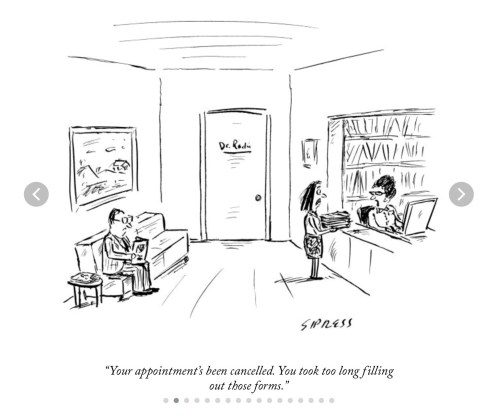
(From this week’s New Yorker’)
So, let’s just recap. It has taken months to get into see this doctor and I wasn’t even granted an appointment until I had jumped through so many hoops that I now also needed to see a physiotherapist because I had put my back out; when I eventually get there, I spend ages filling in information that I know is hardly going to be relevant. And now I am told that after having arrived early so that I could fill in the forms that the doctor is running about 30 minutes late and that I just have to deal with it.
(I’m not going to write about the actual doctor experience, because we know it can be good, it can be bad, it can be disastrous ‘This isn’t going to work, but thanks for your time. I’ll just go pay my bill…..’ which is something that happened when I was interviewing endos a few years back.)
- You leave with another ream of paper – prescriptions, test requests, perhaps another referral letter and are told to call back in a week’s time to get the results.
- But a week later when you call, a new dance starts. ‘No, you can’t speak with the doctor,’ you are told, when you say that you are calling – as requested – to get results. ‘The doctor speaks to people between 1 and 1.15 Monday and Thursday. You’ll need to call back then.’
- You ask if the doctor could either call you back or even email me the results, which gets a response of horror, ‘No we do not correspond via email. The internet is not safe.’ (I at this point, do not say what is going through my head – ‘I do all my banking on the internet and I am not concerned about privacy there. And I am certainly not likely to care who knows what my hand X-ray shows.’ Because there is no point.
- After about four attempts, you eventually get to speak with the doctor who will probably (hopefully) tell you that all is clear and to make another appointment for 12 months’ time.
- It seems that every part of the system is designed to keep apart the two people who actually need to be in the same room, looking at each other and truly engaging.
And this is deemed okay?
It’s not. How many of us would return to a shop if we were treated this way. Even if the people we are speaking with are lovely – which is usually the case – the system is ridiculous. It’s broken, seemingly beyond repair. And I can’t think of any other service where the customer is considered an annoyance. Can you think of any other service where the customer is treated this way?
I just had a call from my friendly tyre mechanic. My car is going to be ready an hour later than he thought and he wanted to let me know. I thanked him and commented on how much I appreciated the phone call. I was probably a bit gushy as I am when impressed with the service I’m receiving. ‘Not a problem at all,’ he said. ‘We like happy customers.’
And I like to be a happy customer!
When I look back at the numerous (i.e. far too many) encounters I have had with healthcare professionals, some stand out. Fortunately, a lot of the time it is because the care I have received has been outstanding and delivered by wonderfully caring and respectful professionals. But there have been times where the experience was no so good.
One of the stories I tell when speaking to medical students about what makes for good communication comes from a very difficult time. I was in hospital with terrible stomach issues. A new doctor had been referred to me and for the ease of this tale, we will call him Professor Poor Communication Skills – Prof PCS for short.
Prof PCS was an expert in his field and by the end of my time in hospital, I actually quite liked him. He was loud and direct and I appreciated his no-messing-around attitude. Plus, he worked out what was wrong with my stomach, stopped the pain and got me out of hospital.
However, it took a while – and a little bit of coaching – for me to come to like him.
When Prof PCS came to see me for the first time I had already been in hospital for about a week. I went through what had been going on and he ordered a few blood tests and x-rays. With that, he promised to return the following day with the results. I didn’t really mind the way that he blustered in and out in a flash and didn’t explain anything because really, there was nothing to explain! I didn’t mind that he didn’t give me details of the tests he was running because I could kind or work them out and figured I could ask questions the next day.
I didn’t really care for the way he had stormed in and not introduced himself. Or the way he didn’t make eye contact when he spoke.
The next day came and I waited for him to do his rounds. Late in the afternoon, I heard his booming voice in the corridor. I remember thinking that he was speaking terribly loudly to his patient about their test results and that everyone could hear.
As he rounded the corner into my room, I realised that he had been talking about my test results. By the time he was standing at the end of my bed, he was halfway through a sentence and announcing all sorts of things that didn’t make sense because I had kind of missed the beginning of what he had been trying to say.
I looked at the nurse who was standing slightly behind him. I was confused. And I was actually a little angry.
‘Excuse me,’ I said to him. And then repeated myself. ‘Excuse. Me.’
‘Yes?’ I don’t think he was used to being interrupted because he looked a little surprised.
‘Hi,’ I said. ‘Can we just stop for a second?’ I took a deep breath, collected my thoughts and started.
‘For this to work,’ I waved my hands between the two of us. ‘I need you to be in the same room that I am in. I need to be able to see you when you speak. I need to be able to ask you questions and be clear that you are speaking to me. I need to see your body language and your eyes and be clear about what you are saying. I do not want you to start your consultation with me whilst you are still in the corridor. Is that okay?’
He looked stunned and completely lost for words. The nurse smiled.
I can’t believe that I was the first person to have ever pulled him up on this behaviour, but when he left the room (after explaining things very clearly, answering my questions and telling me what I could expect next) the nurse said that she had never seen him look stunned before. She also said that other patients had commented on how uncomfortable they were with his ‘bedside manner’, but no one had ever commented on it directly to him.
I was reminded of this encounter the other day when I was reading about Kate Granger and her #HelloMyNameIs campaign.
Kate is a doctor – a geriatrician and a writer. She is also has terminal cancer.
When she was an inpatient, she noticed that many of the healthcare professionals looking after her did not introduce themselves. She had no idea who was speaking to her about her care. She (and her husband) decided to do something about it. This from the #HelloMyNameIs website:
‘…we decided to start a campaign to encourage and remind healthcare staff about the importance of introductions in the delivery of care. I firmly believe it is not just about knowing someone’s name, but it runs much deeper. It is about making a human connection, beginning a therapeutic relationship and building trust. In my mind it is the first rung on the ladder to providing compassionate care.’
It’s incredible how such a simple idea has taken flight. Events have been held throughout the UK and there have been over 800 million impressions on social media. The more I have read, the more amazed I am at just how far-reaching this initiative is and how entrenched it has become in some places.
It is indeed wonderful.
However it is also kind of shocking that we need a campaign to remind people to introduce themselves and remember the importance of taking the time to connect with people at a time where they are possibly feeling very vulnerable and scared.
The next time I speak with medical and nursing students about effective communication, I will be holding up #HelloMyNameIs as an example of doing things right. And it will be the perfect anecdote to balance out the Prof PCS story.

Yesterday, we took the kidlet to her new orthodontist. We had been referred from her dentist and this was going to be the first discussion about the kid needing braces. She had a bit of nervousness about the whole process and wasn’t feeling all that great. She was also concerned that there would be pain involved. But, as I explained, this was just a chance for us to hear what was ahead and hopefully be able to ask any questions we might have. Plus she could meet the people at the clinic who she would be seeing regularly. And I also reminded her several times that if she didn’t feel comfortable with what she saw and who we met, we could go elsewhere.
The second we walked in, I knew that we would be staying with this clinic. The first thing we noticed on the wall was a white board which said ‘Welcome to today’s new patients’ and we spotted our kid’s first name up there with a few other names. The kidlet felt pretty good about that!
We walked to the front desk, and a lovely woman smiled at us all and turned her attention straight to the kidlet, saying hello and welcoming her to the clinic and introducing herself. She made eye contact the whole time with the kid before turning to hand me a clipboard. ‘Would you mind filling this in please? And, if it’s okay with you,’ she said turning back to the eleven year old, ’I’d like to show you around.’
The two of them went on a little tour of the practise and I heard them chatting away, the kidlet asking questions as each different space was introduced. When the kid returned to us in the waiting room, she was holding a clipboard of her own. ‘I need to fill this in,’ she said, and took great care answering questions about her likes and dislikes and interesting things about herself.
A short while later, the dental nurse came into the waiting room and, again, went straight to the kid. ‘Hi, I’m K,’ she said holding out her hand. ‘Is this mum and dad?’ She asked turning to us.
‘Now, I need to take some photos – just in that room over there. The room is tiny – are you okay to come by yourself? Or you can bring mum or dad if you’d like.’ The kidlet jumped up and smiled, clearly very pleased at being asked directly what she wanted. ‘I’ll be fine,’ she said.
The rest of the appointment continued the same way. When we were shown into the treatment room, K explained exactly what would happen once the orthodontist entered the room. The orthodontist welcomed the kidlet first and then introduced herself to us. The kidlet was asked regularly if she had any questions and anything she did ask was answered efficiently and clearly. She was congratulated on asking smart questions (mostly different versions of ‘is it going to hurt’) and no one tried to rush through things or to dismiss any of our questions.
The practical side of things – i.e how we would need a second mortgage to afford the treatment – was explained clearly to the grown-ups in the room and the ‘rewards’ system (a points program which earned gift vouchers) was explained to the kid. She looked delighted!
We left the clinic feeling very well informed. All our questions had been answered and we knew exactly what was going to happen next. The kidlet felt really positive about the whole experience too.
This is ‘patient-centred’ care at its best. It’s not just lip-service – it was far more than the staff all being overwhelmingly lovely. They were genuinely focused on ensuring that everyone knew what was going on and that the kid understood that this was all about her. She was given options – each of them explained to her – and then we were asked to think about them and make decisions, with the option of being able to ask further questions if needed.
So what does this level of care and attention take? It certainly took no more time that would be expected of a first consultation. There were no more staff members involved than at any other clinic offering the same service.
But what it did take is care and attention and an understanding of the ‘customer’. And respect. A lot of respect.
Today I read an interesting article in the Wall Street Journal about patients managing their doctors. The piece was specifically referring to people living with more than one chronic health condition, which, in the case of diabetes, is frequently the case. But even in those of us ‘lucky’ (?) to only have to deal with diabetes, there is still often a requirement of coordinating other healthcare professionals and services into the bundle of diabetes care and making sure that everyone is always on the same page.
I consider my engagement with my healthcare team to be a partnership. We work together for the same outcomes – me being healthy. And happy. We work as a team.
But I do consider it my job to be the Chairperson and CEO of Renza’s Diabetes Pty. Ltd. It’s my life and my diabetes and I am best placed to decide what goes on the agendas at the meetings. I wrote the vision and mission statements. And designed the logo.
I know that there are still some healthcare professionals out there who think it is their job to be in the driver’s seat. But I like to think that with changes in education and training of medical students (and ongoing training of existing HCPs), that the ‘God complex’ exhibited by many in the past is diminishing. (Perhaps this is wishful thinking and I just manage to work with HCPs who don’t do this?)
Living with diabetes requires a lot of management. I’m not talking diabetes self-management here, I’m talking about the organisation required to keep things ticking along – regular appointments, making sure the supply cupboard is not bare, complications screening dates, pathology appointments, plus all the other regular checks advised of those with a functioning pancreas – the list seems, at times, to be never ending. I have often thought that I would like a PA to manage my diabetes life. It would be a full time job! Plus, they could get me coffee.
So if we are doing all that management – as well as the self-management which gives us a picture of exactly how our diabetes is going – then who else should be responsible for shaping the direction of our engagement with health professional team?
I adore that when I walk in to see my endo, after the lovely catch up chatter, her question is always ‘How can I help you today?’ There is no jumping in asking me about numbers; she doesn’t tell me what she thinks I want to know; she doesn’t tell me what she things I should know. She asks what my agenda is, and then waits.
And then off we go – sometimes on odd tangents – but at the end of the appointment, I always feel that I have gone in and been able to address what I wanted to. I am sure that in her mind, there are things she would like us to have covered, and she often gently asks about those, but if they are not on my radar she most respectfully packs them away for when they are.
Does this mean I am ‘managing my doctor’? I don’t think so. It means that I am asking for help with what I need and she is able to do that. It means that we work together. And it means that I am getting what I need. There is nothing at all wrong with that.
A few years ago, Diabetes Victoria developed handy checklists for people with diabetes to act as a reminder for health checks. You can access the type 1 diabetes checklist here and the type 2 diabetes checklist here. In lieu of a PA, these are mighty useful. Although they won’t make you coffee.
I frequently give talks about how to get the most of our healthcare professionals. One of the things I talk about is making sure that we find the HCPs that work best with us. I talk about interviewing doctors – something that I did years ago when I was looking for the right endo. It’s a two way street. One doctor told me that he didn’t think that we would work well together. He was completely right and I walked out of that appointment rather quickly!
I also talk about being really clear and upfront about things – what we need from our HCP, what we expect. And then give them the opportunity to do the same thing.
This is pretty much what I want to say to every HCP when I meet them for the first time.
Dear Doctor
Hi. You and I are on the same side. My side. We are both championing for me to be the best I can be with the cards I’ve been dealt.
I thought that we would start out by me telling you what I need from you and I would love it if you did the same. This is a relationship that works two ways. You need things from me and I need things from you. Let’s get all that out on the table from the beginning.
Mutual respect is really important. I come with mine ready to give to you. I won’t, however, be quite so generous if you don’t demonstrate the same thing.
Judgement is not welcome in our consultations. That message is actually for me as much as it is for you, because I am totally judging you. I expect you to be judgemental and not understand me or my condition. Show me that I’m wrong. And then don’t judge me for being such a pain in the arse!
My health condition is one that you know a great deal about. That is why I am coming to see you. I want to know everything thing you know that is relevant. But I need you to remember that I have a unique expertise in the field of Renza’s Diabetes. I am the world expert in this field and I will impart everything I have learnt and continue to learn about it to you. If you could then help me make sense of that, I’d really, really appreciate it.
I am not stupid. I have a really good understanding of the health system of which I am, unfortunately, a user. I also know a lot about the technical sides of my condition. I totally get that you need to make sure that I am clear about what you are saying, but please don’t dumb it down too much for me. I promise that I don’t care about looking stupid. I’ll ask if I don’t understand.
I use humour a lot to try to deal with what is, at times, a really scary thing to live with. Sometimes you may think that my humour is not particularly appropriate. A lot of the time you won’t find me funny (but for both of our sake, please pretend; I promise to ignore your fake laugh). I don’t make fun of the situation because I am making light of it. Or because I don’t care. I always care a great deal. But sometimes, it’s what I need to get me through.
I’m really not good at asking for help. But I am coming to see you because I need it. I may seem to be going the long way around getting to actually ask for what I need. Feel free to ask and prompt and even push a little.
I’ll say it again. I care a great deal about my health. I want to be healthy and well and on top of everything. There will be times – and they may be extended times – where it seems that I don’t care. The important word there is ‘seems’. I do care. Really. Sometimes though, it is just overwhelming and exhausting. But I really, really do care.
I have a beautiful family and a great job and a shoe collection that may make you jealous and really like to drink coffee. I bake a lot and love old black and white films. I have wonderful friends I spend time with – frequently over a meal somewhere. Exercise and I are not mates. I read voraciously and should probably seek some sort of therapy for my inability to stop buying books. I have a thing for bright red lipstick and have too many handbags. I love Nutella. And bacon. And doughnuts. You may wonder why I am telling you this. It’s because all of these things are part of my life. Just like diabetes. And it goes to explain why diabetes is not the most important thing in my life or the thing that I focus on all the time.
I’m terrified about my future. I am scared about diabetes complications, I lie awake at night worrying about the chance of my daughter getting diabetes and I fear becoming a burden on my loved ones. Diabetes is scary. It is not just a condition of numbers and lab results. It is (an unwelcome) part of my present and my future.
I solemnly swear that I will never, ever walk into your office asking you about some ridiculous cure I read about on the internet. Remember that bit about me not being stupid? But equally, the internet is where I get a lot of my support and information about living with diabetes. I have a support network of people living with diabetes from all around the globe. They build me up, tell me about new things, help me work through tough times. They are, to me, as important a part of my diabetes management as you are. Don’t treat them with suspicion.
So, did you know that cinnamon can cure diabetes? I’m disconnecting my pump and eating cinnamon doughnuts and nothing more for a week to see how it goes. Just kidding. (Pretend laugh. Now.)
And finally. I want you to remember all the time that I am doing the best I can at that very moment. It may not be as much as you would like, but this isn’t about you. It’s probably not as much as I would like either. Acknowledging what I am doing makes me feel really great. And frequently then makes me want to do better.
Thanks for reading. I really do hope this is the beginning of a beautiful doctor-PWD friendship.
Best
Renza
Friday tunes. Oh, Vinnie Barbarino!
I recently gave a short presentation on wearable medical devices that provide constant, real time data, and what that means for people on a day-to-day, minute-to-minute basis.
I had a slide that was a word cloud, including some of the (non-sweary) words I use regularly.

Being conscious that the crowd were not all necessarily diabetes-savvy, I focused on the data aspect and what that means for me emotionally more than the technicalities of the technology.
Afterwards, over tea and Arnott’s cream biscuits (Kingstons FTW!), I spoke with a (non-diabetes) healthcare professional – a GP who had never seen either an insulin pump or CGM before.
‘What great technology! It’s like you don’t have diabetes anymore,’ the GP said to me, clearly not having listened to any of my talk – especially the bit where I said sometimes tech could actually be more overwhelming and a constant reminder of my diabetes. Or the part where I said that as much as I love the devices, I still need to drive them and do a lot of work.
I shook my head gently and smiled. ‘I wish. And one day, I hope it will be like that. But this tech, whilst terrific, is part of my arsenal in the significant self-management tasks I do each day to manage my diabetes.’
He looked far less impressed.
‘Oh,’ he said. ‘So it’s not all that great?’
‘No, no. I’m not saying that.’ I wondered if he had actually heard anything I said. Because as much as I talked about the overwhelming side of the technology and all the data, I spoke a lot about how useful it is too.
‘It’s complicated,’ I said. ‘Sometimes I love this tech; other times I hate it. But mostly, I am glad I can use it the way I want.’
I munched on my Kingston biscuit, thinking. ‘I guess it’s kind of how I feel about my mobile phone. I love it – it means that I can reach everyone I want to whenever I want to and they can reach me. It means I can check Twitter and Facebook to see what everyone is up to. I can check the weather. I can receive emails and reply to them all the time. It’s great, right?’
‘And it’s a pain in the arse as well. Pretty much for all the reasons that it is great. But regardless, I wouldn’t be without it.’
He nodded. ‘I think I get it now. That’s an analogy that makes sense to me. Diabetes is so huge. A lot of it doesn’t make sense.’
It was my turn to nod. ‘So much of the time I am guilty of forgetting that not everyone gets the intricacies of life with diabetes. I try not to have expectations that people know about it, but find it difficult to explain. Maybe I need to come up with non-diabetes explanations.’
‘Like ‘life is like a box of chocolates?’ Forrest Gump managed to do it.’
I laughed. ‘Actually, that’s a pretty good analogy for diabetes too,‘ I said.
He thanked me and walked away, promising to learn more about diabetes technology.
I spoke with a few other people, ate another (couple of) Kingstons and got ready to leave. As I was collecting my things, I heard the GP speaking with someone else. ‘The technology is great,’ I heard him say. ‘But it can be frustrating at times. Kind of like the frustration from having a mobile phone and being reachable all the time.’
I smiled to myself and left the room.





 Diabetogenic