
You are currently browsing the category archive for the ‘Food’ category.
There are few topics guaranteed to polarise and cause debate like food and what we are eating. Our choice of what we put in our mouths will always generate comments, whether invited (and welcome) or not. And add diabetes to the mix and it gets even worse. From ‘Should you be eating that’ to ‘Here, this is low fat, low sugar, high cardboard content’, we get it all!
I wrote a couple of months ago about how I had unintentionally started eating low(er) carb, and shared my thoughts on how that was going. I’ve also made a few comments on my social media feeds about some things I’d been trying. Interestingly, and as a result, I’ve been contacted by complete and utter strangers wanting to give me their thoughts. This in itself is not that odd; I frequently have messages from people I don’t know about my blog.
What is different here though, is the tone that is often used. And it is not always particularly positive. I’ve been accused from jumping on a bandwagon, loving Pete Evans (that one made me laugh for about four days straight!), letting down the team and being untrue to my Italian heritage. I ignored them all.
I’m a few months in now and couldn’t really care less what people think. I am trying something to try to improve my own diabetes management, not anyone else’s and I’m certainly not even considering suggesting that this is something others might like to try. The My Diabetes My Rules thing possibly applies here more than anywhere else.
The experiment has been continuing, and what I have been most interested in is not only the results regarding my diabetes, but I also really wanted to know if this change in my hearting habits is truly sustainable.
So, a couple of things I want to say to begin with. I have not adopted low carb high fat as a way of life for me. I am ad hoc at best. There are some things that I refuse to change and I have no problem with that at all. This lack of real commitment has drawn criticism from a few people who also thought they would message me to say that if I wasn’t doing low carb high fat properly that I was a fraud and should just shut up. I ignored them too. (That’s the beauty of writing your own blog – you don’t have to listen to people!)
The sustainability issue seems to have worked for me by muddling through the best way I can, making sure that I never say no to something I really want to eat. And perhaps, that was the ‘Aha’ moment for me. There is no right way to do this – except the way that works for me.
For example: I love bread. Love it. Adore it. Love. Love. Love. But there is bread and there is bread. When I eat bread, I only eat bloody good bread. Like a beautiful, chewy seeded sourdough from Baker D Chirico, bought fresh from the bakery and slathered with lashings of real butter – preferably French; always salted.
I’ve decided that there is no point eating a piece of highly processed square bread out of a packet that is not freshly baked and is full of preservatives. So I don’t eat it.
My breakfast most mornings continues to be a milky coffee. I’m nor cutting out the milk or the sugar, even though I know both do raise my BGLs. But I manage that as well as I can, hoping for no spike within half an hour of consumption. I am not good in the mornings without that first (and often second) coffee. And for the love of all that is good and those around me, it’s best that I just have my latte and get on with it.
Overcoming the mindset of needing to eat carbs has been a huge challenge for me. HUGE. It is possibly a combination of 18 years of conditioning about the need to include carbs in my meals and also generally loving carb-based foods.
But there are options. And as I work out what they are, meals are becoming easier.
Where I think I have been getting the biggest bang for my buck is adapting evening meals to be lower carb. This has resulted in far nicer glucose levels in the evenings, overnight and, subsequently, in the mornings. For me, it’s complete
ly and utterly undeniable that not loading with carbs equals diabetes that is far easier and nicer to try and manage.
 So, here are just a few things that I’ve prepared recently to give you an idea of what I have been doing to lower my carb intake. Often, my evening meal is zero carbs which is generally what I have been aiming for as this offers the best post-prandial results.
For the colder months, the oven has been working overtime, cooking braises and stews for hours at a time. Or one pan wonders like this that combine chicken, chorizo, lemon, garlic and spinach.
 I always love to serve them with mashed potatoes, but have tried mashed cauliflower instead. I refused to even entertain the thought of mashed cauli until recently, when I decided to try it and have found it it delicious. (I either steam or bake it first
and then pulverise it with a stick blender with salted butter (lots) and milk. Or cream if I have some in the fridge.) I can eat a huge bowl of it and my glucose levels do not shift a smidge. (I know this to be true because I have, on several occasions, eaten nothing but a huge bowl of it for dinner and then watched the flat line of my CGM.)
 Actually, cauliflower has become a favourite food. And it’s insanely cheap at the moment. Roasted cauli has become another staple. My favourite way is to cut out the core and bake it whole, drizzled with olive oil, oregano and fresh garlic. But cauliflower is one of those veggies that simply soaks up flavours, so anything goes. I’ve also tried lemon, garlic and rosemary which works a treat. (I’ve worked out that steaming the cauli in the microwave for about 5 minutes first cuts the cooking time down, so usually I do that before shoving it in the oven.)
I made low carb gnocchi one night with hazelnut meal instead of flour and tossed them through a burnt butter and sage sauce, with tiny pieces of crispy fried pancetta sprinkled on top.

Do I feel as though I missing out on anything? Not really. Because if I want something, I still eat it. No foods are considered taboo, there are still no ‘good’ or bad’ foods. I still bake heaps and sample everything I make. (Case in point – these amazing squidgy choc-chip cookies I made the other day that are delicious!)

But what I do know is that minimising riding the blood glucose rollercoaster makes me feel better and this is by far the easiest way I have ever known to do that. It’s not perfect and there are still un-explained highs and lows. There is no name for this way of eating. But it is working for me, so for now, I’ll stick to it.

Overdosed on all the carbs!
By the time I walked into the office yesterday, I was ready for the day to be over. Horrendous low on my way in (seriously, I hate the two-hour warm up phase when I put in a new or restart a Dex sensor) and the frenzied, gluttonous consumption of as much glucose as was in my car. (For the record – two juice boxes and large packet of jelly beans.)
A morning mountain of sugar does not start the day at all well with the overdose of glucose pulsing through my veins turning my muscles to lead and my brain to pulp. And it continued throughout the day, with reminders of the rotten start peppering my day, all the way to bedtime when I found four rogue blood glucose strips stuck to my body. They fluttered like butterflies to the ground when I took off my bra. (That sounds a lot prettier and more delicate than it actually was.)
Hypo mornings are the worst. Especially when they involve the guzzling of the equivalent of my body weight in glucose.
I arrived at work 15 minutes late for a meeting, covered in sweat, hair plastered to my head and my sunglasses skewwhiff on my head. Nothing says ‘I’m-ready-for-the-week-and-to-be-a-smart-sassy-expert-contributor-to-an-important-meeting-with-important-people-and-yes-of-course-I-know-what-I-am-talking-about’ like post-hypo glow.
These days start badly. And don’t end well. I take a ‘begin as I mean to go on, and go on as I began’ approach literally, and figure that if beginning with a carb load suitable for an Olympic marathon runner the day before race day, then I may as well keep it up and compete in my own little Olympic challenge: the carb race.
I mean, why not eat a doughnut or two for breakfast next, right? Or waffles with jam AND syrup AND whipped cream?
And of course, I’ll have morning tea. ‘Biscuits,’ you say? ‘I’ll take six…teen,’ I respond.
Sushi rolls for lunch, because today is not the day to work out how to bolus for white rice and who cares anyway?!
It would be rude to say no to the brownies on the counter of the café next door to the office that I am visiting for the fifth time because caffeine is the only thing that is making me remain upright and remember how to string two words together that actually make sense. (So: ‘Yes, another milky coffee please. And sure, add sugar! All the sugar!’)
Pasta for dinner with more pasta and then add some pasta on the side because carbs, carbs, carbs. And the chocolate chip cookies that the kidlet made over the weekend as treats for her school day lunchbox make excellent treats after dinner for carb-mummy.
And while this is all going on, I am bolusing, bolusing, bolusing; insulin stacking, insulin stacking, insulin stacking. And chasing my tail because of course I end up low and then high and then low.
I know, I know. I didn’t need to keep the high carb day going after my breakfast hypo. But sometimes, when the days starts off going to hell in a handbasket, sometimes, I can’t work out the way (or be bothered) to salvage it. And I wonder what is the point of limiting my carb intake for the rest of the day if the floodgates were jammed open before 9am.
I climbed into bed last night exhausted. Exhausted from the low that started the day, the sluggishness of so much glucose still in my system and a day of peak-and-trough glucose levels that always make me feel listless. I said a silent prayer to the diabetes angels to please, please, please let me sleep through the night and not be up all night weeing out the sugar due to the glucose overdose, or needing to treat a low due to the likely insulin overdose. I pleaded for balance and flat-lines and an absence of alarms.
I woke this morning with the slight hangover the comes from too much sugar and a day on a rollercoaster. Waves of nausea wash lightly over me occasionally, reminding me of the day before. Delicately, I am stepping through the day. Watching my CGM trace, reacting gently, eating cautiously, dosing warily. And cursing diabetes. Completely and utterly inelegantly.
‘Do you eat a lot of carbs?’
This was the question that had me stopping and thinking about my diet and how it has changed in recent times.
It is also a little bit of a taboo topic and I feel a little odd writing about it here. I really don’t care about being judged by others when it comes to my diabetes decisions, however for some reason, food attracts so much attention and judgement, I am somewhat reticent to write this post.
Firstly, and most importantly, please do not take this as medical advice. Or nutritional advice. In fact, there is no advice here at all– just some thoughts about what I do that seems to work for me. I am not a healthcare professional of any sort whatsoever. Please keep that in mind while reading.
I should also say that I had no intention to change my diet. It was just one of those things that happened slowly over time.
So what’s different? Well, mostly, it has to do with my carb intake. I eat considerably fewer carbs these days than I have in the past. Why? No idea. As I said, it wasn’t planned. It hasn’t been part of a no or low gluten diet; it certainly hasn’t been part of a weight loss strategy. And it utterly has not been part of an intentional low carb (high fat or otherwise) plan.
Honestly, I get a twitch in my right eye when I hear talk about low carb, because anyone who wants to suggest that I should stop eating doughnuts is, in my opinion, in need of a cup of tea and a lie down.
But even with this aversion to the LC idea, the thing I have found is that, by default, I have adopted a far lower carb diet than is recommended by dietitians and other healthcare professionals.
In my case, where this is has been most obvious is not in the ‘sometimes foods’ I eat. When I want a doughnut, I still eat a doughnut. Because as much as I write about them here, I actually only eat them occasionally. And that hasn’t changed. On the occasions I feel like a doughnut, I eat a doughnut.
The real change has come in the day-to-day foods I eat. Some of these changes include:
- I cook and eat less pasta than I used to and when I do, there is more protein and vegetable-rich sauce dousing the penne or orecchiette or farfalle or macaroni.
- If I make a risotto – again, a rare occurrence – the vegetable and meat component has been significantly increased so that I am getting a lower carb hit.
- I eat breakfast only on the weekends (this has always been the case and always will be and that is all there is to it!) and will only ever eat half or, at the most, one slice of toast that comes with my eggs, bacon and avocado (or whatever I have ordered).
- I don’t snack on carb-y foods – I’m now more likely to grab a handful of nuts than a piece of raisin toast.
- I’ve stopped thinking that a meal is not a meal unless there is a large serve of carbohydrate on my plate. This was tough, because old habits die hard and the very first dietitian I met, the day after I was diagnosed with diabetes, insisted I eat ridiculously huge quantities of carbs with every meal and I stuck to that for a while.
- I prefer sugar to artificial sweetener in my coffee, but instead of two sugars, I’ve cut down to one and sometimes, none.
Am I eating a low carb diet? Well, strictly, no. Is it lower carb? Yes, you bet! The Dietitians Association of Australia website suggests that an ‘average adult’ should eat 310 grams of carbs per day. I can’t think of the last time that I ate that many carbs in a day. (Looking back through my pump boluses for the last couple of days, my total carb intake is well under 100 grams.)
So, how does all this affect my diabetes management? Mostly, it has shown me just how much easier my diabetes is to manage when I eat fewer carbs. Low carb days result in far smoother CGM lines. Fewer carbs mean less insulin, which means less likelihood of lows, which means less likelihood of rebound highs, which means I ride the glucose rollercoaster less frequently. It’s an equation that makes so much sense and, for me, it works because, overall, I feel much better.
Is it right for everyone? Hell no! It’s right for me now, but who knows what I’ll be like in a few weeks time!
So why the hesitancy to write about this? Diet is a highly personal issue. But there is undoubtedly a real sense of reluctance to enter a debate about how a diet that is not necessarily endorsed by dietary guidelines may be beneficial to managing diabetes. I have too frequently heard HCPs shut down conversations about low carb diets – often low carb, high fat – however there are more and more people with diabetes saying this way of eating works for them.
Is this a case of the science needing time to catch up with what people are doing? I think yes. But I am not a scientist or a dietitian and I certainly don’t understand the science behind diet. But I know what works for me. And that is really all that matters in this case!

As it turns out, I made mushroom risotto for dinner. This huge mound of six different kinds of mushrooms was cooked with chorizo and onion before being stirred through a small amount of perfectly cooked arborio rice. A huge bunch of baby spinach leaves were stirred through at the end of freshness and a touch of green.
I remember when absolutely nothing was open on Good Friday. I used to say that it wasn’t a particularly good Friday because there was nowhere to go to get a decent coffee. These days most of our favourite places are open across the Easter weekend. Well, not all…

The DOC boys’ excuse for not working on Good Friday.
This four-day break seems to be mostly about food, which is never a bad thing.
It started like this with a batch of the teeniest-tiniest cupcakes to take into work yesterday.

This morning kicked off with a visit to a café for breakfast (might not mention the bacon I had with my breakfast to my dad…), followed by popping into a favourite bakery for the best hot cross buns in Melbourne.

And the rest of the weekend will wind itself around cups of tea at home, or coffees in cafes with friends, a big family lunch on Sunday and an assortment of chocolate eggs (and bunnies) and baking.
There will be reading and movies and a music gig here and there.
It won’t all be about food. There will be some exercise too. I’m in a basketball battle with a few diabetes friends, so I’m getting a good workout there too… (Annie – this is ALL your fault!)
All in all, a few restful days to look forward to. If you are lucky enough to have the time off: enjoy! And if you are working – thank you!
And don’t forget to Give That They May Grow. No one wants to use the Royal Children’s Hospital. But we are so glad for it if we need to.
OzDoc tweetchats are fertile ground for posts on this blog! Often, as soon as the chat is over, I start to write because some that was discussed has triggered a wave of ideas, or thoughts or, as was the case after last night’s chat, wanting to know more.
This week’s chat was all about food – one of my favourite topics in the world, and one that I could, quite honestly, speak and write about full time. I think about food a lot. A. Lot. I have been known to ask the question ‘What will we have for dinner?’ as we sit down to start to eat lunch. I have rushed home, desperate to turn on the oven and bake a cake and then sit in front of the oven, watching it cook.
There is a lot to love about food. But clearly, from last night’s discussion and from many discussions with others, food is not all about bowls of cherries. (I am counting down until November when cherry season is upon us again….)
Guilt and food are two words that are frequently used in the same sentence. This is not only for people with diabetes. It is entrenched in our way of thinking.
We are almost conditioned to feel guilt when we eat certain things and this in turn forces us to think that what we are eating – and could be enjoying in the moment – is a bad, bad thing.
I’ve written about how language and food get intertwined and mixed up. But what I really want to know is where the guilt comes from. Why do we feel it? How did we learn to feel that way?
I don’t ever feel guilty about what I eat. Ever. I’ve no idea why – I just don’t. (There’s plenty of other stuff I feel guilty about, so I don’t feel guilty about not feeling guilty about food!)
Is it what we hear from those around us? Cutting comments from family members, shaming comments from friends or judgemental comments from health professionals can all take their toll.
I have heard them all. I have had family members comment on what I am eating (especially when I was younger and ate like a proverbial horse). I have been asked if I should be eating that. I have had healthcare professionals judge what I eat (when I bothered to tell them).
But besides annoying me, (and visualising hitting them on the head with a spoon I have recently been using to scoop Nutella directly from the jar), I’m not bothered. No long lasting effects and certainly no feelings of guilt.
That’s not the case for everyone. And that’s what I am interested in. Why is it that in some people guilt-inducing comments are like water off a duck’s back, yet for others, result in hours of anguish, hurt, tears and stress?
I watched the response to last night’s chat with great interest. The questions were all very thought provoking and generated a lot of discussion. But not once, was the word ‘guilt’ mentioned in the questions. And yet a lot of answers did.
It seems that the two just do go together for a lot of people. I know that is the case for people without diabetes. But undeniably, it is worse for many of us who do live with it.
Tomorrow is Ash Wednesday, marking the beginning of Lent, and when I was a good Catholic kiddie, I used to do what Sister Mary-Magella expected and give up something for Lent as a form of atonement. Or something. I am a little sketchy on the details.
Inevitably, I would give up chocolate. All the kids gave up chocolate. (I remember once saying that I was going to give up wine, but that didn’t fly with Sister Mary-Magella because I was only about nine years old at the time and she figured that excluding vino from my diet wouldn’t be too much of a sacrifice. Clever nun.)
Here’s what I can tell you about my experiences of giving up something for Lent: I sucked at it.
I would announce that I was giving up chocolate in my 9am religion class and as soon as the words slipped from my lips, it was all I could think about. Suddenly, I wanted chocolate; I needed chocolate. Everything looked like chocolate and everywhere I turned, I saw chocolate. Chocolate. Chocolate.
But here’s the thing. We rarely ate chocolate when I was a kid. In fact, the chance of me actually eating chocolate on that day – a Wednesday – was slim to non-existent.
And yet, it was all I could think of. I couldn’t concentrate on learning about long division for all the thoughts of chocolate running through my mind.
Of course, I never, ever made it the full forty days without eating chocolate because the very next time it was offered to me – as that occasional treat, or at a friend’s place or at a party, I would dive straight in.
I think I learnt pretty early on that restriction is not a good idea.
But giving things up is still a big thing – and you don’t even need Catholic guilt to get in on the game these days. You may know it’s FebFast which is a month-long campaign to give up either alcohol or added sugar.
I understand that the idea of FebFast is to get back on track after the silly season of excess. But to me, I see that there is too much guilt associated with these sorts of campaigns. I don’t like the ‘You have been bad, now do your penance and atone’ attitude behind it.
Or perhaps, it’s just that, clearly, I have no self-discipline or willpower. As was demonstrated when I was nine and tried to give up chocolate for the first time.
Nowadays, I don’t do Lent. In fact the only reason I know that tomorrow is the start of Lent is because I know today is Mardi Gras and I am dreaming of being in New Orleans, eating beignets. And Mardi Gras is also Shrove Tuesday, which means that we will be eating pancakes at some point. Which I will be celebrating with flipping glee!

Heart-shaped pancake treats, made last week to celebrate World Nutella Day.
This post is dedicated to my husband who frequently jokes complains when I take photos of food and post them online. Every time I pull out my phone to take a photo he asks if it is for my (non-existent) food blog, which he thinks should be called ‘The art of mastication’. So that is the name of this post and it also marks the start and the end to my food blog. (Amen.)
So, my sister bought me a Veggetti. (Say it out loud – soft g – and get over your laughing. Actually, that might take a little longer; I still snigger every time I say or hear the word. Because: 12 year old humour.)
Anyway, the idea of the Veggetti (snort) is to turn vegetables into ‘noodles’ with just a twist of the wrist (chortle). Simply, you shove the vegetable in one end and out comes long spirals of zucchini or carrot or cucumber or whatever you have on hand in the veggie crisper that needs to be used. It takes no effort and is a tiny device, so you don’t need to clear bench space or cupboard space. (This is important if, like me, you have at one time or another found your cupboards overflowing with a popcorn maker/waffle iron/milkshake maker/ice cream maker/yoghurt maker/pie maker etc. etc. that was used once and then never again.)
I think that a lot of people using a Veggetti are trying to limit their carb intake and replacing regular spaghetti and noodles with vegetable noodles. This sounds ridiculous, because I love spaghetti and noodles, so my reason for using the Veggetti is more to make food look pretty.
This was the result of the Veggetti’s first spin:

What we have here is zucchini ‘spaghetti’, chorizo, flaked almonds cooked in a basil-infused buttery-olive-oil sauce. I then threw in some al dente tagliatelle, because it’s not a pasta dish unless there are carbs in it!
Next night, I made rosemary and sea salt potato hash and dumped some aioli and smoked salmon on top. On the side was a salad made of cucumber ‘noodles’, snow peas and white nectarine, with a balsamic dressing tossed through it. Looked like this:
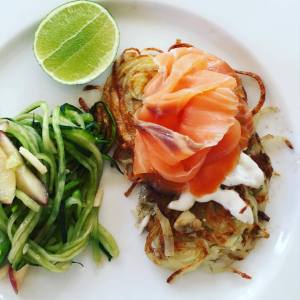
Overall, I have to say it is definitely a healthy way of eating. I’ve certainly not cut out carbs, but I have found that overall I’m not eating as many (even when using potatoes) which has resulted in a more stable line on my CGM. Plus, I am using more vegetables in each meal I’m making.
Will I use it forever and ever? Probably not. I will most likely get tired of it and the novelty of spiral vegetables will get old. As will the Veggetti jokes (actually, maybe not). But for now, it is a nice way to be using lots of fresh vegetables,and throwing together fun and delicious meals that photograph beautifully. And that, my friends, is the aim of the game. Pretty photos.
With the weather changing, I find myself starting to rethink what we are eating at home. The delicious and warming braises and casseroles that have been a staple of the cooler months are replaced with lighter options such as salads and grilled chicken or steak. The oven is rarely turned on – instead we need to think about buying a barbeque for the back garden so we can grill and eat outside.
My trusted and well used Le Creuset heavy-based casseroles seldom come out from their cupboard. But large salad bowls and platters are on frequent rotation, piled high with lighter food.
Fruit is no longer stewed, instead cut up and eaten fresh. The selection in the fruit bowl and in the fridge moves from mostly citrus and apples and pears, to stone fruits – nectarines, peaches, mangoes. Grapes get popped in the freezer; melons are cut up in Tupperware in the fridge for easy-reach snacks and we start to count down until cherry season hits.
And fruit is also thrown into salads – mango mixed with chicken, avocado, walnuts and rocket; white nectarines sliced and sprinkled over platters of cooled freekah, fresh tomatoes, herbs, artichoke hearts and prosciutto.
If only I had a green thumb, I’d get into planting vegies too. Alas, an overflowing pot of basil is usually all I can manage – meaning an easy meal of fresh pesto stirred through pasta is never more than 10 minutes away!
Mimicking the change of seasons with a change of our menu is one of the most wonderful things about food. It reinvigorates meal planning which can get in a rut and helps keep things interesting. And it’s easy for me – with easy access to farmers’ markets, fresh food stores and the Queen Victoria Market just across the road from work.
I’ve been thinking about this a lot recently because, as many of you may know, the IDF’s campaign for World Diabetes Day this year centres on healthy eating and, more specifically, access to fresh and healthy foods.
Because the food we eat does impact on the ability to manage our health. And diabetes is part of our health.
Some people with type 1 diabetes are a little pissed off at this message. They are banging the ‘type-1-has-nothing-to-do-with-what-you-eat-and-this-is-mixing-up-the-messages-and-what-I-ate-had-nothing-to-do-with-why-I (-my-child) –got-type-1’ drum and have been annoyed that the IDF is daring to suggest that there is a link between food and the wellbeing of people with type 1 diabetes.
But the food we eat does impact on our diabetes management, something that sometimes does get lost in our ‘but-I-can-eat-anything’ protestations.
Of course we can eat anything. We have tools to help us to do that and to do it safely. We can bolus for the doughnut we choose to eat for lunch, just as easily as we can bolus for the sandwich we eat.
But that’s not the point. No one is saying that. What this campaign is about is how the food we eat contributes to healthy living. We need insulin to survive, tools to manage our BGLs and access to food to treat lows, sustain energy and be healthy.
In just the same way that there are people in some parts of the world who do not have access to insulin or diabetes consumables, there are places where there is no access to affordable, fresh, healthy food. Of course all of this impacts on a person’s ability to live well with diabetes. It impacts on their ability to live well. Full stop.
The IDF is strongly suggesting that healthy eating is a right, not a privilege. And no one can disagree with that. Surely.

Last night – as a last hurrah to pie weather (and the need to use up the leftovers from a roast chook) a final pie was baked. With a little maths-nerd humour thrown in for fun.
I’m back!
Yes – three weeks of conferencing and travelling and walking and eating and doing not much – and yet so much – have come to a jet-lagged conclusion and I find myself back writing, back at work and, most importantly, back with the kidlet. Which means all is wonderful and I am happy.
So, some diabetes highlights/lowlights from my travels.
This at Dubai airport. Double arrows down, a shitload of insulin on board and a grumpy face. Cleary, a lowlight!
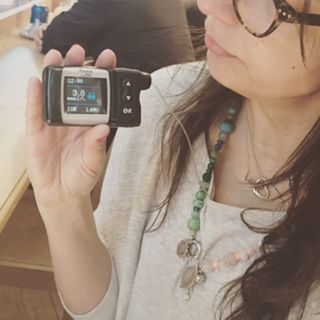
And because I am #NotGoodAtDiabetes, I did it again in Copenhagen:

And in Stockholm.

Stopping in my tracks (and employing the brilliance of Google Translate) after seeing this newspaper on our last night in Stockholm.

Being so grateful for this sight in the press room at EASD in Stockholm…
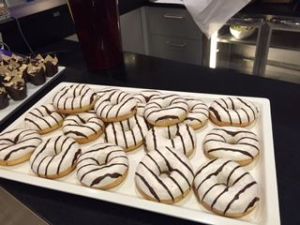
… because I was low with #ConferenceHypoSyndrome.

Days doing this:

Which meant crazy days of barely needing to bolus as we walked, walked, walked and walked all over cities.
And days of walking meant carb stops of cinnamon buns flecked with cardamom and sprinkled with sugar in Stockholm. And in Copenhagen, no cardamom, but icing drizzled over their tops. And then, once in Paris, flaky, buttery pastries that left tell-tale crumbs down our shirts.

And coffee. Coffee. Coffee. Coffee.

And ice cream because when in Paris, one must Berthillon!

In Paris, I came to an abrupt stop when I saw this:

I went in and spoke to the baker who told me that all the pastries were made using low sugar and low fat recipes. ‘Why?’ I asked him. ‘Why did you start this bakery?’ ‘My father has diabetes. And I do too.‘ He said. ‘And so do I,‘ I told him. We bought a croissant and I was expecting something dry and without the wonderful full flavour of a pastry whose main ingredient is butter and was surprised. It tasted delicious. He knew what he was doing! (Questionable marketing aside!)
There was the crappy night where I realised that my pump was out of insulin and, in my handbag changeover, I had forgotten to throw in my ‘spares bag’, so we needed to leave the jazz gig we had travelled halfway across Copenhagen to hear – before it even began – so that we could get back to the hotel and replenish my insulin stores. A complete #EffingDiabetes moment.
On our way from Copenhagen to Paris, I set off every possible alarm at security and was directed to a security officer. ‘I am wearing a medical device,’ I began, expecting the questions and the confusion and the necessary explanations. ‘An insulin pump? You have diabetes?’ was the reply. My stunned look was met with, ‘My husband wears one.’ And she smiled and sent me on my way.
But then in Dubai, as I was escorted to a sparse, windowless room, my ‘I have diabetes, I am wearing a medical device,’ was met with confusion and questions and the need to find a supervisor and, for the first time ever, a request for the letter from my doctor.
But here’s the thing. When I look back at this time away, it won’t be the hypos or the highs or the diabetes that I remember. It won’t be the times I had to stop to guzzle juice, or check my BGL. It won’t be the numbers or the alarms, warning me to eat something.
It will be the days spent catching up with DOC friends. It will be remembering how, with some of these friends, we made ‘riding the worm’ a thing in Sweden. It will be visiting the ABBA museum, and wandering around cemeteries. It will be afternoons being reacquainted with friends who live half a world away. It will be lounging on the grass at Place des Vosges, and sitting in cafes that we have visited before. It will be thinking about the amazing food – like the incredible beef tartar in Stockholm, and Berthillon’s blood orange sorbet. It will be about the waiter at a local café near our apartment in the Marais who didn’t so much as walk as shimmy and sing our breakfast order back to us. In French.
It will be about all those things. It will never, ever be the diabetes. Ever. And that is just the way it should be.
Every Sunday, in the Life magazine of The Age newspaper, is a column where people (usually B to Z grade celebrities) are asked about what they eat on a given day.
They all seem to follow the same boring, unadventurous, ‘this-is-what-a-dietitian-wants-to-hear’ diet. Usually, they start their day with lemon water (to help kick start their metabolism or help with their bodies pH or boost their antioxidant intake or cleanse their liver – it depends which pseudo-science crap they have been reading up on that week), which I am reliably informed (by, you know, qualified practitioners) does nothing other than potentially erode tooth enamel.
Mostly, the foods consumed by those lying about reporting what they ate include a lot of kale, brown rice, kale, grilled salmon, kale, green tea, kale, organic vegies, and kale. Because, kale.
It was in such an article that I first heard of Pete Evans with his ridiculous claims of activating his nuts.
The dietitian – the very sensible and very lovely Dr Joanna MacMillan – then usually comments that even though the person had lied reported eating well, they should try to incorporate more grains/leafy green vegies/lean meat/low fat dairy etc. in their diet to ensure they are following evidence-based dietary guidelines. There is (thankfully) often a ‘stop believing the crap you are reading’ message in there – and a reminder to stop eroding their tooth enamel first thing in the morning.
So, I thought I would write down everything I consumed on a recent day. And then translate it into the language used in these articles.
Breakfast
Caffe latte
Single origin organic coffee grown by virgins on an Ethiopian hillside, reverse-osmosis filtered organic water, organic milk from cows grazing on organic kale while piped music is played to them, fair-trade, organic, raw sugar grown under the organic sun and picked by night under an organic full moon.
Avocado toast
Two slices of artisan organic sourdough bread, evenly toasted by hand with a blow torch using organic butane, spread with organic avocado picked that morning, speckled with organic black sea salt from the organic Black sea.
Lunch
750ml pineapple juice (I had just mowed the lawn and was hypo. Really hypo.)
Pure filtered organic pineapple nectar, extracted by hand from an organic pineapple, naturally sweetened by smiling pineapple nectar extractor pixies.
Afternoon tea
Caffe latte
As above, but this time sweetened with organic agave syrup from Mexico.
Dinner
Homemade pasties.
Ratatouille of organically-grown baby vegetables including organic peas, organic potatoes, organic green beans, organic corn, organic onion, organic celery, organic spinach, organic zucchini, organic eggplant, organic garlic, organic turnip with organic micro-herbs wrapped in organic butter-pastry, gently baked until organically golden brown.
Salad of avocado, spinach leaves, sesame seeds and dressing
Avocado as above, organic baby spinach leaves picked just before becoming teenage spinach leaves, sprinkled with organic sesame seeds drizzled with a dressing of organic EVOO and organic balsamic vinegar.
Dessert
Three gluten free chocolate chip cookies (gluten free because the only flour-like product in my house at the time I had a sudden urge to bake was almond meal. Strictly NOT for any health benefits.)
Trio of gluten-removed organic dark chocolate shard biscotti made with gluten-free organic almonds, crushed by hand, baked into organic orbs of goodness.
Basically, my diet that day involved a couple of coffees, three quarters of a litre of pineapple juice, two slices of bread with avocado, a couple of pasties and three chocolate chip cookies. Not great at all. But honest.
And it was a good day, a healthy day. Because with everything I ate, I bolused insulin for it (not the pineapple juice – that hypo was terrible!). I ate what I chose to eat and then did what I needed to do to manage my diabetes. I took insulin. Or rather, sub-cutaneously infused organic insulin made by the delicate hands of Celtic insulin faeries.





 Diabetogenic