
You are currently browsing the category archive for the ‘Family’ category.
‘Are you here for work?‘ It was just after 7am in LA, and the border security officer looked tired. He studied my passport, holding it up, comparing the photo with the even-more tired-looking, and rather dishevelled, person standing in front of him.
‘Yes. For a conference in Boston.‘ I said, trying to smooth my hair.
‘Oh, the diabetes one?’
‘Yes. That’s right.’ I said. My flight from Melbourne was full of people attending the ADA conference. I know this because I knew half of them. Plus I kept hearing snippets of conversation with ‘diabetes’ being thrown around.
‘My mum (mom!) has diabetes. Type 1. She should go.‘ He said. He flipped through my passport. ‘How long are you here for?’
‘Only for the conference and then three days in New York. I’ll be home in nine days.’
‘That’s not long after travelling so far,’ he said to me.
I smiled. ‘You’re so right. But I’ve left my family home this time. So I don’t really mind only being away for a short time.’
‘Enjoy the conference.’ He stamped my passport and was about to hand it back to me when he looked at me again. ‘Do you have diabetes?’
‘Yes. I do,’ I said. ‘I have type 1. Like your mum.’
‘Do you use a pump?‘ he asked.
‘Yes. And I’m wearing a CGM as well.’
‘My mom needs to talk to you,’ he said. ‘You look healthy. Keep it up.’ He passed me my papers.
‘Thanks. I hope your mum is okay,’ I said, noticing the concerned look on his face – one frequently worn by loved ones of people with diabetes. He nodded and I walked off, heading towards the baggage carousel.
Diabetes is really not a topic of conversation much for me when outside of work. And outside of this blog. I know – hard to believe. But when I am around friends or with my family, there may be a passing comment, but it rarely dominates discussion.
Having said that, we had our neighbours over for dinner last weekend and the ‘Pumpless in Vienna’ story got an airing – and not by me! It was interesting to hear it told from the perspective of one of the main characters in the story.
And then yesterday, while I was in Geelong, I had lunch with my team mate Kim (this is Kim!) and not once in our hour long chat did we speak about diabetes. Not once. In fact, it wasn’t until I got up to leave and mentioned to the waitress that I would love to continue to sit by the fire, but had to rush off to give a talk, and she asked me what the talk was about, did the word ‘diabetes’ come up.
‘Oh. Is it about type 1 or type 2 diabetes?’ she asked. Kim and I looked at each other with surprise – and a little delight. ‘Well, in this case both. But usually we work with people with type 1 diabetes,’ I said. ‘Our waitress over there has type 1 diabetes,’ she continued. It’s possible that Kim and I squealed at that point. ‘I’m so annoyed that I need to leave now – I’d love to chat with her. But Kim here isn’t going anywhere!’ And out I walked. I hope they had a chance to catch up!
I love a good diabetes in the wild story!
Other things occupying my small mind this week.
Cards to send when you don’t know what to say
I love these! They have been all over my social media feeds. They are such a wonderful idea. Emily McDowell has created empathy cards for people with serious health conditions.
I love the one that says ‘I’m really sorry I haven’t been in touch. I didn’t know what to say’ because often that is the case. We don’t know what to say. But if we have a friend going through a tough time, it’s not about us or our awkwardness. This card shows that even though you feel clumsy with words, you are thinking of your friend.
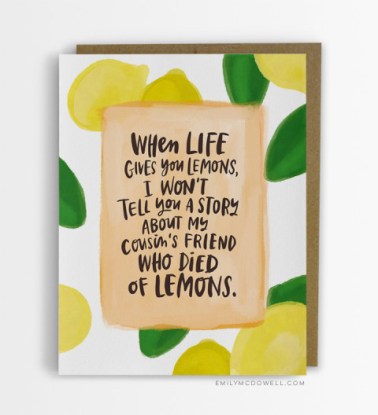
This is my favourite – and probably most relevant to diabetes. Please don’t tell me about you grandmother who lost her limbs because of lemons. Okay?
Numbers mean nothing on their own
I had a very cool Twitter exchange with the super clever Dr Rick Kausman after I tweeted a link to this terrific piece he wrote for The Conversation this week. Numbers (in this article’s case weight) only ever tell part of the story – and often not the most important part!
Quick! Time’s running out for MILES 2
Diabetes MILES 2 is about to close. Do it. Do it now! (Read about it. Read about it here!)
There is a place for Dr Google in our healthcare teams.
While seeking medical advice exclusively from Dr Google isn’t the best idea, there is no denying that the internet and social media are indeed a significant source of information that really can benefit people living with health conditions. I hear blogs are a good source of information and support. Apparently. So I’ve heard.
Have a read of this great piece from MD Joyce Lee. I think she gets it right when she says this:
Healthcare, wake up. It’s not the 1990s anymore.Social media, google, and the internet ARE medical therapy.
Dr House was wrong
What do you know about Lupus? Dr House seems to believe that ‘It’s never lupus’, but actually, sometimes it is. I’ve grown up with an understanding of this autoimmune condition. My gorgeous mum has been living with it kicking its arse for more than 30 years.
Here’s some information to brush up your basic lupus knowledge. And considering that May is Lupus Awareness Month, now is a good time to get some facts!
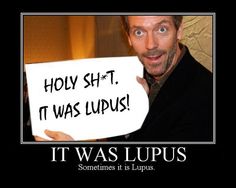
Sorry – couldn’t help myself.
Taking a diabetes break
Well kind of. There are some lucky teens taking an artificial pancreas for a spin in the real world as part of a study being run out of Yale. Read all about it!
There will be no sleep
Next week is Diabetes Blog week. It’s gonna be huge!
Happy Mother’s day, Mum!
My Mum is brilliant. She really is. And when she sent me this text message bagging the paleo diet, she hit new levels of brilliance.
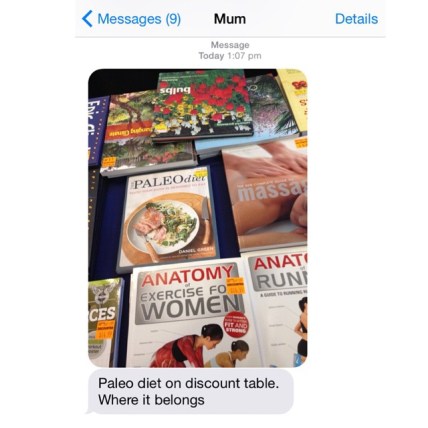
Happy Mother’s Day, Mum. If I can be half the mother you are, I’ll be doing well. Love you. x
Yesterday, I woke up to this tweet from the fabulous health psychologist, Dr Katharine Barnard (who, apart from being quite brilliant is also incredibly lovely and fun to have a cuppa with!):
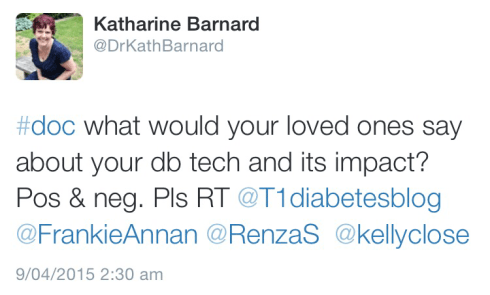
I didn’t have to think about it. I immediately replied with this:

I am very lucky when it comes to having a supportive network around me to help me manage my diabetes. Ultimately, the decisions are mine, but that doesn’t mean that my family is excluded from the discussions.
And it also doesn’t mean that I don’t consider my family when making decisions. This has been especially true when considering technology that costs a lot of money.
When I first started on a pump, there were no subsidies for consumables. As such, I needed to think about where the $300 per month ongoing costs would be coming from. It was 14 years ago; we were newly married with a mortgage. $300 each month was (and still is!) a lot of money to find in the household budget.
We worked out that we would be able to afford it (the pay off was fewer shoes for me), but we were also really lucky to have been told by both our families that they would help out if there were months that we couldn’t afford the supplies.
In later years, the same issues needed to be considered with CGM consumables. Again, with no subsidies, could we find the money to cover the costs of the consumables.
But the financial is not the only thing that impacts on family. What about the impact of having a loved one constantly attached to medical equipment?
When I first started pumping, I wondered what it would mean having a device stuck to me all the time. Would it be a constant reminder to me of my diabetes (not that diabetes is something that is easily forgotten)? But even more than that, I was also worried about how other people would see me. What would my friends and family think when they saw this little box permanently attached to my belt, or shoved down my top? What would they think when they saw me pull it out to press a few buttons? Would it change anything? Would they think differently of me? Would they think of me as ‘sick’?
I worried about how my husband would react to the infusion set taped at all times to my stomach.
In my case, it turned out that none of this mattered. In fact, no one made a big deal out of it; instead everyone was really supportive of me using the technology to manage my diabetes and congratulated me on my decisions.
So it surprised me a couple of years ago when I trialled the Dexcom CGM. I had been wearing CGM for a number of years already without feeling particularly self-conscious.
But the Dexcom sensor, with its different shape to other CGMs flung me back to the uncertainty and insecurity about wearing a(nother) device on my body. As I put in the first sensor and pushed on the transmitter, I felt queasy in the pit of my stomach. Again, I worried about what people with think of the thing protruding through my clothes. And would Aaron start to think that his wife was turning into a cyborg in front of his very eyes, with more and more buttons and beeping machines keeping me running?
As it turned out, I was, again, worrying for nothing. No one said anything. My parents and in-laws show only kind concern and support; my sister hasn’t made any comments about any of the tech (which is a little disappointing because I am sure that she would come up with some brilliantly hysterical snipe that would have me doubled over laughing – this is, after all, the woman who gave me this birthday card for my 40th); my friends ask general questions about how things are going. And Aaron and the kidlet just take the tech of what it is – life saving.
All of their support and encouragement of my diabetes will never, ever be taken for granted – I will be forever grateful. And accepting me for who I am – robot parts and all – is a gift they give over and over and over again. I was reminded of that with Kath’s tweet to me yesterday.
It absolutely doesn’t matter if you are a fan of Coldplay or not (I’m not) but this cover of ‘Yellow’ is possibly the most beautiful thing I have heard in a long time. I can’t stop listening to it. We were lucky to see Petra Haden and Bill Frisell play when we were in New York in an absolutely stunning gig. Enjoy – and check out their other stuff too.
One night, when the kidlet was three years old, we heard her cry out. She had been in bed for an hour or so and we thought it was simply one of her usual I’m-not-tired-so-I-will-try-every-trick-in-the-book-to-not-have-to-go-to-sleep tactics. She is extraordinarily good at these!
We went into her room to find her crying – whimpering, really.
Parents: ‘What’s wrong, darling?’
Kidlet: ‘I stuck a pebble up my nose.’ (It actually sounded like ‘I stuck a pebble up my dose’ because her nose was, of course, blocked. She helpfully illustrated her story by pointing to her left nostril.)
Parents: ‘What?’
Kidlet: ‘I stuck a pebble up my dose.’
Parents: ‘Darling, what? Why did you do that?’
Kidlet: ‘To keep it safe.’
I had a look and sure enough, a pebble was firmly wedged up her tiny left nostril. I knew that the worst thing would be to try to get it out with a pair of tweezers – I would only push it further up, making it even harder to remove.
‘I guess we’re going to the hospital.’ I said to Aaron. Now, we’re like pretty much any other parents. We would avoid a trip to A & E at all costs. But we knew that there was no escaping this one!
So, we bundled the kidlet into the car and headed to the hospital, fortunately less than a ten minute drive from home.
As we walked up to the triage desk, I could see that it was definitely a REALLY busy night. There were parents and kids everywhere; kids that looked really, really sick. We walked in with our skipping, bright, happy three year old. Who had a pebble stuck up her nose.
‘Hi,’ I said to the triage nurse. ‘Our three year old stuck a pebble up her nose. It’s stuck there now.’
The triage nurse didn’t even look up. Clearly this was not a rare occurrence.
We gave all our details and were told to head to the waiting room.
‘How long’s the wait?’ I asked, knowing full well that this is the question that triage nurse’s despise because the answer they want to give is ‘How long is a piece of string’ but they have to be polite.
‘A while. About four hours. Maybe a little more.’ She said. Again, she barely looked up. I guess that it must be soul destroying to repeatedly see that look on the faces of parents who have just been told that they will not be sleeping, possibly ever again.
By this stage, the kidlet had turned into the happiest and most social kid in the world. Sure she had a pebble stuck up her nose, but it was night-time and dark and she was out and there were people around. ‘I have a pebble stuck up my dose,’ she told anyone who would listen, pointing to her nostril.
We asked her to sit with us. ‘Sweetie,’ I said. ‘Everyone else in here has come to the hospital because they are really, really sick. That is usually why kids have to get out of bed and come to the hospital. They have things that it would be better if you don’t catch. So please sit here with us. And absolutely do not speak to anyone holding a bucket. We do not want you to get gastro. Daddy and I do not want to get gastro. Got it? Don’t. Talk. To. Anyone. With. A. Bucket.’
We settled in for what we were expecting to be a long wait, so were very surprised when after about 10 minutes, a nurse called out to us.
‘Now,’ she said to the kidlet. ‘What do we have here?’
‘I have a pebble stuck up my dose/nose.’
‘Hmmm, let me see.’
She had a look and then turned to us. ‘Okay. That’s really stuck in there! I think she’s going to need to see the doctor, so I’m afraid you are in for a long wait. But let’s just try something; it may work. It may not.’
We were prepared to try anything to avoid a four hour wait with all the bucket children back in the waiting room!
She turned to the kidlet. ‘I want you to lie down on the bed, and open your mouth, okay?’
And then she turned to me. ‘And I want you to block her right nostril – the one without the pebble. Then, I want you to blow into her mouth, really hard. It may dislodge the pebble making it possible for me to remove it.’
‘Really?’ I said.
‘It may work, it may not,’ said the nurse. ‘Let’s try it.’
She explained what we were about to do to the kidlet who immediately asked, ‘Is it going to hurt?’
‘Not at all,’ promised the nurse.
I pressed the kidlet’s right nostril, blocking it tightly and leant down over her. ‘A really deep breath – hard!’ the nurse instructed.
I did as I was told and blew into the kidlet’s mouth.
And sure enough, the pebble not only became dislodged, but shot out of her nose. And across the room.
Apparently, the look of shock and surprise on both my and the kidlet’s face was hysterical because the nurse and Aaron burst out laughing.
I recovered from my surprise, stood up and threw my arms around the nurse. And then the kidlet. We couldn’t get out of the hospital fast enough!
I was reminded of this story the other day when I was speaking to a parent who had spent the evening before in A & E with her daughter, who has type 1 diabetes. Thanks to a tummy bug, her daughter was seriously dehydrated and dealing with very high BGLs.
The conversation shifted to the amount of time she has spent in doctors’ offices, hospitals and at the GP in the 12 months since her daughter’s diagnosis. It amounted to hours and hours and hours and hours. Her daughter had missed days of school because it had taken so long for a correct diagnosis (their GP kept telling them it was just a virus and her daughter needed rest). After a couple of weeks of this, she was rushed to hospital in an ambulance, drifting in and out of consciousness, before they were told she had type 1 diabetes.
‘I’m so sorry,‘ she said to me after we’d been speaking for about an hour. ‘I sound like I’m whinging.’
‘You absolutely don’t!’ I said. ‘And even if you did, I think you have something to whinge about.’
The truth is that she really wasn’t whinging. She was being very matter of fact about her daughter’s diabetes journey so far. She didn’t complain about any of the HCPs she had seen – although it would have been completely warranted if directed towards the bloody GP and his misdiagnosis.
She asked me about our kid and if she had ever been taken to A & E. ‘Only once,‘ I told her. (Actually, there was a second time when she was about 4 and had a really high fever, but we ended up at the GP clinic at the Children’s instead of having to deal with the three hour wait of the emergency department.)
‘Really? Wow! Lucky you!‘ she said. ‘Was it for something serious.’
‘Um, no. Not so much.’ I said and I told her the pebble up the nose story. She loved it – she thought it was hilarious.
But that was it; one visit to the hospital with a perfectly healthy kid who wanted to keep a pebble safe so she hid it. Up her nose. And we were out in less than an hour thanks to a superhero nurse called Nicole!
Kids with diabetes learn early on that they will be spending more than their fair share of time visiting HCPs. Their visits to A & E are often for much nastier things than a stuck pebble. Their visits last much longer than an hour.
I thought about this after I had said goodbye to the mum I’d been chatting with. In fact I thought about if for a long time. One A & E visit, appointments for her immunisations and maybe one, two at the most GP visits per year. That’s our kid’s encounters with doctors.
The mum called me the next day and asked if it would be okay to tell people the ‘pebble up the nose’ story.
‘Absolutely!’ I said. I asked her if I could write a little about our chat.
‘That’s fine,’ she said. ‘We all learn from each other. I really learnt a lot from you yesterday. Talking to adults with diabetes is really helpful for me.’ Then she paused. ‘Although, really, that trick about how to dislodge a stuck pebble from a kid’s nose is probably the most useful thing I’ve ever heard.’
‘We had diary today,’ said the kidlet. We were all sitting at the table having dinner. This, I have come to understand, is one of the times we learn most about what the kidlet is thinking and what she is up to.
At the beginning of the year, all the kids were given diaries. Each night they are meant to fill details of the the book they are reading and the page numbers they have read for the day. I get why this is important. It allows the teachers to see just how much the kids are reading and the sorts of books on their reading lists. It teaches discipline and it provides a record.
Now, we have a reader. She is one of those kids who reads under the covers with a torch after lights out. When I call out to her and she doesn’t answer, it’s because she is most likely sitting somewhere outside, puppy at her feet with her nose in a book, so engrossed that she doesn’t hear my increasingly-annoyed voice calling her name.
For the first week, the kidlet was a little obsessive about her diary. Every night when Aaron and I went in to tell her to turn the light out, she would say she had to fill in the details. So, she would climb out of bed to find her diary and dutifully write in it.
I started to get annoyed. It was messing with our hard-worked-for bedtime routine with a kid who is the master of delay-tactics. She just had another thing added to her arsenal to delay going to sleep. And this time it was school-sanctioned!
The diligence lasted a couple of weeks. And then, it stopped. I completely forgot about it, so didn’t ask her.
So when she told us that she had ‘diary’ today, I realised that I’d not seen her filling it in much recently.
‘Do you still complete that every day? I’ve not seen it at home.’
‘Nope,’ she said. ‘I fill it in at the last minute while I’m sitting in class. I write down the books I’ve been reading and guess the number of pages. I know that I’ve been reading; I read every day. Heaps! Why do I need to write it down in a diary? That doesn’t show how good my reading is, does it?’ She said this without a hint of sheepishness.
I smothered a smile.
I knew I should tell her that she needs to do what she is asked to do by her teacher. I knew I should say to her that there is a reason for keeping the diary. I knew I should mention to her that it is something all kids are required to do and that she is no different from the other kids.
I knew that.
But I also knew how hypocritical it would be for me to tell her that. If she asked me what was being achieved by filling in the diary each day – how it would improve her reading or learning skills – I couldn’t give her an answer.
There is no way I would fill in a log book of my BGL levels just as a matter of course. If there was a reason for it – checking basal rates, trying to deal with pesky lows (or highs) – sure, I can see why.
But if the reason is just ‘its’s-what-we-get-all-people-with-diabetes-to-do-just-because-we-do’, I’s refuse. I can’t see the point.
Later on, I suggested that the kidlet have a conversation with her teacher about the diary and to talk about ways that she could use it that are meaningful to her – such as listing all the books that she finishes reading, or listing books she would like to read. She considered my ideas and said she’d think about it. (Possibly ten year-old speak for ‘If I say okay, will you stop talking about it, mum?’)
I thought about her sitting there in class just before she was to show her diary to her teacher. I thought about her frantically writing down the books and guesstimating page numbers. I wondered if she was using different coloured pens, so it looked like she had filled it in each day rather that in one hit. And I smiled. Because that’s exactly what I would do. That’s exactly what I did do.
Like mother, like daughter. And then I stopped smiling. Those teenage years are gonna be a nightmare!
I woke up on Saturday morning and for an exquisite 15 seconds, I didn’t remember the night before. Then I moved. Then my body remembered.
Gingerly, I swung my legs to the side of the bed so I could get up and to go to the bathroom. The pain under my left breast was making it difficult for me to breathe, much less move.
My feet gently touched the ground and I pushed myself to standing. I steadied myself and once certain I wasn’t going to fall over, I walked to the bathroom. Flashes from the night before running through my head.
Awake. Asleep. Awake. Asleep.
Forcing food down my throat, falling back to sleep.
Waking and feeling like I was drowning.
Not being able to remember which way to turn from our bedroom.
Trying to stand up to get to the kitchen and not being able to support myself.
Finding myself in the kitchen staring at an empty bottle of orange juice.
It was the middle of the night. The kidlet was, thankfully sound asleep and didn’t stir, despite my crashing and clumsy movements. At one point, I dropped a glass on the wooden kitchen floors, but even the loud crash didn’t wake her.
Aaron was at a gig and still hours from home.
After almost two hours, I started vomiting. My BGL was still sitting under 3mmol/l. I lay down on the bed and thought that I would need to get to the hospital.
Eventually, I called my parents and asked them to come over, thinking that one could stay with our daughter while the other took me to A&E.
By the time they arrived, I was a mess. I couldn’t stop crying; I felt nauseous and faint; my heart was beating fast and hard in my chest and I breathing was difficult.
‘Renz, darling. What do you want us to do?’ they asked. ‘Do you want to go to the hospital?’
I didn’t know. I didn’t know what was the right thing to do. I couldn’t concentrate enough to make a decision. I was distracted and kept thinking about what would have happened if I had passed out on the floor in the hallway, crashed to the ground and had the kidlet wake to find me there. I felt guilty for getting my parents out of bed and out of their house in the middle of the night to rescue me – and then not be able to tell them what I wanted and what I needed.
I decided not to go to A&E. The thought of having to spend at least 6 hours on an emergency room bed was even more overwhelming than having to continue to deal with what was going on. The danger period seemed to be over – at least I was remaining conscious now.
At 3am, my BGL had finally hit 3.2mmol/l. It was three hours since I first woke and started eating. I still didn’t feel confident enough to sleep even though I was exhausted. I turned on the television, just in time to see Ryan Reynolds being attacked by a snake in Buried.
At 4am, just as the movie ended, my BGL was 4.1mmol/l. I felt it safe enough to go to bed.
I spent most of Saturday dozing, trying to rid my body of the aching and exhaustion and my mind of feelings of desperation. But they remained.
I had a constant headache that moved in waves from dull to pulsating. I needed to rest after doing anything remotely energetic. I mowed the front lawn – not more than a postage stamp of grass – and needed to lie down for half an hour afterwards. Pushing the hand mower back and forwards caused the pain in my ribs to throb.
I ached all over, I felt fragile and tears kept forming in my eyes. I looked at my daughter and had to keep pushing away the thought of her finding me unconscious.
By Sunday morning, after a good night’s sleep, I felt a lot better. I still had a dull ache in my head and a twinge in my left ribs. But overall, I felt better. My body had started to heal and I felt like I had some energy back.
I spent Sunday afternoon at a local street festival, enveloped by gorgeous food, loud music and bright colours. We sat and watched some Bollywood dancing and then climbed the stairs to an upstairs bar to hear a hard swinging big band belt out some Frank Sinatra (and this). Occasional flashes of being hypo would pop into my head and I’d smother them by distracting myself with the energy around me.
Today, a couple of days later, there are no lasting physical scars. The pain has gone. The nausea has gone. And the headache is no longer there.
But I am so fragile. I feel damaged and I feel broken and I feel beaten. I am frayed with exhaustion.
And yet. It’s another day. And I’m here. On I go.
I was sitting on the bed in my underwear, a towel wrapped around my wet hair, doing a full set change on my pump.
Mornings are a little hectic around our place. I am a pretty organised person but despite best laid plans, mornings still have the potential to head into a disordered mess. I blame the dogs – especially the puppy – who in their cute four-legged way have the potential to derail the morning routine.
But today, everyone was calm and just getting on with the job of getting themselves sorted and out of the house at the right time. Even Sooty was minding her own business, quietly chewing on a pair of Aaron’s socks in a corner.
The kidlet climbed onto the bed next to me to speak about something that was happening at school that day, talking a million miles an hour and brushing her hair at the same time. Excellent multi-skilling!
Without missing a beat in her commentary (or grooming), she watched me draw insulin into a new cartridge, flick the outside of the syringe with my finger and push a few tiny air bubbles out, a little spray of insulin heading into the air. I inhaled, thinking what I always do when I smell insulin, ‘The smell that keeps you alive’.
I connected a new line, loaded the cartridge into my pump, tightened the cap and primed. A couple of drops of insulin fell onto my bare legs.
And then, I peeled away the tape, pulled off the blue cap and pushed the cannula into my skin, quickly pulling out the introducer needle.
At that point the kidlet stopped speaking to me about school, her hairbrush poised mid-air.
‘Ouch,’ she said. ‘How can you do that and say it doesn’t hurt?’
‘It doesn’t,’ I said simply. ‘At least, not much. And that one really didn’t hurt.’
I feel that diabetes has desensitised me to so much. I have become more accepting of my own mortality and, even though I don’t like to think about it, I am resigned to a shortened life span. As I age, I expect limiting complications. I accept pain more readily. I know that my health cannot be taken for granted and that my immune system has the potential, at any given moment, to do something stupid. There are days that I feel an exhaustion that I am sure is connected to diabetes, but deal with it by simply getting on with things. I wear robot parts on my body and no longer even bat an eyelid when I catch a glimpse of them taped to my skin.
And I don’t feel the pain of needles anymore.
I looked at our beautiful daughter. ‘You would be surprised at what your body and mind are capable of, darling,’ I told her. ‘These things keep me healthy. I’ll do pretty much anything for that.’
She hopped off the bed and headed into the kitchen for her breakfast. I threw on my clothes for the day, gathered up the rubbish – the used pump line and cartridge, and packaging from the new ones – and followed her into the kitchen.
The smell of insulin lingered in the room.
‘Oh and I need to keep a food diary this weekend for my homework. Everything I eat today, tomorrow and Sunday,’ announced the kidlet in her rundown of what she had been up to on her second day back at school last Friday. We were walking to our local café for a Friday afternoon treat and to meet up with one of her friends and her friend’s mum.
What? Fuck? Why? The words ‘food diary’ hit me like a brick. Immediately, I wanted to charge at her. ‘Who is going to look at it? What are you doing it for? You know that there is no need to keep a record of what you eat – we eat a really healthy balanced mix of great food.’
I took a deep breath and didn’t say any of that.
While I may not, at times, have a particularly healthy relationship with my body (stupid, broken, scarred, unable to do the things that it should etc. etc.), I do have a very healthy relationship with food. But I know that a lot of other people don’t and I am frequently concerned about how food is discussed.
Food shaming is real and can be damaging. People’s understanding of food and nutrition varies widely and when we start using words like ‘clean’ or ‘good’ and ‘bad’ to describe what we are eating, food suddenly goes from being a source of joy to a source of judgement.
I stepped back for a moment as the kidlet continued her random commentary of her school day and, half paying attention to what she was saying (I knew there would be a quiz about it later!), I thought about how to approach the food diary thing without projecting my issues onto her.
‘So,’ I started casually. ‘What are you doing in class that relates to keeping a food diary?’
‘We are talking about healthy lunchboxes.’ She was wrangling the lead of her puppy as we were walking and pulled Sooty closer to slow her down. ‘You don’t like this idea, do you mum?’
Damn kid and her astuteness. I thought I was playing it so cool.
‘Um…well…I…Why do you say that?’
‘Because I know that you get annoyed when people talk about food in negative ways and say that some foods are bad. And I know that you think things like I Quit Sugar, and that other guy you keep saying is nuts, are really terrible because you love food and think that it should be enjoyed. Not something that is judged. Right?’
We arrived at the café and the conversation was (thankfully) cut short. She ran off to play with her friend.
The next day, we were in the car together, heading home to awaiting homework, and the kidlet said ‘One more thing. We need to say what the word ‘diet’ means to us.’
Again, I (internally) shuddered. What an ugly word. Why are they teaching kids to diet? Or even talking about diets? What is going on? I slowed down my thinking.
‘Okay’, I said. ‘How would you define that word?’
‘I would say it is the variety of foods we eat. And I would say that we have a diet that is made up of lots of different foods including fruit, meat, vegetables, bread, dairy, sometimes we have cakes and biscuits… And that we mostly have homemade food, but eat out too sometimes.’
She paused.
‘Oh darling,’ I wanted to say. ‘You are so on message.’ Instead, I reached over and squeezed her knee. For a brief moment, it flashed through my mind that just maybe we were doing something right in raising this gorgeous kid.
I glanced over at her and smiled, about to tell her that I thought it was a perfect way to define the word diet. But before I could she added, ‘Oh – and Nutella. We eat Nutella too.’ She was looking sideways at me with a cheeky grin on her face.
Bang! On message. That’s our girl.
I love food. Yesterday’s post which outlined all the eating we’ve been enjoying while in New York probably points to that. As would many other posts.
And it is the truth. I love food. I enjoy it. I celebrate it. I cook it. I read about it. I share it.
Food is a joy. When I think about different periods in my life, there is always a soundtrack of the music I was listening to, and the meals I’d cooked with love, or shared with family and friends.
There are meals that I have had that are still spoken about – years later. ‘Hey, remember that first meal we had at that gorgeous little place in Venice? I had incredibly gnocchetti with seafood?‘ I might say, to which Aaron would reply ‘Yes! And I had the four cheese gnocchi. God that was good. So good.’ That meal was consumed in 2001.
And our daughter recalls fondly the taste of the plums that would fall from the tree in the back garden of our old house, and how we would sit out there in summer and gorge on the fruit, the juice dripping down our chins.
This is the language of food.
So when I read this the other day in my Facebook feed, I was just shocked. I read it with complete and utter disbelief.

Why, why, why would anyone deliberately make food taste terrible, bland or boring?
There is nothing – NOTHING – in this piece of so-called advice that is useful. There is nothing that provides smart advice for how to eat healthfully or listen to your body for hunger cues. There is nothing that says food can be a part of life that is enjoyable, fun, non-threatening and delicious.
This advice makes food sound like it is something to be feared. It makes food sound like the enemy. But worse, it does not explain how food can be part of a healthy way of life. It does not talk about portion sizes, or balanced eating, or how to incorporate a little of everything into an eating plan.
It is restrictive. It is scary and it makes me feel so sad.
When I was first diagnosed with diabetes, I had no idea what it would mean to my diet. Would I suddenly have a list of restricted or banned foods that I could never enjoy again? Would I need to completely change the way I ate? Would food become a source of stress rather joy?
I have learnt that the joy of food is not lessened at all because of diabetes. I still can eat whatever I want. And I do. My diet is healthy, balanced, full of fresh foods, fun, enjoyable and never, ever boring. And there is no such thing as a taboo food.
I am just so glad that the advice I have taken – as a person with diabetes, but even more so, as a person who loves food – is that there is no need to fear food. I am so glad that what I eat – and what my family eats – is based on what we like to eat, what we want to eat and what works for us. It may not work for you, but it works for us. (The kidlet could probably do without Brussels sprouts, but I am convinced that I will win her over on this one!)
This blog is NOT about advice. Nothing that I write should be considered as something to follow or as advice. So I am going to give you some. Don’t take the dietary advice of a celebrity personal trainer. If you need some help working out what to eat that makes you feel happy and content, see an accredited practising dietitian. If you have problems with your relationship with food, speak with your GP, and ask for a referral to a psychologist.
But whatever you do, enjoy what you eat. Life is too short to eat over-cooked chook.
By the way, here is an awesome way to cook Brussels sprouts: finely slice them, then sauté in a fry pan with a little olive oil and garlic. After about 1 minute (absolutely no longer), toss in some toasted pine nuts (or walnuts, almonds, whatever you have handy). To be fancy, add some bacon cut into thin strips. (To be EXTRA fancy, make it candied bacon by crisping up the bacon in a little maple syrup first.)
Before even opening my eyes, I could feel it. It started in the pit of my stomach – a kind of fluttering – and rose to my chest, where my heartbeat started to quicken.
I was low. Not horribly so – I could comprehend where I was and what was going on. But nonetheless, I knew that I would need to act soon. Well…soon-ish. I snuggled under the doona focusing on my heartbeat; willing it to slow down a little.
Even though our apartment is warm – beautifully so – I didn’t want to have to remove myself from the warm bedding, put my feet on the cool parquetry and pad to the kitchen.
My eyes were still shut and I wished that I had a jar by my bedside full of jelly snakes – like I do at home – so I could just reach my arm out.
But I’ve not found any sweets here that I like to use to treat lows. Jelly Belly jelly beans take too long to chew, and often I find myself gagging as I chew, chew, chew before swallowing. Gummy bears are pure evil and leave the most horrendous after taste. And I don’t like over-the-counter glucose tabs. (This is where I remind myself that I should organise a Gluco Lift order before heading home…..)
No. I would need to get up, go to the kitchen and find something there.
I opened my eyes and turned to the bedside table to check the time. And there, right in my line of vision was a tall glass of orange juice. I sat upright, very quickly.
‘How did that get there?‘ I asked
‘I put it there,’ said Aaron, who was awake and reading a magazine. ‘You’ve been low a couple of times in the mornings, so when I got up to get myself something, I brought it in for you.’
I looked at him gratefully.
It takes a village – I’ve said it before. Diabetes is constant, it doesn’t end, and each and every day there are dozens of things I do to stay healthy and try to be on top of things. Most of the time, I just do them – on my own, without fanfare or even comment.
So, it’s little actions like this make me truly appreciative. It’s not ‘just a glass of juice’; it’s someone noticing something about my diabetes and doing something to help. Not because they were asked to – I am pretty sure that I had not even mentioned that I’d woken low a couple of mornings – but just because they thought it would help.
I guzzled the juice – downing it in just a couple of gulps – and cuddled back down into the warm bed. Within a short time, I could feel my heart rate had returned to normal and the fluttering feeling in my stomach had disappeared.
‘Thank you, hon,’ I said. I knew that he wouldn’t want me making a big deal of it (he would be the one saying it’s ‘just a glass of juice‘). But it made one diabetes thing for the day less of a pain to deal with.





 Diabetogenic