
You are currently browsing the category archive for the ‘DOC’ category.
How are two separate Twitter incidents in the DOC related when one was started after someone without diabetes made some pretty horrid comments about diabetes and the other was a conversation diminishing the whole language matters movement to something far less significant and important than what it is truly about.
Let’s examine the two.
EXHIBIT A
Sometime over the weekend, someone I’d never heard of came out with some pretty stigmatising commentary about diabetes. This person doesn’t have diabetes. But hey – joking about diabetes is perfectly okay because, why not? Everyone else does it. Jump on the bandwagon!
She deleted her original tweet after several folks with diabetes pointed out just how and why she was wrong. And also, how stigmatising she was being.
In lands where all is good and happy, that would have been the end of it. We would have moved on, lived happily for a bit, until the next person decided to use diabetes as a punchline.
But no. She decided to double down and keep going. It was all bizarre and so out of touch with what the reality of diabetes is, but perhaps the most bizarre and startling of all was her declaration that there is no stigma associated with diabetes. Well, knock me down with a feather because I’m pretty sure that not only is diabetes stigma very real, but I’ve been working on different projects addressing this stigma for well over a decade now.
EXHIBIT B
At the same time this mess was happening, there was a discussion by others in the DOC about being called a person with diabetes versus being called (a) diabetic. I’m pretty sure it was a new conversation, but it may have been the same one that played out last month. And the month before that, and a dozen times last year. Honestly, to me, this conversation is the very definition of bashing my head against a brick wall. If you’ve played in the DOC Twitter playground you would have seen it. It goes something like this:
‘I want to be called diabetic.’
‘I don’t care what others say, I like person with diabetes.’
‘Why should I be told what to call myself?’
‘I am more than my diabetes which is why I like PWD.’
‘My diabetes does define me in some ways, which is why I like diabetic.’
(And a million variations on this. Rinse. Repeat.)
I have no idea why it keeps happening, because I’m pretty sure that at no time has anyone said that people with diabetes should align their language with guidance or position statements to do with language. I’m also pretty sure that at no point in those statements does it say that people with diabetes/diabetics (whatever floats your boat) must refer to themselves in a certain way. And it’s always been pretty clear that those adjacent to (but not living with) diabetes should be guided by what those with lived experience want.
AND it’s also been pointed out countless times that it’s not about single words. It’s about changing attitudes and behaviours and addressing the misconceptions about diabetes. And yet, for some, it keeps coming back to this binary discussion that fails to advance any thinking, or change anything at all.
Is there a great discussion to be had about person-first versus identity-first language? Absolutely. And looking at long-term discussions in the community there are some truly fascinating insights about how language has changed and how people have changed with it. But does it serve anyone to continue with the untrue rhetoric that people interested in language are forcing people with diabetes / diabetics (your choice!) to think one way? Nope. Not at all. It’s untrue, and completely disingenuous.
These two seemingly separate situations are connected. And that is completely apparent to people who are able to step back and step above the PWD / diabetic thing. People who know nothing about diabetes keep punching down because they think diabetes is fair game. And people with diabetes are the ones who are left to deal with these stigmatising and nasty attitudes.
I woke this morning to this tweet from Partha Kar.

I was grateful for the tag here because the frustration Partha has expressed mirrors the frustration I am feeling on the other side of the world.
I don’t know why this keeps coming up, I really don’t. I honestly do think that most people understand that we talk language in relation to stigma and to discrimination and to access. That was how it was addressed at the WHO diabetes focus groups earlier this year. That is how it was addressed at the #dedoc° symposium at ATTD. It is how the discussion flowed in last year’s Global Diabetes Language Matters Summit. Most understand that these issues are far more pressing.
If people want to keep banging a drum about the diabetes versus diabetic thing, that’s fine. But I reckon that many of us have moved well beyond that now as we seek to address ways to change the way people think and behave about diabetes so that we stop being the butt of jokes or collateral of people punching down on Twitter.
Throughout ATTD I got to repeatedly tell an origin story that led us to this year’s #dedoc° symposium. I’ve told the story here before, but I’m going to again for anyone new, or anyone who is after a refresher.
It’s 2015 and EASD in Stockholm. A group of people with diabetes are crowded together in the overheated backroom of a cafe in the centre of the city. Organising and leading this catch up is Bastian Hauck who, just a few years earlier, brought people from the german-based diabetes community together online (in tweet chats) and for in person events. His idea here was that anyone with diabetes, or connected to the conference, from anywhere in the world, could pop in and share what they were up to that was benefitting their corner of the diabetes world. I’ll add that this was a slightly turbulent time in some parts of the DOC in Europe. Local online communities were feeling the effects of some bitter rifts. #docday° wasn’t about that, and it wasn’t about where you were from either. It was about providing a platform for people with diabetes to network and share and give and get support.
And that’s exactly what happened. Honestly, I can’t remember all that much of what was spoken about. I do remember diabetes advocate from Sweden, Josephine, unabashedly stripping down to her underwear to show off the latest AnnaPS designs – a range of clothing created especially to comfortably and conveniently house diabetes devices. It won’t come as a surprise to many people that I spoke about language and communication, and the work Diabetes Australia was doing in this space and how it was the diabetes community that was helping spread the word.
I also remember the cardamom buns speckled with sugar pearls, but this is not relevant to the story, and purely serving as a reminder to find a recipe and make some.
So there we were, far away from the actual conference (because most of the advocates who were there didn’t have registration badges to get in), and very separate from where the HCPs were talking about … well … talking about us.
Twelve months later EASD moved to Munich. This time, Bastian had managed to negotiate with the event organisers for a room at the conference centre. Most of the advocates who were there for other satellite events had secured registrations badges, and could easily access all spaces. Now, instead of needing to schlep across town to meet, we had a dedicated space for a couple of hours. It also means that HCPs could pop into the event in between sessions. And a few did!
This has been the model for #docday° at EASD and, more recently, ATTD as well. The meetups were held at the conference centre and each time the number of HCPs would grow. It worked! Until, of course COVID threw a spanner in all the diabetes conference works. And so, we moved online to virtual gatherings which turned out to be quite amazing as it opened up the floor to a lot of advocates who ordinarily might not be able to access the meetings in Europe.
And that brings us to this year. The first large international diabetes conference was back on – after a couple of reschedules and location changes. And with it would, of course, be the global #dedoc° community, but this time, rather than a satellite or adjacent session, it would be part of the scientific program. There on the website was the first ever #dedoc° symposium. This was (is!) HUGE! It marks a real change in how and where people with diabetes, our stories and our position is considered at what has in the past been the domain of health professionals and researchers.
When you live by the motto ‘Nothing about us without us’ this is a very comfortable place to be. Bastian and the #dedoc° team and supporters had moved the needle, and shown that people with diabetes can be incorporated into these conferences with ease. The program for the session was determined by what have been key discussions in the diabetes community for some time: access, stigma and DIY technologies. And guess what? Those very topics were also mentioned by HCPs in other sessions.
There have been well over a dozen #docday° events now. There has been conversation after conversation after conversation about how to better include people with diabetes in these sorts of events in a meaningful way. There has been community working together to make it happen. And here we are.
For the record, the room was full to overflowing. And the vast majority of the people there were not people with diabetes. Healthcare professionals and researchers made the conscious decision to walk into Hall 118 at 3pm on Wednesday 27 April to hear from the diabetes community; to learn from the diabetes community.
If you missed it, here it is! The other amazing thing about this Symposium was that, unlike all other sessions, it wasn’t only open to people who had registered for ATTD. It was live streamed across #dedoc° socials and is available now for anyone to watch on demand. So, watch now! It was such an honour to be asked to moderate this session and to be able to present the three incredibly speakers from the diabetes community. Right where they – where we – belong.
DISCLOSURE
My flights and accommodation have been covered by #dedoc°, where I have been an advisor for a number of years, and am now working with them as Head of Advocacy.
Thanks to ATTD for providing me with a press pass to attend the conference.
Sometimes it takes me a couple of days after a big diabetes meeting or event to work out my main takeaways. I think about it and throw things around, reliving certain aspects, considering what was discussed, carefully thinking about all possible interpretations to make sure that I am clear about what people were saying
I didn’t need time after last week’s World Health Organisation Focus Group on Advancing the Lived Experience of People Living with Diabetes because the takeaways were there straight away, loud and clear.
There were three things for me:
- The acknowledgement about the importance of language and communication. I wrote about that the other day.
- Barriers to access include far more than affordability. Affordability is absolutely a cornerstone of being able to get the best care, take the right meds and use the right technology, but there are a lot of other obstacles and blocks that impact on outcomes. More on this another time.
- But, for me, THE biggest take away was the support that was overflowing from most people in attendance, and they way they were looking out for each other, looking to each other, and looking for ways to remain connected to support the astonishing work being done in the community – from grassroots initiatives, right through to involvement in political campaigns at the highest organisation level.
I have been so lucky to be the recipient of that sort of support from other people with diabetes over the years. Whether it’s invitations to be involved in their projects, or having an EOI flyer flicked my way, or being recommended for something, the love and generosity of others with diabetes has certainly opened up a lot of advocacy opportunities. I have tried to pay it back, and, (to use a #dedoc° voices motto), #PayItForward as well. A benefit of working for a diabetes organisation has meant that I have been able to co-design and develop programs to involve others. Initiatives like the #DAPeopleVoice and countless speaking occasions, and nominating people for initiatives such as the IDF YLD have opened the door for others with diabetes to step through and find a platform for their own advocacy.
One of the things that I learnt early on is that there is a lot of stuff to go around. If people want to get involved, there are always ways in. Chelcie Rice’s ‘If they don’t have a chair for you, bring your own’ words ring in my ears a lot when I think about making sure PWD have a seat at the table, and I’ve extended that to ‘And make sure you bring a chair for someone else, or give yours up for them’. Increasingly, I’ve done more of the latter.
Also early on I learnt to ignore the people who did nothing more than complain about who gets invited where, instead understanding my own value and reason for being involved, while also making sure to find a way to bring along those who genuinely were interested in being included and were willing to work to make it happen. (The incredible responses to this tweet show how people got a break in diabetes advocacy and what it’s taken to keep going.)
Supporting others is as easy as sharing someone’s blog or social media posts, linking to them here in my own writing or to their Twitter handle when I mention them, celebrating their work to others and applauding their wins.
Attitudes of support were demonstrated in spades last week. I had direct messages from dozens of attendees, some reaching out for the first time, that were just so damn encouraging and kind.
At the same time, I was frantically messaging others to ask about their work and if there was anything I could do to promote it. I sent the #dedoc° voices application link to a number of people who were at their first advocacy meet, and hoped to do more.
One of the nicest messages I received was from someone I’ve known for years on Twitter, but never actually been at the same event or involved in the same project. We exchanged some lovely messages, acknowledging how terrific it was to finally find ourselves in the same Zoom room, and a hope that it would continue.
The overwhelming openness, kindness and consideration of others was disarming. There wasn’t a sense of competition or resentment for anyone doing other things. There was appreciation and respect of others’ efforts. And that led to meetings being set up, collaborations taking shape, and a list of exciting new things to check out and share.
Look, if this seems all a little utopian, maybe it is, and maybe I sound annoyingly Pollyanna-ish. I’m sure that there were some folks there who walked away with a very different vibe. And that’s fine. Not everything floats everyone’s boat. Perhaps not everyone connected with others the same way I did. Perhaps they weren’t as comfortable reaching out to others to offer their support, or maybe they didn’t see or hear anything they thought worth supporting. As always, diabetes experiences – whether in a clinic appointment or an advocacy event – will be different for different people.
For me, I started from a place of wanting to be there and wanting to connect with others. When I think about it, there is an element of selfishness in my advocacy work, as it’s allowed me to always find a way to connect with others with diabetes, to learn from them, to work together, to jointly elevate our place in the diabetes healthcare space. It’s served me well. And it’s given me the change to receive and give support to others, too. It’s a good place to start. And it’s a good thing to keep doing.

DISCLOSURE
I was invited by the WHO Global Diabetes Compact team to be part of the facilitators at the Focus Group on Advancing the Lived Experience of People Living with Diabetes. I happily volunteered my time.
Advocacy is a slow burn. I say those words every day. Usually multiple times. I say it to people with diabetes who are interested in getting into advocacy, not to scare them off, but so they understand that things take time. I say it to established advocates. I say it to people I work with. I say it to people in the diabetes world who want to know why it takes so long for change to happen. I say it to healthcare professionals I’m working with to change policy. I mutter it to myself as a mantra.
Slow. Burn.
But then, there are moments where there is an ignition, and you realise that the slow burn is moving from being nothing more than smouldering embers into something more. And when that happens I can’t wipe the smile of my face and I start jumping up and down. Which is what I was doing in my study at home at 2am, desperately trying to make as little noise as possible so as not to wake my husband and daughter who were sounds asleep in other rooms off the corridor.
The World Health Organisation conducted the first of its two focus group sessions for people with diabetes yesterday (or rather for me, early this morning), and I was honoured to be part of the facilitating team for this event. In the planning for the questions that would be discussed in the small break out groups, the WHO team had gone to great pains to workshop the language in the questions so they were presented in a way that would encourage the most discussion possible. That was the start of those embers being stoked.
I think that the attention to how we framed the discussion points meant that people thought about their responses differently.
The topics last night were about barriers to access of essential diabetes drugs, healthcare and technology. Of course, issues including affordability, health professional workforce, ongoing training and education were highlighted. These are often the most significant barrier that needs to be addressed.
But the discussion went beyond this, and time and time again, people identified stigma and misconceptions about diabetes as a significant barrier to people not being able to get the best for their diabetes. It certainly wasn’t me who mentioned language (at least not first), but communication and language were highlighted as points contributing to that stigma.
This recurring theme came from people from across the globe. It was mentioned as a reason for social exclusion as well as workplace discrimination. There was acknowledgement that perceptions of diabetes as being all about personal responsibility has affected how policy makers as well as community responds to diabetes – how serious they see the condition.
In the discussion about diabetes-related complications, the overall language had been changed from ‘prevention’ to ‘risk reduction’ and this was recognised in many of the discussions as a far better way to frame conversations and education about complications. This isn’t new – it was a recurring theme when a focus in the DOC was the hashtag #TalkAboutComplications. I wrote and co-wrote several articles about it, including this piece I co-authored with the Grumpy Pumper for BMJ.
The direction the discussions took were a revelation. No. It was a revolution!
So often at other events and in online debates when language and communication has been raised, conversation has been stalled by people pushing agendas about wanting to be called ‘diabetic’, as if this is the first and only issue that needs to be resolved. That didn’t even come up last night because the people who were highlighting the implications of language understood that when you look at the issues strategically and at a higher level, those details are not what matters.
What matters is looking at Communication with a capital C and understanding its influence. It elevated the discussion so far above the ‘it’s political correctness and nothing more’ that it would have been ridiculous to drag the discussion back to that level.
For years, there has been push back regarding communication because people have not stood back and looked at impact. That has changed.
When I wrote this four years ago highlighting that diabetes’ image problem diabetes – all those misconceptions and wrong ideas about the condition – has led to fewer research dollars, less understanding and compassion from the community, more blame and shame levelled at individuals … it was to emphasise that the repercussions have been significant.
Thankfully as more people started stepping back and considering big picture – health systems, policy, community education – I could see that there were shifts as some people stopped talking about political correctness and started asking what needed to be done to really move the needle. It seems that’s where the very, vast majority of people were during the WHO focus group
This diabetes #LanguageMatters movement stands on the shoulders not of the people who have elevated the issue in the last ten years (although those contributions have been massive!) or the position papers and guidelines that have been published (although those have certainly aided the discussion in research and HCP spaces), but rather, the people in the diabetes community who, for years, knew that language and communication was a driving factor in our care. People like those in the (Zoom) room yesterday.

Looking for more on #LanguageMatters
Click here for a collection of posts on Diabetogenic.
The Diabetes Australia Language Position Statement (Disclosure: I work at Diabetes Australia and am a co-author on this statement.)
The Diabetes Language Matters website which brings together much of the work that has been done globally on this issue. (Shout out to diabetes advocate Jazz Sethi for her work on this.)
DISCLOSURE
I was invited by the WHO Global Diabetes Compact team to be part of the facilitators at the Focus Group on Advancing the Lived Experience of People Living with Diabetes. I am happily volunteering my time.
Usually, as February comes to a close, there is a flurry of excitement in the diabetes online community as the final tally for the annual #SpareARose campaign is announced.
This year is different. With war breaking out in Ukraine, it didn’t make sense to end the campaign at the exact moment that many in the diabetes community were wondering how to help our brothers and sisters affected by the war.
And so, after a frantic 24 hours of emails, text messages, phone calls and people doing things, #SpareARose for Ukraine was launched.

It’s live. Right now. And you can be part of it.
The colours may have changed a little, but the campaign remains that same: a donation – not matter how big or small – will help people with diabetes living in challenging situations. All funds are donated directly to Insulin for Life, a charity that has years of experience working providing insulin and diabetes supplies to under-resourced countries and responding to emergencies. This is an emergency.
Insulin for Life will be earmarking funds donated in March for their efforts supporting people with diabetes affected by the war in Ukraine. They are part of an international consortium, with partners in Ukraine, and they have supplies ready to go if, when and where they are needed.
You can help by sharing details of how to donate to #SpareARose for Ukraine with your networks. Speak with your workplace to see if they will support the campaign by matching employee donations. You can connect with the campaign online (Twitter, Facebook, Instagram) and share what we’re posting. Remember to share outside as well as within the DOC to reach as big an audience as possible.
And, of you can, you can donate.
#SpareARose for Ukraine builds on what has always been a community campaign. It was started by diabetes advocates, it continues to be coordinated by diabetes advocates, all on a volunteer basis. It is underpinned by the philosophy ‘BY the community, FOR the community’. Please support any way you can.

Gosh, it’s been a hot minute since I last did one of these. The whole point of Interweb Jumble posts on Diabetogenic is to highlight anything that has caught my interest in the online diabetes world, write about initiatives I’ve been involved in, and, most importantly, to elevate the great work being done by others living with diabetes. Building folks up and promoting their amazing efforts has been at the heart of what I do, so I’m always happy to share what others are doing.
Grab a coffee, tea or shandy, (Don’t. Don’t grab a shandy), and read on.
Diabetes Chat
YES!! There is a new place to congregate online, in a different format, and with this one, you get to hear people’s voices. (Sorry to everyone who had to endure my 7am Aussie accent last Tuesday!). This is a new initiative that’s been set up by three DOC folks – Tom from the UK, and Chris and Sarah from the US, utilising a new feature on Twitter called Spaces. It’s a terrific way to host an online peer meeting, creating yet another time and place that is BY people with diabetes, FOR people with diabetes. There is a weekly guest who gets put through their paces with terrific questions from the hosts and those listening in, and an open mic chat time as well.
It’s super impressive to see people from all over the globe participating. It reminds me a little of the DSMA tweetchats which are very welcoming and open to all, regardless of where you live around the world.
Search #DiabetesChat on Twitter for more.
dStigmatize
The team at diaTribe has once again tapped into one of the important issues, and much spoken about topics in the diabetes community and developed a terrific new website addressing diabetes stigma. It’s called dStigmatize and you can find it here.
I’m delighted to see Diabetes Australia’s work on stigma and language highlighted so prominently on the site (disclosure: I work at Diabetes Australia and have been involved in this work), including the videos from last year’s Australian National Diabetes Week campaign, which have been viewed hundreds of thousands of times.

Seasons of…diagnosis
New research out of Finland asked if more people were diagnosed with type 1 diabetes during colder months. You can read the paper here.
And a discussion on Twitter about it here.
HypoRESOLVE podcast
The HypoRESOLVE comms team created a new podcast to showcase the incredible work of this researchers involved in the project, with a strong emphasis on how people with diabetes are involved in the project. I was delighted to host this podcast and speak with some truly remarkable clinicians and researchers as well as other people with diabetes who are on the projects Patient Advisory Committee. (Disclosure – I am on the HypoRESOLVE PAC. PAC members are now paid an honorarium for our time working on this project, however we were not at the time of recording or working on this podcast.)
Here is the most recent episode (on Spotify).
Better engagement with PWD = better services
Great paper from a team out of the UK looking at how connecting with the lived experience expertise of people with diabetes, health professionals and diabetes health services can improve service delivery.
One of the co-authors is one of the GBdoc OG, Laura (@Ninjabetic1 on Twitter), and it’s great to see her name back in the diabetes world, contributing to this important discussion.
And the DDA podcast…
The Danish Diabetes Academy developed a podcast out of their Winter School that featured Postdocs who had participated in the academy speaking with others in the diabetes world to discuss who academic researchers work to ensure their research reaches and benefits those they are researching. I was so honoured to be invited to be interviewed for their first episode and answered questions about how communication is important when engaging people with diabetes to be part of the research process. You can listen here.
Language Matters for Portuguese speaking friends with diabetes!
The latest in the Diabetes #LanguageMatters stable is this document out of Brazil. Always terrific to see more and more statements coming out, highlighting the importance of language and communication in diabetes.
Thinking of starting on an insulin pump?
If so, the awesome Grainne at Blood Sugar Trampoline has you covered with this post. It is truly one of the most measured pieces I’ve read about things to consider if you are on the path to starting an insulin pump. The gushiness and superlatives that many of us resort to when banging on about how much we love our pumps are replaced with sensible, and practical advice and suggestions. If this is where you’re thinking of taking your diabetes management, Grainne’s piece is a must read.
Who doesn’t want to come to ATTD!?
#dedoc° voices is back and heading to ATTD in April this year, and applications are still open if you would like to be considered as part of the program. Successful applicants will be granted access to the entire ATTD program, giving them an opportunity to share what they see and learn with their networks. Make your submission count – this is a competitive process and success is more likely for those who take the time to provide details of how they will be involved in the program. Details here.
(Disclosure: I am an advisor to the #dedoc° voices program. I do not receive any payment for this role.)

World Health Organisation
In March, the World Health Organisation, through the Global Diabetes Compact, is hosting a two-day focus group for people with lived experience of diabetes. If you’re interested in getting involved, there is an expression of interest process you can complete here.
Also from WHO is this survey which is asking people with diabetes how to improve messaging and communication. You only have until 28 Feb, so get onto it now! (Disclosure: I was a volunteer consultant in the development of this survey)
Massive kudos to the Global Diabetes Compact team who are doing an absolutely stellar job engaging with the community. Always so terrific to see!
A diabetes sea shanty…
You’re welcome.
(Follow @TypeWonDiabetes on Instagram here.)
People with diabetes and their involvement in research
An end of year delight was this article that I co-authored making it to publication. The article is about how to better involve people with health conditions in research (which really seems to be something I’ve been very focussed on recently!).
Spare a Rose – last push
February still has a last few days which means that Spare a Rose isn’t over yet. You can still donate and contribute to this year’s total and support people with diabetes in under-resourced countries through the Insulin for Life program.

February 1 and Spare a Rose. The two go hand in hand in my mind. It’s when the diabetes community comes together to support a campaign that gives back in the most fabulous way. For anyone who is new here, or who isn’t sure why the DOC takes on a fetching red hue for the month of February, let me explain.
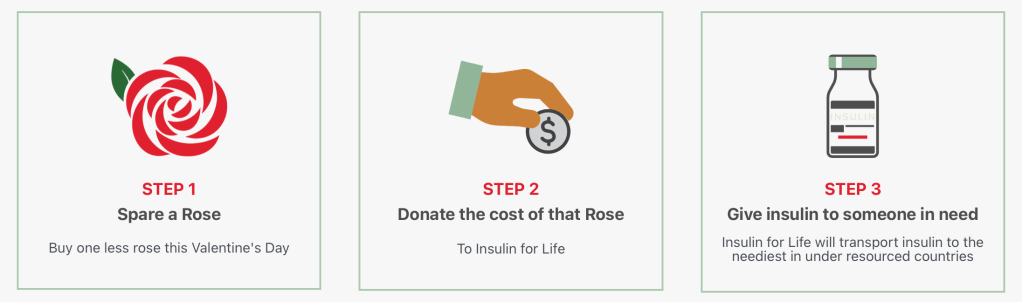
#SpareARose is a beautifully simple idea that asks people to forgo one rose in the bouquet to their love on Valentine’s Day, and instead, donate the saving from that one rose to a charity that supports people with diabetes in under-resourced countries. That one rose (about $5/£5/€5) covers the monthly cost of insulin.
Since 2013, the campaign has been known as Spare a Rose, Save a Child, and the charity that has received all donations has been Life for a Child. Over those nine years, the diabetes community – people with diabetes, people affected by diabetes, diabetes organisations and diabetes industry – has raised close to US$400,000, providing months and months of insulin to children in under-resourced countries. Plus, it’s raised the profile of the charity. Back when it started, very few people in the diabetes community knew about Life for a Child. Now, it’s supported financially by many, and recognised by even more.
For 2022, the campaign is doing something different and broadening its outlook to support people with diabetes diagnosed as adults, or who ‘age out’ of programs that have an upper age limit. Life for a Child supports people up to the age of 26 years. But of course, type 1 diabetes is for life, as is the need for insulin, diabetes supplies and healthcare.
With this in mind, #SpareARose has changed to Spare a Rose, Save a LIFE to recognise how the campaign will be helping adults with diabetes now, and the new charity partner – Insulin for Life.
Insulin for Life is a global charity and supports people with diabetes in many of the same countries supported by Spare a Rose. It’s so wonderful to know that these people will continue to receive insulin and other diabetes supplies, even once they hit 26 years of age, and beyond. You can read more about the important work done by Insulin for Life here.
Despite these changes, the campaign remains the same. One rose = one month of life. It’s a fabulously simple equation. What also remains the same is that it is a campaign BY the community, FOR the community. Every single person in the Diabetes Online Community can be a part of #SpareARose. We’ve seen tweetchats hosted by people across the world, we’ve seen fun challenges on twitter (remember #SpareAFrown?), we’ve seen videos and vlogs and lots and lots of blog posts. #SpareARose is on Twitter, Facebook and Instagram.
Of course, it’s not just financial contributions that make #SpareARose the success it is. It’s also about the community raising its voice to a veritable roar, and elevating the campaign and its charity partner. If you can donate, please do. If you can share, please do. Every time you share, someone might be click on the donate button, or the share button.
#SpareARose to Save a Life. Is there a more meaningful gift to make in the name of a loved one, a friend, a colleague, or in your own name? I really don’t think so.
DISCLOSURE
I’m so honoured that I get to be involved in this campaign by sharing and promoting it as widely as I possibly can. I have spoken about #SpareARose across the globe and written dozens of pieces to raise awareness of this fabulous grassroots campaign, and anyone and everyone can do the same thing. Really, I have no disclosure. I volunteer my time, along with a number of other diabetes advocates from around the world who drive socials to talk up #SpareARose. We also work with diabetes organisations and industry to encourage donations. If you would like to get involved, please reach out. The more the merrier!
Last year, facing the first Christmas in the times of COVID meant that for many people, celebrations were very different to other years. Our huge Italian family gatherings were put on hold because the idea of sharing food around a table, sitting in close proximity, and basically bringing together thirty or so loud Aussie-Italians, all shouting, because we all believe we need to be heard over everyone else, was considered not especially COVID-safe. Instead, we met in parks for catch ups, physically distanced and masked up.
We also waived gift giving for the year. Instead, I made donations in the names of all my cousins’ kids, and for the Secret Santa gifts we (thankfully) didn’t have to buy. (I remain especially Grinch-like about this particular Christmas activity and you can read all about why here.)
Charities are continuing to do it tough. Not only are fewer people able to donate, but more and more people are relying on their services to get through.
Insulin for Life is once again running its Secret Santa campaign and what a great way to share some love this festive season! All donations make a difference, but to give you an idea, if you can spare $5, you’ll be providing a week worth of diabetes supplies – insulin, syringes, and glucose strips – to someone with diabetes in an under-resourced country.
There’s lots of information available on the Insulin for Life website, but this one statement certainly brings home just how dire the situation is for so many of our diabetes brothers and sisters around the globe: For every two people alive with type 1 diabetes, one person has died prematurely due to lack of basic care.
Let me just share that again: For every two people alive with type 1 diabetes, one person has died prematurely due to lack of basic care.
Even though I have been volunteering for years now for different diabetes-related charities that support people with diabetes in under-resourced countries, I haven’t become immune to feeling shock when I see the stark truth written out in such simple terms.
Every single person can make a difference and improve the situation for people with diabetes in these situations. Donating is not possible for everyone, but there are other ways to help. If you are on social media, you can amplify the cause and share this blog post, or the donation link with a few words explaining how impactful donations can be (use the hashtag #IFLSecretSanta). You can organise a fundraiser at work, school or with friends – doing the legwork to make things like that happen are important and make a huge difference too. You could do a Facebook or Instagram fundraiser. You can pass a hat around at Christmas drinks and ask people to throw in any loose change they have. No amount is too small. Every contribution matters.
I was just chatting with some of the amazing people from the Insulin for Life team, and I was thrilled to hear donations are already coming in from the community. Of course, I’m not surprised. The diabetes community has always been amazing at giving back, as evidenced by the amazing efforts seen over the years with Spare a Rose.
Insulin for Life’s Secret Santa campaign is just getting started. Last year was the first year, and the community stepped up. And in 2021, even after the absolutely horrendous year so many have had, there are people in the DOC showing up to support the campaign once again. That’s what this is all about. It’s what it’s always about.

Gosh, there’s lots in the #DOC-iverse (#DOC-osphere?) about seeing diabetes, isn’t there? Yes, yes there is. Not sure about you, but I seem to be seeing a lot of bright, shiny, happy people (and a pop star or model or two) talking about diabetes, when usually they are pretty quiet about the whole diabetes thing. Which is fine. No one needs to spend their time advocating all about diabetes every minute of the day.
But I wonder if any of the marketing boffins who threw together their messages of inspiration bothered to check to see what the International Diabetes Federation are up to for World Diabetes Day on 14 November. Afterall, that’s the showstopper event of the month, isn’t it? Celebrating the birthday of the bloke who I give thanks to every day for keeping me alive.
A bit of history about World Diabetes Day to help understand that it’s not just about privileged folks with diabetes showing off their high-tech gadgets strapped to their impossibly beautiful bodies. (And yes, I know I sound like the Grinch who stole World Diabetes Day, but I think that understanding the foundation of this day is kind of important because that all seems to get swallowed up in PR spin.)
World Diabetes Day means something. In 2006, it became an official United Nations Day thanks to United Nations Resolution 61/225. At the time it was one of only two official UN health days. But even before that, World Diabetes Day had been going on for some time. It was in 1991 that the IDF, together with the World Health Organisation, created World Diabetes Day in response to growing concerns about diabetes.
Over the last thirty years, World Diabetes Day themes have aimed to be inclusive of people from around the globe, but perhaps there has been a (necessary) focus on how to improve diabetes outcomes for people in under-resourced countries. Maybe that’s why I find it a little galling when it appears that the day is about showing off your latest diabetes kit or shouting to the globe about how diabetes doesn’t stop people reaching their dreams. I love positivity and I’m often accused of being far too Pollyanna for my own good, but having a good look beyond our own privilege is important if we’re trying to get across a global idea of what is going on in the world of diabetes.
This year the theme is ‘Access to care: if not now, when?’. The World Diabetes Day website is full of resources that explain the theme. There are materials you can share to help explain just what access means to different people.
It all seems to be a little bit of a throwback to community initiatives of the past. The diabetes community has been the creators of some absolutely stellar campaigns – ideas that seem to have been founded in similar frustrations about which I’m smashing on my keyboard today. In 2014 there was a campaign that asked us to ‘Put the World back in WDD’ which was in response to there being a very Western focus on World Diabetes Day. Sometimes it feels that some things never change. The #Insulin4All hashtag that was first used to highlight how people in under-resourced countries struggle to access insulin is now most often linked with insulin pricing in the US.
Access means different things to different people, and the materials the IDF has put together consider this. Even if you live in a well-resourced country, with decent subsidised, tax-payer funded (never free!) healthcare, it’s likely that some part of your diabetes care is still difficult to access. It may not be insulin or diabetes supplies that are your access issue – it could be mental health support or different tech solutions.
Here in Australia, thanks to Medicare, the PBS and the NDSS, we have well-subsidised diabetes care. It’s not perfect, but it is certainly better than I hear from friends in other places around the world. But there definitely are still deficiencies in our care. Mental health care is limited – and almost impossible, it seems, to access. Only 50% of people with type 1 diabetes can access subsidised CGM and Flash GM through the NDSS. People in rural and remote areas of the country have far more difficulty accessing quality, regular diabetes care. The outcomes for Indigenous Australians with diabetes fall far behind. As always, people who are disadvantaged in some way are disproportionately affected, and face more difficulties accessing the care they need.
How you choose to celebrate (or not) this month and World Diabetes Day is entirely up to you. You may choose to ignore the ‘official’ theme of the day and focus more on other initiatives and once again, all perfectly okay. Just as YDMV, so may your diabetes advocacy.
But if you are interested in focusing more on access, have a look at the World Diabetes Day website and pledge your support for greater access to diabetes care. Read about the Resolution that was adopted by United Nations Member States that calls for urgent, coordinated global action on diabetes.
Look, I know. UN Resolutions don’t sound nearly as sexy as a six pack with a CGM plastered to it, but it is pretty cool that the WHO and the UN are talking diabetes.
And while celebrating the centenary of insulin, learn where insulin is not easy to come by, and why that is. Through volunteer work supporting both Life for a Child and Insulin for Life, I have learnt a lot about the challenges faced by people with diabetes in under-resourced countries. If you can, please consider making a donation this month to either, or both, charities.
And if looking to the community, it’s wonderful to know that there will be a docday° event on World Diabetes Day that is dedicated to the theme of access. You can learn more about that event here. It’s free to join, and will be live streamed on Facebook – you don’t even need to sign up.
But perhaps a final thought. How great would it be if those with really, massively high followings, (and followings not-only-in-the-diabetes-community), used this time to talk about making a real difference – a difference to people with diabetes who are struggling to access the basic drugs and supplies to actually live with the condition.
Sure, ‘seeing diabetes’ helps raise awareness, but as ever, I ask how much of that actually cuts through and gets out of the community that is already seeing diabetes every single minute of every single day?

I facilitated an event for Ascensia (disclosures at the end of this piece) last night/early morning and the crappy time was partly (mostly) my fault, because although I sacrificed the Aussies and suggested we draw the short straw in the time zone lottery, I forgot that daily saving would have kicked in for us meaning kick off time was 11pm and not 10pm. That may not seem much – I mean, what’s an hour? – but there is definitely a psychological barrier about doing work after midnight. (Anyway, I digress, and that paragraph has just about put me to sleep).
The reason for last night’s adventures after dark was a facilitating gig for Ascensia’s latest Diabetes Social Media Summit (DSMS). The thing I love about (and why I am so keen to be involved) in these Summits is because they have tacked some difficult topics that are often hidden away.
This one was no different in that we looked to address something that needs more attention – diabetes and women’s health. In my introduction, I wanted to make the point that diversity and inclusion is important when speaking about any aspect of diabetes, and that for us to be truly inclusive in a discussion about women and diabetes, we needed to hear from women who represent all corners of the diabetes world. I particularly referred to needing better representation from women in the LGBTQIA+ community.
The other thing that we had wanted to make sure that we didn’t focus too much on diabetes and pregnancy, because so often that is the only easily information about women’s health and diabetes that can be easily found (and saying that, there does seem to be a bias towards women with type 1 diabetes). Of course, understanding and being aware of how diabetes can impact on pregnancy is important, but it is certainly not the only issue that women with diabetes want or need to know about.
In fact, one of the discussion points was that for some women, pregnancy is not a topic they want discussed. There is the assumption that all women of childbearing age need information about having a healthy baby when that is not the truth. Contraception discussions do not necessarily equal an invitation for pre-pregnancy counselling, and there needs to be some sensitivity in how healthcare professionals in particular raise the topic, and rid themselves of the belief that all women want to have kids.
There is so much more to talk about. So, so much more.
We touched on how much our cycles can impact and influence glucose levels (and a very amusing tangent where we joked about how when we see monthly perfect glucose patterns, they clearly don’t belong to people who menstruate – or people who understand the absolute havoc hormones can wreak on CGM traces).
We spoke about birth control and how the OCP can also make a significant difference to glucose levels, yet many of us were not told about that.
Of course, we spoke of menopause, but only briefly; briefly not because it’s not an important topic (or a super relevant topic), but because we just got caught up talking about other things (and perhaps my facilitating skills weren’t as tight as usual).
And we spoke about how cultural gender issues need to be shown and understood so that the experience of privileged white women with diabetes are not seen as the only experiences.
For me, the central message that I heard time and time and time again was that topics about the very things that occupy a lot of the headspace of women with diabetes are simply not discussed with us. And there is little research to inform our decision making, or even to help us form the right questions to ask. At best, we are given some piss-weak explanation that points a finger at diabetes being to blame. At worst, we are dismissed.
I do wonder when research and diabetes education will catch up. I know that there are some wonderful researchers doing some important work here, but we are so far from normalising discussions about women’s health and diabetes as part of our typical healthcare routines. We’re miles away from getting rid of the preconceived and outdated ideas about women’s sexual health.
Beyond discussing different women’s health matters, we also spoke about just how these discussions fit in the diabetes community. This was a completely unplanned turn for the summit (it was not a topic on the agenda), but I’m glad we had it and I’m glad that I am writing about it. Because of the nature of women’s health, sex and diabetes, there is a lot of taboo, shame, fear, and vulnerability. I know that some of the rawest and most open I’ve been in my writing has been when I have been dealing with moments in my life that were so, so hard and I was so, so vulnerable. When I look back, I sometimes wonder if I was right to hit publish after writing, and perhaps I should have tucked away the paragraphs until I was feeling stronger. Or not published at all. While I have been told that my words have provided some comfort to others facing similar challenges, it left my gaping, open wounds very public and visible.
After writing about miscarriages, I’ve been called selfish for wanting to have a child and potentially passing on diabetes to them. Writing about my fears of passing on diabetes to my child I’ve been told that perhaps I should have thought of that before I got pregnant. Speaking about body image concerns, I’ve been told to toughen up and stop being so shallow. I’ve seen and watched other women with diabetes experience the same thing, and I feel their pain as I watch them navigate the muddy, and sometimes distressing waters.
We spoke about how women are treated in the diabetes community, particularly when we write about struggles and difficulties, and the words and terms that are thrown our way when we dare to share how we are feeling. The ‘angry woman’ trope that I’ve written about before has been directed to many others too.
These discussions are real, and they are necessary. I am one of the loudest, most vocal supporters of peer support and have spoken about the value and importance of diabetes peer support and the online community on stages literally around the globe. Peer support saved me at times when I thought I was broken beyond repair. But it also can be a source of pain and bullying and nasty confrontations, and perhaps we need to have those discussions too so that when someone decides that they are ready to share and be especially vulnerable that they look out for themselves as much as looking out for the community. It’s all very well to want to share to connect and help with our own and others’ isolation but leaving ourselves exposed isn’t easy.
One of the attendees last night reminded us that we could share with selected friends in the community, still allowing for that peer support but under the protection of a safe space. It’s interesting, because until maybe two years ago, I had never experienced how unsafe the community can be to individuals. I’d not felt that before. While I still share a lot, these days I’m more inclined to turn to those trusted friends in the DOC who I know will be honest, open, but never nasty or judgemental.
Online spaces are different for women than they are for men. The misogyny that is inbuilt to even those that we think are allies comes out, often surprising us, as throwaway comments about a woman’s age or appearance. It is ever present in the diabetes community too. I’ve rolled my eyes as some of the most vocal advocates who have loudly aligned themselves as being supporters of women, revert to type, with snide sexist commentary. I’ve seen people in the DOC referred to as ‘angry old women’ for daring to be furious, older than 25 and a woman! I roll my eyes now when I know someone has called me angry. I also know that they’ve just announced to everyone how threatened they are of women who dare to not go quietly, and how they expect us to remain in our place!
There was so much more that we could have spoken about last night. We didn’t touch on body image and disordered eating (and yes, I know that this is not the domain of women only, but this is about us!), we didn’t talk about sex all that much either, even though it is often highlighted as an issue that needs more coverage and information. Again, it’s not because they are not important topics; it was because the fluid conversation took a feminist turn that highlighted a highly biased social and healthcare environment where it is seen as perfectly fine that the needs, and concerns of fifty percent of the diabetes community are barely considered.
Perhaps if we had a more feminist approach to, and model of, healthcare, the misogyny that has meant the topics important to us have not been researched, and are not discussed, could be eliminated. And women with diabetes would not be feeling ignored.
Disclosure
I was invited by Ascensia to help plan the agenda for #DSMSWomen and facilitate the discussion. I have been paid an honorarium for my time.





 Diabetogenic