
You are currently browsing the category archive for the ‘DOC’ category.
Part of my work involves attending diabetes conferences both here and around the world. Sometimes I have a speaking gig, other times I’m there for meetings, and always I’m there to learn as much as I can about the latest in diabetes.
I love this part of my job in equal measure with not loving it. The ‘love it’ part is because I get to meet with and hear from some absolute superstars in diabetes research and get front row preview seats to what they’re working on. And I love it because I get to see other advocates who are there for the same reasons I am.
The ‘not love it’ part is because I spend a lot of time away from my family and ‘real life’. I feel enormous mother guilt (this time I missed the kidlet’s Winter Music Concert) and feel lousy for leaving lists of plans and schedules for people other than me to manage. Plus jet lag. I talk about jet lag so much because these days it is absolutely kicking my arse as it turns me upside down and into a bumbling, confused, unintelligible mess.
I realised when I was at ADA in Orlando that all my overseas DOC friends have only ever seen me at my jet lagged, time-travelling worst. They get exhausted, grumpy, vague, annoyed me. And they get me doing weird things like falling asleep in front of them only to suddenly get a second wind and become almost hyperactive where I speak a lot – and really quickly – about weird things such as Australian-isms that I believe they absolutely must start to use in their day to day vernacular. (Only click on this tweet if the eff word and spiders don’t offend you…)
And then, I reach a point where I abruptly stand up and say ‘That’s it!’and just leave and head to bed, often mid-conversation. Why they still want to talk and hang out with me is actually a mystery!
But I am glad they do want to spend time with me, because sometimes, being at a diabetes conference is really hard going emotionally.
We sit there listening to some pretty tough stuff; scary stuff. We hear ourselves being spoken about as ‘subjects’ in research which takes away our ‘human-ness’ and makes us sound like rats in a lab.
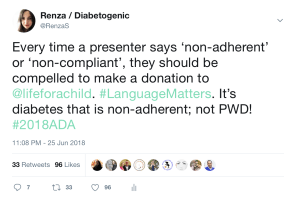
We are referred to with words that make us sound like petulant children (‘non-compliant/non-adherent/failed’ etc.) and all we can do is tweet our frustration (and language positions statements) begging that presenters be considerate in the words they use.
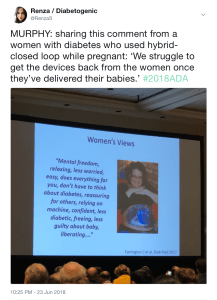
We hear scary, scary tales of all the things that can go wrong with diabetes in a variety of different situations. I reluctantly walked into an 8am session on diabetes and pregnancy, and even though that ship sailed a few years ago for me now, I still brace myself for the research showing that diabetes can and will impact on our developing babies, and children once they are born. That mother guilt I spoke of early is gets turned into mother-with-diabetes guilt which is a monster of proportions all to itself. (Of course, the wonderful Helen Murphy’s talk at 8am was not scary or mother-with-diabetes-guilt-inducing. Instead it was full of interesting facts about how APS impacts positively on diabetes pregnancies. Hurrah!)
Diabetes-related complications are spoken about in matter-of-fact ways that zone in on specific parts of our body and suddenly we stop being whole. ‘The diabetic foot/eye/kidney’ is still attached the rest of us, and yet whole sessions dissect them from our bodies and focus solely on that part of us, forgetting how connected we are to them (literally and figuratively!)
We are told about how diabetes increases the risks of so many, seemingly unrelated problems that can only make me feel as though the cards are stacked so against us that, sometimes, diabetes just isn’t fair. (See also – or maybe don’t – this released today…)
We sit there listening to advice on how things could be improved and sometimes, shake our heads at the disconnect between what is reality to those of us actually living diabetes and the ideas from researchers and clinicians. We wonder what – if any – engagement there has been with the people this advice is meant to serve.
It can be – it is– emotionally draining, exhausting, frustrating.
Those moments when a friend’s sideway glance, or eye roll, or a snarky comment in response to yet another kick in the gut because diabetes is all bad news, is a reprieve from feeling a little shaken. (Of course, it’s not all like this. Often we sit in sessions and feel that those presenting are truly championing our efforts and we do high five through those presentations.)
And those evenings when the sessions have finished, and the official dinners are over and we simply sit together, debrief, refocus and put diabetes back in perspective, make me whole again. It’s the same at every conference. The people may change depending on the location of the conference, but there are always people there. And I’m grateful for that, because I may return home exhausted and jet lagged, but I’m not overwhelmed at what I have seen and heard. Which I fear is how I would be if it wasn’t for the caring, smart, understanding, wonderful people in this tribe .
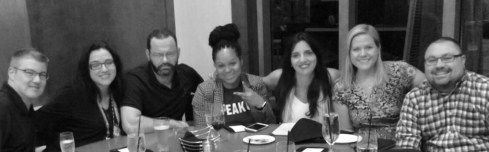
Tribe at ADA
Without fail, the first thing I put into my schedule when I am attending either ADA or EASD is the update from Life for a Child (LFAC). It’s usually held on the first day of the conference, bright and early in the morning and, for me, it sets the scene for the conference. It anchors me, so that throughout the remainder of the meeting, while I am wandering around a fancy exhibition hall, or listening to talks about the latest in technology (usually what I am drawn to), I must never forget that for some, access to insulin, diabetes supplies, education and support is incredibly difficult.
At ADA this year, there was no update session. Instead, the LFAC team gathered some of the advocates who were there so we could meet to discuss how we could continue to work together, through initiatives such as Spare a Rose, to raise funds for, and awareness of, the program.
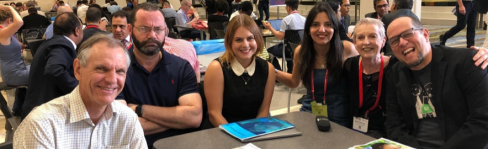
L-R Dr Graham Ogle (General Manager LFAC), Grumps, Emma Klatman (Health System Reform Specialist LFAC), me, Angie Middlehurst (Deputy Manager & Education Director LFAC) and Manny Hernandez.
When I am writing and talking about LFAC, I usually do it in the context of asking – urging – people to consider making a donation. Around Valentine’s Day, the one rose = one month of insulin equation is repeated over and over again to highlight just how little it takes to make a difference to a young person with diabetes in a developing country.
But I’m not sure that everyone knows just how far reaching and important the work carried out by LFAC actually is, or how donations are used. Recently, they released their annual report, highlighting just some of their successes, and I thought I’d share some of them here.
To start with, last year LFAC helped over 18,500 young people from 40 countries.

Support offered by LFAC goes beyond just providing life-saving insulin for young people with type 1 diabetes. Other diabetes consumables, such as syringes and blood glucose monitoring kit is available. A1c checks are provided, providing baselines and ongoing data for centres in developing countries. Services such as education, workshop and resources are developed, translated and distributed, and support for healthcare professionals is offered.
In Haiti last year, 51 children attended a camp for children with diabetes – the first of its kind ever held in that country. (As someone who frequently speaks about the benefit of peer support, I know how amazing this would have been for the children who attended. Meeting other kids who instinctively ‘get it’ would be the same as the feeling I get when I meet and speak with others who are living with diabetes.)
LFAC also has an active research focus which is critically important in highlights aspects of diabetes, (including incidence, prevalence and mortality; cost of, and access to care; success of intervention and care-giving approaches; psychological impacts of diabetes), in young people in less-resourced countries. This research is vital in informing future programs, activities and services. LFAC research can be accessed here.
Life for a Child does all this and more, working towards their vision of a world where no child should die of diabetes. The fact that this should be their (or any organisation’s) vision – 97 years after the discovery of insulin – is heartbreaking.

Being a part of the extended Life for a Child family is one of the most important things in which I am involved. Writing blog posts and talking about the program sometimes seems like such a small thing to do, but I am committed to raising awareness of the issues faced by the young people the program helps, and raising funds so they can do more.
I have only touched on their important work, and despite the great achievements I’ve mentioned here and the number of young people benefiting from the program, there is still a waiting list for support.
Pumps. Pens. Syringes.
Patch pump. Pod.
Share your data. Don’t share your data.
Blood glucose monitors. Continuous glucose monitors. Flash glucose monitors.
Low carb. High carb. Low(er) carb. No carb. ALL the carbs.
Private diabetes team. Public clinic.
#WeAreNotWaiting. #WeAreWaiting.
Apps for recording data. Scribbling down numbers on the back of an envelope. Making up numbers as you go along.
Online peer support. Face to face peer support. No peer support.
How fortunate we are to have choices – to have choices we can make for ourselves for our own brand of diabetes.
I’m feeling a little burnt out at the moment by the zealots online who think it’s their way or the highway. Do what works for you and share it, by all means. But attacking someone else for doing something different is just being a dick. Don’t be a dick. There’s really no need.

I’m in London for a couple of days of meetings before flying to Copenhagen….for another couple of days of more meetings. But I was smart this time, managing to set aside a whole day before the meetings start to do this:

These three women – these wonderful women – are part of the lifeline I have to help me manage diabetes. It may have been faulty pancreaes that brought us together, but what ties us together is support, friendship and love.
Thank you Annie, Georgie and Izzy for coming to meet me in my jet-lagged state in London. Thank you for building me up, and filling my jar. I couldn’t do this diabetes shit without you all.
The three most important women in my life are forces of nature: My mother, president of union, has instilled in me a desire to do work that helps others. My sister, the fiercest, feistiest, smartest person I know, who constantly challenges me to think outside my comfort zone. And my daughter – my amazing, miracle kid, (and kids like her) – is why I feel that the world is actually going to be okay.
The supporting cast of close family – mother-in-law who just happens to be an Australian aviation pioneer, my sister-in-law, aunts, cousins – and friends means that I am constantly surrounded by brilliant women doing brilliant things. I am astounded, daily, at the challenges they overcome, their triumphs, the lives they change, the impact they are making.
And in my diabetes life it is women – the incredible women – who keep me going and keep me motivated. My diabetes healthcare team is made up exclusively of women who truly breathe the whole person-centred care belief system, building me up and then supporting me as I do the best I can with diabetes. The women I have worked with, and continue to work with, in diabetes organisations who champion those who would otherwise be forgotten have become friends, mentors and daily cheerleaders.
It is people like Cherise Shockley, founder of DSMA; Dana Lewis, creator of Open APS; Susan Alberti, philanthropist; Jane Speight, diabetes language forerunner; Taryn Black, Diabetes Australia policy director and champion for having the voice of PWD heard; Riva Greenburg, journalist, changing the way we see people living with diabetes; Annie Astle, advocate and speaker, and the person I am most grateful to have come to know because of diabetes; Monique Hanley, cycling legend; Christel Marchand Aprigliano, advocate leader; Cheryl Steele, CDE extraordinaire and leader in diabetes technology education; Kerri Sparling, author, blogger and incredible advocate; Anna Norton, Sarah Mart and Karen Graffeo, the women behind Diabetes Sisters; Melissa Lee, incredible communicator, singer, former leader of DHF and now at Bigfoot Biomedical; Kelly Close, founder of diaTribe and Close Concerns; Georgie Peters, speaker, blogger, diabetes and eating disorders advocate…
And you know what? I haven’t even scratched the surface. The diabetes world is shaped by women, built by women, sustained by women. Advocacy efforts are often the brainchild and then led through the blood sweat and tears of women. And how lucky the world is!
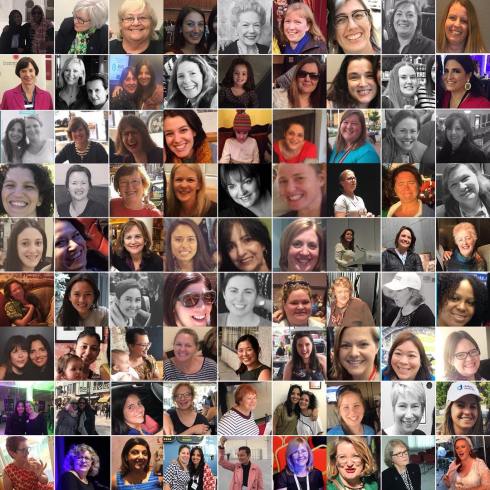
I celebrate these women today and every day!
More writing about women and diabetes, and women’s health.
This is what Diabetes Privilege Looks Like
One Foot in Front of the Other
Have you been thinking about making a donation to Spare a Rose; Save a Child, but just haven’t managed to do it yet? Did you think that because Valentine’s Day is over that it’s too late? Watch this and find out why your donation is still greatly needed.
Donate now to have your donation added to the 2018 Spare a Rose tally. Just click on the image below.

There is an indescribable feeling I have following a diabetes conference. Swirled in amongst the exhaustion, information overload, jet lag (because conferences are always in ridiculous time zones that are not AET), and memories, I come back galvanised in a way that can only happen when spending time with those in my tribe: others living with diabetes.

I returned from three days in Vienna bone-achingly exhausted. After being reunited with my family and not being able to stop hugging them, a few days of not-great-but-okay sleep and bucket-loads of Melbourne coffee under my belt, and time to process and write about what I learnt, I find myself recalibrated and ready for what’s next.
The hours of travel is a memory, the conference sits comfortably alongside all the others I’ve been too, my conference name badge is hanging in my office with all the others, and I’ve plans already underway from successful meetings.
In a lot of ways, the status quo has been restored and I am back to my real life after a few days of conference life.

But what is not the same is the level of vitality I now have, my veins pounding with the vigour that comes only from spending time with the people who are working to and for the same things because they get it at a personal level that is only apparent to those of us whose very DNA is affected by this condition.
I came to realise a few years ago that I have an invisible jar in my mind, and how empty or full that jar is depends on the time I’ve spent with likeminded diabetes friends. When the jar is nearing empty, I find it difficult to focus my energies on the advocacy and support issues that often are front and centre of my mind. I feel myself flailing and falling short because I don’t have the support of those I need to boost me up.

Of course, I am lucky enough to have others with diabetes around me even when I am in Melbourne (hello neighbour!), but it is those I see at these sorts of conferences – the ones whose minds and hearts are full of similar ideas, similar frustrations and find similar reasons to celebrate– that fill that jar right up. It is when I can simply turn to someone because they are sitting right there, have an animated conversation and high five each other with our enthusiasm that I feel capable and able to take on the world.
Those people who share my pancreatically-challenged existence, who breathe the same health condition, and struggle, celebrate and despair in similar ways to me, are the ones who fill up the jar ways to sustain me until the next time. My motivation is high, the momentum fast, my mind is working overtime. And my jar is overflowing right now with those people who may have beta cells that don’t work, but they make up for it in ways you couldn’t even begin to imagine.
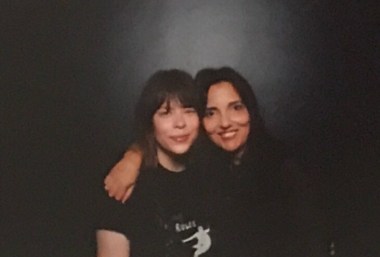
Tine – who inspires me every time we speak.
Here I am speaking too fast, hands waving erratically (#TooMuchCoffee), with an idea about how we can get Spare a Rose, Save a Child better known outside the diabetes community…

Click image to donate
It’s that time again. Supermarkets are covered in red heart-shaped foil balloons, fluffy heart-shaped pillows and velvet heart-shaped boxes of chocolates. Florists are about to hike up the price of roses by three or four hundred percent. And the sex shop in my neighbourhood has an odd display of edible underwear in the front window, surely begging the question: who the hell actually thinks that is a good idea as a gift for any occasion? Anyway, I digress..
It must be Valentine’s Day.
We don’t do Valentine’s Day in our place. It is a Hallmark occasion if ever there was one and quite frankly, the idea of being loving and affectionate and amorous one day a year is ridiculous and would leave me feeling very short-changed.
But despite my complete and utter aversion to organised romance, I have, for the last few years, thrown my weight behind Spare a Rose, Save a Child. And today, with two weeks until Valentine’s Day, it’s time for me to start talking about it again… A reminder of how the whole Spare a Rose thing works:
Instead of giving your Valentine twelve (overpriced) roses, give them 11, saving yourself about AUD$6. Donate that six bucks you’ve saved to Spare a Rose.
All funds raised by Spare a Rose go directly to the Life for a Child program which provides insulin and diabetes supplies for kids in need and your six dollar donation is enough to provide a month’s worth of insulin to a kid who might otherwise not have any.
It’s pretty easy and you don’t need to be good at maths to work out how much to donate to actually make a difference.
Of course you can give more – you can forgo the flower thing altogether, donating the cost of the whole dozen (meaning you’ve just provided a full year’s worth of insulin for a child). Aaron knows my favourite sort of vase on Valentine’s Day is an empty one, with the cost of the whole bunch going to Spare a Rose.
You know, here in Australia it the most it will cost to buy insulin is $39.50. If you have a healthcare card it’s $6.40. We really are so fortunate that the vast majority of Aussies don’t have to worry about insulin prices increasing at terrifying rates or insulin not actually getting into the country. I don’t for a moment think our healthcare system is perfect.
But it is a far cry from places where children and adults are dying because they cannot access insulin. That is the reality for a lot of people, and we can do something about it.
Six dollars. That’s all it takes. And it is as easy as clicking here. Please donate.
DISCLOSURE
Spare a Rose Save a Child is an initiative of a few well known advocates from the DOC in the US. In the last couple of years, they’ve invited me and advocates from the UK to be involve in the campaign. (Obviously, I receive no funding to work on this, and am doing it because I believe in it.)
Towards the end of last year, I wrote about some things happening online trying to encourage people to openly and freely speak about being diagnosed and living with diabetes-related complications.
When conversations about diabetes complications are brought into the public domain, often two things happen.
Firstly, people start to talk. That whole cornerstone of peer support – reducing isolation and sharing stories – flings doors and windows wide open, and people, often gingerly at first, start to offer their own experiences. Inevitably, someone will say that they don’t speak about their complications because they fear the judgement that will follow. Or that they believe they are the only one their age facing complications because they have never met another person, or read a blog post from another person sharing a similar experience.
Secondly – and most damagingly – there is judgement. And it comes in spades, often sending some of those who had started to open up retreating back into the depths of diabetes taboos. This is not helpful for anyone.
So I wasn’t surprised when, during a useful discussion starting online about living with diabetes related complications – which resulted in some people willingly talking about their own experiences – the horribly judgemental comments started infiltrating the conversation.
I shared this post that I wrote almost five years ago about why we need to reconsider the way we speak about diabetes complications as I thought it was relevant to the current online conversation. In fact, everything I wrote in that post was still true because diabetes continues to be a terribly stigmatised condition and, within that, those of us living with complications seem to face additional stigma and judgement.
If for one second anyone doesn’t believe that statement, here are just some of the comments that I received (on LinkedIn and Twitter) after sharing the post:
‘If considering that many people who are type 2 diabetic quite simply exercise too little and eat too much fat…… which has immense financial consequences for the provision of healthcare…….. how else do you propose to get these people to lose weight and stop emburdening (sic) themselves on our NHS? If you take away the need to shame them you take away the most powerful way of making them take responsibility for their health.’
‘Sorry Renza but if we get complications of diabetes then we have failed. We are each responsible for own health and must try to maintain it at all cost.’
‘Diabetic complications do not happen with ‘perfect’ blood sugars. I agree that we must be supportive and sympathetic and the insulins available don’t help but it’s still the patient’s responsibility and not the doctors. Sorry if this doesn’t bode well with you.’
Is it any wonder that people are reticent to speak about developing complications if people are thinking like this?
I have written before that I believe diabetes has an image problem, because I can’t think of any other health condition that, if a treatment does not get the desired outcome, the person living with that condition is blamed. I have never heard someone being blamed if the cancer for which they are being treated does not end up in remission. I don’t know of anyone with rheumatoid arthritis who is blamed if their pain increases or their mobility decreases. I’ve not heard of someone with psoriasis being accused of not caring for themselves if their skin flares up.
But all bets are off when it comes to diabetes and fingers are pointed fairly and squarely in the face of the person living with diabetes if they develop complications.
Diabetes complications happen. It is, unfortunately, a reality for many people living with diabetes. I’m not trying to be negative or scare people, but we know that the longer we live with diabetes, the more likely we are to develop complications.
In this post, The Grumpy Pumper says: ‘Complications are a hazard of what we have. Not a failing of what we do.’ Maybe if we take that as the starting point we can take away the blame. And maybe if we take away the blame, we break down the stigma. And maybe if we break down the stigma, we can start having a real discussion about how we treat complications if they develop, and get to treating them.
And maybe if we stop thinking that developing diabetes and anything that happens after living with it is a shortcoming we can stop feeling so judged and shamed, because others will stop judging and shaming us. More to read on this topic:
Riva Greenberg shared this one.
Sarah K from Sugarbetic wrote this.





 Diabetogenic