
You are currently browsing the category archive for the ‘Diabetes’ category.
On April 15, 1998, I was inducted into the world of diabetes. I had no idea what lay ahead of me and it was a year where I really didn’t have time to be diagnosed with a chronic health condition. At the time, I was 24 years old, in the middle of wedding-planning, trying to buy a house, changing careers and moving. Diabetes wasn’t part of the plan. It still isn’t, come to think of it, but I don’t really have a say in the matter now.
Today, I’m reposting a letter I wrote to my 24 year old self about what I could expect. I’ve made a few little changes (you can read the original post here) , and the reworked one below:
Dear 24-and-a-half-year-old-me
Oh, sweetie. Diabetes sucks. You don’t know that yet, but let’s clear that up from the beginning. It sucks. It’s not fun and it is a pain in parts of you that you didn’t even know could hurt. But figuratively more than literally.
Right now, you are overwhelmed, stressed, anxious, scared and terrified. In a couple of weeks you’re going to get angry. Really angry! It’s OK to be feeling all these things.
You will be fluent in a new language within the next few weeks. Words that you’d never heard of become part of your vernacular, and you become incredibly conversant in anagrams. BGL, CSII, HbA1c, DA-Vic, CGM, ADEA…. And you will delight in the fun way mmol/l rolls of your tongue. (I promise – that will make sense!)
Believe it or not, you are going to be absolutely fine about sticking a needle into your skin four times a day. And you’ll find that actually, it doesn’t hurt. You won’t be quite as comfortable about the jabbing your fingers what feels like a million times a week to find out what your blood sugar is doing.
But things get better. The lancet device you have now is pretty horrendous and in a couple of years, you’ll get a new one that doesn’t make quite as nasty a clunking sound, and will hurt less. Also, the first meter you have will take 20 seconds to count down to tell you your BGL. Wait until you get one that takes five seconds! You won’t know what to do with all that extra time in your day! And one day you’ll get a meter that plugs into your iPhone. (And one day, you’ll know what an iPhone is!)
Find out everything you can about insulin pumps. Speak with people using one. In three years you will have one and it will change your life. I want you to hold on to that over the next couple of years when things are not going as you’d like with your diabetes management and you think that you’ll never work it out. You do. And your pump is a huge help. Technology that you have no idea about is going to become an integral part of your life. Don’t be afraid of it – embrace it. But remember that these tools are there to help YOU manage your condition. Don’t become a slave to the data and don’t feel that you can’t take a break and go back to basics if that’s what you need.
(Also, perhaps tone down the evangelical pump attitude you develop. You become a little zealot-like. Yes, it worked for you, but it may not be for everyone. BUT INSULIN PUMPS ROCK!!!! As for CGM – let’s just say that your mind will be blown!)
Can we just talk about guilt for a minute? Diabetes comes with a lot of it and you’re going to learn that really quickly. Here are some things that you absolutely should not feel guilty about:
- The fact that you don’t change your lancet EVERY time you check your BGL
- Ditto goes for pen needles, and after three years, pump changes
- What you eat. Food does not have a moral compass.
- When you feel overwhelmed and completely ‘over’ having diabetes
- Not wanting to be a diabetes advocate ALL THE TIME
- Accepting that saying ‘that’ll do‘ when it comes to your diabetes doesn’t make you a bad person; in fact, it makes the whole diabetes palaver more manageable!
As you are in the middle of your wedding plans, here are some things I want you to know about that day so you can relax a little. It is a fantastic day. Your dress is stunning, your hair looks fine and you find the shoes you have been searching for. Diabetes comes along for the ride, but it’s in the background and no one mentions it on the day except for your mum asking quietly if your BGL is OK. When you think back to your wedding day, look at the photos and watch the video, you won’t be thinking about diabetes. You’ll remember the song that was played as you walked down the aisle and the faces in front of you. You’ll remember dancing the tango at the reception and the band playing Stevie Wonder as ‘gli sposi; were introduced to their friends and family.
(Also, the cars will be running late, but they’ll get there; and deliver you to the church inside Aaron’s ‘you’ve-got-fifteen-minutes-or-I’m-heading-to-the-pub’ timeframe.)
Oh, and when you meet your endocrinologist for the first time, he is going to tell you that diabetes will not stop you from having babies, as long as you have finished having your family by the time you are thirty. And you are going to wonder how it will be possible for you in the next five and a half years to fit in all the things you planned AS WELL as have a couple of kids. Don’t stress. Soon, you will find an endocrinologist who sets you straight. And when you are three days shy of thirty-one you will have a daughter. She’s a delight.
He will also show you some scary pictures of amputated limbs, kidney failure and tell you that you may go blind. Please, please, please don’t be shocked by what he says. The scare tactics that are used on you by him and other diabetes health professionals you will meet in the next couple of years will actually make you angry and determined. This is a good thing. As you seek out information, you will learn that complications are not inevitable and you will do everything possible to minimise your risk. And you will also come to understand that the guilt associated with complications is not fair.
You are going to meet some incredible people in the next few years – some of them become some of your best friends. Having a support network of people living with diabetes will inspire you, help you. Seek them out! And you have no idea what this means, but when, in 2011, you decide to get on Twitter, embrace it like there’s no tomorrow. Your mind will be opened up to a world of amazing, inspiring, caring, funny people all over the world who, like you, live and love with diabetes. You will call these people your friends and you will be part of a global community that makes you feel accepted and safe.
So 24-and-a-half-year-old me. The future isn’t as grim as you think it is right now. Your life isn’t life with diabetes. Diabetes isn’t the central part of it and I know that right now you wonder how it can be anything other than that. But it’s not. There will be times where you feel that it is all consuming and taking over everything, but by and large you manage to keep it in its place. You will get to forty and be healthy and surrounded by the people who love and support you and while you will have encountered some of the most difficult times, you will also have encountered some of the most wonderful. Diabetes is only part of your life.
Also, go and eat a cupcake today – just because you want to. It’s what I am going to do right now!
Much love from your much wiser, 40 year old self.
We have two dogs and one cat. They are fluffy, cute and very much part of our family. And while I like to think that they are wonder animals, they’re really not. Bella, the Maltese/poodle cross used to sleep under the coffee table and every time she woke up, hit her head. She did this for three years. Until we got rid of the coffee table. Jasper, who is getting old now, has only one thing on his mind – food. He’ll eat anything, including the green leaves at the top of a strawberry and the watermelon rind. Cherry the cat is, as most cats, quite brilliant, and manages her staff (the three humans of the house) in typical cat aloofness with a side of purring cuddles thrown in so we remember how much we love her.
Gorgeous? Yes. Smart? Not so much.
For years of I’ve heard stories of dogs and cats that can sense if their owners’ BGL is dropping. Clever hypo alert dogs are being used by people with impaired hypo awareness to notify them of undetected lows. I’d read these stories. And then think of our little pets whose skills don’t go much beyond sleeping, eating and looking cute. I was resigned to the fact that none of our pets would save me in a sticky situation. Except, I think that the other night, Jasper may have done just that.
Until recently, Jasper slept at the end of the bed. A new, higher mattress and his old age have meant that jumping up was becoming harder and harder. Instead of effortlessly leaping up, he would run from side to side of the bed, front paws on the mattress, his boofy head popping up, looking a little like a meerkat as he waited for one of the humans to lift him up. After getting sick and tired of this routine, we bought him a bed and he now sleeps in a corner of the room.
The other night, I put myself to bed early and promptly fell asleep. After about an hour, I stirred because Jasper was doing his meerkat impersonation, but only on my side of the bed. Suddenly I felt him gently tapping at me. I told him to leave me alone and go back to his bed. But he refused. Dozing in and out of sleep, I could feel his paw on my arm and then he stared whining.
Finally, wide awake and annoyed at being woken, I started to get out of bed, thinking he needed to be let out or wanted his water bowl filled. As soon as I stood up, it hit me. I was low. Really low. I slumped back on the bed and grabbed the lolly jar from the bedside table and threw down a handful of jelly snakes. Jasper sat down at my feet, watching me earnestly. As I started to feel a little less woozy and could sense my BGLs coming up, Jasper padded back over to his bed, got himself comfortable and fell back asleep.
I ate a couple more jelly snakes and checked my BGL. It was back in range. I could hear him snoring gently in his corner and ten minutes later, as I started falling back asleep, I thought that maybe he is a wonderdog after all.

Jasper the Wonderdog
How often do you ask for help because of your diabetes? Yesterday at work, I had a hypo that just wouldn’t quit. I ate the equivalent of the weight of a tram/rhino in jelly beans. It worked eventually, but for a long time I was hovering around the 3.0mmol/l mark, anxiously checking every 10 minutes to see if there was any increase in my BGL, while at the same time waiting for the inevitable spike (yep – came two hours later in the form of a lovely 26.5mmol/l. #DuckingFiabetes).
So, did I call out to anyone and ask for their help? Did I request someone come and sit with me for a bit – at least for the part where I was seriously wondering if standing was a good idea? Nope. Instead, I fought through, guzzling glucose, sitting in meetings, smiling my way through. Anytime I saw someone and they asked ‘How are you?’ did I say ‘Low, low, low, low’? Nope. I said ‘I’m fine, thanks’ and threw them what I thought was a winning smile, but given my hypo state was most likely a lopsided grimace.
I’m not good at asking for help. The one hypo I’ve had that required an ambulance occurred when I was walking around the park one evening with a dear friend. She noticed me throwing down a handful of the jelly beans I carry with me whenever we walk and casually asked if I was okay. ‘Yep – all good’ I said and we continued powering away. Her concern grew as I started shovelling the jelly beans down and became distracted, but every time she asked if I was okay or if we needed to stop, I’d smile and tell her all was fine and that the glucose would start working shortly. Even as the sweat started to drench me and I felt my legs start to turn to liquid, I swore that all was okay. At no point did I say to her that I was concerned that I was about to pass out. At no point did I tell her that I thought I was not going to make it back to her apartment. ‘I’m fine.’ I said. Over and over and over. Until I wasn’t and the next thing I remember was waking up on her the floor of her apartment with a paramedic about to shove a dextrose IV into my right arm.
On those occasions where I have needed help, I’ve been left feeling beaten. I vow to step things up and not let diabetes win again. But is it a matter of diabetes winning? Perhaps this ridiculous doggedness to insist that ‘I’m fine’ is actually doing more harm than good. Would it have been so terrible if yesterday I had said to a colleague ‘I am having trouble getting my BGLs up. If I have to eat another jelly bean I’m going to vomit. Would you mind at all finding me some juice to drink?’ Would they have thought any less of me; seen me as helpless; decided that I was losing to diabetes?
Of course not. But this isn’t about what others think. I need to feel that I can do this on my own. I don’t want the burden of my condition to become my family’s burden. I don’t want to acknowledge that diabetes is changing and that what worked in the first decade and a half is perhaps not going to now. I need to believe that I am fine; that I’m going to be fine. Really. I’m fine.

On my bedside table
A favourite book of mine is An Equal Music by Vikram Seth. I first read this book back in 2000 when I had not long stopped playing music. The book spoke to me for a number of reasons, but mostly because Seth completely nailed the way that he wrote about musicians. Having been one for a long time, married to one and surrounded by friends who are musicians, I found myself smiling at how right he got some of the nuances. I’ve lived through and participated in detailed discussions about composers – deriding those not as beloved as others, hours upon hours of intricate dissections of performances, passionate debates about the quality of one Shostakovich string quartet over another. And Seth’s version of this was so spot on!
We develop a language when we are part of a community. The music world certainly has one and I consider myself still quite fluent due to the people I am around a lot.
And the diabetes community has one too. The language itself is full of words and abbreviations that only make sense to those who use them on a daily basis. And there are distinctions we insist upon that make others consider us pedants. There are in-jokes that make sense only to those who ‘get it’.
But it is about far more than just the words or the descriptions. It is about the way we talk and the meanings behind the words – often resulting in confusion from those not part of the group. It can be exclusive for this reason, which whilst usually not great, does make us feel that we are part of something distinctive. I’m not necessarily sure that is a good thing when we haven’t actually chosen to join this club, but regardless, I know the way I relate to others with diabetes often employs shorthand to get straight to the point and avoid detailed descriptions and explanations.
Think about it. When you say to someone with diabetes that your BGL is 2.1 (or 21) mmol/l, they will immediately know what that means. Say it to someone who has no connection to diabetes and the will not understand that it means you need to do something. Immediately.
I come back to An Equal Music every year. Sometimes I read it all, other times I skim through, finding passages that are particularly significant to me. I get swept back into the world of chamber music and Beethoven. It was a different time in my life. I feel lucky that I can recapture it – even in just a tiny little way – in the pages of this beautiful book.
Technology in diabetes has come a long way in recent times. In the almost-sixteen years I’ve had diabetes, we’ve seen the advent of ‘smart’ pumps, CGMS and even trials of closed-loop systems that make the artificial pancreas seem a real possibility in the not-too-distant future.
BGL meters are smarter too, with new ones having built-in wizards to help keep track of insulin on board to avoid stacking-induced hypos. Carb to insulin ratios and insulin sensitivity factors can also be programmed to help calculate the amount of insulin required, taking into account how much insulin is still active, the carbs in what you are about to eat as well as your current BGL. These calculations, once the domain of pumps only, can now be used by all people with diabetes with minimal training.
There are aggregate apps that pull together data, make them into pretty graphs and assist with finding patterns, highlighting problems and allowing the user to send the information to their HCPs for online discussions (or follow up at your next face-to-face appointment).
There is data everywhere and we can track, estimate and predict our BGLs, insulin doses, carb intake. It’s all there for the taking.
And it can be overwhelming.
If information is power, then with this much information at our fingertips, we should all be incredibly powerful! But sometimes rather than power, instead I find it’s information overload. I stop responding to the data because there is just too much of it. In the same way that we are bombarded with social media updates so we stop listening, the never-ending data stream become white noise, too hard to distinguish anything of any real meaning.
I mentioned that in an endeavour to keep things simple, I stopped wearing my CGMS. There was no point in attaching an $80 sensor if I wasn’t going to be doing anything with the numbers it was constantly giving me. Instead, it made sense to do whatever BGL checking I felt I could manage and actually respond to the information in a meaningful way.
I’m still enjoying this lower level of data collection and am finding that it has contributed to be staying on track, rather than contributing to a season of burnout. Tailoring the information I can deal with is a smart way for me to ‘cope’ without being the data nerd I am at other times.
You will never hear from me that the technology available in helping manage our diabetes is a bad thing. You will never hear me say that it is a waste of time or pointless or an unnecessary expense. But I will say that I think there needs to be an acknowledgement and understanding that sometimes it’s just too much and can result in feelings of desperation, exhaustion and a sense of it all being just too much!
If you are finding that all the data is excessive and paralysing you into inactivity, think about cutting back the information you are collecting to the basic minimum. This, of course, will be different for everyone and there is no right amount of data for everyone. Being safe, feeling satisfied and being able to cope with what you are getting is key.
It’s Friday! So here are the Pogues.
Also – would you vote for me in the Australian Best Blogs 2014 Competition? Click here to be taken to a short survey and select Diabetogenic (half way down the first page) as your blog of choice. Thank you!!
The other day, I visited my daughter’s classroom because she wanted to show me some work she had on display. This term, the class has been speaking about healthy minds and bodies and one of the activities was to draw a poster about a magic medicine of their own invention.
There was hers: colourful and bright, beautifully drawn, neat handwriting. This cure-all had the ability to get rid of pimples, chicken pox and under-eye bags. All by just adding water! Her medicine comes in a variety of flavours and offers a money back guarantee if you are not satisfied with the results. Also, it is recommended by doctors. And Prince Harry. Don’t ask – I couldn’t even hazard a guess why!
I was chuckling away at the before and after pictures she’d drawn (I think that the developers of this particular preparation are more Ponds Institute rather than CSIRO) when I saw something extra she had added.
There, in a break out box was an extra special cure. This magic medicine will also cure diabetes – type 1 and type 2 (she’s nothing if not inclusive). I looked at it and smiled, my heart breaking a little. No other kid had added anything about curing a parent’s broken body. But my little girl had. Because diabetes lives with us and she would like to be able to fix it.
So she did. In a magic medicine of her own creation, she cured diabetes (as well as the dark circles under my eyes). All this with Prince Harry’s endorsement. What a kid!

It’s Friday! Here’s some The Eastbeats for your listening and dancing pleasure!

Kim
Don’t let this smile fool you. Diabetes is giving me the shits at the moment!
You can read more from Kim at her blog, 1 Type 1.
Diabetes Tales is a new thing I’m trying out at Diabetogenic. If you’re interested in taking part, let me know!
Next month, it will be 16 years I’ve lived with diabetes (in case anyone is looking for gift ideas, wax or peridot are the suggestions). And as someone who at the best of times has a memory like a sieve, I have some trouble remembering much before my diagnosis. It was a long time ago, my life looked very different to now and I was a very different person. But there are some things that I miss…
- I miss my stomach not looking like a pin cushion
- I miss walking around the house with little on not having to worry about getting infusion sets caught on door handles
- I miss not knowing about carbohydrates
- I miss not having to stick fingers with a lancet dozens of times each week
- I miss drinking a glass of juice without considering the graph on my CGM
- (I miss not knowing what a CGM is)
- I miss not worrying about long term health complications
- I miss not feeling guilty about numbers, food, my actions
- I miss being able to leave the house with a tiny clutch bag
- I miss suitcases without diabetes supplies
- I miss knowing nothing about diabetes
- I miss not thinking about how what I was eating/doing/drinking/thinking impacts on numbers
- I miss stress just being stress and not meaning a spike in my BGLs
- I miss feeling healthy – or at least being seen as someone who lives with a health condition
- I miss not being different to my sister
- I miss not worrying that my sister will also get diabetes. And while my daughter wasn’t born when I was diagnosed, I miss the possibility of not having to worry that my daughter has inherited my faulty genes.
- I miss never being hypo
There are many blessings that have come from being diagnosed with diabetes – pancreatically-challenged friends, a great job, travelling the globe talking about diabetes. All of those things – I’d miss them terribly. But diabetes? No. That is the one thing that I wish I could miss.
What do you miss about your life before diabetes came along? Are you too young to remember?
There has been a lot of hoopla on social and mainstream media about a mum who posed in a crop top and shorts, surrounded by her gorgeous three young boys, showing off her body, with the words ‘What’s your excuse’ emblazoned atop the picture.
The image is lovely (they’re all in red; Photoshop in a couple of reindeer ears and a Santa hat and she could use it for her 2014 family Christmas card). But what is not so lovely is the accusatory and more than slightly judgemental text that comes with it. What’s my excuse for what? I’m not really sure what she’s asking. Is she asking what my excuse would be for not having a body like that? That’s an easy one to answer. I don’t like exercise and just the thought of doing sit ups makes me want a bacon sandwich. Also, I don’t care. And also, I don’t particularly see that I need an excuse for looking the way I do look. Or don’t look.
Can you imagine if I put up a photo on this blog of me surrounded by the things I do (family, friends, work, baking cupcakes, eating cupcakes, going to music gig, drinking coffee, writing, watching ‘House of Cards’, enjoying the latest anime movie at home with our nine year old, dancing around to Billy Bragg*) holding a lab result with an A1c of 6.5 per cent with ‘What’s your excuse?’ above my head?
My A1c is not 6.5 per cent right now, and quite frankly, I don’t look for excuses as to why that’s the case. But even if I was sitting in that sweet spot, it’s not my job to question others as to why they are not. It’s none of my business and it also promotes that ridiculous idea that as long as my A1c is in target then I’m a success.
I think of the times when my A1c has been what is considered ‘perfect’ and I know that it hasn’t signified that I’m winning at life. Or even diabetes for that matter.
When I was pregnant (with my daughter as well as other times when I miscarried) my A1c sat in the mid 5s – low 6s. But I was checking my BGLs every 20 minutes and any result above 8mmol/l had me in tears as I worried about what I was doing to the developing baby. I would panic as I waited for my A1c results, fearing a number that would suggest I wasn’t being the best mum-to-be I could.
Periods of extreme stress when I don’t eat much also result in much lower A1cs, but the stress and anxiety I’m experiencing don’t really suggest to all else in my life being great.
We can’t point to a number (whether that be a diabetes number or a number on the scales) or how we look in a crop top as a measure of success.
I am all for celebrating people’s successes. I love it when my friends with diabetes have been really working hard at reducing their A1c and tell everyone about it. It’s great news and it should be celebrated. But that’s because it’s about them and what they have done. Not about why others are falling short.
Enough with the judgement folks. You want to rejoice in something you are proud of – knock yourself out! I’ll celebrate with you. Just don’t do it at the expense of others.
*It’s Friday. Dance around to Billy Bragg!
I tell my story for many reasons – most of them selfish. Plus I’m an over-sharer and I like the sound of my own voice (in my head, for real, in 140 characters or less and any place people will listen to or read me).
But more than that, I tell my story (here, in social-media land, in interviews, at conferences) because I am trying to connect with others. I want to know how YOU deal with days you can’t get your BGL above 3.5mmol/l despite mainlining glucose (or the days you’re high for no reason and are shoving insulin into you like there’s no tomorrow).
No one has diabetes all worked out and no one is a pin-up child for this stupid condition. But everyone has their own story which is real, honest and something they are trying to make sense of. Everyone has tips and tricks and ways to make diabetes more manageable. Everyone has tales of soaring highlights and terrible hardships. But not everyone wants to share them.
I am so blessed to be surrounded by friends who live with diabetes. Just walking into my office means I have an in-real-life support group of people with diabetes (see below). My gorgeous friend Jo is also my two-doors-down-neighbour. We have been known to share meters, strips, pump supplies and insulin. (We also tried to get our endo to buy the house in between us when it was up for sale, but for some reason she didn’t like the idea. Perhaps it could have been the suggestion that we remove the back fences so we could pop in for private consults whenever we felt like it.)
This is not, I now know, typical. The number of times I’ve met people with diabetes who act a little overwhelmed because it’s the first time they’ve been in the same room as another PWD. I know what that feels like! Even though I’m surrounded by people with diabetes, I still can’t help but get excited when I meet someone new with a faulty pancreas. DO YOU HAVE DIABETES TOO? SO DO I! HOW LONG HAVE YOU HAD IT? IS THAT YOUR INSULIN PUMP? HOW LONG HAVE YOU BEEN PUMPING? CAN WE BE FRIENDS NOW FOR EVER AND EVER AND EVER AND SHARE STORIES OF MIDNIGHT HYPOS AND THINGS THAT HAVE NOTHING TO DO WITH DIABETES TOO? is how I say hello. Once, I had to be restrained from throwing myself across a table at a café when I saw a man pull an insulin pump from his pocket to bolus for his morning fruit toast and coffee. ‘He may not want to talk about diabetes with you, Renza’, I was told. My response? ‘Of course he does. He just doesn’t know it yet.’
But the truth is that sometimes people really don’t want to talk about it with others. They hold their diabetes cards very close to their chest (I hold my insulin pump close to mine) and are not inclined to give out every private detail with complete strangers (or even their closest friends).
We need to make sure the quiet ones have a voice too and that the loud ones (that’s my hand you see waving in the air) are not seen as the only ones whose stories count.
You don’t need to be out there with your diabetes to have a voice. There are ways that you can silently make a difference. I just hope that everyone realises that their story and their voice is important and significant. And I also hope that no one thinks that reading the stories from the over sharers like me means that we have it all worked out. I know I don’t. And that senseless 18.9mmol/l my meter just threw at me after a lunch of no-carbs proves just that!
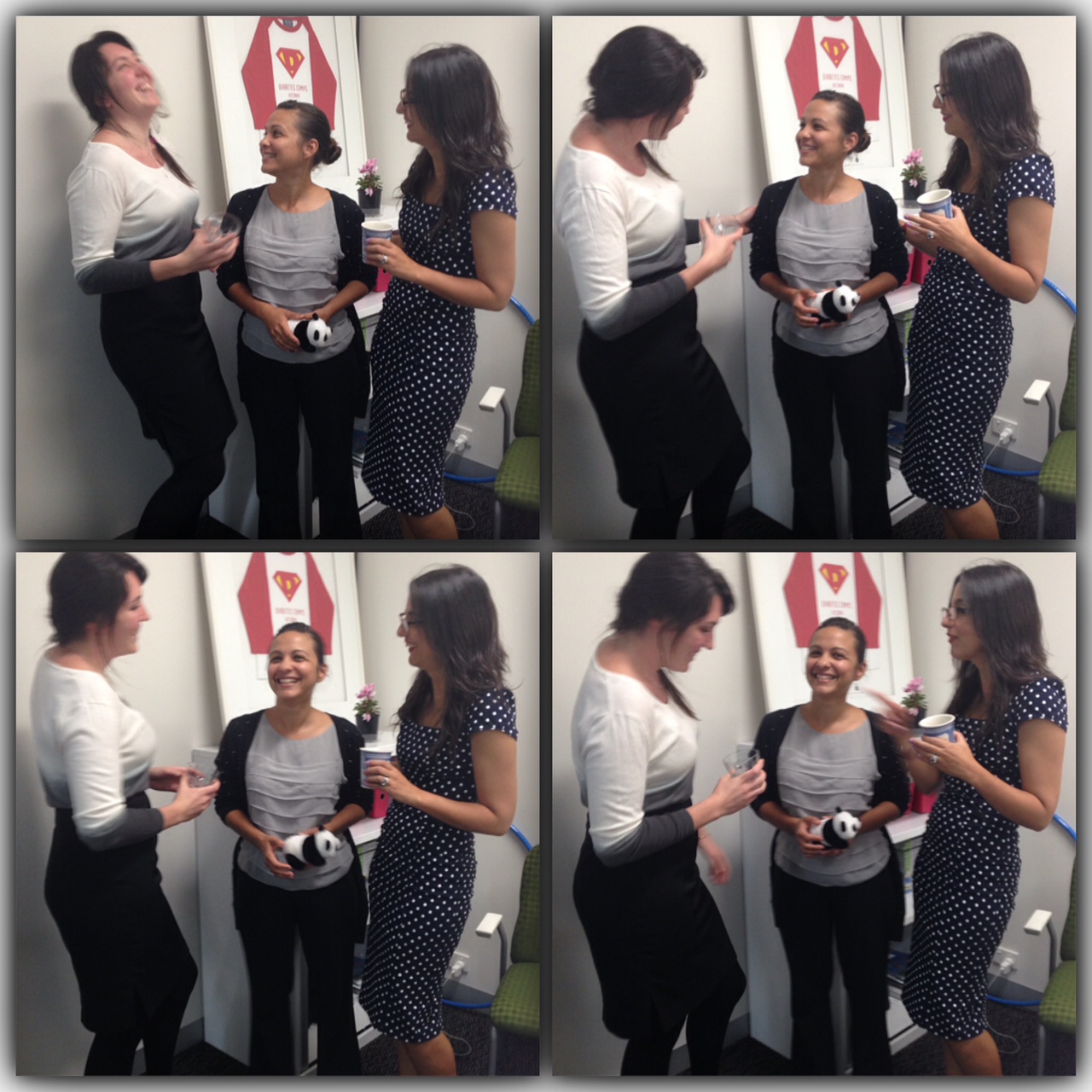
Today in the office…..





 Diabetogenic