
You are currently browsing the category archive for the ‘Diabetes’ category.
For a couple of weeks now I have been feeling well below par. I am exhausted. I’ve not been sleeping particularly well, which is unlike me, and yet, all I feel like doing is sleeping. I’ve felt nauseous and not been interested in food, and even coffee has lost its appeal. (As I am a woman of particular age, when explaining these symptoms to others I see eyebrows rise questioningly, heads tilt and the words ‘Could you be…’ start to form on their lips. No. I am not.)
On Monday, my sister and I did some shopping – something we could both do for Australia our skills are so impressive – and I had to sit down in the stores while she was doing her usual trick of finding clothes marked down to a quarter their usual price in her size that looked perfect on her.
I went out for breakfast on Monday morning and when I got home, I had to sleep for a couple of hours just to be able to face the thought of going shopping.
As soon as I started mentioning that I wasn’t feeling great to those near and dear to me, they immediately suggested I go see the GP. But I dismissed it as being because I am busy at work with lots of deadlines looming / we just lived through a bathroom renovation / We’ve been binge-watching a new TV series and should be going to bed sooner / <Insert excuse here>.
I even told myself in a moment of spectacular denial ‘I have diabetes. It’s a chronic health condition and sometimes it makes me feel crap’, when the truth of the matter is that my diabetes has been somewhat quiet and manageable over this period and I would be furious at anyone who dared to automatically assume the reason for me not feeling a hundred per cent is due to my pancreatically-challenged state.
However, two weeks later, I think they may have been right. I probably should go to the GP and get checked out. I am sure it is just a low-grade virus and all it needs is time and rest. (Oh look – there I go again with the denial….)
As much as I hate to admit it, I do blame diabetes when I am not feeling well. I hear myself say things like ‘I had a couple of hypos yesterday’ or ‘I woke with high BGs’ to explain away anytime I feeling out of the ordinary.
I remind people all the time that ‘sometimes it’s not diabetes’ and yet I seem to be happy to use it as an excuse to myself when convenient.
When your body is broken to a degree, it is difficult to know what to do when the usual ‘not feeling well’ things come up. For people who don’t live day in, day out with a chronic health condition, they see it as irregular and react. Those of us with bodies that are a little rogue at times just decide that it is part of being broken.
It took my mum saying something for me to realise that I might want to delve a little deeper than deciding it was just more ‘system failure’. Where others would jump in and suggest I go to the doctor the second I mention not feeling well, mum gets that it could just be part and parcel of the tiredness we sometimes feel living with a chronic heath condition. She gets it – she lives it.
So when she told me the other day that I was ‘looking gaunt’ (proving yet again that at the core, she is (wonderfully) a true Italian nonna), and that she was a little concerned, I snapped to attention.
So – tomorrow I plan to go to pathology and have blood drawn, using the full blood work path request my endo sent me a couple of weeks ago as a precursor to my annual diabetes screening. I will do it and then I’ll follow up with my GP (who is sent a copy of the results) and see where I go from there.
It could just be a low level virus. It could be just tiredness or an iron deficiency. It could be something different altogether. But I am pretty sure it’s not diabetes even though I have been stubbornly trying to convince myself otherwise.
If you are part of the Diabetes Online Community, you probably would know that 20 April was the second annual #IWishPeopleKnewThatDiabetes Day. I wrote about the first event last year and you can read all about it here.
I am a little late writing about it, because truly – what more can I offer to the discussion? If you want to experience the power of the day, search on Twitter (or, to a lesser degree, Facebook or Instagram).
For me, there are two real benefits to #IWishPeopleKnewThatDiabetes. For people with diabetes, it is a chance to have many of our feelings and experiences validated. We see other people communicating the same successes and frustrations; the same victories and disappointments; we see humour in what is often a sea of doom and gloom, and we feel less alone and part of a tribe.
The other benefit is how #IWishPeopleKnewThatDiabetes has the ability to go beyond the DOC. People from outside ‘our world’ can catch incredible insight into all those aspects of diabetes they would never ever otherwise see if their only reference points were the six pm news or a tabloid story in a local newspaper. They would be able to see beyond the numbers – the statistics that are huge and incomprehensible – to the individual and the day-to-day impact.
I loved that there was such a strong focus on the issues of accessibility from people all over the globe. (Go Diabetes Kenya, by the way, for your awesome tweeting!)
It was terrific to see diabetes organisations getting into the mix and contributing to the day. Special shouts out to Diabetes UK, Diabetes Kenya (again), Diabetes Canada and American Diabetes Association for strong shows. And I was so proud to see Diabetes Australia (disclosure – I work for them, but none of the IWPKTD tweets were from me – kudos to Jenelle) and some of the local diabetes organisations including Diabetes NSW, Diabetes QLD, Diabetes WA and Diabetes TAS for getting involved and tweeting and retweeting throughout the day.
After days of these sorts of awareness days, I feel a little emotional. I have gone back and re-read some of the tweets and am struck by how similar – and how different – we feel about living with diabetes. My feelings run the gauntlet from anger and frustration through to hope and inspiration. Mostly though, I feel connected and supported.
#IWishPeopleKnewThatDiabetes doesn’t end today. There is a website and a blog, and you can sign up for updates. A huge thank you to Kelly Kunik (AKA Diabetesalicious) for coming up with idea and running with it. And a huge thank you to everyone for sharing your thoughts.
The world is bathed in purple today with the death of Prince. I have had this clip on repeat all day.
On this day in 1923, insulin became commercially available.

Fast forward 75 years to 1998, and on this day, I was given a shot of insulin as I sat in the offices of an endocrinologist. That morning, I was diagnosed with type 1 diabetes.
As I watched the doctor quickly and proficiently inject my arm, I had no idea just how precious, effective and dangerous this magic elixir could be. And I had no idea just how lucky I was.
I am not lucky because I have diabetes. Despite being one of those eternal (and annoying) glass-half-full types, I struggle to see the positives in being diagnosed with diabetes.
But I am lucky that if I have to have diabetes, it is here in Australia where I am afforded the luxury and ease of access. Getting insulin is as simple as asking a doctor for a prescription, calling the pharmacy to order it in and the next day picking up a couple of months’ supply for the grand cost of $40, after which I take it home, leave it in my refrigerator and use it as I need.
I have been doing this now for 18 years. My diabetes has come of age. It can drive, vote and drink (three things I should definitely not do if my glucose level is low.)
Diabetes is not a blessing. I don’t think I have ever hated something more and doubt I ever will. I despise the way it has intruded into my life and has eaten away at things I once took for granted. I detest that my loved ones have had to become experts, and are now fluent in the language of ‘diabetese’. I loathe the fear and terror that it has caused me at times.
On this day in 2016, I am thinking about having lived with diabetes for a significant part of my adult life. I am thinking of how it has shaped me, the times it has forced my hand, the way it has influenced the direction my life has taken. I see how it has made me think certain ways, re-evaluate aspects of my short- and long-term decision making and made me advocate for something in which I once had no knowledge (or interest).
But mostly, I am thinking about how I get to celebrate my diaversary as a day of success and triumph. And that many do not. My privilege is starkly obvious as I celebrate with a piece of cake, and, coincidentally, pick up a waiting insulin prescription from the pharmacy up the road.
So, today, I am making a donation to T1International to commemorate this day and those far less fortunate when it comes to living life with diabetes. If you have a spare few dollars – perhaps even just 18 of them – maybe you could, too.
I frequently refer to myself as ‘the difficult child’ – not so much in my family setting, because there I am clearly the perfect daughter (just ask my sister!). But professionally, I am sometimes difficult because I have been known to ask a lot of questions, think outside the square and am a risk taker.
And I would also be termed difficult in other settings.
For example, I am, according to this article, what would be considered a ‘difficult patient’, a term that I really struggle to understand.
Anna Reisman MD, an associate professor at Yale School of Medicine, wrote the article, sharing a recent conversation she had with some med students who asked ‘can’t these patients stop with all the questions?’ instead, wishing for patients who simply listened and did what they were told. They wished for ‘easy patients’ rather than ‘difficult’ ones.
Living with diabetes can be difficult. It doesn’t behave how we would like it to or how we expect it to. It makes us frustrated and angry and sad and annoyed. It makes us want to try different things as we hope to get better results and see in-range numbers. And sometimes – often – we are the ones searching, Googling, asking others and wanting for more and better and different treatments.
When I ask questions or walk into a HCPs office asking to try something new, I am not being difficult or questioning their expertise. I simply want a discussion about how I can improve my health.
The only reason I manage my diabetes the way I do is because I researched, asked questions and told my HCP it was what I wanted to do. I wasn’t being difficult when I first raised the idea of ditching MDI for a pump. Nor was I being difficult when I asked about CGM. Or when I wanted to change to a different insulin.
I was looking for ways to make my diabetes less difficult – because it is a difficult monster! It is not the person being difficult. It is the condition. And this clarification is important.
I think frequently the term ‘difficult’ is used instead of the word ‘empowered’ or assertive – neither of which are interchangeable with ‘difficult’.
In the article, Dr Reisman offered some excellent advice to the med students explaining why patients who do ask questions and want to take charge should be celebrated – not discouraged. And she ends the article with this pearl:
‘Don’t dread patients bearing questions, I told my students. Welcome them. They’re some of the best teachers you’ll encounter.’
I can’t think of a better way to explain it!
I read a few other pieces by Dr Anna Reisman and this is another brilliant take on the expertise of patients.
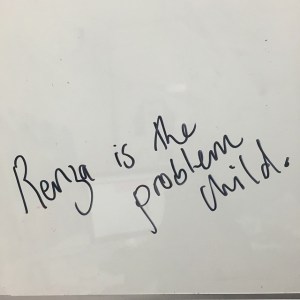
Always difficult. I mean assertive.
Today, I am writing about Aussie Rules Football. I know nothing about Aussie Rules/Footy/AFL, so let’s get my status as a complete and utter non-expert out of the way to begin.
I have actually been asked to write about this by a football tragic who we will, for purposes of this post, call Footy Tragic.
Footy Tragic loves football. Footy Tragic has an encyclopaedic mind when it comes to the history of AFL and if you ask her anything about the team she follows (Collingwood…spit) she knows everything. Every.Thing.
Footy Tragic also knows a lot about diabetes and when the two worlds collided, she was not impressed. We discussed what we could do to try to fix it – because together, we think we can solve many, if not all, the problems of the world – and while I can’t promise to actually make it all better, I can write about it.
At various times, there have been AFL players with diabetes. Dale Weightman played for Richmond when I was a kid and he is still regarded as a role model for children with diabetes. (He is also a very nice bloke who was a frequent guest speaker at events I coordinated in my previous role.)
Today, there are a couple of fairly high profile (so I am told) players including Jack Fitzpatrick (who plays for Hawthorn) and Paddy McCartin (St Kilda) who was the 2014 number 1 draft pick. (I don’t actually know what a draft pick is and I can only assume number 1 is good, so well done, Paddy!)
Anyway, Paddy has been having a good run with the senior St Kilda side this year, which is brilliant. What is not so brilliant is how the reporters and match callers are dealing with the player with diabetes, which is, of course, a terrific story to tell.
To begin with, the commentators tried to give an explanation of diabetes by informing listeners that ‘There are many kinds of diabetes, but Paddy has the ‘full on’ one.’ They were also pleased to announce that while Paddy had trouble with his diabetes last year, one of the doctors at the St Kilda Football Club has ‘worked out’ his diabetes and Paddy is ‘good to go now’. His sugar levels are ‘all fine’!
With what I can only imagine were their super serious voices, the commentators shared that Paddy is brave – as are all people with diabetes – because they (we!!) have blood taken ALL the time and Paddy has blood taken on the boundary line.
During Saturday’s match, Paddy went off the ground after being hit on the head, but the commentators made sure to clarify that it could have been because of ‘diabetes issues’.
So, here is the thing. It really is brilliant when we have elite sportspeople absolutely kicking ass (and footballs) in their chosen sport. It is fabulous for them and it is great for others living with diabetes to see people achieving and excelling.
It’s also great because it gives balance to the lousy way many people with diabetes are portrayed in the media.
But would it be all that difficult for there to be a tiny bit of research done somewhere to accurately speak about diabetes in the context of this (and other) elite sportspeople?
Let’s be clear.
Paddy has type 1 diabetes, which is no more or less full on than any other type of diabetes. All diabetes is full on. All diabetes is serious. All diabetes sucks.
Paddy has not had his diabetes ‘sorted by his doctor’. Although if he has, and his doctor is hiding some magic ‘diabetes sorting pill’ (or hat! Diabetes sorting hat!! – Harry Potter Digression) he better bloody share it around. What Paddy is doing is working incredibly hard – undoubtedly with his healthcare team – to make sure that he can get out on the field and…do whatever they do on the field.
If Paddy gets a knock to the head on the field and there is blood oozing out of his forehead and he is acting a little woozy, it’s probably a concussion – not ‘diabetes issues’. Because, sometimes IT’S NOT DIABETES!
Paddy is not having blood taken on boundary. He is pricking his finger to check his glucose. I am not minimising this – I know it sucks – but let’s be truthful about what it is.
I am not expecting AFL commentators to know everything about diabetes, but I do expect them to not make things worse, or add to the considerable confusion of what diabetes is all about.
Paddy McCartin is an absolute legend – as is anyone with diabetes excelling in whatever they do. He is showing that diabetes is not stopping him and I honestly can’t even imagine what it takes for him to manage his diabetes while playing football at such an elite level.
I just wish that we could celebrate what he is doing with the right messaging, and work towards dispelling some of the myriad diabetes myths.

This pretty much explains my Aussie Rules expertise. (Click cartoon for source)
Stuff.
Click.
Read.
Share.
Yesterday…
…was World Health Day. There was a lot of chatter about diabetes – it was everywhere! The focus was, as to be expected, type 2 diabetes and specifically how it can be prevented. But there was some type 1 diabetes-specific information.
This was definitely my favourite poster from the WHO’s campaign. Highlighting the symptoms of diabetes and encouraging HCPs to check people for diabetes will, hopefully, mean fewer diabetes misdiagnoses.
The BBC online interviewed UK woman, Lydia Parkhurst, and provided some balance to the day by looking at the day from a type 1 diabetes perspective.
Diabetes FAQ
A new website has just been launched which aims to answer diabetes-related questions in a simplified way. Diabetes FAQ allows readers to ask questions and then answers are added to the site’s database.
I’ve written this piece for the new site. Check it out!
#LanguageMatters
Yep. We all know that.
And here is what happens when it goes very, very wrong. (Hastag #EffOff)
(And this too!)
 Lego
Lego
When I was a little kid, I loved Lego. For many years, my birthday and Xmas lists were all about the stuff. Lego gifts were always given in the same way: the box was all wrapped up; I would tear the paper away; I would squeal with delight at whatever Lego masterpiece I was given, excited at what was inside the box. And then, my dad would gently take the box from me with these words, ‘Okay darling, I’m just going to make sure all the pieces are here and then you can have it.’ He would then put it together and then I would get to play with it. It wasn’t until I was older that I realised how most people did Lego!
We had some really great things and my favourite was, ironically, a hospital. A few years ago, my mother-in-law gave me a castle with a drawbridge after hearing me say once that I regretted never having had one when I was a kid. I got to put that one together all by myself.
Anyway – a clever person in the UK has decided to explain diabetes using Lego bricks. Check out Brickabetes on Twitter and Instagram.
Stigma
International Diabetes Federation YLD Program President, Cajsa Lindberg has written a powerful piece about diabetes stigma and overcoming healthcare inequality. Read it here.
Diabadass
You may remember Sierra Anne Sandison for her ‘show me your pump’ campaign in the Miss America contest from a couple of years back.
She has recently started selling these very excellent t-shirts. The first run sold out in a few days, but they are back in stock.
Swellegant
Have a great weekend! In the meantime, watch this gorgeous clip from one of my all time favourite movies.
Collective nouns are one of my most favourite things.
I was given a gorgeous book as a birthday present a couple of years back and love flipping through the pages, remembering the collective nouns and admiring the stunning illustrations.

From ‘A Compendium of Collective Nouns’ from Woop Studios. Click for more!
Today, I thought I would throw it out there and start to collect some diabetes collective nouns. (I only wish I could draw so they could be accompanied by images…)
A BRILLIANCE of PWD
A POSSE of PWD (at a diabetes conference)
A HUSTLE of PWD (meeting for a drink)
A DEFIANCE of PWD (when asked ‘should you be eating that?’)
A SADNESS of diabetes diagnoses
A KINDRED of DOC folk who are more than just diabetes peeps.
A BAZILLION of BGL strips
A SUPPORT of family
A SPLURT of bloods
A HAPPINESS of Nutella jars

Source
A FAILURE of kinked pump lines
An EXPENSE of sensors
A JUDGEMENT of HCPs
A ROBOTIC of CGM users
A DELIVERY of insulin pumps
A HOPELESSNESS of NPH insulin
A BEEPING of BGL meters.
A SAVIOUR of dirt-covered-jellybeans-discovered-at-the-bottom-of-one’s-handbag-(or-in-one’s-car-glove-box)-when-there-are-no-other-hypo-treatments-around.
A FRUSTRATION of consistently high BGLs
An INTELLIGENCE of diabetes blogs
A CERULEAN of Blue Fridays
A BINGE of hypos
And finally my favourite diabetes-related collective noun. I was thrilled when I discovered the unofficial mascot of the DOC already has a collective noun and it is so fitting:
A BLESSING of unicorns.

This Thursday is World Health Day and the spotlight for 2016 is being shone on diabetes. In the next few days, we can expect to see diabetes mentioned in the media a lot. There will be numbers describing the size of the ‘epidemic’, there will be scary pictures and there will be threats about what will happen if we don’t all act NOW.
Much of what is written will be by journalists who do not have an in depth knowledge of diabetes, so the chance of them getting it wrong – or, at least, not finessing the details – is pretty high.
What upsets me most is when people with diabetes are not represented particularly accurately. I don’t like the pity party often thrown for us – especially because once we get there, the only food served is sugar free. And carrot not in the form of cake.
Seeing myself referred to as a ‘sufferer’ or ‘victim’ infuriates me, and the assumptions and the blame and stigma associated with a diabetes diagnosis makes me even madder.
Those of us living with diabetes (or with someone with diabetes) understand just how much language matters when talking about diabetes.
There are tools available that can point journalists in the right direction when speaking about and to people with diabetes – and the issue of diabetes.
The terrific Team Novo Nordisk has made real strides with providing the media outlets covering the team with some practical tips and a ‘Guide to Communicating About Diabetes.’
And, of course, the Diabetes Australia Language Position Statement* is also a valuable resource that offers suggestions of language and words that motivate and empower people living with diabetes, highlighting how negative and inaccurate language can be harmful and discouraging.
The fact that World Health Day is focusing on diabetes is a good thing in my mind, because it means that people are talking about diabetes. And if we can, in some small way, shape the dialogue – or at least, shape the language being used when speaking about diabetes – the outcome may be a better representation of life with diabetes. We can bust myths, set the record straight and explain how paralysing diabetes-related stigma can be.
This is not only about defining the different types of diabetes, although there are times in the dialogue that would be helpful. It is about offering a fair, precise and considerate picture. And it is about remembering that even when talking about huge, scary numbers that clearly define the issue, there are people involved who are living with diabetes every single day, doing the best we can with the cards we’ve been dealt.
So, with this in mind, I am making a slight pre-emptive strike and asking that anyone writing about diabetes does so in an accurate and respectful way. I will be tweeting throughout the week using the hashtag #LanguageMatters and, when I see examples of writing that is neither accurate nor respectful, will be tweeting the journalist and source directly. I won’t be aggressive; I won’t be angry. But I will call them out.
If it’s something you are interested in, please get on board. Let us tell the real story of diabetes OUR way. #LanguageMatters 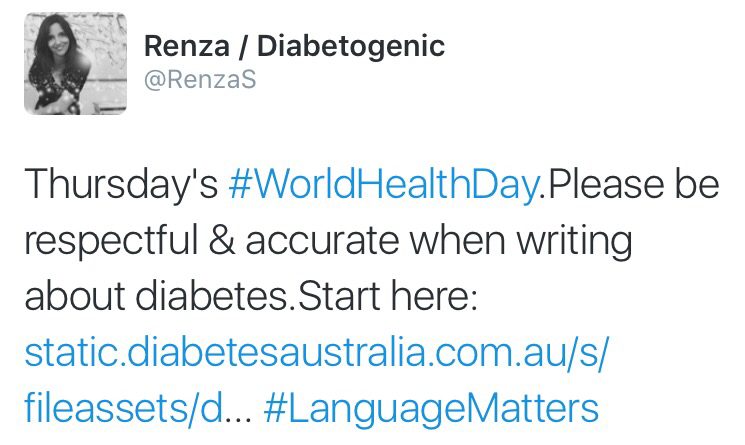
*I work for Diabetes Australia, however at the time this position statement was developed, I worked for Diabetes Victoria. During the writing of this statement, I provided some comment (from a consumer perspective) to the ACBRD team who composed the position statement. The ACBRD is a collaboration between Diabetes Victoria and Deakin University.
Despite what the media may say every time they herald the ‘end to painful injections’, it has never been the needles, the pump insertions, the finger-pricks or the sensor insertions that cause the most discomfort when it comes to living with diabetes.
They are not even where I feel diabetes most.
I feel it in my heart with an increased heartbeat when I feel the fear of ‘what could be.’
I feel it in my eyes as I see the evidence of diabetes on my body with devices, healing and healed scars, tape residue and a pump hidden in my underwear.
I feel it on my skin with the goose bumps I get when hearing the words ‘me, too’ from someone who understands what living with diabetes is truly about.
I feel it through my veins as I sense blood being pumped faster to alert me to a low.
I feel it in my smile when I see – and feel – the power of support and connectedness.
I feel it in my tears as they roll down my cheeks with the frustration of never seeming to be able to get it right.
I feel it in my fingers as I load insulin into a cartridge, feel for knots in an infusion line or grope around in my bag for my kit.
I feel it in the dark recesses of my mind when I consider the scary things that only get an airing when my defences are down.
I feel it in the pit of my stomach as the guilt that inevitably comes to the surface. Guilt about the burden I am on my family and friends.
I feel it on my lips as the tingling of a low or the dryness of a high remind me that I must attend to my blood sugar.
I feel it in my hip pocket as I fork out more money for more strips, for more pump consumables, for more sensors, for more insulin, for more health insurance, for more medical costs. Because there is always more.
I feel it in my words, as I struggle to articulate exactly how I feel, what I need, what I want.
I feel it my nose as the smell of insulin hits and automatically the words ‘It’s the smell that keeps you alive’ jump into my head.
I feel it in my mouth – the sickly sweet aftertaste of the jelly beans or the pineapple juice I have consumed when I just want to sleep.
I feel it in my ears as I hear the click of a lancet device, the beep of an alarm, the ticking of insulin being delivered.
I feel it in my feet as I walk barefoot to the kitchen and there is the sensation of a rogue BGL strip on the floorboards.
I feel it underneath me when I sleep and I roll onto a pump or lie over my sensor.
I feel it. It is everywhere.
I speak and write about language a lot.
I will continue to do so, because I truly believe that the words that engulf us when we speak or hear about diabetes have a direct impact on how we feel about our condition. The emotion cannot be removed from it and negative or judgemental, stigmatising or blaming words make us feel…well….negative, judged, stigmatised and blamed.
I frequently point my finger at healthcare professionals for their use of judgemental language and the media for their use of poorly researched facts and sloppy language. And I note lazy jokes where my health condition is considered a punch line.
You may have read it here or heard it when I have given a talk (it will probably get an airing tomorrow!). And if you follow me on Twitter, it is highly likely you will have seen me tweet the link to the Diabetes Australia Language Position Statement to someone who hasn’t quite got it right.
But I have never ever been able to put into words how I feel about the language that some of our loved ones – or caregivers – use when speaking about diabetes and how it can – completely unintentionally – be damaging.
My dad – love him to pieces – sees my diabetes as an illness. He thinks that I am sick. I have spoken with him over and over about why that is not the way I see my diabetes and that I am actually incredibly healthy, and he absolutely means to harm when he uses the words he does. But they do affect me.
I sat in a meeting while low – managing perfectly well, but having explained the reason I was munching on glucose tabs – and my manager at the time asked if I needed a nurse. He was concerned, but I realised he also didn’t trust my ability to look after myself when I am more than capable – something I had demonstrated to him over and over again.
I am not the parent of a child with diabetes, so I don’t get to play in that space and comment. But I do have real concerns at times. I worry about the language that is used around kids and the way that the child’s diabetes is being represented.
So that is why when I woke this morning and read this piece over at A Sweet Life from Moira McCarthy Stanford, my words stopped. I couldn’t even think straight for a moment because every single thing she wrote resonated so strongly. I actually burst into tears. (I was low, so there was that too. But honestly, I just couldn’t believe how clearly and articulately she put into words my thoughts.)
Moira’s blog post should be required reading for anyone around someone with diabetes. She nails it. Perfectly. I urge you to read it. I urge you to share it. If you are part of a family support group, send it to all members of the group and discuss is amongst yourselves. You don’t need to agree with it all, but it is definitely worth having a robust and honest discussion about it.
If you are a parent (my parent!), I hope that you understand why these phrases and words have the potential to be damaging.
At no time would I ever dismiss the difficulty of having a loved one with diabetes. I can’t imagine what it takes to watch us living with it and not really be able to do something. I would never underestimate your role.
But sometimes, the words you use underestimate ours. Moira – thank you for not doing that.





 Diabetogenic