
You are currently browsing the category archive for the ‘Diabetes’ category.
On Monday and Tuesday of this week, I attended and facilitated Abbott Diabetes Care’s #Dx2Melbourne event which brought together eleven Australian diabetes bloggers. (All my disclosures can be found at the end of this post.)
(Just a recap – the DX (or Diabetes Exchange) series of events have now been run about half a dozen times. Other than #DX2Sydney and this year’s Melbourne events, the others have been held in hard-to-take cities including Stockholm, Berlin and Lisbon and have been attended by bloggers from the UK and Europe.)
#Dx2Melbourne reunited most of the bloggers who attended last year’s event, with some new faces thrown in for good measure. I was introduced to Alana Hearn for the first time, finally got to meet diabetes yoga guru Rachel Zinman, and caught up with Helen Edwards. (All the links to the blogs of the ‘repeat offenders’ who attended #D2Sydney can be found on this post.)
Some may believe that I am naïve in saying this, but the event is not about product. In fact, apart from a 45-minute presentation – the session that kicked off the two days – there was no other discussion about Libre or any other diabetes product unless it was specifically raised by one of the bloggers. Abbott did not have a new product to push; Libre has been out for over 12 months now in Australia.
(I am not, however, naïve enough to think that events like this are not part of the health industry’s 21st century marketing strategy. But, as I said last year when responding to a comment on my blog about this, this is the 21st century marketing. And I’m glad that consumers have a place in this strategy, because it would be far worse if industry was continuing with 20th century marketing strategies which completely excluded people with diabetes, and did not offer us any opportunity to directly engage and work with industry. Any device company NOT doing this is falling way behind and needs to catch up.)
As the Abbott team stated in their welcome, the idea of the DX events is to continue their commitment to bring together people living with diabetes to share ideas. And for Abbott to get an idea of what it is that is important to people with diabetes and what makes us tick – albeit a very select and privileged sample of advocates.
With this in mind, for me, the most valuable part of the event was the discussions that were completely driven by the bloggers. In an open session where we were exploring ‘why we blog’, I listened carefully as everyone articulated their reasons for going online and sharing their stories with strangers.
Reasons varied – some do it because they simply want to tell their story, some because they love to write, some have specific issues within diabetes they want to open up for discussion, some see it as an advocacy platform. What we don’t hear – ever – is anyone saying ‘Because I want to make money doing it’. I can be all evangelical about it and say it’s because we’re a choir of angels, but mostly I think it’s because we’re smart enough to know the limitations of what it is that we do, as well as understanding the strength is in connecting, not money-making.
We also considered the shortfalls of having an online presence.
I’m an over-sharer and I know that there is a lot I write that many others wouldn’t feel comfortable sharing – and some people have told me that it is sometimes difficult to read. I also write about issues that are of no real concern to others, and they are more than happy to let me know that I’m wasting my time and energy on such irrelevant (language) matters. I also know that as soon as I put something out there, I am opening myself up for comment – both positive and not-so-positive. We had a discussion about how we manage unwanted attention and, in the most extreme cases, trolling.
I have never regretted anything I have written or shared, and have never taken anything down because I’ve felt it was too personal. But I have had some very unwelcome and sometimes nasty comments sent my way.
I found this a really useful, but somewhat challenging, discussion. I have written about some very personal experiences, probably most notably, pregnancy loss. I’ve also written a lot about how diabetes impacts my mental health. These are two topics that are frequently hidden away, surrounded by shame and secrecy – precisely the reason that I am committed to writing about them.
However, the times I’ve been trolled – and fortunately, that hasn’t been often – it has been when I’ve shared very personal stories. They’ve been the times where I have found myself at my most vulnerable, and being so exposed makes any sort of negativity harrowing.
It was reassuring to discuss – and remind each other – that even though we are voluntarily putting ourselves online, we are not inviting people to be nasty and disrespectful. Online is real life, despite what some people may think. This is the space where many of us convene to work together, support each other and share information; it’s not a place for personal attacks.
I left the event on Tuesday feeling utterly exhausted, but also filled to the brim – a feeling that only comes after spending a solid period of time with others treading the blogging and advocacy boards. I was reminded of the similarities as well as the differences we experience living with diabetes. I felt buoyed by the various issues that draw our attention. I felt desperate at the access issues I still hear about – both here in Australia and overseas. But most of all I felt part of something that is much bigger than me, much bigger than my blog and much more powerful that anything I can do on my own.

Abbott Diabetes Care covered all my costs to attend #Dx2Melbourne, and provided all attendees with two FreeStyle Libre sensors and, if requested, a scanner. There was no expectation from Abbott that I would write about the event or any of their products, and everything I do write about it is my opinion, in my own words, and in no way reflects those of Abbott – or anyone else, for that matter.
I’ve spent the last two days at #dX2Melbourne – a two day event bringing together bloggers from across Australia. This was the follow-on from last year’s #DX2Sydney which coincided with the launch of the FreeStyle Libre. The event was hosted by Abbott Diabetes Care and I’ll be writing about it over the next couple of days (and disclosing like nobody’s business on those posts).
Today, I was on a ridiculously early flight to Canberra and on my way to the airport while it was still dark, I thought there is not enough coffee in all the lands to make me smile. But then I remembered my new diabetes spares bag that arrived last night all the way from Copenhagen. It’s bright yellow and made by Monica Vesci from Casualty Girl and it looks like this:

Bet it made you smile too! You can get your own – as well as lots of other fun diabetes-related goodies – on her e-shop, here, where you’ll also find this slightly more G rated version!
I paid for my little bag and the postage to Australia from Copenhagen.
I was slightly mortified at an exchange I heard recently between a person with diabetes and a healthcare professional. The HCP was correcting the PWD, who repeatedly referred to themselves as ‘(a) diabetic’, urging them to not use the word as some find it offensive.
Sometimes, it seems that we forget that the idea of discussing, and hopefully improving, the language used about diabetes is to better the experience of people with diabetes. My personal crusade is not about completely eliminating the word ‘diabetic’, for example.
I know many people with diabetes who use the word – as both a noun and an adjective – and are very comfortable to refer to themselves that way. This piece from Mel Seed at Twice Diabetes explains why she is more than happy to use the word. I appreciated her side of the debate. It all fits neatly into my philosophy of ‘My diabetes, my rules’.
But the point of the whole #LanguageMatters movement is not about people with diabetes defending the language choices we make. It’s about others. The Diabetes Australia Language Position Statement as never intended to be for people with diabetes. It was always for healthcare professionals, the media and the general community.
Rosie Walker, on her Successful Diabetes blog, captured it all perfectly when she said this in a recent post about diabetes language matters:
‘This is not a call for people living with diabetes themselves to ‘mind their language’. Anyone is perfectly free to refer to themselves and their condition however they wish – as in most other areas of life. This is about how other people, and especially health professionals and scientists, use language in relation to diabetes and those with it, and especially when they are not in earshot or attendance…’
When a healthcare professional tells someone with diabetes to not use a word to describe themselves, it’s just another example of trying to control the PWD. In the same way that we want choice about the devices we use or the treatment plan we employ, we demand choice in the words we use to describe ourselves and our diabetes.
I have started a separate page on Diabetogenic about all things #LanguageMatters. Click here or on the link at the top of the page for more.

Let’s pretend that tomorrow, we all woke up and on the front page of every newspaper around the globe there was this announcement: ‘Cure for type 1 diabetes found’. Details in the article under that beautiful heading told us that there was a cure that met the ‘Three As’: it was Affordable, Accessible, and Available to every single person with diabetes around the world that very day. All that was required was a simple visit to a hospital for a dose of ‘Diabetes Be Gone’, and you, or your loved one, would no longer have type 1 diabetes.
How would you react? Would you do it?
In recent times, I’ve been following some online discussions in other health and disability groups about curing conditions and what that means. There is push back from some groups saying that they don’t like the idea of being cured (or having their kids cured) because it is part of their identity and that by saying they need to be ‘fixed’ in some way is claiming they’re less than whole – or somehow inferior.
A lot of the criticism is aimed at parents of children with disabilities or other chronic health conditions who are desperately hoping there will be a cure for their child. Adults with those same conditions are urging these parents to stop considering their child is broken and looking for the thing that will ‘fix’ them.
I find myself feeling conflicted when reading these discussions, and don’t ever really comment myself. But I have been thinking a lot about how it relates to diabetes. (For the record, none of the conversations I’ve been reading have anything to do with diabetes. Some people participating have disabilities, some have (other) chronic health conditions.)
I can claim –and do – that I am not defined by diabetes. I can shout that diabetes does not equal my identity and that it is just a part of me. But it would be disingenuous to suggest that my life has not been shaped by diabetes. My thought process is very different now there’s the constant hum diabetes in the background. I have chosen a job that is most directly influenced by being diagnosed with diabetes. The way I behave and the things that I am committed have a strong connection to being a person living with diabetes.
Where my constant frustration and advocacy efforts used to be directed at the lack of funding in the arts, that attention is now shared with a larger, more desperate concern about lack of funding in health. I used to go into bat for music education to be valued as highly in schools as maths and science, and now I want to know why diabetes is not given the same consideration, funding, research attention as other health conditions.
Diabetes is not and never will be all of me. But it is undeniably a very large part of me and I cannot deny that the person I am today has been moulded by being a person living with diabetes.
So what would I do if there was that cure? If it meant taking away the thing that does keep me employed, writing, speaking at conferences – the thing that, probably more than anything, I am known for?
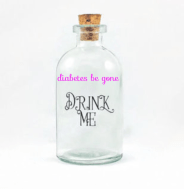
What would I do if my dose of ‘Diabetes be Gone’ made all that redundant?
I would queue up. I would wait for my turn in line until the cure was handed to me and I would take it, savouring the moment that I no longer had the worry, the stress, the anxiety, the heartache that accompanies living with diabetes. I would happily and without a second thought remove the very part of me that has, to a great degree, made me the person I am today.
Because the truth of the matter is, I do believe I need to be fixed. I have a part of my body that is broken and does not do what it is meant to do. The longer I live with diabetes, there are increased chances that I will develop complications associated with this condition. And today – every day that I am living with it – things happen that mean I have to stop, treat and recover from whatever diabetes throws at me.
Does it make me a lesser person? No. Does it make me a broken person? It makes a part of me broken, so perhaps yes…yes it does.
I am not ashamed I have diabetes. I am a strong advocate, able to stand up for myself and ask for (and get) what I need.
But you bet that if there was a way to make this go away, I would want that for myself. And I would want it for every other person in the world who is living with diabetes.
I understand why people with diabetes want a cure. And even more, I understand why parents of kids with diabetes want a cure.
The world needs diversity. And we need to know and understand not everyone is the same, or is perfect. But if there was something that could take away pain, suffering, emotional distress, and all the other diabetes crap, I want it. Even if it meant being out of a job and needing to rediscover and redefine myself.
It arrived in the post back in April: a little package from my pump company reminding me that my pump warranty was due to expire and it was time to start thinking about getting a new pump.
Inside the thick envelope was a shiny brochure with bright pictures of people looking very happy and excited with life, while wearing an insulin pump; the insulin pump the company was suggesting should be my new pump. The insulin pump that has been my insulin pump – the exact same model I trialled for the first time back in January 2013 and have been shoving down my bra for the last four years. Nothing new to offer; no design changes; no software upgrade. Exactly the same pump.
Today, I am walking around with an out of warranty pump. Does this concern me? Well, yes and no. If I didn’t have a couple of old pumps at home in my diabetes cupboard, I’d be far more concerned.
I don’t particularly feel any loyalty towards one particular pump or pump brand. I know that there are some people who are very much Team Pump Company A or Team Pump Company B. My feelings about pumps are they deliver insulin. I know that some have different bells and different whistles, but I just need something that is going to easily and accurately deliver the drug that keeps me alive.
Making the decision four years ago was a no brainer: I was desperate to use Dexcom, so I chose the pump that integrated with it. These days that’s less of an issue because I use G5, so integration with a pump is less of an issue.
To be honest, I’m a little cross. As someone who is clearly a Dtech enthusiast, it’s laughable that I would even for one minute consider committing for another four years to a pump that I have already been using for four years – and let’s remember, it wasn’t new when it arrived in Australia; friends in Europe had already been using the Vibe for a couple of years when we eventually got it here. Can you imagine committing to using the same model mobile phone for eight years?
Plus, it’s worth noting that the look of the Vibe is very similar to the Ping and 2020, both of which had been around for a number of years before the Vibe. The design is well over ten years old and you bet that’s important if I’m wearing the bloody thing 24/7.
My trial last year of the Medtronic 640G, truly the only real innovation in pump technology in recent years, left me cold. I found the sensor accuracy a problem, which negated the excitement I had about the SmartGuard technology. And I found the pump clunky and big, and struggled to get it to fit comfortably down my top.
If I’ve ever understood the reason for the whole #WeAreNotWaiting movement, it is right now. It’s why I started reading up on Loop and ordered what I need to get my own build underway. I’ve not had the time or headspace to actually do anything about it yet, but right now, it’s the only thing that is giving me any buzz about real diabetes tech advancements here and now.
So, for the time being, I’m in pump limbo (which sounds like an cheeky game that happens after a few drinks at a DOC get together, but really is not). I’ll get around to working out if I can manage to get Loop happening and see how I go with that. But I can’t see that there is any likelihood that, unless absolutely critical, I’ll be getting a new pump soon. My PHI will be pleased about that. Even if I’m not.
You know that old word play about why we should not assume anything? Because ‘assume’ makes an ‘ass’ out of ‘u’ and ‘me’. Yes, it’s lame and I don’t like using ‘u’ for ‘you’ (because I’m a word nerd and don’t do ‘text speak’), but the sentiment is good.
There are so many assumptions that come with diabetes. And almost all of them are destructive.
‘People with diabetes must have eaten too much <insert food/drink type> as a kid.’
‘People get diabetes because they’re fat.’
‘People get diabetes because they don’t exercise.’
‘Diabetes means you are sick.’
‘People with diabetes could be managing better if they just tried.’
Many of us will have had these sorts of comments made directly at us. Some of us will have heard people say these things. Most of us will have seen these sorts of comment perpetuated in the media and in popular culture anytime diabetes gets a mention.
And they are all wrong.
It’s time that we removed all negative assumptions and replaced it with just this:

Imagine how different things would be if that was the starting point of diabetes discussions. Instead of the judgement and finger pointing that often is associated with a diabetes diagnosis, the first thing that everyone said was ‘And now let’s talk about living well with it.’ Instead of the threats, the attitude was ‘You can thrive with the right treatment’.
Finding out someone has diabetes does not in any way give you a window into their life or an indication into their behaviour. But it does tell you that they have a health condition that requires regular management and the best possible treatment.
Imagine how much easier life with diabetes would be – and how much kinder the conversation would sound – if the next time we told someone we have diabetes, the only thing we heard was ‘Are you getting the healthcare and treatment you need?’
Wouldn’t that be a great place to start the conversation?
There have been many occasions in my daughter’s twelve-and-a-half years that, as we’re about to walk out the front door, we’ve looked at each other and stopped. ‘Well, one of us is going to have to change…’ one of us, usually I, say. There we are, standing there in almost identical outfits.
But despite her affinity for stripes and jeans, and oversized grey cashmere knits, and constant comments about how much we look alike, she is not me. We are different people; we like a lot of different things; she loves ice-cream and I really don’t; we have different things that bother us.
I seemed to forget that in the last couple of days and a gnawing feeling in the pit of my stomach – a problem that is mine – overtook my rational side, and I thrust it upon my girl.
This story isn’t about my kid – I am not here to tell her story. This tale is about how I dealt with my fear of her developing type 1 diabetes.
To set the scene: she has been a little under the weather. Before the end of last term, she had a head cold. Her lips were dry and cracked from having to breathe through her mouth, and she was revoltingly sniffily.
She had two very relaxing weeks at home to mark the break between semesters one and two, and returned to school last week very rested and perfectly well. And came home on day two of term complaining of a sore throat, sore head and dizziness. The next morning, she woke up with a full-blown head cold again, and she said her stomach was also a little sore and upset.
This persisted for the rest of the week and over the weekend, so I decided it was time for her to visit the GP. I made an appointment for the middle of the week and as we waited, she continued to complain of a sore stomach and some nausea. She was tired and generally poorly.
And that was where the gnawing monster started to rear its most ugly head, whispering viciously to me. ‘She’s drinking more. Isn’t she?’ came the first comments. ‘Did you notice how many times she has refilled her glass with water?’ it hissed as I stood in the kitchen throwing together dinner, and she popped in to mention something to me. ‘Didn’t your mum say something about her drinking a lot when they took her to the opera a couple of weeks ago?’ I was reminded. ‘She went straight to the bathroom the second she got home. She’s been doing that lots…’
Suddenly I found myself noting empty glasses in the house and listening out for the loo being flushed. I surreptitiously glanced at her when she walked into a room, assessing if she looked as though she’d lost any weight recently. (She didn’t.)
Eventually, as casually as I could, I asked her if she’d noticed any changes in how she was feeling. ‘Darling,’ I said, as we sat on the couch during a commercial break in Masterchef. ‘Have you noticed that you’re thirstier than usual?’ I scrolled through my phone as I asked her, not really looking at anything blur by and pretending that it was just a passing comment and I hadn’t really stopped breathing as I waited for her response. ‘Nup,’ she answered.
When she came back from the bathroom a little later in the evening, I asked her, in the same (false) off-the-cuff way if she thought she was needing to pee more frequently than usual. ‘No,’ she replied, without hesitation.
As nonchalantly as possible, I said, ‘Sweetie…I feel like…I’ve noticed that you seem to be drinking more…and maybe going to the bathroom a little more than you usually do,’ I hated myself for saying it to her and drawing her into my concern.
‘No. I haven’t.’ And she told me how many times she remembered going to the bathroom that day. She reminded me that she keeps forgetting to take a drink bottle to school and sometimes doesn’t drink anything until she gets home. (I ignored that bit of information, even though I probably should remind her to do something about that and hydrate regularly…#BadMotherMoment2198756)
I should have let it go. But I didn’t. ‘I’d really like to check your blood sugar. Would you let me do that?’
(I’m going to stop there, because even as I write this I know how I sound. And in an effort to defend my behaviour (mostly to myself rather than anyone reading) I want to point out that I have checked her blood sugar no more than about half a dozen times in her whole life. I don’t whip out a meter and jab her at the first sign of anything out of the ordinary. I just don’t do that and never have. But regardless of that fact, it doesn’t make it right that on this occasion I allowed my anxiety to spill over and start to become hers.)
In what I can only call one of my less excellent parenting moments, I asked her several times, even though she refused, until she eventually stormed from the room telling me that there was no reason for me to be feeling worried about this because she was not drinking more or peeing more.
I’ve not been able to stop thinking about the whole situation. I am horrified at how I allowed my irrational, unfounded fears to flood out of me. I am angry that the worry that is always in the back of my mind was allowed to grow and grow and unleash its full force onto my darling girl.
In the past, I have sought help from a psychologist about these fears and concerns. I know that I am irrational. I also know – of course I know – what the stats are, and the percentage chance that she will get diabetes. I also know that if she does, we are equipped to ensure that she gets the best possible care and the best possible support. I know it will not be the end of the world.
But mostly, I know that my fears are not her fears and never should be.
We went to the GP. My kid outlined her symptoms, and mentioned that I thought that she was going to the loo and drinking more than usual, but denied that was the case. Pleasingly, the GP did a urine test. All was fine.)

One of us had to change. (NYC 2014)
A week away from blogging during what happened to be a super busy week in the diabetes world. Let’s play catch up!
ICYMI #1
Bigfoot Biomedical + Abbott Diabetes Care. Details here. Great commentary from diaTribe here, and Diabetes Mine here.
ICYMI #2
Did you see Adam Browne’s piece on diaTribe about the worst food advice he’s received?
When I was diagnosed I was told ‘Eat as much low GI food as you like’ and I remember at the time that not sitting well with me. It turned out to be a disaster because I wasn’t taught to count carbs, but there was this expectation that I would be eating large quantities of rice, pasta, bread and potatoes to match the insulin dose I was prescribed.
I do wonder how different things would be had I instead been given advice that helped me manage my glucose levels, rather than feel I was constantly scuffling with them!
Vaccine buzz
I’ve always been interested in the research developing vaccinations to prevent T1D. This out of Finland was doing the rounds yesterday.
I for one welcome our new robot doctors
This article from Forbes is all about how robots will be taking on an increased role in healthcare.
#LanguageMatters in the UK
After ADA, I wrote that there was some excitement from the UK about developing a language position statement. This blog post from Rosie Walker (Successful Diabetes) and Anne Cooper got the ball rolling in terms of getting some feedback from people with diabetes with a call out for people to have their say.
(And there is a tweet chat about this very topic, which for those playing at home (i.e. Australia) kicks off on Wednesday morning at 5am. I’m going to try to be there, but seriously, I suspect I’ll read up on it at a decent hour once the coffee kicks in!)
And while we’re talking language
I am interested in language beyond just the diabetes space and was interested to read this piece about US Senator John McCain’s diagnosis of brain cancer and the inevitable rhetoric that followed. Many promised that Senator McCain would survive because he is a ‘fighter’ and a ‘battler’.
I don’t like using this sort of language to discuss health conditions, because in a fight, there is always a winner and a loser. And it suggests that people who do not survive must not have fought or battled hard enough when we know that is absolutely not true.
Why I write…
There was a lot in this piece on Medivizor from Stephanie Zimmerman, where she shares why she writes about healthcare.
Type 1 and the egg
This is a beautiful and so simple metaphor by Maureen, who tweets as @MumofType1 to explain what living with type 1 is all about for her son.
How much access do you have to your HCP notes?
This study looked into the experiences of healthcare users with reading and providing feedback on their visit notes.
#HelloMyNameIs heading to Sydney
If you are in Sydney on 26 September, you may be interested in this free event about the #HelloMyNameIs campaign which was created by Dr Kate Granger, (I wrote about the campaign here). This week marks the anniversary of Kate’s death, and her husband, Chris Pointon, will speak about the movement.
And finally something funny…except it’s not
Gwyneth Paltrow is an acteress, so why anyone would seek medical advice from her is a little confusing. But apparently, she has armed herself with a team of healthcare hacks professionals so that she feels that she is more than qualified to sprout wellness rubbish.
In recent times she has faced the wrath of the science community on Twitter because, amongst other absurd ideas, she suggested that women should shove a jade egg up their vaginas to…actually, I’m not really sure why. I’m not going to comment on that (beyond saying: don’t do it) because superhero OB/GYN Dr Jen Gunter has already done that.
But when one of her healthcare hacks starts talking about autoimmune conditions, you bet I’m going to chime in. Especially, when one of them, Dr Steven Gundry, claims this: ‘I have yet to see an autoimmune disease that cannot be cured or put into remission by simple dietary changes and supplementation’ and then goes on to suggest which supplements will cure autoimmune diseases. Stop it!
Gwyneth – I really liked you in that movie about deadly viruses (possibly because you died in the first 15 mins), but you need to really shush now about healthcare. And stop suggesting women shove jade eggs up our vaginas, for god’s sake!
(Settle down, Mum & Dad…)
I don’t have any tattoos on my body. And I rarely wear medical ID jewellery. How are these things connected?
Well, a lot of people with diabetes have diabetes tattoos, often on the inside of their wrists. Many say the reason they decided to tattoo their medical condition quite prominently on their body is because they don’t like to wear medical ID jewellery, (or don’t want the hassle of remembering to wear it). A tattoo is as permanent as you can get! Once it’s on, it’s on!
I’ve never really been interested in getting a tattoo, and I certainly have never even entertained the thought of getting a medical ID tattoo. This is obviously a very personal decision and I actually really like a lot of the diabetes tattoos that I’ve seen online. But it’s just not something that is very ‘me’. (And perhaps somewhere in this deeply cynical body of mine, a teeny tiny part of me that things maybe, perhaps, possibly there will be a cure for diabetes in my lifetime. And that unicorns exist.)
I do try to make an effort when I am travelling alone to wear my medical ID bracelet that I bought from a number of years ago. But the truth of the matter is that I very, very rarely do. Call me vain or shallow (guilty, guilty), but I don’t like the look of most medical ID jewellery, and even more, I don’t like looking down seeing a constant reminder of my medical condition staring back at me. I love wearing bracelets, but one that screams ‘chronic health condition’ is not really what I want to see when I am typing away and hear the jingle jangle of my bangles.
Today on my Instagram feed, this came up:

It’s from Pep Me Up Diabetes Blog which is run out of Germany by my friend Steffi. Steffi is awesome. I’ve met her in person a couple of times now as she’s also part of the Roche Bloggers Group. To date, her business has mostly sold very cool stickers for FreeStyle Libre sensors and scanners. She gave me a couple of stickers last year in Munich and I quite enjoyed sporting this one on my arm over the top of my sensor:

Now, Steffi has broadened her business to include temporary tattoos such as the one showcased on her Instagram feed today, as well as a couple of others which are also fabulous. In fact, if I were to get a permanent diabetes tattoo, I suspect that it would look like one of these:
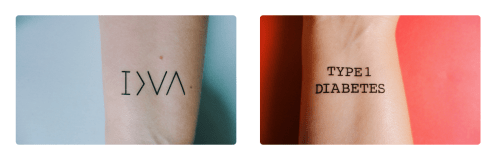
(The first one means ‘I am greater than my high and lows’.)
I can see the merit of using a temporary diabetes tattoo. For me, travelling alone would be the time that I think it would be most appealing. But there are a lot of other situations that would be great too: music concerts and festivals, large sporting events, or even as a ‘try out’ for a more permanent inking!
I really love this idea – well done Steffi – and it is another example of some truly wonderful and fun things that are going on in the diabetes world by people with diabetes. Do support them if you can!
Want your own temporary diabetes tattoo? You can order here. And Steffi ships all over the world. Even Australia!
GIVEAWAY!
Steffi has kindly offered to send me a couple of tattoos for a giveaway. Want one? Click here and tell me when and why you would use one of these tattoos.
Wait – I think I found an alert bracelet I like! As I was scrolling through the Pep Me Up website, I found this and ordered it!
What a week. It’s been a big one. And here are some words I said to wrap it up…
And here’s some further reading..
All the details of this year’s National Diabetes Week 4Ts campaign.
IDF type 1 symtoms and DKA awareness campaign.
The tragic story of Peter Baldwin’s missed type 1 diabetes diagnosis and how his parents have committed to raising awareness of the signs and symptoms of type 1.
Georgie Peter’s type 1 diagnosis story via her blog Lazy Pancreas.
Thoughtful post from Rachel from Yoga for Diabetes about her diagnosis of LADA. Diabetes is so complex…!
See you in a week or so…I’m taking some time off here to catch up on everything else after the busy week. If you have a couple of spare minutes, please consider endorsing my nomination for this years WEGO Health Awards. Just click on this link – it doesn’t take long at all!





 Diabetogenic
