
You are currently browsing the category archive for the ‘Diabetes’ category.
I know that the last thing anyone needs right now is someone else writing about what they have been eating, cooking and baking during lockdown. I think that my Instagram feed is about 75% banana bread at the moment, which is of no interest to be as I don’t like bananas. About 20% is sourdough starters, because suddenly everyone is an artisanal baker, ready to throw down a challenge to the likes of Lionel Poilâne. (Poilâne died in the early 2000s, so probably won’t rise to the challenge. There’s a bread pun in there…)
So, I feel that this post about food really isn’t necessary, except that even when not in lockdown, I spend a lot of time focussing on food. I like to blame my Italian family for it, but I think it’s just that I love everything food has to offer. From planning, shopping, prepping, cooking, serving up and then eating, the whole process is one that I love.
And so, I’m sharing some of my most recent baking and cooking efforts, mostly because I am a lazy baker and cook. By that I mean that I look for the simplest of recipes that will yield the most impressively delicious results. This means that those who I share my food with think that I am far more expert that I really am. I’m not ready to correct those misconceptions yet.
Baking
My current baking output is out of control at the moment. In normal, non-pandemic times, I bake cookies and biscuits every Sunday, so the kid has something sweet to take in her lunchbox and share with friends. I post pics of the end product (and a timelapse cooking video) on my socials with the hashtag #AndOnSundaysWeBake. Occasionally, I may bake something another day during the week.
All bets are off in the time of COVID-19 and so I needed a new hashtag: #AndOnEveryFuckingDayWeBake is far more accurate in these extraordinary times. The neighbours have been getting deliveries on their doorsteps, and I’ve discovered small batch baking, or become super-efficient at halving recipes to make just enough for one morning tea, or after dinner treat.
I rarely follow recipes – I just make things up as I go along. But I’ve tried to find similar receipts along the way just in case you suddenly have a burning desire to get in the kitchen and create.
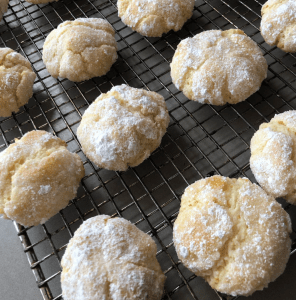
Amaretti
Literally a ten minute back up resulting in delicious and fancy biscuits. You can use any citrus or other flavouring. These ones were orange. Similar recipe can be found here.
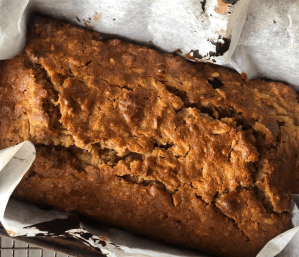
Apple, cinnamon and walnut bread
Banana bread can go fuck itself, but give me a decent apple bread any time! Add cinnamon and you are halfway to curing your diabetes. And everyone knows that walnuts are a superfood (bullshit), so really, this loaf should be found in a fancy, overpriced health food café. Similar recipe can be found here.
Focaccia
I bake bread now. And this focaccia was sublime. I’ve made it a few times to serve with whatever soup I’ve had cooking on the stove all day. Similar recipe here.

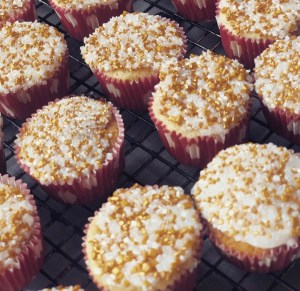
Sparkly cupcakes
When your neighbours celebrate a special anniversary while in lockdown, it’s compulsory to make them cupcakes that sparkle in the sunlight. Nigella’s basic cupcake recipe never fails.
Brownies
And more from Nigella. Here, her emergency brownies can be knocked up, and out of the oven ready for you to eat in half an hour. Put the kettle on. Recipe here.

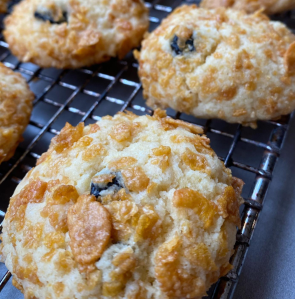
Cornflake biscuits
This is a pretty good pantry staple item recipe. All crunchy and crispy and downright delicious with an afternoon cuppa. Similar recipe here.
Anything citrus
If it’s got lemon, orange or lime in it, you can bet I want to make it.
I’m calling these biscotti all’arancia e cocciolato and they look rather impressive. But really, they’re just orange shortbread dipped in chocolate, but jeez they tasted great! Similar recipe here.

Did I mention I love lemon? This cake is a lemon loaf, with lemon syrup and then lemon drizzle because triple the lemon is always the best. Similar recipe here.
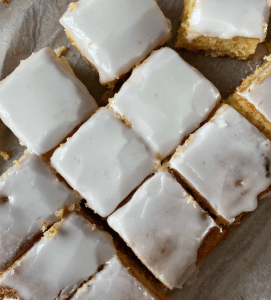
But possibly my favourite was this mandarin loaf which contains two whole mandarins thrown into the food processor for the most intense mandarin-y flavour and then more mandarin zest and juice in the icing. Similar recipe here (just replace the orange with mandarins).

Cooking
A combination of weather cooling down, the day getting darker earlier and the whole lockdown thing has meant that I’m looking for foods that are comforting, and take ages to cook, just sitting on the stove for hours for their flavours to develop.
Sauces
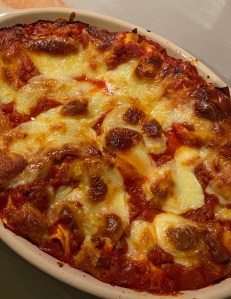
Last week’s Bolognese sauce cooked for over six hours and then was decanted into take away containers for the freezer, the neighbours and that night’s lasagne. Find whichever bolognese recipe works for you. Just don’t add zucchini.
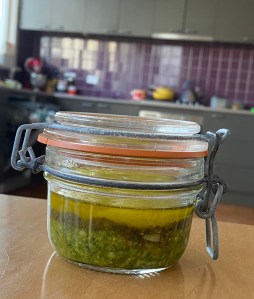
And the end of Summer signalled the end of our basil plants, so I whizzed all that was left up and made pesto. Even with the warmer weather becoming a distant memory, the taste of summer will still get a few more outings with the little oil-topped jars of verdant pesto goodness waiting in the fridge. No recipe, but basically, just add basil, parmesan, toasted pine nuts, garlic, salt and olive oil to food processor and blitz. Great to stir through pasta and veggies, or dollop on top of soups.
Pies
Look, it’s true that I made shepherd’s pie last week just so I could sing ‘A Little Priest’ while prepping it. But it was so worth it, because it tasted great! I wouldn’t even know where to start with a recipe, but I just sweated off some finely diced carrot, onion, celery and garlic added some lamb mince, stock, and simmered the crap out of it for a while. I then added other veggies that needed to be used up (some peas and corn) and then poured into a casserole and topped with mashed potato. Make swirly patterns on the potato and then crumble some panko crumbs over the top. Bake until all crunchy and bubbly and it looks like this:
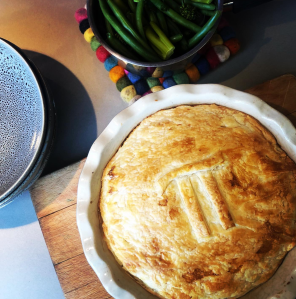
And chicken pie is a perennial favourite around here. A little maths humour on top because I’m a nerd. Find whatever chicken pie recipe works for you!
Pasta e ceci
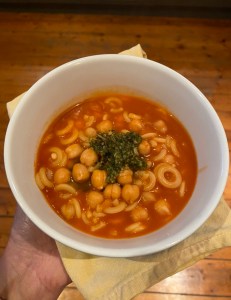
My kid has never, not once, never eaten pasta out of a can in her life, and yet, decided to tell me that my pasta e ceci which used Rustichella d’Abruzza Anellini looked like SpaghettiOs. I don’t really care, because it was beyond delicious and everyone had seconds. The recipe was from Smitten Kitchen.
So that’s how I’ve been spending my time in the kitchen. No banana bread to be found (I didn’t include the zucchini bread I baked, but that was wonderfully delicious slathered with soft salted butter), but lots of other things. We are all going about our lockdown experiences in ways that work best for us.
For me, that involves being around food. I guess a big part of it is wanting to nourish myself and my family because it’s something that I can do, and I know I can do it well. There is so much other uncertainty, but when I start to cook and bake something, I know exactly how it is going to turn out.
I have noticed that my reaction to hearing or reading something upsetting and stressful is to walk into the kitchen, open the pantry and start to load ingredients on the kitchen bench. I plug in my firetruck red Kitchenaid stand mixer, and off I go. ‘Nothing bad ever comes from creaming together butter and sugar’, I think to myself, as I become hypnotised by the paddle spinning around. My breathing slows down and my anxiety levels diminish. And cake! Soon there will be cake.

This morning I woke up, got myself organised for the day, headed to our local for our morning takeaway coffee. And then I ripped out my pump line on a door handle.

Which, all in all, seems like a pretty damn appropriate way to celebrate my twenty-second diaversary.
One day I might get good at diabetes. But I guess today is not that day.
Other diaversary posts
Last week, I had a drive thru flu shot because that’s the COVID-19 world we live in now.
My GP practice has a super-efficient process set up that involved a phone consult with my doctor earlier in the day, a time locked in for me to get my shot and clear instructions for what to do once I arrived in the practice’s car park.
At the appointed time, my GP called to confirm that I was there, instructed me to expose my right upper arm, and came out to the car park to jab my arm. I waited in the car for 15 mins and then drove off. It was clear, easy and safe.

We’re coming into flu season in the southern hemisphere, and if you haven’t already, now is the time for everyone to make plans for how and when to get your vaccination. In Australia, flu vaccines are free for all people with diabetes.
I know that some people are wondering why flu vaccine messages are still coming out so strongly even though we’re all meant to be physically isolating. It’s still important for a number of reasons. Obviously, we don’t want people to get COVID-19 AND the flu, and we don’t want people adding to the strain of what is likely to be an over-stressed health system.
Perhaps our physical distancing will have an impact on lowering numbers this year, (which would be great considering that over 300,000 people were diagnosed with the flu last year in Australia alone). But physical distancing is no guarantee that we won’t get infectious diseases such as COVID-19 or the seasonal flu. And that’s why we need to do all that we can to minimise the risk, and potential subsequent outcomes.
The message for those of us living with diabetes is the same when it comes to getting the flu as it does for getting COVID-19. We are probably not more likely to actually get either of them, but if we do, diabetes could complicate our recovery. Plus, managing diabetes with any sort of infection usually comes with a massive degree of difficulty.
The message is clear: get your flu shot. Encourage friends and family to get theirs. It really is the responsible thing to do.

So, today I had a moment and completely lost it. Tears – big, fat tears – sobbing and ugly, snotty crying. I didn’t even try to hide it, which is what I would usually do. There’s no hiding anymore now that we are all living in confined spaces and pretty much on top of each other all the time. (Sorry to the neighbours if they heard too. Inner-city living means not much space between house boundaries…)
I felt a lot better afterwards. Lighter and less overwhelmed. I realised that being all peppy and positive was weighing me down – perhaps that annoying Pollyanna-ish exterior was becoming like an armour.
I really try to not do the whole ‘what if’ stuff. This was something that I worked on for a long time with my psychologist. Catastrophising diabetes isn’t a great idea at the best of times. Adding a pandemic to the ruinous thinking isn’t especially fun.
It’s not surprising that people with diabetes are talking more about how our mental health is faring in the current situation. Living with a life-long condition that is so demanding and has the ability to mess with our minds in the most insidious way already makes us susceptible to feeling distressed. Now, it feels like that has been turned up to eleven.
I’m trying to remember how I learnt to move from thinking ‘what if <insert whichever scenario was terrifying me at that moment>’ to ‘what if it never happens’. It took me a long time to understand how to do that, with varying levels of success. There were always scenarios that made me feel extra level anxious, and it was a struggle to try to be rational. I found that by allowing myself to think about the most worrying, scary and uncertain things for a set amount of time – giving permission, I guess, to the worry and concern – I could then move on.
It turns out that pandemics bring out the catastrophising. The end-of-days thinking is not especially good for one’s already stressed mental health. Thinking about the things that are happening or that could happen is hard. Hard and scary and terrifying.
This week, I’ve kept coming back to how the Diabetes MILES study showed that the number one problem area for people who participated in the study was worrying about the future and development of diabetes-related complications. There is so much fear of the unknown in diabetes. We just don’t know how it will all play out. We do what we can, we assess and try to minimise risk, we do the best we can with the situation we are in. But we don’t really know what is around the corner.
COVID-19 is that all over again. But with diabetes thrown in for good measure.
Today, I gave permission for the worry and concern to come out because pushing it away wasn’t working. It flooded over me and weighed me down. And then I allowed the tears and the sobs. I didn’t try to stop it, I didn’t try to hide it away. And then…then I could breathe again, and work on the things that help me feel lighter.
So, I’m breathing so deeply. I’m standing in the sunshine. I’m watching our littlest dog run around in circles because she (still) hasn’t realised that she’s not a new puppy anymore. I’m listening to my husband play music. I’m listening to my kid’s laughter because it’s my favourite sound.
And I’m still muttering to myself that this too shall pass. Not yet, and maybe not for some time, but it will. This. Too. Shall. Pass.
Friends… how are you today?
The other day, I went to a local pharmacy to buy some pump lines. There is one pharmacy in my neighbourhood that usually has insulin pump consumables on the shelf, so I don’t need to order them in. I just pop in when it’s time to top up my supplies and get what I need. I asked for a box of the lines I use. ‘There are two on the shelf,’ said the sales assistant. ‘Do you want both? You probably should stock up.’
‘No thanks,’ I said to her. I only ever buy one box at a time, usually when I am down to my last three or four lines. With the new box, I would easily have a six to eight-week supply.
‘Oh,’ I said to her. ‘You really don’t need to encourage people to buy more than their usual order. We don’t have shortages – that has been confirmed by Diabetes Australia and the Department of Health. Suggesting people stockpile is not a good idea at all.’
Are you stockpiling, or thinking about it? If so, I’m ask you to please reconsider.
I get that these are confusing and stressful times. I haven’t seen a roll of loo paper on the shelves at my local Woolies for weeks now. Other pantry staples are in high demand. And since the weekend, fresh fruit and meat sections have been almost stripped bare. Despite being told that we don’t need to panic buy, we’re seeing this behaviour and it is causing a great deal of distress to a huge number of people.
The last thing we need is for there to be the same situation when it comes to diabetes meds and supplies.
Here’s the deal: we are okay. There are no shortages. We don’t need to panic and stress. That has come directly from the Department of Health who has oversight of all drugs and NDSS supplies. It has also been communicated from Diabetes Australia*.
Where things have the potential to go the way of loo paper is if people suddenly start changing their buying behaviours. Then we have problems.
Think about it this way: before coronavirus, when was the last time you couldn’t find loo paper if you needed it? Never, right? And now, because there was some weird idea that toilet rolls were going to run out, people bought packs and packs of it. I know people who have hundreds of rolls of loo paper stocked up in their houses at the moment. I also know people who have been down to their last roll and are desperately trying to find kindly neighbours who will happily and readily spare a square (or two).
This is what happens when people change their buying behaviour and we really don’t want that to happen with diabetes medications and supplies.
WHAT YOU CAN DO
Be sensible! And don’t change from what you usually do.
What is your usual buying pattern? For me, I have always called in my insulin prescription when I open my second to last vial of insulin. That has been my pattern for years.
I buy pump consumables when I am down to the last few of each. A box of lines lasts me around six weeks; cannulas longer because I tend to reuse them a couple of times. I top up blood glucose strips when I’m down to half a box. (A box lasts me forever because I really only use them to calibrate, and I am rather lax at that).
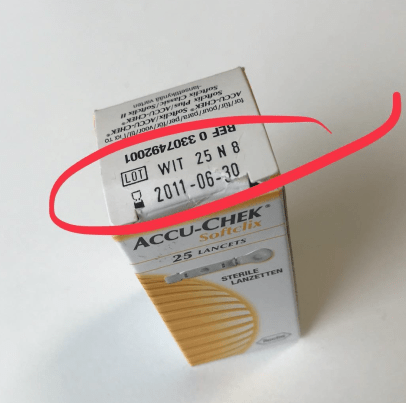
The only, only thing I have a ridiculous stockpile of is lancets. Because: who changes lancets? And the only reason I have that stockpile is because every new meter comes with about ten of them. Plus, I think I still have the same box I bought 22 years ago at diagnosis…
I am making no changes to my buying pattern and behaviour and I would urge everyone to do the same. If people just keep on keeping on, we will not have shortages. If people start to make changes and panic buy, we could be in situation loo paper.
OTHER CONSIDERATIONS
We do have limits on our NDSS usage. I know I rarely think about this, because I never reach mine. I remember needing a special exemption when I was pregnant because I was doing a heap more BGL checks each day, but other than during that time, I have never needed to worry about getting to my limit.
ALL drugs and diabetes supplies have ‘use-by’ dates. The shelf life on some items (such as sensors) is shorter that on others. If you stockpile, there is a good chance that what you have hoarded will be out of date by the time you get through your supply. That will mean that when you eventually go to use them, they are not covered if something goes wrong (such as sensors not lasting their full time etc).
Also, if you reach your limit, that could mean that you are no longer able to access subsidised product, and you may be required to pay the full amount for them. For those of us who remember the days before pump consumables were on the NDSS, it suddenly makes running a pump VERY expensive…
PLEASE THINK OF OTHERS
When I left the second box of lines of the shelf at my pharmacy last week, I did that knowing it was likely that someone else would be in soon after needing the same lines. If you order two or three times more than usual, someone downstream is going to potentially have trouble accessing what they need when they need it.
Some people can only afford their diabetes supplies on pay day, or when they are running really low on supplies. They rely on being able to access things WHEN they need them and cannot stock up beforehand. Please be considerate of people in all situations.
If we all are sensible about this, we can completely avoid supply problems.
WHAT TO DO IF YOU ARE ALREADY STRUGGLING TO GET WHAT YOU NEED
Contact the NDSS (1800 637 700) with every single detail of what is going on in your situation. Provide details of the access point (usually a pharmacy) that has not been able to provide you with what you need. How long has this been the case? What are you trying to purchase? Have you tried somewhere else locally? (Remember that most pharmacies do not keep insulin or NDSS products in stock and they need to be ordered in.)
Also, please, please, please do not engage in online speculation of shortages online. This is what causes panic! If you have a personal experience, contact the NDSS!
TWO FINAL THINGS
- Keep washing your hands!
- IF YOU ARE STOCKPILING LANCETS, STOP IT. STOP IT NOW!! You KNOW you will never use them! And no one else will either, so they will haunt and mock you from your diabetes supplies cupboard/drawer for the rest of your days.
*DISCLOSURE
Yes, I work for Diabetes Australia, however I am not writing this because of that and have not been asked by anyone at Diabetes Australia or the NDSS to write this.
I am writing it because I am a person with diabetes who does not want to find herself struggling to access the meds and supplies that I need to stay alive, nor do I want any of my diabetes brothers or sisters to find themselves in the same situation.
No need to stockpile lancets. Or anything else!
Burnout. It’s absolutely on my mind at the moment. I am burnt out with diabetes; I’m burnt out with advocacy. And I am burnt out with coronavirus – especially the bit where everything I see and read keeps mentioning that it’s all really just mild…except for elderly people and those with chronic health conditions.
Oh yeah – that’s me. The chronic health condition bit, although I am feeling old – so old – at the moment, too.
(I’m also burnt out at my husband breaking into song every time he hears the words ‘COVID-19’, and if I never hear the song Come On Eileen again it will be too soon. But I digress…)
I’m not afraid of coronavirus. I’m taking the precautions that have been recommended. I’ve not panicked or stockpiled anything, and I’m still going into work. Probably the way I have been most impacted is that I will be in Melbourne next week instead of Berlin, and again at the beginning of April when I was meant to be in Copenhagen. As with most people, I’ve been grounded and probably won’t be seeing the inside of an airport for a few months. It’s a small price to pay to stop the virus’ spread. (Alas, reaching Qantas Platinum One status will remain elusive for another year.)
All in all, I’m pretty calm and rational about what I need to do personally and understand how our own personal actions can and will contribute to the wellbeing of others. At least, I have been feeling calm and rational…
In the last couple of days, I’ve noticed that I am starting to tense up whenever coronavirus is mentioned, and I know that I have moved from just taking any information in, to feeling increasing levels of concern. I get that my anxiety has been heightened lately – due to completely unrelated reasons – and that is now being reflected in how I am responding to coronavirus. I am tangibly feeling upset when I hear stories of people with chronic health conditions being diagnosed with it, and the other day, I found that I was fighting back tears as, yet again, some politician somewhere promised that people who were diagnosed with the virus would most likely be okay – as long as they were not old or chronically ill.
I don’t like diabetes making me feel defenceless, and yet, here I am, feeling highly exposed and vulnerable.
Thankfully, reporting has seemed to be a little more sensitive in recent days and I’m feeling less disposable, or perhaps I was just getting better at avoiding anything that was making me seem that way. At least, that was the case until I started reading accounts out of Italy about how overwhelmed their health system has become. I can’t even begin to imagine the distress HCPs must be feeling at needing to determine who gets treatment and who doesn’t – in many cases deciding who lives and dies. If the situation in Italy was to happen here, would I be one of those left to die because of my diabetes?
These thoughts are starting to keep me awake at night.
So today, I’m thinking about my mental health and how I can better look after it in light of the way I am starting to feel. The last thing I want is to become completely overwhelmed. I need to keep being rational and calm and sensible – not panicky and unable to think straight.
I’m being very selective about what I am reading. I don’t watch or read tabloid news ever, and I’ve actually blocked accounts on my socials so that I don’t accidentally see their scaremongering on my feeds. The balance between informing and alarming people seems to be a fine line that many don’t seem to understand.
Instead, I’m looking at the sensible and smart advice, where evidence is king, and content is based on fact. Diabetes Australia (disclosure: I work there) has been providing regular updates for Aussies with diabetes, including information from the Department of Health which reassuringly confirmed that there are no shortages or supply issues with insulin, diabetes drugs or NDSS supplies. (If you’re elsewhere, check local diabetes org sites and if there is nothing there, reach out and ask them to get onto it!)
Children with Diabetes, Diatribe and Beyond Type 1 have been doing a stellar job providing smart information and avoided any panic and alarm. I am so grateful that when I see a post from one of them on my feed because they calm, rather than distress. I also love how they are acknowledging that this is tough for those of us with diabetes and that feeling overwhelmed is understandable. I’m holding on to that.
I’m also doing a lot of risk assessment. We’re not in lockdown here in Australia, so I am still going into work for the main part. Perhaps if I didn’t drive in or have my own office once I get there, I’d reconsider working from home for the next couple of weeks, but honestly, being around people is therapeutic sometimes and keeps those dark thoughts at bay.
As ever, trying to find a balance is essential and I think about that whenever I am about to walk out the door. Minimising contact with the outside world is hard and as social isolation is one of the things being recommended, I think about friends and family living alone. Online communities work to reduce isolation, and I hope that people who need to connect with others are able to do so.
These are difficult times and finding a way through will be different for everyone. As much as I don’t understand people stockpiling loo paper (really, I’m confused), I don’t want to blame or judge anyone who is doing whatever they can to try to feel some control over a situation with so much that is unknown.
Living with diabetes means we do have extra things to think about and they can make us feel overcome: this is perfectly normal and okay (as is feeling completely relaxed about everything, by the way!). I seem to be muttering to myself ‘This too shall pass’ a lot. Because it will.
But in the meantime, to my friends and peers with diabetes, be kind and gentle to yourself and each other. That always goes a long way to helping with emotional wellbeing.

Sometimes it feels as though discussions in the diabetes are seasonal. Like clockwork, we see the same conversations happen at the same times. Without missing a beat, almost as soon as a scientific conference is over, someone will comment about how difficult it is for PWD to get to conferences (true, however this year, #dedoc° voices could have assisted a number of the people who were stating that), and then there are discussions about disclosure by PWD who are fortunate to attend, even though pretty much every advocate I know who attends these sorts of things does a stellar job of disclosing.
And of course, the nature of the first big meeting of the year, ATTD, means that there inevitably will be noise about the gap in technology access. And you bet this is a discussion that we need to be having on regular rotation.
After attending my first ATTD, I wrote a piece about the complete and utter dichotomy of being at a conference that was only talking about the latest and greatest in technology while, at the same time, whilst the community was in the midst of its usual Spare a Rose month of fundraising. I struggled to balance the idea that we were talking about automated insulin delivery at the same time as urging donations so people could just get insulin!
Today, I’m revisiting the piece I wrote after last year’s ATTD, where my worlds of diabetes technology and language matters merged, and combined this with the over-representation of those at the super-dooper-tech-y end of the diabetes technology spectrum. (‘Super-dooper-tech-y’ is, obviously, a very technical term.)
I don’t for a moment think that meetings with a strong tech focus should end, or that those who are innovators in technologies should take a seat and let others speak. I don’t believe that at all. I will be forever grateful to the pioneers who continue to push the envelope and make things better for people with diabetes. But I do think that we need to ensure that there is equal attention to those who – by choice or because of their circumstances – are not walking around with an algorithm driving their diabetes.
If we truly believe that all diabetes stories matter, then we need to hear from people doing diabetes in every way possible. Perhaps if we make more of an effort to find and hear those stories, we will stop minimising our experiences, and starr seeing that whatever we are managing to do is truly enough…
DISCLOSURE 1 (for ATTD 2020)
I was an invited speaker at #ATTD2020, and my registration was covered by the conference organising committee. My airfare and part of my accommodation to attend ATTD was covered by Lilly Diabetes so that I could participate in the DOCLab advisory group meeting which took place on Friday, Saturday and Sunday. Other accommodation was covered by DedocLabs (I am an advisor for the #dedoc° voices program) and Novo Nordisk (I am a member of DEEP). I have not been asked to write or speak about any of the activities I attended, or anything I have seen at the conference.
We all do a good job at undermining ourselves at times. We use a four letter word that diminishes what we are doing, and limits the value of our experience and expertise. That four letter word is ‘just’.
In diabetes, we hear it all the time: ‘Oh, I just have type 2 diabetes’ as though it is insignificant and doesn’t have any challenges. ‘I’ve lived with diabetes for just a couple of years’ because we think there is only currency in decades of living with the condition, when really any length of time with diabetes is meaningful.
And we are all about minimising our experience when it comes to the treatment of our diabetes. ‘I just use diet and exercise to manage my type 2 diabetes’ or ‘I’m just on tablets’ or ‘I’m just on injections twice a day’ or ‘I’m just on MDI’. The list goes on and on. And on.
I realised just how ridiculous we have become with this when I heard myself, during a conversation with a fellow Looper, ‘Oh, I just use Loop’. (More on that later…)
At the Ascensia Social Media Summit at ATTD we spoke about this, specifically how there is almost a stigma within the diabetes for those seen to not be using the shiniest and brightest and newest of technologies. It seems that some people almost feel embarrassed if they are not constantly updating their technology toolkit with the most recently launched product.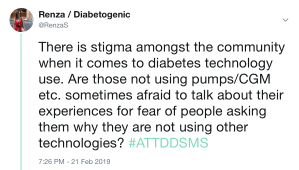
The idea that anything that we are using today is ‘yesterday’s technology’ is wrong. Blood glucose monitoring can’t be ‘yesterday’s tech’ if it is what most people are using to track their glucose. And syringes and pens can’t be considered the ‘old way to deliver insulin’ when that is how the vast, vast majority of inulin-requiring people with diabetes get insulin into their bodies. Plus, every single one of us using a pump must be able to deliver insulin this way because machines break.
Somewhere in discussions about our treatment technologies, we seem to have forgotten that, actually, not everyone wants to be using the latest kit. And that is okay. There is a spectrum of diabetes technology, and as long as we are on it somewhere and managing our diabetes the way that works best for us, then elephant stamps all around!
There is clearly an over-representation of people at one end of that spectrum dominating on and off line conversations. Spend a couple of hours in a diabetes Facebook group and it would be a reasonable assumption that most people are wearing pumps and CGM. But that’s not true.
And it could appear that DIYAPS is the way to go for most people with T1D, when the fact is that numbers are relatively low. It’s hard to estimate exactly, but there may be somewhere between 2,000 and 3,000 worldwide how have ‘built their own pancreas’. That is just a drop in the type 1 diabetes ocean.
It’s fantastic for those of us interested in this technology to be able to (virtually) congregate and talk amongst ourselves. I learn so much from my peers in these groups – just as I have with all aspects of life with diabetes. The lived experience continues to trump any other way of learning about diabetes.
Of course, that doesn’t mean that we shouldn’t be talking about technology used by limited numbers. Of course we should. We want others to know about it so they can make an informed choice about whether it may be right for them. We want our HCPs to know about it and to support those of us using all sorts of technologies and treatments.
Where it becomes problematic is when there is the misconception that this is the norm. Or when those not using the newest technology feel that they are wilfully doing diabetes the ‘old way’. It’s unfair to think for a moment that those who are not using the tech ‘don’t care’ enough about themselves – especially when decisions are made based on a very good understanding of what is available and what they have decided works best for them.
So, back to my ‘Oh, I just use Loop’ comment. It was directed to someone far more technologically advanced than me; someone who runs all sorts of other programs alongside their DIYAPS. They generate lots of reports and make lots of changes and seem to have far more bells and whistles than I even knew were available.
I nodded as they told me all they were doing and then, when they asked me how I manage my diabetes, I answered that I just use Loop. I heard myself saying it and stopped and corrected myself. ‘I mean…I use Loop. It works for me. Perfectly.’
We don’t need to make excuses for doing diabetes our own way. If we truly have choice (which I know is not always the case), and we have made the choice based on what we believe to be the best possible treatment and technology for us at that moment, then surely that’s a great thing. We shouldn’t ever be made to feel less committed to our own health and wellbeing. That’s not how it works.
DISLCOSURE 2 (for ATTD 2019)
I was invited by Ascensia to co-chair the Diabetes Social Media Summit at ATTD (#ATTDDSMS). I did not receive any payment or in-kind support from them for accepting their invitation. I have co-written a piece for the blog, however this was not edited (apart from inevitable jet-lag-induced typos) and all words are those of mine and the piece’s co-author. You can read that piece here.
Happy International Women’s Day!
I usually acknowledge this day with a post about some of the amazing women that we see in the diabetes world. Instead, today I’m going to take a more personal approach and mention some of the women who have so impacted me recently. Some will have been mentioned before – but maybe that’s because they continue to be the women who I look to. (I’ve linked to their Twitter accounts where possible.)
| Kerri Sparling | Dana Lewis
Alicia Jenkins Cheryl Steele Emma Stendhal |
Moira McCarthy
Rachel Portelli Helen Murphy |
That’s a pretty long list and it barely scratches the surface. But it serves more than the purpose of just signalling some of the women whose paths I’ve crossed in recent times, or whose work has inspired me in some way. It is a list to show just how easy it is to find women who are experts in diabetes in one way or another. It shows how women can just as easily be singled out to stand on a stage, sit on a panel, be interviewed in front of a camera to talk about diabetes.
Because that’s not always happening as equally as we would like.
Last year, at the IDF, the Women and Diabetes stream was led by a man (as it had been at the previous IDF Congress); there is only one woman on the advisory panel for ATTD; gender balance when it comes to speakers at diabetes events is generally not even close to equal; panels are often dominated by men.
All the women I have mentioned have, in some way, been trailblazers. I know many of them quite well, and I have seen and heard the challenges they face, the looks given around them when they speak and write, and the words that are used to describe them when their challenges hit a nerve. There is no one way that we choose to do our advocacy or our work. But our personality – how loud or quietly we do it – shouldn’t be a measure of anything.
Recently, a couple of people have referred to me as ‘strident’. My views and opinions have also been described that way. For the record, I didn’t ask for an assessment of my personality or my opinions; these were offered up to me (by men) who thought that my confidence and directness – and stridency – was part of the reason that I’ve been having a slightly tough time in some parts of the diabetes world lately.
Strident is a word that mostly seems to be directed towards women who will not go quietly, who stand up and challenge the status quo, who are seen to rock the boat, who want to be heard, who have opinions and are not afraid to share them. Sometimes, our anger and frustration comes to the fore and that is seen as us being unable to control our emotions. We’re not always called out overtly; sometimes instead there is reference to the preference for ‘moderate voices’. Moderate voices and opinions are okay. Strident ones? Not so much.
But you know what? I’m owning it. In much the same way that I have embraced the term ‘deliberately non-compliant’, I am now taking on board the term strident. You bet I’m a strident woman and I am proud to say that. And I’m proud to stand alongside dynamic, passionate, smart, controversial, sassy women who will not, and do not go quietly. Strident women – I know them and I am one of them. I am in outstanding company.

Previous IWD posts





 Diabetogenic