
You are currently browsing the category archive for the ‘Conferences’ category.
New year, new jumble. And lots of saved links from the last few weeks to share.
#OzDOC 2.0
Did you know that after OzDOC had it’s ‘final’ tweetchat at the beginning of December last year, it’s had a reboot and is now continuing to go at a great rate. David Burren (AKA Bionic Wookiee) kicked off the chat but is looking for people to volunteer to the moderators’ roster. There’s a brand new Twitter account to follow (@OzDOC_host), but the #OzDOC hashtag continues to shine brightly.
Same #OzDOC time, same #OzDOC channel. (i.e. Tuesdays at 8.30pm AEDT)
And while we’re talking tweetchats…
…make sure you keep an eye out on the #GBDOC tweetchats, which also had a bit of a restart last year and are going absolutely brilliantly. Follow @GbdocTChost for topics and moderators.
Now is a great time for Aussies to participate in #GBDOC because with the time zone difference, the chat is on Thursday 8am AEDT…which is actually quite pleasant. (It all goes to pot and becomes more difficult when daylight saving kicks in/out in respective hemispheres in coming months, but for now, it’s certainly manageable!)
Jane’s profile
It’s no secret that I’m a huge fan of Professor Jane Speight and I make no apologies for mentioning her so frequently on this blog. She is truly a champion for and of people with diabetes and her pioneering work on diabetes and #LanguageMatters, and social stigma are changing the landscape for those of us living with diabetes.
Last week, a profile of Jane and her work was published in The Lancet. Congrats, Jane. I can’t imagine a more worthy recipient of this attention. Please keep on keeping on. I for one am very grateful to have you on our side!
Read the article here – it’s free, but you will need to register/log in to access it.

(Click photo for source)
Dear ‘patient’
I was really interested to read this BMJ Opinion piece about medical letters, with the writers suggesting that instead of addressing ‘report letters’ to referring (and other) doctors and HCPs, that they should be addressed directly to the person, CCing in the doctor who would ordinarily have been sent the letter.
I love that idea! My endo generally copies me in on anything she sends out to my other HCPs to keep me in the loop, but I think that actually writing directly to me is even better.
HCPs would need to completely reconsider the language they adopt, the terminology they use and the overall tone of the communication, and I believe that there is nothing that should be shared with another HCP about me that shouldn’t be shared directly with me.
Interesting idea. And interesting to see if it has legs…
Writing for Grumps
After writing for me a few weeks ago, I returned the favour and wrote a post for The Grumpy Pumper. (I think the deal he made was something like ‘I’ll show you mine if you show me yours’, so I had to come up with the goods.)
This is all part of Grumps’ attempts to get people with diabetes speaking about #TalkAboutComplications in an open and honest way to help reduce the shame that seem to go hand in hand with a complications diagnosis.
Get ready for Spare a Rose spam
This year’s campaign is about to kick off. And if you want to know why I support this campaign, here’s just one reason.
Hospital admissions and T1D study
Rebecca Munt from Flinders University is currently enrolled in a PhD at Flinders University and is looking for participants in her research.
The focus of her study is to explore the experiences of self-management for adults with type 1 diabetes in the hospital setting (when T1D is not the primary admission diagnosis). If you’re interested in participating in Rebecca’s study, have type 1 diabetes, are over 18 years of age and have been admitted to hospital within the last two to five years (not for diabetes), please call Rebecca on (08) 8201 5749 or email rebecca.munt@flinders.edu.au
(The project has Social Behavioural Research Ethics Committee approval from Flinders University.)
Future of medical conferences
I have been very vocal in recent years about the shortcomings of diabetes conferences, specifically the lack of involvement and engagement of people with diabetes as part of the planning, running and presenting of the conference. So this piece really resonated about why medical meetings need a revamp, and some ideas for what could be done differently.
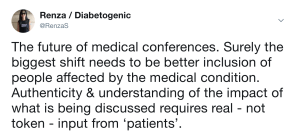
(Click for original tweet)
Because #NothingAboutUsWithoutUs.
Does the story we know and love about Banting need a rewrite?
I was fascinated to watch the short documentary shared in this story which suggests that the frequently-told story of the discovery of insulin is missing out a critical part.
It was the best of times, it was the worst of times…
This blog post by Sue Robins detailing two vastly different medical appointments is compelling – and quite heartbreaking –reading.
More D Merch
Totally true!
Click image to get your own!
I was thrilled and honoured to speak in the symposium at #IDF2017 all about peer support. I shared the program with Chris Aldred, better known to all as The Grumpy Pumper, and advocate Dr Phylissa Deroze (you can – and should – find her as @not_defeated on Twitter).

Speakers in the peer support symposium at #IDF2017
When we were putting together the program for the symposium, the idea was that it would offer an overview of what peer support can look like, beginning with how diabetes organisations and community health groups can facilitate and offer a variety of peer support options, and rounding up with the perspectives of people with diabetes who provide and participate in peer support.
I spoke about how diabetes organisations in Australia, through the NDSS, offer a suite of peer support choices, urging the audience to think beyond the usual face-to-face or, increasingly, online peer support group. Activities such as camps for children and adolescents with diabetes, information events, education sessions (such as DAFNE) are all avenues for peer support. Peer support need not only take the form of a group of people sitting in a (real or virtual) room talking about diabetes in a structured or unstructured way. It can happen just by putting people with diabetes in the same space.
I’d never met Phylissa before, but I quickly learnt she is the definition of the word determined. She spoke eloquently about her own type 2 diabetes diagnosis which was anything but ideal. Instead of feeling beaten and overcome by how she had been let down by the healthcare system, she turned to her peers, finding a group that not only helped her diabetes management, but also gave her confidence to live well with diabetes.
Phylissa now facilitates an in-person support group for women with diabetes in Al Ain in the UAE, and is a huge supporter of, and believer in, the power and importance of peer to peer engagement and support in diabetes management. You can read more about Phylissa’s work on her website here.
Grumps, in true Grumps style, gave a talk about how his approach to peer support is more organic and certainly not especially structured. Although involved in some more planned peer support, he believes the most effective way he can support others with diabetes is on an individual, more informal way. Kind of like this:

Click image to see tweet.
And as if putting into practise his talk at the Congress, last week he started a conversation on Twitter about his own recent experiences of being diagnosed with an ulcer in his foot opening the door for people to speak about diabetes complications.

Click image to see tweet.
The way we speak about diabetes-related complications is often flawed. The first we hear of them is around diagnosis and they are held over us as a threat of the bad things to come if we don’t do as we are told. They are also presented to us with the equation of: Well-managed-diabetes + doing-what-the-doctors-say = no complications.
Unfortunately, it’s not that easy.
From then on, complications are spoken of in hushed-voices or accusations. Blame is apportioned to those who develop them: obviously, they failed to take care of themselves.
And because of this, for many people, the diagnosis of a diabetes-related complication is accompanied by guilt, shame and feelings of failure when really, the response should be offers of support, the best care possible and links to others going through the same thing. Peer support.
Back to Grumps’ raising diabetes complications on Twitter. After sharing his own story, suggested that we should not be ashamed to talk about complications.
That was the catalyst others needed to begin volunteering their own stories of complications diagnoses. Suddenly, people were openly speaking about diabetes complications in a matter-of-fact, open way – almost as if speaking about the weather. Some offered heartfelt sympathies, others shared tips and tricks that help them. But the overall sentiments were those of support and camaraderie.
The recurring theme of the peer support symposium at the Congress was that we need to find others we can connect with in a safe space so we can speak about the things that matter to us. It’s not the role of any organisation or HCP to set the agenda – the agenda needs to be fluid and follow whatever people with diabetes need.
END NOTE
While we’re talking peer support, how great is it to see that the weekly OzDOC tweetchat is getting a reprise this week, with Bionic Wookiee, David Burren at the helm. Drop by if you are free at the usual time: Tuesday evening at 8.30pm (AEDT). I’ll be there!
Disclosure
I was the Deputy Lead for the Living with Diabetes Stream, and an invited speaker at the 2017 IDF Congress. The International Diabetes Federation covered my travel and accommodation costs and provided me with registration to attend the Congress.
This week has been brutal. I arrived home from the IDF Congress very late on Saturday night after a very long journey from Abu Dhabi and since then, my body clock has had no idea where I am, despite my actual body being very much in the midst of Melbourne’s sometimes sweltering summer. My mind is all over the shop, sleep is something that happens if it wants (which it doesn’t really) and, for some inexplicable reason, I’m off coffee.
So, yes, I am a delight to be around right now. Want to hang out?
My time at the Congress, however, was one of those weeks that makes me feel so fortunate and privileged to do the job I do and have afforded to me the opportunities that come with it. Apart from a very full schedule of outstanding talks from leaders in the diabetes world, the congress was packed with advocates from around the world. I was totally with my tribe.
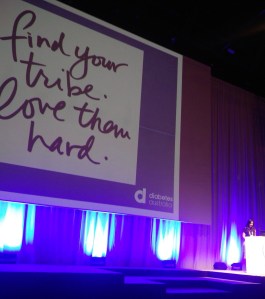
That’s me talking about diabetes and peer support!
There is lots to write about the Congress and I’ll do so in bits and pieces over the coming few weeks, but there were some stand out moments that I wanted to touch on and thought I’d try to do that now. (I’ve already started this blog post about four thousand, three hundred and twenty-eight times, so who knows how we’ll go here…)
Dot points – because they seem to take less energy and mental bandwidth…
- This is the only diabetes conference primarily aimed at healthcare professionals that has a stream completely and utterly dedicated to ‘living with diabetes’ (LWD). This is, in equal measure, brilliant and problematic. It’s brilliant because it means that there is a real opportunity for people with diabetes to be on the speaker program, have their accommodation, travel and registration funded, and be part of the conversation at the actual meeting. But it can be problematic because it means that often, there are not all that many HCPs in attendance at the LWD sessions. I believe that one way to improve this situation is to include PWD in other sessions as well as have an exclusive stream. More on that another time, perhaps.

Click image to see tweet.
- So with that in mind, if your HCP was at the Congress, I’d be asking them which LWD stream sessions they saw and have a stern talking to them if they reply with ‘not a one…’ Hopefully they will be more like UK Consultant Diabetologist, Reza Zaidi who not only attended a number of the LWD sessions, but also tweeted throughout them and asked questions.

(Click image to see tweet)
- I patted a falcon (not a euphemism). There were falcons at the Congress. I am not sure why they were there. But obviously, I was terrified. I tried to overcome my fear of birds by being brave and patting one. I am still scared of birds.

- There was a language session in the LWD stream (of course), but it was clear that a few of the exhibitors, presenters and those putting together posters for presentation could do with a refresher course on not using the word ‘compliant’. Call me, folks. I can help.
- There was a fascinating discussion during the language session when it was explained by someone asking a question that the word for ‘diabetes’ in Japanese is literally translated as Sugar Urine Disease. And yes – you bet that adds to the stigma of diabetes…
- And one final language point. There was a lot of talk about needing to ‘battle’, ‘fight’, ‘combat’ and ‘challenge’ diabetes as though this is a war. I’m not sure that this is a particularly useful way to think about it all.

Click image to see tweet.
- Getting a break from the Congress proved almost impossible. So I was so grateful to the diaTribe Foundation for forcing us out of the conference centre and into an Art Gallery with one of their Art Walk series events. We got a guided tour of the brand new (as in, open for less than a month) Abu Dhabi Louvre. Stunning!

The amazing Abu Dhabi Louvre at sunset
- For some reason, the IDF put me up in the middle of nowhere on a golf course. Perhaps they were hoping I would take walks. Or improve my swing. I did neither of these things.
- I am more than used to getting asked about the ‘thing’ on my arm. My Dexcom sensor and transmitter are quite obvious and people are curious. I almost have come to expect it and I am happy to answer questions as long as they are asked respectfully. I don’t, however, expect this at at a diabetes conference. And yet, that happened over a dozen times. But possibly, the most surreal experience was stepping onto the Dexcom stand in the exhibition hall and having a few of the sales reps nearly tripping over themselves to ask what it was, how it worked, what it felt like and why it was on my arm. And then they wanted to see the iPhone and Apple Watch app and ask more questions, suggesting that Congress attendees visiting the stand ask questions of me and another person sporting one of their devices. Obviously, I should be on commission…
- Diabetes conference exhibition halls can be confusing places. There are stands offering products that seem to be so far removed from diabetes that surely the exhibitors have accidentally turned up the wrong week for the wrong conference. I’m still confused by what the fluffy dolphin (pictured here with Annie, Georgie, Grumps and me) has to do with diabetes or what was happening on this stand.
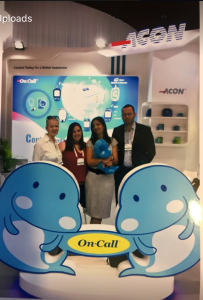
Dolphins and diabetes… join the dots.
- The Abu Dhabi National Exhibition Centre (ADNEC) might look like pretty much every other conference and exhibition centre I’ve ever been to (they all do), but jeez, it was certainly the largest I’ve ever been to. It was, in fact, quite cavernous and a lot of the time seemed quite empty, despite there being over 8,000 attendees. All that space, and still nowhere to get a decent coffee.
- I chaired a really important session about diabetes complications. It was great to have an open, frank and honest discussion about living with complications and how they impact on the lives of people with diabetes. (Although, I could have done without the clip from Steel Magnolias to introduce the session on complications in pregnancy.)
- Finally, it was so lovely to see the wonderful Wim Wienjen’s legacy on show during the hypoglycaemia talk. The book he authored alongside Daniela Rojas Jimenez is due for publication soon.

That’s it in dot points for today. I’ll be back soon writing more about the Congress. (I guess four thousand, three hundred and twenty-nine is a charm….)
Disclosure
I was the Deputy Lead for the Living with Diabetes Stream, and an invited speaker at the 2017 IDF Congress. The International Diabetes Federation covered by travel and accommodation costs and provided me with registration to attend the Congress.
(Hat tip to Professor Tim Skinner for the title of today’s blog post.)
In an effort to terrify the bejeezus out of healthcare professionals get the word out about Loop and OpenAPS to a group of diabetes healthcare professionals, I decided to work my Loop story into my talk at last Friday’s #ADATS meeting. I was a little nervous about it, but being on the ADATS Committee, and recognising the name of the conference – Australasian Diabetes ADVANCEMENTS and TECHNOLOGIES Summit – I knew that there was no way I could talk about the latest diabetes tech advances and not talk about the DIY movement.
To set the scene, I started with the old chestnut of showing how far diabetes technology has come:
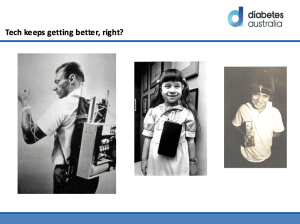
Then showed a slide with all our shiny new tech:
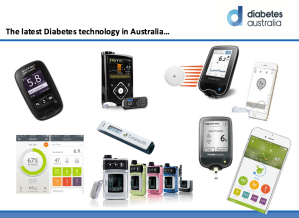
But then I stopped, and changed the slide a little, leaving the same photos, but altering the title to ask a question:

And then, I showed them what cutting edge diabetes tech really looks like:
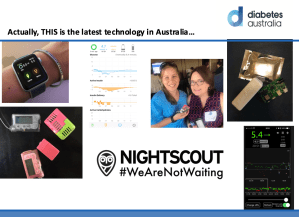
I used the next slide to explain how I drive my Dtech these days, and how my iPhone and Apple Watch are part of my diabetes tech arsenal.
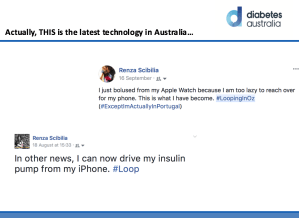
‘So…How many of you know about OpenAPS or Loop,’ I asked. Very, very few hands went up.
‘What about Nightscout? How many of you know about, and understand,d Nightscout?’ A few more went up – but really not many.
I nodded my head, completely unsurprised.
Then I told the audience I’ve been using Loop for almost three months. I explained how I ‘hacked’ an insulin pump, ‘became an app developer and built an app’… and now, my basal insulin is fully automated. I showed a screenshot of the app, and pointed out the dozens and dozens of small basal rate adjustments automatically made every day.
I explained how much better I feel, how much more time my glucose levels are in range and how I simply wouldn’t be without this technology now. I told them how I now wake up feeling that I can move mountains because night after night after night my glucose levels remain in a flat, straight line thanks to those micro basal adjustments, and I wake to a number that ranges no more than between about 5mmol/l and 5.8mmol/l.
‘How many of you are a little scared by this?’ I asked and waited. Hands shot up; many heads nodded. I waited some more, shrugging my shoulders a little.
‘This isn’t the scary future,’ I said. ‘It’s not dangerous, futuristic or downright terrifying – which is what I’m sure some of you are thinking. This is happening here and now. There are two other people in this room using one of the two systems and there are probably around thirty people across Australia who have started using one of them.
‘And if you are a healthcare professional working with people with diabetes, it makes sense to be aware of these technologies. Also, Nightscout has been around for a number of years now. It’s really not okay if you are working with people with diabetes and you don’t know about Nightscout…’
I know that my talk received a mixed reception. There was a lot of nervousness from some of the device company reps in the room – especially the maker of Loop-able pumps. Some HCPs were simply aghast and did nothing to hide their feelings, one person telling me that I was being irresponsible doing such a thing and even more irresponsible talking about it.
But others were far more interested. The rep. with type 1 diabetes from a device company who announced at the end of the day that he was ‘going home to hack his insulin pump’ was obviously interested. As were a number of other people with diabetes in the room. A couple of HCPs spoke to me about my experience, and one told me that he knows someone in the process of setting up Loop.
But mostly, there was nervousness and shock that not only is this happening, but that there are step-by-step instructions online so that anyone can get onboard. ‘You mean that ANYONE can access the instructions? For free? So any of my patients could do this if they knew about it?’ asked one endocrinologist while a diabetes educator he works with stood behind him sharing his horror. ‘Yep!’ I said cheerfully. ‘It’s all open source. No one is trying to make a buck out of this. It’s for everyone. Isn’t that fantastic! They didn’t share my enthusiasm.
Here’s the thing…I wasn’t (and am not) for a moment suggesting that it is the role of HCPs to start recommending this technology to the PWD they see. But it is naive of them to deny it is happening, or that the only way people with diabetes will find out about it is if their HCP mentions it. Also, I’m not recommending that everyone with diabetes should find a suitable pump and start Looping. I’m simply sharing my story – which is what I have always done here on this blog, and elsewhere as a diabetes advocate.
The title of this blog post came about when I mentioned the mixed reception a little later on in the day. I was sitting with three others at ADATS (who I knew would be sympathetic), and psychologist Tim Skinner commented that one of the reasons that HCPs might be so uncomfortable is because I am going beyond simply not following their directions of how I should be managing my diabetes. ‘You’re actually being a deliberately non-compliant diabetic,’ he said cheekily (Tim was one of the authors on the Diabetes Australia Language Position Statement, so he knew the response he’d get from me using such terminology). ‘This is a lot more than simply being ‘non-compliant’. You have actively hacked a diabetes device and are using that to change the way you are managing your diabetes. Deliberately non-compliant!’
He’s right. I never thought I’d wear the term ‘non-compliant’ as a badge of honour, but right then and there, I kind of was.

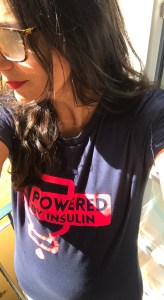
Even my t-shirt is deliberately non-compliant. (You can get your own by clicking on the photo.)
LOOP!!! I know you want more info. You can read my last couple of posts about my experience here and here, but the full details, continually updated by the brilliant Loop and OpenAPS brains trust can be found here. Read them. Also, you may want to join the (closed) Looped Facebook group. And if you are in Australia, we have our own (closed) page dedicated to local issues at Aussie Aussie Aussie. Loop, Loop, Loop. (And just a reminder – no one can build your Loop system. You have to do it yourself, but it is actually super easy once you have all the components.)
Disclosure
My travel costs were covered by the National Association of Diabetes Centres, the organisers of ADATS. I was on the ADATS organising committee.
Our kid has always enjoyed drawing. I’m someone who struggles to draw a stick figure, so I am frequently impressed by her ability to sketch and paint things that are actually quite good, and I’m able to easily identify.
The other day, I was tidying up the kitchen table when I came across one of her sketches. I picked it up and looked at it. ‘This is gorgeous, darling,’ I said to her as she sat at the table doing her homework. And then I stopped. ‘Wait…why are you drawing a woman pole dancing?’

Exhibit A
She looked at me with that expression that only a teenager-in-training can, and then started laughing. ‘Mum!’ She exclaimed, taking the drawing from my hands. She turned the paper ninety degrees, and held it up to me. ‘It’s a witch on a broomstick!’

Exhibit B
Ah, perspective!
On Friday last week, I spoke at the first Australasian Diabetes Advancements and Technologies Summit (#ADATS) in Sydney. My talk was ‘The consumer perspective on new technologies’. So, as usual, I crowd sourced some ideas from Facebook friends. I do this for two reasons… one: it gives me the opportunity to share the thoughts of other PWD so that my voice is not the only one heard. And two: I’m lazy.
I centred my talk around the love/hate relationship I have with diabetes technology and asked others to give me a couple of dot points on what they love, and what they don’t really love (or hate) about diabetes tech.

In many cases, the things people love are also the things they hate, and that makes so much sense to me!
Our perspective of our diabetes devices can change all the time. Some days, I am so appreciative for all the information my diabetes technology offers; other days I want to ignore it as it just makes me want to cry. Sometimes I love the devices and I can’t imagine being without them; other days I long for my body to be free of them. Some days, I love the alerts and alarms, and respond to them promptly; other days, the noise is unbearable and I switch off everything I can so I don’t need aural reminders of just how hopeless I am at diabetes.
My perspective can spin on a coin, and often it takes very little for me to move from loving every piece of technology to wanting to bin it all.
The point of my talk was not to bitch and moan about the technology I know I am so fortunate and privileged to be able to afford and use. It was to try to explain that the bells and whistles, and data and information can truly be wonderful. But our feelings about the tech will change (often several times in the space of a day) and this does affect how we feel about our diabetes.
Disclosures
My travel costs were covered by the National Association of Diabetes Centres, the organisers of ADATS. I was on the ADATS organising committee.
My blog break was completely unplanned, but once EASD was over and my family joined me in Lisbon, I knew that our next three weeks together would be completely dedicated to chasing the sun, relaxing, eating, wandering through art galleries, napping in the afternoons. And not writing.
I thought the best way to get my writing chops back would be to share some pictures. Because pictures tell a thousand words, which means I won’t have to write many!
So, here are some photos. With tenuous links to diabetes…
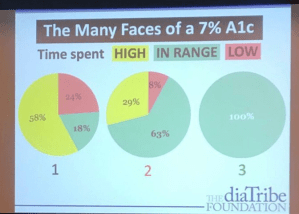
Fab event (as usual) by diaTribe at EASD. And this slide is just so damn on point and why I keep harping on about time in range rather than A1c:
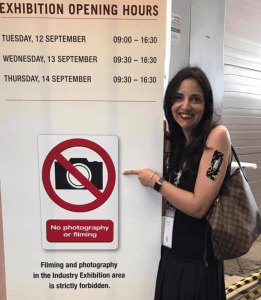
We’ll title this photo ‘As if’. Or ‘Pffft”:
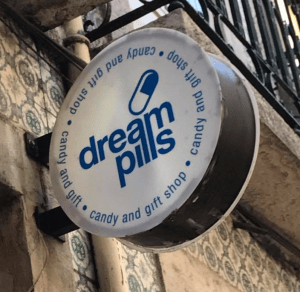
Wandering the streets of Lisbon, I found a shop that I wish was a real pharmacy:
Smart advice found in Lisbon. In my hands is the best chocolate cake I have ever eaten:

Also in Lisbon, this #LanguageMatters gem printed on the window of a water-side restaurant:
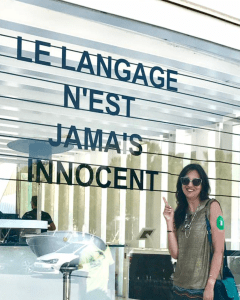
All day, every day. With thanks to Finn:
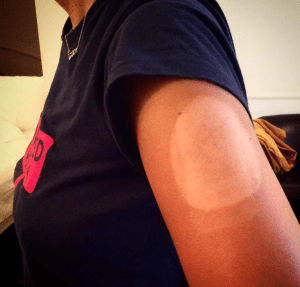
This is what happens when the sun is bright, all day is spent wandering around. And a Dexcom is firmly affixed to my upper arm….
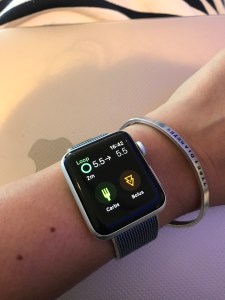
It appears that Loop has broken my diabetes:
It’s important to visit family when visiting other countries. Thanks to CEO Chris Askew for the great catch up:
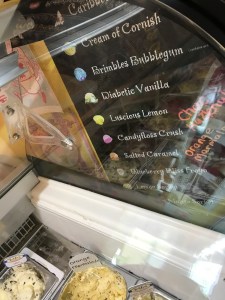
We visited Cheddar, went to an ice-creamery and discovered their ice cream has diabetes:
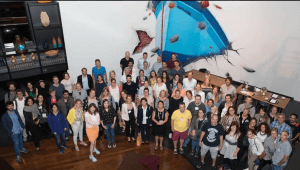
And finally: tribe.
DISCLOSURES
My flights and accommodation costs to attend EASD2017 have been covered by Roche Diabetes Care (Global). Yesterday I attended the Roche #DiabetesMeetup (more on that to come). Roche also provided me with press registration to attend ATTD. My agreement to attend their blogger day did not include any commitment from me, or expectation from them, to write about the day or their products.
Our holiday following EASD was funded by my family’s dwindling bank balance.
It’s both exciting and slightly demoralising walking around the exhibition hall at a truly international diabetes conference. Exciting because it’s often where new things are launched. And it’s a good place to find coffee. Demoralising because a lot of the exciting things will never make their way to Australian shores. And the coffee can be really shit (the Lilly coffee stand was staffed by Aussie baristas, so it because my favourite!).
On day one, I wandered around the Expo Hall at EASD, doing the circuit a number of times. I seemed to find myself repeatedly drawn to stands showcasing insulin pumps. Maybe it was subconscious. Maybe it was just that their stands were the brightest!
Interestingly, Medtronic was not at EASD. Their absence was conspicuous – especially in a week of another product recall – and one that really is significant. I did see several talks that mentioned the 670G however, so it was disappointing that they were not here to answer the questions that many people seemed to have. (Although, given that I spent most of my time with European advocates, those questions would have all been variations of ‘When are we getting it?’…)
Animas was tucked away in the corner of the J&J stand, with no news on offer about where things are with the long-promised, and long-awaited Vibe Plus which is integrated with Dexcom G5. Rumour on the street (but it is just rumour) is that it’s not happening any time soon.
There was little mention of the Roche pump offering on their stand, although there were images and sales staff to answer questions. But there is nothing new coming in this space from them at the moment with most of their energies being dedicated to MySugr, GoCarb and the Senseonics implantable sensor.
I said hi to the European Cellnovo staff (all of whom somewhat disconcertingly knew who I was). They are super excited about launching in Australia. There is nothing new from them at this stage (but you can read my initial thoughts on the pump here, and Frank Sita’s here.)
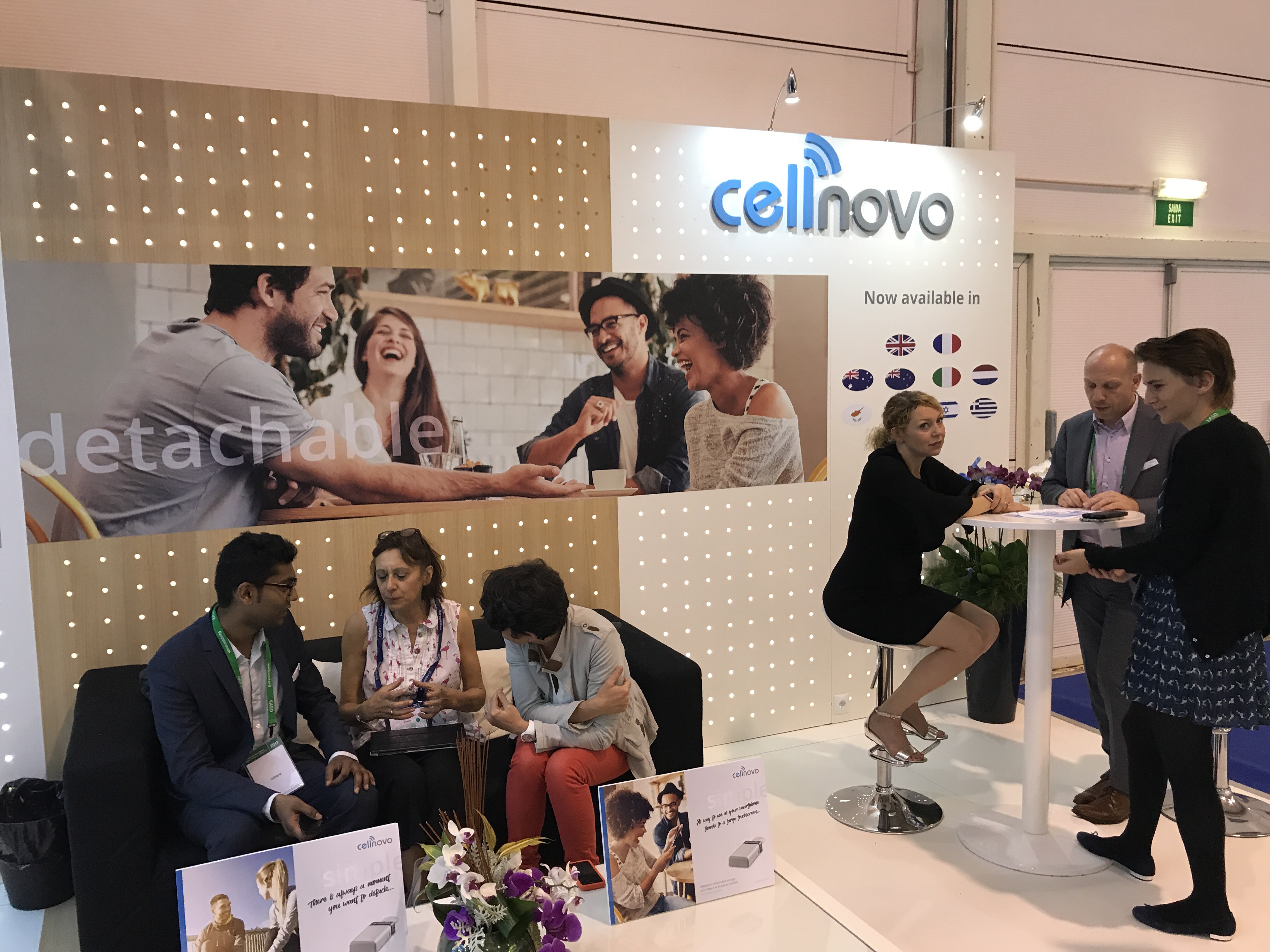
No stranger to the Australian market, DANA had a pretty damn big and glossy stand here at EASD, proudly branded with their somewhat odd tag line is ‘Ubiquitous insulin pump’. DANA in Australia (distributed via a third party) has had some issues in Australia recently – mostly to do with the availability of their infusion sets.

The most exciting news from DANA was their big EASD announcement of their new pump – the DANA RS. You can read Mike Hoskins’, from Diabetes Mine, scoop about it here, but the essence is that the pump is ‘Android OpenAPS-able’ without the need for an additional piece of hardware. This is a very big step in the very right direction for integration of pumps with the whole #WeAreNotWaiting philosophy and congrats to the team for embracing it.
What I’m far less enthusiastic about is that DANA has persisted with using a proprietary battery. I find this really, really appalling and utterly non-user-centric. This was the case with the previous DANA R pump, and to replace the battery, users needed to place an order for cartridges.
No idea when the new DANA will be in Australia… I guess it’s just a wait and see, but absolute credit to DANA for making it possible for people to use Android OpenAPS with a new pump.
Ypsomed (‘Ipso-med’) had their nifty Ypsopump (‘Ipso-pump’) on show and I had a little play. It’s fun – I like the look of it and it is super-easy to use. I’ve been told that they are heading down under, so please do watch this space!

And finally, the bright and shiny team from Kaleido were brightly and shinily showing off their pump again. It still is beautiful. It still is fun. It also still is not on the market. I really, really would like to see them actually get to launch stage. And soon.

Okay, so the pump wash-up in relation to Australia is this: it looks like we might actually start to have some real choice on the pump market in the (hopefully) not-too-distant future. I remain frustrated with the current situation, dismayed that if I wanted a new pump this very minute (which I am entitled to) my choice is a pump that is just too large and clunky with features that just don’t work for me, or exactly the same pump as I’ve been using for the last four and a half years. Come 1 October Cellnovo will be ready to go with consumables on the NDSS, and there is the first hint of improved choice for people with diabetes.
And that can only be a bloody good thing!
I flew into Lisbon, arriving at my hotel just after midnight on Monday. I get that Australia is a long way from everywhere, but the 38 hours’ transit was a record for me and as I tumbled into bed, I dreaded the alarm that would sound a mere 6 hours away.
However, I’ve done this enough times now to know a sure-fire way to overcome jet lag is to organise a relatively early morning meeting that involves coffee and local pastries. (Hello, Pastelaria Versailles and thank you for your beautiful baked goods.)
The main reason for this trip was to attend the Roche #DiabetesMeetup. (Disclosures? Yep-all at the end of this post….) This is the third one of these meetings I’ve attended (read about the first one at EASD2016 here and the next at ATTD2017 here) and, as always, it was great to see the familiar faces of dynamic diabetes advocates doing dynamic diabetes advocacy.
This year, there were a whole lot of new faces, with over 60 diabetes bloggers from across Europe having been invited to become part of the conversation. As well as attended the dedicated satellite ‘consumer’ events, the bloggers are all given press passes to attend all of EASD.
This is astounding. It means that it is impossible to walk around the conference centre without seeing other people with diabetes. Arms adorned with CGM or Libre are not startling – they’re everywhere. The beeps and vibrations of pumps can be heard in sessions, causing heads to bob up, and knowing glances to be shared. Our presence here is undeniable.
On the first official day of the EASD meeting, the third annual #DOCDAY event was held. While Bastian Hauck (the event organiser) starts by inviting bloggers to the event, he warmly and enthusiastically extends the invitation to HCPs and industry too.
On Tuesday, the room was full of people, discussion and enthusiasm
#DOCDAY has become a platform for anyone who attends to take the stage, and five minutes, to share what they’ve been up to in the diabetes advocacy and support space. I stepped down from my usual language soap box, proving that this pony does indeed have more than one trick.
Instead, I spoke about the role of people with diabetes at diabetes conferences. I couldn’t think of a more appropriate time, or a more suitable room to plead my case, even though I knew that I was preaching to a very converted choir!
Two weeks ago, in Perth, there were a few of us wandering the #ADSADEA conference as part of the Diabetes Australia People’s Voice team. And at one point, on Twitter, where our presence is felt more than anywhere else, an interesting, frustrating and downright offensive (if I’m being honest) discussion started.
It was said that diabetes conferences are the safe place of diabetes healthcare professionals and that perhaps a day at the start of the conference could be dedicated to people with diabetes, but the delegate program (delegates being only HCPs) start the next day.
As you can imagine, that didn’t go down too well with some of the diabetes advocates in attendance.
I am actually unable to provide you with the arguments offered as to why people with diabetes should be excluded, but I think it included reasons such as HCPs need a space to be among peers, these are scientific conferences, HCPs need lectures without people with diabetes (not sure why – are we really that terrifying?).
I’m not into preventing people with diabetes attending diabetes conferences. Melinda Seed’s vision of 1000 people with diabetes at the conference is far more aligned with mine. We are not asking that the conference we ‘dumbed down’. I don’t want the sessions to be any different than they are now (with the exception of having PWD as part of the speaker list – but that is regardless of who is in the audience).
Here’s the thing. Organising a team of three consumers to attend (as happened in Australia) required someone to provide funding and coordination. That was Diabetes Australia and I’m really proud that the organisation I work for created this initiative.
To have over sixty advocates supported takes a commitment. I won’t for one moment suggest that I am naïve enough to believe that we are part of industry’s marketing strategy. But we absolutely should be part of that strategy. I am more than happy to give Roche the shout out and kudos they absolutely deserve for bringing us all together. I don’t use any of their products at the moment (although, in the past have used their meters), so I’m not in any way spruiking their devices or suggesting you go and update your meter with one of theirs.
But I am grateful that as part of their engagement with people with diabetes involves bringing us together at a diabetes conference.
What’s the role of people with diabetes at diabetes conferences? Our role is to share from inside with those not here. We’re here to remind attendees that using language that diminishes us and our experiences and efforts in living with diabetes is not okay. We’re here to tell industry they’ve messed up when they design is not spot on, or their marketing misses the mark. We’re here to challenge the idea that we should be quiet, ‘compliant’ and do what we are told.
As I said at #DOCDAY, we have a responsibility to share what we learn. I acknowledge – every single minute of every single conference day – that I am privileged to be here. And that comes with responsibility to share what I see, hear and learn.

DISCLOSURES
My flights and accommodation costs to attend EASD2017 have been covered by Roche Diabetes Care (Global). Yesterday I attended the Roche #DiabetesMeetup (more on that to come). Roche also provided me with press registration to attend ATTD. My agreement to attend their blogger day did not include any commitment from me, or expectation from them, to write about the day or their products.
Last week, I was invited to speak as the consumer in a peer support symposium at ADS ADEA. My talk was called ‘People like me’ because more and more, I’ve come to understand that the real value for me in peer support is the combination of the masses with diabetes – as accessed through the DOC – as well as those who form a part of my ‘inner circle’, or tribe.
So, obviously, my first slide was this one:

And then, I introduced the audience to my tribe from last week:
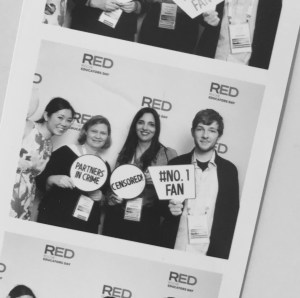
People like me! The #DAPeoplesVoice Team (L-R) Ashley, Melinda, Renza, Frank
The peer support symposium was coordinated by the ACBRD. Last year, they produced this report for the NDSS. They brought together four speakers, each speaking about different considerations of peer support.
After I gave my personal perspective on the peer support that works best for me, Professor David Simmons from Western Sydney University spoke about the evidence. The idea (as outlined in the symposium abstract) was to ‘…identify ways in which they are in synergy and/or tension with one another’.
David began by speaking about the Peers for Progress model, highlighting its four core functions of peer support:
- Assistance in daily management
- Social and emotional support
- Linkages to clinical care and community resources
- Ongoing support, extended over time.
I can only speak for myself and my own experiences, but the peer support I have carved out for myself meets all these points. While points 2 and 4 are probably the most relevant to me, I certainly have used my peers to assist with the day-to-day grind of living with diabetes and have also found connections with clinical support through my peers.
My experience is certainly not structured or formal in any way, however, for me, it works and it works superbly. Which was another point that I made – we need to find the right sort of peer support and that may be different for different people.
Some PWD may prefer to have something that is very organised. I prefer a more ad hoc, dip-in-and-out-as-I-need-it approach, and focus my energies on what I require at specific times. I also love the online community and the support it offers because it meets many of the things I’m looking for: flexibility (there’s not a meeting on the first Monday of each month to attend and if I can’t make that, I miss out); broad reach and a variety of people (which means that I will always find someone to provide support, no matter what the issue; diversity of experiences so my own understanding of what is going on with others is constantly growing, evolving and, often, challenged; all over the world allowing me to connect with people whatever the day of day – or wherever I happen to be (speaking of which…anyone in Lisbon next week?).
Another discussion point during the symposium was to do with the need for evidence to strengthen the case for peer support, which will ensure adequate funding to run programs. I find this a slightly double edged debate, really. I understand that with limited funding, those holding the purse need to know that money is going to go to programs that are known to work. But equally, I know peer support works. People with diabetes know peer support works. Melinda Seed, clearly frustrated (as am I) at the constant need to defend the value and importance of peer support, posed an interesting question, here:
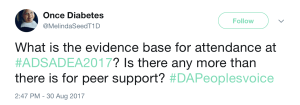
Now, I don’t doubt for one moment that HCPs get a lot of benefit from attending diabetes conferences. Of course they do – they hear from leading experts, learn about the latest research finding, network with colleagues, speak with industry about new diabetes technologies and treatments. The leave feeling inspired, have improved knowledge, feel supported by others doing what they are doing, and have new tips and tricks up their sleeves top improve their practice. They know that. We all do. And yet where is the evidence to support it?
(For the record, someone did point out on Twitter to Melinda that the difference is that conferences are privately funded and therefore do not stand up to the same scrutiny that programs seeking public funding do. Melinda responded (quite correctly) that this argument doesn’t really hold water as many attendees there attend on the ‘government dime’. It is an interesting discussion….)
I think one of the problems we might have is that we narrow the definition of peer support sometimes, and perhaps some people think that it’s too fluffy and feel-good, and just about sitting around someone’s kitchen table and chatting. But as I said in my talk, there is much more than mere ‘tea and sympathy’, (although, I’m reticent to dismiss the power of such interactions because I know that sometimes those moments do produce a lot of support from people who are otherwise feeling very isolated and alone.)
I am speaking at the World Diabetes Congress at the end of this year and will be challenging the notion that peer support is all about group meetings. It is more than the traditional ‘support group’ model. One example I gave was the Pumpless in Vienna story (yeah – I’ll tell that whenever I can!). It was through peer connections that my friend Jo found a pump. It can also be seen and found in other ways – camps, information sessions, structured education programs. Peer support can be found in a lot of places, even if that’s not the term we give to it.
CEO of Diabetes Australia, Greg Johnson, and me talking peer support after last week’s symposium.
Disclosures
Roche Diabetes Australia has covered my travel and two night’s accommodation for my stay in Perth as I am a presenter at the Roche Educators Day (RED). There is no expectation from Roche that I will write anything about the RED, but I expect I will because it’s always such an interesting and enjoyable day!
The remainder of my time in Perth is part of my role at Diabetes Australia.





 Diabetogenic