
You are currently browsing the category archive for the ‘Community’ category.
In a month where there is A LOT of great stuff happening in the diabetes world, stop for a minute and get to know D-Coded, a brilliant new resource which helps to break down diabetes research in an accessible, informative, and authentic manner. It simplifies complex research studies and contextualises information without losing any of the insights and provides people with diabetes a starting point to better understand research, and work out how to delve deeper if we want.
One of the challenges of communicating research is that it can be a lot of detail using specialised language and complex stats and data interpretation. There may be an assumed knowledge that people simply may not have. There are acronyms, jargon, abstract concepts and the details can be lengthy and overly detailed. And that’s if we can see it! Often research papers are behind a paywall, so we can’t event see it in the first place.
Diabetes research is the reason that we are all alive today and it gives us hope for the future. At any one time, the research agenda is advancing to find ways to prevent, cure and treat all types of diabetes in ways that give me so much hope. And so, it makes sense that we should have access to it in a way to keep us engaged and interested and wanting to know more.
One of the tactics I’ve employed over the years is to ask researchers to break down their research into a tweet (280 characters or fewer), or as an elevator pitch. Most find it impossible to do. There is a language to research that can be complex, confusing, and complicated – just as there is a language to lived experience that confounds others. (Don’t believe me? Throw HbA1c, #YDMV, CGM, DIYAPS etc. around and see how people outside our community follow what we’re saying!) D-Coded does that for researchers. Everyone wins here!
It comes as no surprise that this came from the team at Diabesties. Led and powered by Jazz Sethi and involving community, it’s a project that once again shows how lived experience innovation drives change, this time by levelling the knowledge playing field.
Check it out and share as widely as you can.
DISCLOSURE
I am a Lived Experience Advisor on D-Coded. I don’t receive any payment for my involvement and am honoured to have been invited to be part of this project.
On November 14, the world will literally light up in blue to celebrate World Diabetes Day. And here in Melbourne, an event highlighting one of the most important issues in diabetes today will be held. The entire event will be dedicated to how the global diabetes community is coming together to work to #EndDiabetesStigma. And you can be there!
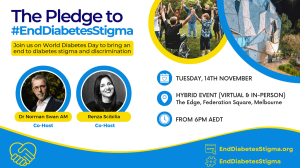
I’m delighted to be sharing the hosting seat with Dr Norman Swan, physician, journalist and host of Radio National’s Health Report. A veritable A-Team of people from the international diabetes community will be part of the event, sharing their experiences of diabetes stigma and why efforts to end it are so necessary and timely. There will be representatives from the global lived experience community, diabetes organisations and health professionals and researchers. You really don’t want to miss it!
For those able to attend in person, you’ll have a chance to catch up with diabetes mates. Any chance for opportunistic peer support is a great thing and I’m so pleased that I’ll be seeing diabetes friends that I’ve not seen for a very long time.
This isn’t only for Melbourne locals. There will be a livestream for people around the world to watch, share and be part of on social media. It’s free to attend and will be a great opportunity to see the diabetes world come together on a day dedicated to us!
It’s RUOK? day and while I am ready to jump on any worthwhile bandwagon, this one, today, seems especially important. A (non-diabetes) community of which I am on the periphery is grieving today after the death of a much-loved friend and colleague. I’ve been reading beautiful tributes to this person and messages of love and support to their family. I can’t begin to grasp what their loved ones are going through today.
RUOK? is more than a single day. It’s a movement that emphasises the power of human and social connection and having conversations about difficult things. If you’ve not looked at the website, there is advice about building the capacity of support networks (the very foundations of diabetes peer support groups for decades now) and developing skills to have meaningful discussions with someone who might be struggling.
It’s applicable to everyone, including those who may appear to not necessarily need it. Undeniably, it’s very relevant to diabetes. (This article outlines the increased risk of suicide in people with diabetes.)
Diabetes and mental health may be a topic on the agenda at most conferences and we’ve certainly seen an uptick in mental health and diabetes research over the last decade. But the strides that have been made are not enough. The pathway to genuine support and treatment for people with diabetes remains elusive. Simply telling people to seek help falls short when the help they need is not available.
Our peer networks go a long way to offering support, empathy, and love, but we’re not equipped to handle complex mental health issues. While we can assure people that they are not alone and perhaps offer suggestions for where they may find help, this does not go far enough in addressing mental health care, especially in critical situations. Accessing mental health professionals that have knowledge and training to support people with diabetes is what is needed. And it needs to be easily accessible. Easily affordable. Easily available. Right now, that’s not the case.
On RUOK? Day implores us to tap into our social circles and genuinely check in. (Do it, please; just do it). But there is a braider landscape of mental health in the diabetes landscape that needs real transformation. And while it seems unreasonable to add extra burden to those of us living with diabetes – after all, we are already expected to do so much of the physical, emotional, social, and political labour just to get by – community action drives change so often. We have had successful and coordinated community efforts to increase technology funding and access. Is our next frontier turning our attention to increasing funding and access to mental health care for people with diabetes? I know that some diabetes organisations have this in their sights, but without people with diabetes making noise, the campaign is only half-baked. Our voices amplify the urgency of the issue.
Today is just one day, but if RUOK? Day is what provides the gentle nudge to initiate these conversations, it’s a step forward. The tapestry of personal narratives, community connections and shared experiences form the basis of peer support. But not everyone has a safe space where they can share or the people to share with. Sometimes we need to reach out, extend a hand and signal we’re ready to listen. Keep reaching out. Today. And tomorrow. Every time you can.

Diabetes stigma is a hot button topic in the diabetes world. It has been for some time. I wrote just last month how stigma was one of the most talked about issues at ADA. That week, we also launched an Open Letter from the Diabetes Community, asking health professionals to join us in our call to stop diabetes stigma.
And behind the scenes, for all of this year, another exciting, BIG, project has been hatching and I’m so excited to share it today.
Earlier this year, in an unprecedented show of unity and determination, a group of 51 experts from 18 countries joined forces to pool our lived, research and clinical experience to address diabetes stigma and discrimination. Together, we’ve reviewed the scientific evidence and established an international consensus on 49 Statements of Evidence and Recommendations. The full report on this review has been submitted and is currently under review.
Excitingly, the group also reached a consensus on a Pledge dedicated to bringing an end to diabetes stigma and discrimination. And that’s where you come in! Everyone can sign to show your commitment stop the ingrained negative judgments, stereotypes, and prejudices that influence attitudes about diabetes, and contribute to the stigma so many of us face. This isn’t just for the community. We know there is sometimes an echo chamber as we say the same things to each other, over and over. We also know that while diabetes stigma is indeed prevalent within our community, we also need to tell the story of its harm outside the diabetes world.
Well, here’s an easy way to do both. Please sign the pledge and share details across your social platforms. You can sign as an individual, and we’d also love for you to see if your place of work, school, community group, hospital, church, sporting team, favourite cafe…basically anywhere that is likely to come into contact with people with diabetes (i.e. literally everyone!) would be interested in signing too.
This is a true community effort, with involvement from stakeholders from across the diabetes landscape, across the world. You won’t see logos anywhere, because this for and about all people with diabetes. The names of the people involved in the work so far is on the website.
Are you with us?

A few weeks ago, I saw a post on LinkedIn from Nick Dawson. Nick was around Twitter health communities a lot when I first joined and it was great to read his post and take a wander down Twitter’s memory lane.
The feeling of nostalgia was strong. I don’t remember joining Twitter, but I do remember when I started actually using it to connect with others with diabetes from around the globe and how my diabetes world suddenly seemed infinitely bigger. No longer was I constrained to only people in my own networks, or even my own country. I was a global citizen in the diabetes online world. And it felt great.
Twitter became the cornerstone of a lot of my own advocacy and connections online. I never missed a weekly #DSMA tweet chat, expertly moderated by Cherise Shockley. The rapid fire hour of diabetes power often included hundreds of people. Dana Lewis’ #HCSM weekly chats brought together from different health communities, opening my eyes not only to different healthcare struggles, but also to solutions that helped me with my own diabetes. I used Twitter to find people who were doing incredible things that elevated the voice of people with diabetes. It was on Twitter that I followed along with the first Roche blogger summit that brought together US social media pioneers. I used those sorts of events to shape the Australian Social Media Summit that was held at the end of 2012, coordinated by Diabetes Victoria, bringing together Australian diabetes social media folk and Kerri Sparling from the US.
I was part of the team that started the weekly #OzDOC tweet chats in July 2012, working with Cherise to help get things started close to home. Around the same time, the first #GBGoc tweet chat happened and the first #dedoc° chat, #FRDoc and #ItDOC followed soon after. Back then, those chats were brilliant at highlighting local issues, but by and large, they were indeed global.
Twitter was the tool I used to take notes at conferences, live tweeting sessions to share with those not in the room, and then pulling the information together in briefing documents at works, and writing articles here and on other platforms. And Twitter was the channel where remarkable whole community events happened. Remember Kelly Kunik’s #IWishPeopleKnewThatDiabetes and those #DayOfDiabetes discussions? Or the groundbreaking and overwhelming community event that was #Simonpalooza? It was peer support on demand. There was no need to feel alone with your diabetes if you were on Twitter!
And then, I don’t know when, Twitter changed. Or I changed. Or the community changed. It became harder to find the people who had shone so brightly and made Twitter a place of support and community. I stuck close to old friends who never advertised the Twitter following count, because who cared? I learnt the difference between an advocate and an influencer. And I started to steer completely clear of parts of the community which was so alien to what it had been like when I first joined. #DSMA chats became less frequent because Twitter chats became kind of old hat. #OzDOC chats completely stopped because there hadn’t been a sustainability plan in place and there really wasn’t anyone to take over. Perhaps this was a reflection of how the community wanted to engage and what they…what we…wanted.
For me, most of the day-to-day reaching out I used Twitter for moved to being via private channels. And that worked fine and became the same lifeline that the public space Twitter had once been.
There have absolutely been some bangers recently that have made me remember how great Twitter can be. The weekly #DiabetesChat, using Spaces, launched a new community that, although based in the UK, was very much global. Tom and the organisers went out of their way to include people from other places around the world to be interviewed and lead discussions. I loved it straight away for the beautiful open and welcome feeling that was there and embraced it. #dedoc° isn’t really a Twitter based organisation, but the #dedoc° voices use it brilliantly, and diabetes conference are so visible because of their prolific sharing.
In the last few days, a new Twitter-like app called Threads has been launched and I tentatively signed up and had a nosy look around. It felt like Twitter in 2012. Friendly. Fun. Open. I’ve found Threads friends (thriends?) who I’ve not seen around the Twitter traps for years and have re-engaged. I’ve managed to steer clear from the parts of diabetes Twitter that I’ve actively avoided over recent years.
It’s not perfect. There needs to be an option for people to add ALT text to photos, because that’s not there yet. Apparently it is coming. (But, you know, accessibility should have been a first level consideration, not an after thought…) A desktop version would be useful – it’s annoying only having the option to type on a phone keypad. The lack of hashtags is annoying. (Just today, I went back and read the tweets from that first Australian social media summit by searching the hashtag. What a treasure trove!) Again, this is said to be on the cards. As is the capability to see only threads from people you’re following rather than the mishmash right now. Having said that, sprinkled in amongst the predominantly diabetes focused threads I’ve been seeing, I’m not too disappointed with the cat pics, recipes and book recommendations that I’m seeing a lot of. Also pleasing is that I’ve managed to avoid so much as a hint of the crappy, manipulative, misogynist side of the diabetes world that clouded my Twitter experience for a while before I worked out how to block it out completely.
Is this the future of Twitter? Over here on this new app? Threads feels like the nostalgia Nick wrote about. It really does feel like the ghost of Twitter past and I like it a whole lot more than the ghouls of Twitter present. Come and visit if you’re not there already. I’m @RenzaS and you’ll see me sharing diabetes stuff, pet photos, books. And asking people about their diabetes experiences to help me make sense of my own. I hope to see you there!

On day 2 of the American Diabetes Association Scientific Sessions, rushing between meetings, I overhead another attendee say this: ‘I’ve never heard so many people talking about diabetes stigma’. I turned to them, a bright smile on my face and said, ‘I know, right?’, (a phrase I only ever utter when I’m in the US).
Just a few hours earlier, Jazz Sethi and I had tweeted simultaneously, setting free an open letter from the diabetes community about diabetes-related stigma. You may have seen it; thousands of people have. And others have shared, commented and even translated it into different languages (I think we’re at 6 translations and counting). Here it is!


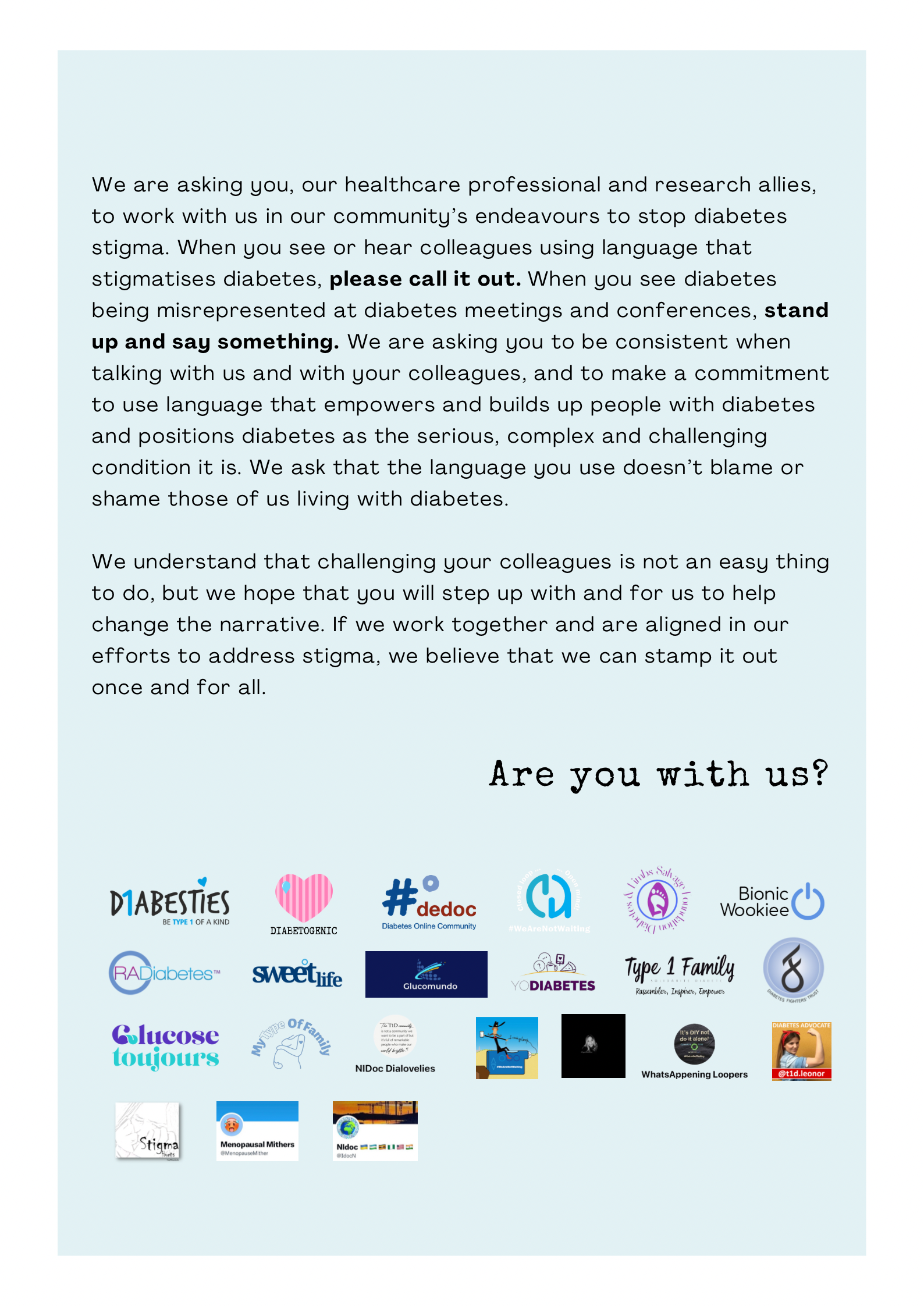
When we first asked advocates from the community if they would like to add their logo to the letter we were surprised by the quick response. Almost everyone we went to said yes. We hadn’t gone out too widely – we wanted to test the waters first. The first version of the open letter includes advocates and peer support groups from across the world. Amazing!
And after our very low-key, (i.e. a couple of tweets from unverified Twitter accounts, so who knows what the algorithm did with them!), we were once again inundated by people asking for us to add their logos. (We haven’t managed to add them yet, but absolutely will in coming weeks. Please give us time if you’ve shared your logo. We’ll get there. And I’ll update this post with the new final page when that happens.)
There is something magic about these sorts of very grassroots, very community, very inclusive initiatives. Not only are they great because they collaboratively offer a narrative from people with diabetes, highlighting an issue that is of great importance to many. They also show you just how powerful and united our community is while also pointing to individuals and groups who are keen to work together, support each other and power the importance of lived experience. And that’s pretty special!
Imagine a community where people come together to make things happen. You don’t have to look far, really. Just look at the diabetes community!
Here’s something new from some folks (Jazz Sethi, me and Partha Kar) who are desperately trying to reshape the way diabetes is spoken about, and how fortunate I feel to have been involved in this project!

The thinking behind these particular language resources is to truly centre the person with diabetes when thinking about communication about the condition. In this series, we’ve highlighted three groups where we know (because these are the discussions we see in the diabetes community) language can sometimes be stigmatising and judgemental. This isn’t a finger-pointing exercise. Rather it’s an opportunity to highlight how to make sure that the words, images, body language – all communication – doesn’t impact negatively on people with diabetes.
A massive thanks to Jazz and Partha. Working together, and with the community, to create and get these out there has been a joy. (As was sneaking into the ATTD Exhibition Hall before opening time so we could get a coffee and find a comfortable seat to work before the crowds made their way in!) And a super extra special nod to Jazz who pulled together the design and made our words look so bright pretty! And a super, super, super special thanks to Jazz for designing my new logo which is getting its first run on the back of these guides.
You can access these and share directly from the Language Matters Diabetes website. These don’t belong to anyone other than the diabetes community, so please reach out if you would like to provide any commentary or be involved in future efforts. There’s always more to do!

I live right near one of the busiest streets in inner Melbourne and Fridays are extra busy. This morning, I was walking quickly to grab a coffee, a mental checklist working through my mind of the things I needed to get done for work for the day.
I was stopped at a light, waiting for green so I could cross. ‘Meeting in 45 mins to discuss the next project; review proposal that was sent this morning; reply to email about Melbourne Uni presentation; send bio and headshot for program for conference in August; amend flights for San Diego trip, call…. Wait. Am I low?’
The unmistakable urgent low alarm of my Dex snapped me out of my to-do list, and I pulled my phone from my pocket. My Dex line was straight, my number in range. I shook my head thinking I must have dreamed the blaring alarm. As I was shoving my phone away, I saw a woman next to me rummaging through their bag. The next second, she crouched down and turned its contents onto the footpath.
‘Hey,’ I said quietly, knelt down so I was level with her. I handed over an unopened packet of Mentos. She looked at me, surprised. I smiled. And said, ‘I’ve done that very thing more times than I care to remember.’ I passed her a small purse and a couple of pieces of paper that escaped from the dumped bag debris. She thanked me and we stood up together. ‘Are you all okay?’ I asked. She nodded. ‘Yep, I’m okay. Thanks.’
The light changed and I set off, giving a little wave. ‘Wait,’ she called after me, breaking the Mentos packet in two and handing half to me. ‘Take this in case you need it?’ I shook my head. ‘You hold onto them; I’m nearly home. Hope the rest of your morning is hypo-free.’
I picked up my pace and turned down a paved laneway, and into a café. As I waited for my coffee, I thought about how that brief encounter was a snapshot of the invisible community of people with an invisible condition. Until, of course, it’s not. Community isn’t always apparent. It doesn’t have to be the coming together for face-to-face meetings, or long Twitter exchanges. Sometimes, it simply lies within fleeting moments of strength and vulnerability and solidarity that provide solace and remind us that there are others out there who truly get it.

Hey, do you remember a couple of weeks ago when it was International Women’s Day and women got a cupcake (probably baked by a woman) and a breakfast (probably organised by a woman) and then we all agreed that gender equality didn’t need to be spoken about for another year?
Look, I know I sound cynical. But that’s only because I am. Every year at Diabetogenic, I write a post celebrating the incredible women working in diabetes. Mostly I centre diabetes advocates who are generally donating their time – and emotional labour – to power advocacy efforts and make change. And if you look back at the history of the DOC, you will see that the majority of the work has been by women in the community. (Don’t @ me with your ‘But I’m a bloke and I’ve done this’ commentary. It’s not the time for #NotAllMen.)
This year, I started to write something, and then stopped, and started again. And then stopped. Anyone who is a frequent visitor to this site or follows any aspects of my personal advocacy knows that I celebrate the incredible work done by grassroots and community advocates (many/most of whom are women) throughout the year and I didn’t want to buy into the ‘It’s-IWD-here-are-the-womens-now-it’s-back-to-the-misogyny-we-usually-deal-with’ crap that seems to be the aftermath of each and every IWD.
So, I’m using today – this random day – to give a shout out to some of the great things going on that you may have seen, or you may have missed. These things are powered by women who, in most cases, are doing this as extra work on the side of their day jobs, and everything going on in their personal lives. But it’s undeniable that it’s this sort of stuff that is going on all the time, usually flying under the radar, but it’s making a difference to so many folks in the diabetes world.
And so…
There is some remarkable work out of India where the Blue Circle Foundation continues to make a mark in diabetes advocacy. On IWD, a team of women from the Foundation conducted an awareness program for 200 women inmates in Yerwada Jail in Pune, India. This is part of their ongoing Project Gaia which creates safe spaces for women with diabetes. Snehal Nandagawli is just one of the women involved in this work. You can hear more from her at this week’s #dedoc° #docday°.

From the UK, Mel Stephenson-Gray has been a brilliant force in the diabetes community for a number of years. She recently launched a fabulous new Insta page celebrating and empowering women with diabetes. It’s called Diabetes Women’s Health Club and the information she’s been sharing (accompanied by gorgeous graphics) is brilliant. I loved the profiles of some of women who were groundbreaking pioneers in diabetes research. Go give the page a follow now!
Dawn Adams hasn’t managed to convince me that she is only one person because the sheer volume of the work she is doing is immense and she’s bloody everywhere. Dawn continues to blaze trails in her research and writings about diabetes and menopause (follow @MenopauseMither on Twitter for great information and support), has been featured in a number of Diabetes UK publications, spoke at the recent #dedoc° symposium at ATTD, and continues to be a daily support and mentor to people across the global diabetes community. I’ve barely scratched the surface with this list. Someone please send Dawn a coffee and cinnamon bun so she can sit down for 30 seconds and recharge her batteries!
Another woman who is a human powerhouse and obviously works 23 hours a day (lazily, she sleeps for an hour) is Jazz Sethi whose work with the Diabesties Foundation continues to multiply exponentially. She’s also a brilliant speaker and gave an emotional talk at ATTD last month. Check out just some of what she is doing here (and stay tuned for something super exciting that we’ve been working on together!)
Also at the recent ATTD #dedoc° symposium, Hamidah Nabakka from the Sonia Nabeta Foundation captivated the packed-to-capacity room, sharing stories of children and young people living with diabetes in Africa. This was held on the first day of ATTD and for the rest of the week, I had people coming up to me and saying that it was their highlight of the whole conference.
I’m getting to this a little late because it was started last year, but Niki Breslin started a brilliant Insta page to build community called ‘My Type of Family’ for anyone with diabetes who is planning and trying to conceive, pregnant, recently had a baby and parenting. There’s lots of great information and encouragement for the community with this page and definitely worth a follow!

I was so excited to see some artwork by Miss Diabetes from New Zealand make it across the ditch Melbourne in an IWD street art exhibition. Her comic ‘Women and Diabetes’ was on show in our city’s iconic Hosier Lane! Miss Diabetes’ diabetes advocacy is super well-known in the community thanks to her tireless efforts supporting Insulin4All efforts and with work she’s done with the WHO diabetes team. You can see the artwork here.
Anita Sabidi in Indonesia continues to drive and build community with her advocacy work that shine very bright lights on issues such as emotional wellbeing and mental health, and women’s health. Anita is a regular speaker about these important topics, and also leads a number of community initiatives supporting women with diabetes in Indonesia. She’s also speaking at #docday° this week.
Dana Lewis never ceases to amaze. Last week she ran 100kms in a day, but unbelievably, it’s not her physical feats that make her name so well known in the diabetes world. It is, of course, her work in open source AID. Last month she gave two presentations at the Open Diabetes Closing Conference, and she has an upcoming session at the ADA Scientific Sessions in San Diego. On top of that, she continues to publish regularly and is a force for nothing but good!
Ashley Ng from Australia has been documenting life with two gorgeous little girls on her blog, opening up about some of the more difficult aspects of parenting while living with diabetes. I love Ash’s candidness and honesty and am always grateful for her ability to be so raw, but also hopeful. Read and subscribe to her blog here.
These women are just a few of the many who continue to make our community tick and flourish. There work is not only meaningful on 8 March: it’s making a difference every, single day. The very idea that women and their achievements get just one day of real celebration (albeit while battling the calls of ‘where’s International Men’s Day?’) is in equal parts frustrating and insulting. I celebrate the incredible work that women spearhead all the time because I know that alongside that work, they are dealing with patriarchal attitudes that make their successes all the more remarkable. That deserves far more than a cupcake!
Postscript
The UN theme for the day was DigitALL: Innovation and technology for gender equality, not the saccharine sweet ‘EmbraceEquity which means absolutely nothing and was created by some corporate machine that does nothing to advance equality in any way. So, if you spent IWD posting selfies of you hugging yourself, that’s great, but what did that really mean when it comes to advancing gender equality?
If you haven’t had a look at the website from the UN, it’s definitely worth it, even if it’s just to see the high-level details, one of which explains that online gender-based violence silences women and discourages their public participation. It may be odd to think this is a thing in the diabetes community when so much of what you see comes from women, but actually, it’s real. Harassment is a concern for many women, and I know of many women who have stopped sharing or locked down their accounts (permanently or temporarily), or deleted them completely, due to this harassment. I’m one of those women. This is something to be mindful of every day – not just a single day in March.
Four weeks. That’s about how long ago it was that the first murmurings of Fiasp being withdrawn from the PBS were heard in the Australian diabetes community.
It’s been a pretty wild ride in those four weeks, hasn’t it? I never should be surprised at the dedication and never-say-die attitude of diabetes communities, but what we saw from the Australian community was next level! And it went beyond that, with Aussie advocates rallying our friends from overseas (hello #dedoc° Voices!) to amplify our efforts here.
And today, news of a reprieve. Fiasp would be available on the PBS for another 6 months for anyone with a script dated prior to 1 April 2023. (That’s the catch – you need a script before that date, or you will have to pay the private prescription cost.)
This is a great result. It gives everyone with diabetes using Fiasp some breathing space to make plans for what happens if we need to change insulins.
There are a lot of beautiful things about grassroots advocacy. Firstly, it can be incredibly responsive. It takes just one person to share, and the community response is often instantaneous.
We saw that here, didn’t we. As soon as it was just a hint about what was going on with Fiasp, people with diabetes in Australia took to it. This was even before the Minister’s office was aware of what was happening! From a petition (amazing, Belinda!), blog posts and discussions in social media groups, to standing around conference exhibition halls (this is exactly what was going on at ATTD with Aussie advocates!) the momentum started and picked up speed.
It is undeniable that the best results happen when everyone works together, and as I said in my post about this issue a couple of weeks ago, …Community advocacy is often the starting point of rumblings that, combined with strong advocacy from diabetes organisations, leads to policy change.
This is a dazzling example of exactly that! A community of all stakeholders coming together, led by community. Doesn’t THAT make you feel all warm and fuzzy? And today, people with diabetes have celebrated in great ways – the people who should be centred in this win for their efforts. This was my tweet about that earlier today:

Some final thoughts
Celebrate the win and cheer with other community advocates. I’ve loved seeing the commentary in online community groups today! Our celebrations are so meaningful because it is our fridges that were going to be bare of Fiasp if this didn’t come through!!
I know it’s tempting to stockpile, but please don’t! There are 14,000 Australians using Fiasp and hopefully everyone who needs to get a script filled over the next six months will be able to do so effortlessly. Of course there is the human urge to make sure we don’t run out but remember that if you have a year’s supply in the fridge, that might mean someone can’t get their next week’s supply.
This isn’t done yet! Six months is AWESOME but keep the pressure up with the grassroots efforts that worked this time.




 Diabetogenic