
You are currently browsing the category archive for the ‘Advocacy’ category.
I have never understood why people shy away from the word ‘feminist’. It is one that I have always worn as a badge of honour and one that most of the women around me are not afraid to use. Sometimes, we have roared about it, and other times we haven’t. But it always seems to be a guiding principle in the way we live.
I’ve always loved this Dale Spender’s quote (one that Senator Penny Wong quoted last night on Q&A in her eloquent explanation of why she calls herself a feminist) because it shuts down any ridiculous comments about feminism being something to fear, or ‘against men’, which is a load of bollocks.

I am not sure if the women around me I admire and love and respect would call themselves feminists, but I certainly see them that way. They raise each other up, celebrating successes, commiserating losses, rejoicing in each others happiness.
When I think about the people who have impacted most on my life since diabetes, they are just about all women. Today, my HCP team is exclusively made up of women and I have been seeing all of them for well over ten years. It took me a while to find the right people for what I needed and it just turned out that the ones who were most compatible were all female.
The people I turn to when I am confused or angry or struggling with diabetes are mostly women.
When I was dealing with the devastating aftermath of miscarriage or the exciting and exhausting exhilaration of new motherhood, the people I wanted to talk to were other women with diabetes who understood the extra demands that diabetes threw into the mix. These were the women who provided comfort and love and a (virtual) shoulder to cry on. And the call of ‘You can do this’ resonated strongly through them all.
I am raising a daughter and one of the things for which I am forever grateful is that around her – and me – at all times are women of great strength, intelligence, compassion, bravery, brilliance and talent.
She sees that every single day in my mother, my mother-in-law, my sister, my sister-in-law, an extended family of assorted aunts and cousins, and my circle of friends who are nothing short of genius.
She sees it in many of her own friends’ mothers who speak to their daughters the way I speak to mine, and she, along with many of her own friends are already demonstrating that kickass attitude that some hasten to shut down by calling them bossy and pushy. When really, they are showing they have the skill and courage to lead.
And she is starting to search out her own hero girls and women, admiring and quoting Malala Yousafzai, shouting about girl power, reading books with strong female protagonists and demonstrating utter shock, indignation and disgust to think that girls are not at all times considered equal.
And she sees me. While I may not be the strongest, brightest, most compassionate, most courageous or most brilliant of the women around her, I do set an example of resilience and kindness. And we use diabetes as an incredibly effective teaching tool to show her just how lucky we are, and how she shouldn’t ever take for granted the privileged life into which she was born.
She knows that diabetes around the world is not a level playing field. And, more broadly, neither is women’s health, whether maternal, sexual or reproductive. Where a baby is born impacts significantly on their health outcomes. As does gender.
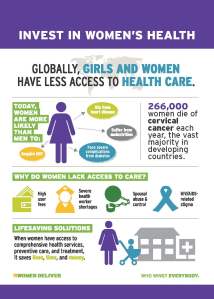
It’s International Women’s Day today. While I am using the day to acknowledge amazing women – those who have come before, are here now, and are our future – I am also using it to remind myself that there is still so much for us to do. The gender gap is not closed – not by a long shot. We need feminism, we need activism and we need days like today to remember what still needs to be done before women around the world are truly considered equal.
Women Deliver is a global advocate for women’s health, rights and wellbeing and promotes the importance in investing in girls’ and women’s health. Take a look at see some of their great work, which includes the infographic above.
‘You’ll be pleased to know that I represented people with diabetes very well in the meeting that I attended yesterday.’
The meeting was all about people with diabetes; making decisions about people with diabetes; looking at processes and practices for people with diabetes; discussing how people with diabetes access healthcare.
And in the room? Not a single person with diabetes.
I looked at the healthcare professional who told me that she had so well represented ‘my people’ and shook my head.
‘And yet,’ I said. ‘You are not a person with diabetes. Can you imagine how much more powerful it would have been to actually have people affected by the things being discussed in the room?’
I was reminded of this conversation, which took place a few months ago, this morning when I saw this from the folks at T1 International. (I’ve written about them before, but please check them out. Their work is so important.)
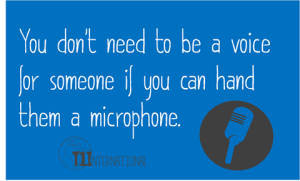
T1 International is working towards adequate access to insulin and diabetes supplies, as well as healthcare for all people across the world living with type 1 diabetes. They are giving a voice to communities that are most often not heard by sharing their experiences and amplifying their stories.
But I wonder, what hope can there be for people in countries where diabetes is so tough if in places like Australia, where we have heavily subsidised medication and supplies (I know, I know – CGM is not subsidised), we are still not being given the microphone?
I never doubt the amazing advocacy initiatives that many healthcare professionals undertake for people with diabetes. It is important and necessary and I am so grateful for it.
However, there is an authenticity that can only be delivered by those walking the miles in our (diabetes-appropriate – pfft!) shoes; not those walking alongside us.
Bringing home the point again was this cartoon that has appeared frequently on my SoMe feeds this week.

Copyright – SocialMediaPearls
Let us in the room. Don’t speak for us. We have voices. Hand us a microphone so we can be heard.
The life expectancy for a child diagnosed with diabetes in sub-Sahara Africa is as low as one year. That’s right: one year.
This is a fact for 2016, almost 95 years after the discovery of insulin.
And it is just not good enough.
In The Lancet just last week, this piece was published about the challenges of accessing insulin around the globe. Why is this drug still so unattainable to so many? Why has access to insulin not had a high priority within agencies such as the UN and WHO?
Why are children and adults still dying when there is a medication available?
I am so angry and sad and desperate that this is the situation and while I am pleased that we are starting to increase the conversation about the unfairness of it, it’s just not enough.
Where is the outrage here? We get angry and feel vilified when someone doesn’t understand the difference between type 1 and type 2 diabetes, or because some celebrity dared to say something stupid about diabetes, and we retreat online and complain and bitch and moan. We say that we feel stigmatised and isolated and misunderstood.
And it’s true. Diabetes is stigmatising and isolating. People don’t understand the details. It’s downright, bloody unfair.
But we are not going to die because we can’t get our hands on a bottle of insulin. Perhaps we need to channel some of our oh-so-easy-to-access outrage and frustration at an issue that can actually save some lives.
A diagnosis of type 1 diabetes in some countries is a death sentence, plain and simple. And a quick one at that.
And this isn’t okay.

I’m just going to gently leave this here. Click on the pretty picture. For $6 you can provide insulin to a child. (And even better, send it on to every single person you know.)
You will see a lot about Spare a Rose this week. I am not going to apologise about it. But you may also like to have a look at Type 1 International and the important work they are doing in this space too.

I wrote about Spare a Rose, Save a Child last year. And the year before that.
I wrote about the easy and logical tie-in with Valentine’s Day.
I wrote about how I would be making a donation and encouraging my Valentine to do the same.
I wrote about how easy it is to support the campaign.
I wrote about how fabulously tangible the campaign is: 1 rose = AUD$6 = 1 month of insulin for a child.
I wrote about how easy it is to get involved.
I wrote about how no child should die because they cannot access life-saving medication.
I wrote all about it.
So I won’t do that again.
Instead – have a read! (And make a donation!)
_________________________________
Yesterday, as I sped around the supermarket, the onslaught of the next commercial opportunity hit me fair and square in the face. No, I’m not talking about Easter (I could act all outraged that there are Hot Cross Buns in Woolies, but we bought some and have been eating them, so that would be kind of hypocritical). I am talking about the festival of love – Valentine’s Day.
Valentine’s Day can go one of three ways for people. It can be a day of overt love declarations involving flowers, cards, poems, sky writing, gorilla-grams, stripper-grams (don’t judge), candle light, champagne, walks on the beach; it can be a day of sadness and misery and feeling left out; or it can be a day of complete oblivion where one is confused why there are so many people carrying bunches of balloons with ‘I wuv you, Shnookums’ written on them in glitter.
This year, I say screw that. This year, I say how about you do something that is meaningful that will not only help others, but also make you feel great. This year, it doesn’t matter if you have a Valentine or not. Everyone can play.
I am, of course, speaking of the Spare a Rose Save a Child campaign.
Now, if you have diabetes and/or any links to the diabetes word, you have probably seen and heard about this campaign before. I’ve even written about it here. The general gist is that instead of sending a dozen roses to your Valentine, send eleven instead and with the money that would have bought the extra one (about $6 in Aussie money) make a donation to Life for a Child. Those six bucks will provide insulin to a kid in a developing country for a whole month. Or, give your Valentine ten roses and donate $12.
All good, right?
But I have a little challenge for you.
This is a brilliant campaign because it is so simple. It’s easy to explain and it’s really easy to get involved. So my challenge is this. Let’s get this moving way out of the diabetes world. Let’s get this into the hands and hearts of our friends and family who may not really consider this as an idea for Valentine’s Day. Let’s tell our workplace HR teams and see if they can encourage it as a work-place wide giving program (there’s even a tool kit to get you started!). Pop in to visit your neighbours and ask them to get involved. Next time you are going for a walk in your local shopping centre, drop in to some of the small businesses and ask them to get involved. Ask your kids if they would like to donate some of their pocket money.
Roses and diamonds and jewellery and books and CDs and vouchers for massages and guitars and DVDs of favourite movies are all lovely and fun for Valentine’s Day and I am not suggesting you complete give up on the idea of sharing gifts. But how about sharing the love a little this year? I know that I certainly will be making a donation and have already strongly suggested to my Valentine that he do the same. (And check out this and this cute card to attach to your gift, telling your Valentine how you’ve shared the love this year.)
So, how about making sure a child has life-saving insulin available to them by donating just a few dollars in your loved one’s – or your – name. Because THAT is a gift of love and I honestly can’t think of anything I would like more this Valentine’s Day.
Almost fourteen and a half years ago, I took up a very part time job at Diabetes Victoria.
The diabetes world was a little different back then and today, as I packed up my office and was farewelled by a group of amazing women I have been honoured to call my team, I reflected back over the years.
- I had been using a pump for about five months when I started working there. It was the first time that many people in the organisation had ever seen one and there were a lot of questions.
- The pump situation in Australia was a little different to today. If you wanted a pump, you had a choice of a Medtronic 507C or a Disetronic DTron.
- Smart pumps were not a thing yet!
- There was no DAFNE yet either.
- The few of us who were pumping had to self-fund the consumables to the tune of about $300 per month.
- It was in May 2004, after a lot of lobbying, that the Government announced that pump consumables would be listed on the NDSS, reducing their costs to about $30 per month. This was the first taste I ever had of political lobbying and advocacy and I loved it!
- Within my first three weeks of being in the job, about half a dozen different women called saying they wanted information about diabetes and pregnancy. We didn’t have anything, so together with some like-minded groups, we set about developing a resource that provided all the information women wanted in a format they liked. That was my first taste of realising how important it was to listen to the ‘consumer’ and it became the overarching philosophy of my work.
- No one was talking prevention of type 2 diabetes. And when that started, it started a discussion about a huge issue.
- No one was talking about diabetes and mental health – except those of us living with the condition. We knew that it was real; we knew that burnout was debilitating; we knew that our mental health directly correlated with our ability to manage our diabetes. Seeing the Australian Centre for Behavioural Research in Diabetes become a real thing has been a game changer for people with diabetes as it has opened the discussion in ways we could only have imagined!
- People with diabetes at diabetes conferences? Not really, but we have made some strides there! (Psssst….but not enough!)
- Social media? Not a thing back in 2001. Now, online support, which was fledgling to say the least back in 2001, is everywhere and accessible by many, many people.
What a change a (almost) decade and a half makes! The diabetes landscape is very different. I’m glad I get to still be a player in this space in my new national job.
But today, it’s about saying goodbye.
And with that, I want to acknowledge a group of women. These women:
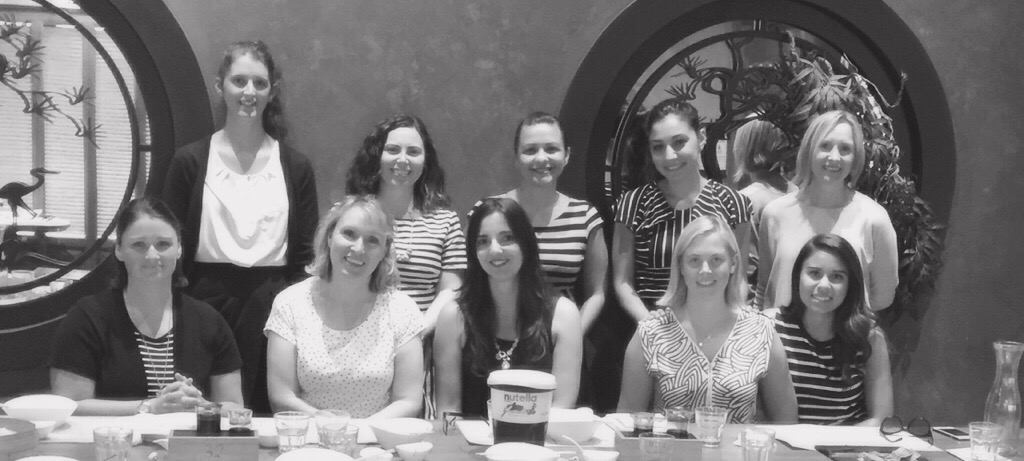
To (in alphabetical order), Alice, Angela, Anika, Carolyn, Elise, Elizabeth, Jane, Kelly, Kim and Kristina: thank you for making my last day so lovely. But more so, thank you for being the people who ‘do’. Each and every day, you come into work and do things alongside – in partnership – with people affected by diabetes to improve their lives in some way. Your commitment to people living with diabetes is second to none, there is no other team like this one in Australia and the work that you do each and every day is, in fact, life changing. We hear that frequently.
I am so fortunate that I got to lead you in my clumsy and sometimes ranty way, and I thank you all for indulging me as you have. I wish you all the best and will be watching – very closely – all your future successes.
When I look back at the numerous (i.e. far too many) encounters I have had with healthcare professionals, some stand out. Fortunately, a lot of the time it is because the care I have received has been outstanding and delivered by wonderfully caring and respectful professionals. But there have been times where the experience was no so good.
One of the stories I tell when speaking to medical students about what makes for good communication comes from a very difficult time. I was in hospital with terrible stomach issues. A new doctor had been referred to me and for the ease of this tale, we will call him Professor Poor Communication Skills – Prof PCS for short.
Prof PCS was an expert in his field and by the end of my time in hospital, I actually quite liked him. He was loud and direct and I appreciated his no-messing-around attitude. Plus, he worked out what was wrong with my stomach, stopped the pain and got me out of hospital.
However, it took a while – and a little bit of coaching – for me to come to like him.
When Prof PCS came to see me for the first time I had already been in hospital for about a week. I went through what had been going on and he ordered a few blood tests and x-rays. With that, he promised to return the following day with the results. I didn’t really mind the way that he blustered in and out in a flash and didn’t explain anything because really, there was nothing to explain! I didn’t mind that he didn’t give me details of the tests he was running because I could kind or work them out and figured I could ask questions the next day.
I didn’t really care for the way he had stormed in and not introduced himself. Or the way he didn’t make eye contact when he spoke.
The next day came and I waited for him to do his rounds. Late in the afternoon, I heard his booming voice in the corridor. I remember thinking that he was speaking terribly loudly to his patient about their test results and that everyone could hear.
As he rounded the corner into my room, I realised that he had been talking about my test results. By the time he was standing at the end of my bed, he was halfway through a sentence and announcing all sorts of things that didn’t make sense because I had kind of missed the beginning of what he had been trying to say.
I looked at the nurse who was standing slightly behind him. I was confused. And I was actually a little angry.
‘Excuse me,’ I said to him. And then repeated myself. ‘Excuse. Me.’
‘Yes?’ I don’t think he was used to being interrupted because he looked a little surprised.
‘Hi,’ I said. ‘Can we just stop for a second?’ I took a deep breath, collected my thoughts and started.
‘For this to work,’ I waved my hands between the two of us. ‘I need you to be in the same room that I am in. I need to be able to see you when you speak. I need to be able to ask you questions and be clear that you are speaking to me. I need to see your body language and your eyes and be clear about what you are saying. I do not want you to start your consultation with me whilst you are still in the corridor. Is that okay?’
He looked stunned and completely lost for words. The nurse smiled.
I can’t believe that I was the first person to have ever pulled him up on this behaviour, but when he left the room (after explaining things very clearly, answering my questions and telling me what I could expect next) the nurse said that she had never seen him look stunned before. She also said that other patients had commented on how uncomfortable they were with his ‘bedside manner’, but no one had ever commented on it directly to him.
I was reminded of this encounter the other day when I was reading about Kate Granger and her #HelloMyNameIs campaign.
Kate is a doctor – a geriatrician and a writer. She is also has terminal cancer.
When she was an inpatient, she noticed that many of the healthcare professionals looking after her did not introduce themselves. She had no idea who was speaking to her about her care. She (and her husband) decided to do something about it. This from the #HelloMyNameIs website:
‘…we decided to start a campaign to encourage and remind healthcare staff about the importance of introductions in the delivery of care. I firmly believe it is not just about knowing someone’s name, but it runs much deeper. It is about making a human connection, beginning a therapeutic relationship and building trust. In my mind it is the first rung on the ladder to providing compassionate care.’
It’s incredible how such a simple idea has taken flight. Events have been held throughout the UK and there have been over 800 million impressions on social media. The more I have read, the more amazed I am at just how far-reaching this initiative is and how entrenched it has become in some places.
It is indeed wonderful.
However it is also kind of shocking that we need a campaign to remind people to introduce themselves and remember the importance of taking the time to connect with people at a time where they are possibly feeling very vulnerable and scared.
The next time I speak with medical and nursing students about effective communication, I will be holding up #HelloMyNameIs as an example of doing things right. And it will be the perfect anecdote to balance out the Prof PCS story.

It’s no secret that I have had some problems with my local licensing authority (VicRoads). It’s also no secret that I have been annoyed and rather vocal about the Austroads 2012 Assessing Fitness to Drive Guidelines – specifically, the introduction in 2012 of the ridiculous section defining ‘satisfactory control of diabetes’ as an A1c of 9% (and the ensuing problems it caused!)
Austroads and the advisory group involved in putting together the guidelines a couple of years ago claim that this value was never meant to disadvantage people with diabetes; that it was there to simply trigger further, specialist treatment. And that it was never intended as an automatic suspension of a driver’s licence.
That may have been the theory. The reality was quite different. Many people with diabetes reported that their treating doctor did in fact interpret the guidelines as meaning that a 9% or above A1c was grounds for licences to be suspended. And that is what happened.
But here is some good news. The new draft guidelines – currently open to consumer consultation, and due for release later this year, have removed the A1c value defining satisfactory control of diabetes. It’s been a long process, but thanks to a lot of advocacy by Diabetes Australia, this is an excellent result for people living with diabetes in Australia.
One of the most enjoyable things about my job is the policy work in which I am involved, and I was pleased earlier this year when I was asked to join the working group reviewing and revising the diabetes chapter in the Guidelines. (Disclaimer: this is part of my work at Diabetes Australia and I was asked to represent the organisation on the working group. Diabetes Australia has received a significant number of complaints from people with diabetes who had been negatively impacted when the 2012 Guidelines were introduced and I have been involved in this work since then.)
The outcome of the review has been that some parts of the diabetes chapter have been completely rewritten. The advocacy efforts led by Diabetes Australia and involving the ADS and the ADEA, resulted in the removal of the 9% (arbitrary) value being eliminated. This is an outstanding outcome.
So, now it is your turn to do a little advocacy.
If you have some spare time over the next couple of days, and you feel really strongly about this issue, now is the time to get on board and participate. The point of public consultation is that people who are directly affected can have their say. If you have diabetes, you are directly affected. If you are the parent of a child with diabetes who, at some point, will want a driver’s licence, you are directly affected.
All the details of the consultation can be found here, including how you can make a submission. I urge you to comment – even if that is to simply say that you support the changes which should ensure that people with diabetes are not losing their licence because for a reason without an evidence base. And you might like to also add that you support the Guidelines’ focus on hypoglycaemia which absolutely can and does affect safe driving. Quick sticks – the consultation closes tomorrow.

At the risk of sounding Grinch-like, there is one thing about Xmas that really, really annoys me. It’s Kris Kringle (sometimes called Secret Santa). We also do a version called ‘Bad Santa’ which is unusually cruel in that people are able to steal gifts they prefer from others.
I find them all a complete and utter waste of time and, quite frankly, money. All up, we (Aaron and I) spend about $120 on KK gifts each Xmas – four KK gifts at the limit of $30 per gift. Please understand it is not the total cost that annoys me. It’s the total waste of it.
At the risk of sounding ungrateful, I don’t need anything. And for $30 I struggle to find something that is fun (and different from the bottle of wine/designer tea/candle that I usually buy).
I have made this very clear to my family who, if reading this, please ignore my Scrooge-iness and let’s all have a nice Xmas dinner!
For a few years now, I have suggested that instead of buying gifts for each other, we pool our $30 each and make a donation to a charity. It actually would add up to a decent amount and has the potential to make a significant difference in the lives of people far less fortunate than us.
Of course, for me, there would be no better way to spend this money than on a charity that is improving lives of people living with diabetes. With the $120 that just Aaron and I spend on KK presents, we could provide life-saving insulin for two years for a child in a country where medication is prohibitively expensive.
I am sure that I will love the bowl or bottle of champagne or colouring-in book I receive from my KK this year. But really, it will make no difference in my life. It will not improve it. Again, I get that I sound ungrateful to the cousin or aunt who has purchased this gift for me, and while I don’t mean to, it is the way I feel.
It feels wasteful. And there are so many ways that the money could be better spent.
So, today I have made a couple of donations. I have made a donation to Spare a Rose, Save a Child, adding to the monthly contribution I already make. The money I have donated will go to the IDF’s Life for a Child program and provide insulin or BGL strips for 12 months to a child who would not otherwise be able to access these supplies.
And I am also making a donation to Type 1 International to help their work in ensuring people with type 1 diabetes around the globe have access to insulin, diabetes consumables and medical care.
If my KKs are reading this, please feel free to give me a handmade card with a little note telling me you have donated the amount of my gift to either of these charities – or another one that you support. I promise that I will think it the best KK present under the tree, and I also promise to stop being a Grinch!
Our Xmas album collection is eclectic. One album that is on frequent rotation in the silly season is Bela Fleck and the Flecktones and their version of The Twelve Days of Christmas is different to say the least! Enjoy if you can.
‘Don’t you ever get tired of talking about diabetes?’ I get asked this quite a lot. And I can see why. There is a lot of diabetes in my life, and I do speak about it frequently.
The truth is that I don’t get tired talking about diabetes. I get tired talking about my diabetes, but the subject of diabetes is one of which I never tire. Diabetes is too hard for too many people – for all sorts of reasons – and until that is not the case, there is too much to do. Being tired or bored is not an option!
Advocacy can be a broad term. It can refer to political process, influencing policy change or promoting people’s rights and responsibilities. It can also be about raising awareness. It can be small or large scale. It can be about groups or individuals.
Advocating for self can be tiring. Often the times we need to be our biggest campaigners and put in the most effort are the times when it is the most difficult. Standing up to hospital staff who want to strip us of our right to manage our own self-managed condition is all good and well and we can get all assertive and angry about it and talk about what we would do if it happened to us. But that moment when we are actually in A&E for an accident or emergency situation, actually standing up for our self may simply be just too hard. Or impossible.
I know that my advocacy energies are different when I am feeling ‘over’ my diabetes. I tend to sit back a little more and not put myself out there so much. And I look for what others are doing and turn my attention and focus to that. It’s kind of like advocacy-by-proxy!
That’s why larger scale advocacy is really important. Big awareness raising campaigns are important – sometimes there is an ask (such as more funding or increased attention to the condition). Other times it’s just to inform people about the state of diabetes affairs.
A lot of the time, it’s not all huge and loud with lots of media coverage – often there are behind the scenes machinations that take a terribly long time, are terribly boring and involve a lot of bureaucracy and paper-pushing. (One great example of that is the three-year-long battle that has been trying to fix the mess up of introducing a ridiculous definition of ‘satisfactory control of diabetes’ in the current Assessing Fitness to Drive guidelines. The revised guidelines are up for public consultation at the moment and I am thrilled to see that the 9% A1c measure has been removed. These advocacy efforts undertaken by a number of Diabetes Australia staff – myself included – will be of significant benefit to people with diabetes holding a driver’s licence. Blog post to come soon.)
Advocacy doesn’t have to hit you over the head. It doesn’t need to be angry and aggressive. It is great when it is innovative and challenging. And it is okay if it makes you feel uncomfortable. In fact, sometimes we want things to be confronting and a little prickly as that can be a catalyst for people start to think and act.
So, a couple of things I thought I’d mention that tick a lot of advocacy boxes.
Today, Kelly Kunik launched the I Wish People Knew That Diabetes website following a hugely successful awareness-raising campaign back in April this year. Go have a look at the site and explore what she has to say.
Festival21 is being held in Melbourne on Friday 11 December. Sandro Demaio’s advocacy efforts are significant for many reasons, one of which is just how innovative and ground-breaking they are. The aim of this initiative is to address some of our most considerable social challenges, including sustainability, promoting healthy communities and climate change, with food as the central topic. To give you an idea of what Festiva21 has in store, this from Sandro in today’s online newspaper, Broadsheet, ‘We’re talking about empowering people to realise that the food on their plate is one of the most powerful tools they have for change. Food is a truly unifying factor across all schools of thought – politics, religion and race. Everyone loves food and everyone loves to eat.’
I frequently say that diabetes takes a back seat to other things in my life. Often, they are gorgeous and pleasurable and fun things – like birthdays and holidays and hanging-out-with-the-people-I-love-days.
Other times it’s because I am too busy and running around, life, work and everything else means that diabetes gets attended to when and where I can manage it.
And, of course, other times it is because I just can’t – my headspace will barely allow it.
But with World Diabetes Day, we are pretty much guaranteed that diabetes – our own and on a larger scale – will be attended to. There will be focus, there will be fuss, there will be attention.
Not this year. This year, for terrible and horrible and heartbreaking reasons, diabetes took a back seat. Because it had to. My heart bleeds, not only for Paris – a city that means so much to me and my family, a city Aaron and I visited only last month, a city where we have spent some of our happiest days – but also for the world where this happens all too regularly.
I have no more words about World Diabetes Day this year. Other than to say, it is over and felt that way, almost before it started.

Jean Julien’s ‘Peace for Paris’ sketch gets the WDD treatment.





 Diabetogenic