
On Sunday, one of those annoying diabetes things happened – a kinked insulin pump cannula, subsequent high glucose levels followed by a little glucose wrangling tango where, instead of rage blousing, I tried to gently guide my numbers back in-range. I thought about how frustrating diabetes can be – unfairly throwing curve balls at us even when we are doing ‘all the right things’. And so, I used this little story for a post on LinkedIn to illustrate why I am so dedicated to making sure that stories like this are heard and lived experience is centred in all diabetes conversations.
Meanwhile, anyone who has even the barest of little toes dipped in the water of the diabetes community would have heard about Alexander Zverev being told by French Open officials that he was not permitted to take his insulin on court. He was expected to inject off court and, according to Zverev, was told ‘looks weird when I [inject] on court’. Insulin breaks would be considered as toilet breaks.
What’s the connection between this story and my LinkedIn story? Absolutely none. Except there kind of is.
I’m not about to write about sports or try to connect my story with that of a top-ranking tennis player. That would be totally out of my lane. (The couple of years of tennis I took when I was in grades five and six give me no insight into life of a tennis player.)
However, when it comes to discussing diabetes and the stigma surrounding it, I’m definitely in my lane. I understand and am very well-versed when it comes to talking about the image problem diabetes faces and how that fuels the stigma fire.
The response from the diabetes community when the Zverev story broke. Most people were incredibly supportive of the tennis player and rightfully indignant of the incident. JDRF UK responded swiftly with an open letter to the French Open organisers, eloquently highlighting why their ruling needed to be changed. And changed it was.
My LinkedIn post was shared a few times and there were comments from people saying that these stories help others better understand our daily challenges and work to cut through a lot of the misconceptions about diabetes.
And then there was this direct message:
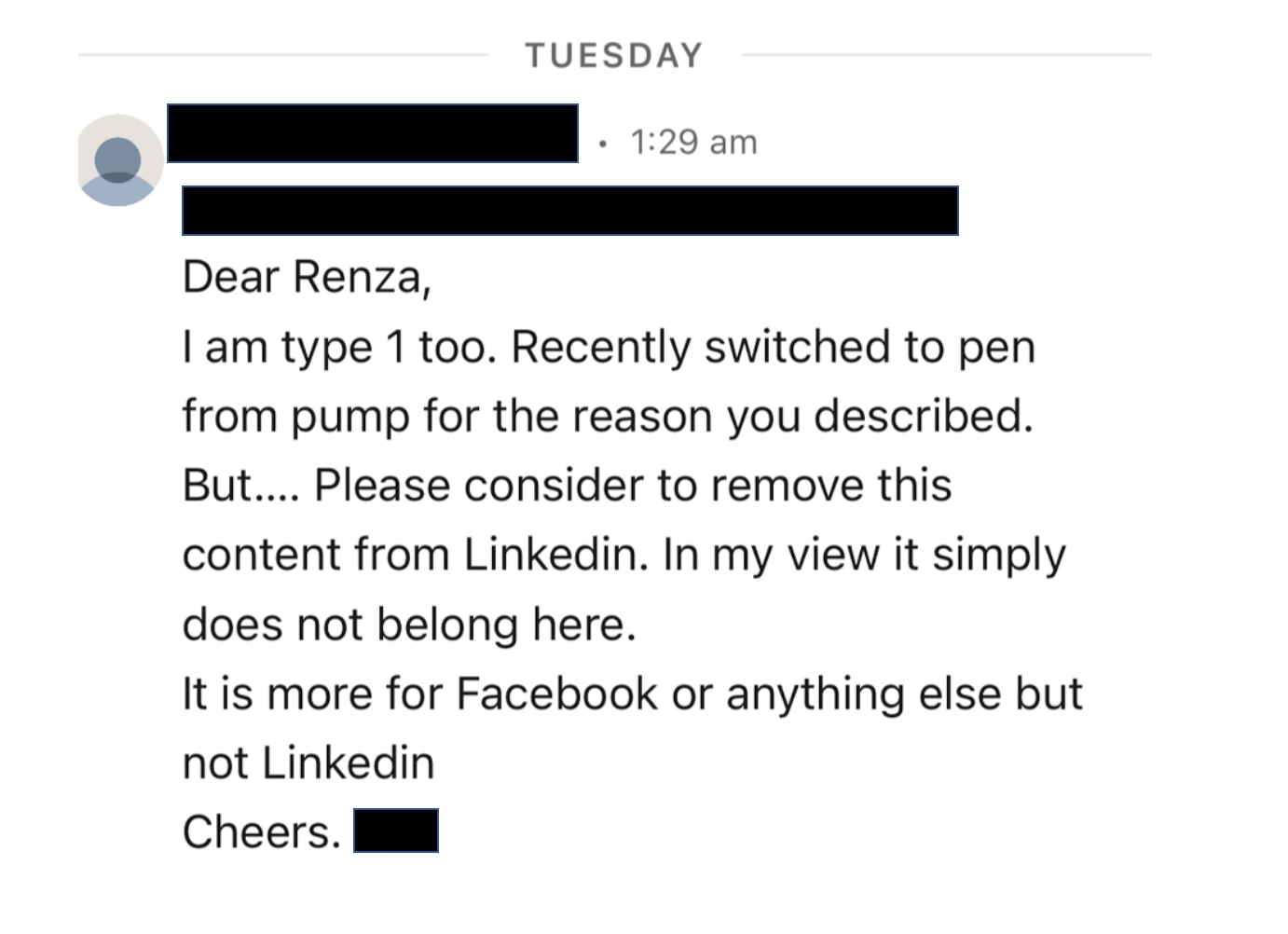
I bristled as I read it. My initial response was ‘How dare this man try to tell me what I can and can’t post on LinkedIn. Who is he to tell me what I can and can’t share?’ I snapped a reply back to him where I pointed out: ‘…I am a diabetes advocate, working to change attitudes and raise awareness about living with diabetes. My post belongs here on LinkedIn as it very much aligns with the work I do.’
But I haven’t been able to stop thinking about it because as problematic as it is for someone trying to silence what people with diabetes share online, there was more that was troubling me.
The idea that diabetes is a topic only appropriate in certain contexts and should be hidden away from others reinforces shame. Suggesting work settings are not the place to talk diabetes plants that seed that diabetes, and people with diabetes, could be liabilities in the workplace. Talking about diabetes on LinkedIn – a platform for business and workplace networking – is relevant because people with diabetes exist in business and workplaces, and the reality is that diabetes sometimes interferes with our work. Which is perfectly okay. Last week, I needed to refill my pump during a meeting. So, I let others on the call know what I was doing and carried on. On another day, I was recording a short video about a research program and after take 224 realised I needed to treat a hypo and did so. I shouldn’t need to feel that these aspects of daily life with diabetes are only allowed to happen out of view.
Essentially, this is what Alexander Zverev was being asked to do at his workplace: hide away when he needed to perform a task that keeps him alive, as if there is something shameful and disgusting about it. In my mind, this top ranked tennis player playing in a Grand Slam competition should be commended. I mean, any tennis player who does that is remarkable. Zverev does it and then goes about performing the duties of a pancreas. His opponents don’t have to do that! Their pancreas doses out the perfect amount of insulin without any help. Talk about an unfair advantage!
Not everyone wants to talk diabetes with others and that’s fine. But those of us who are happy to speak about and ‘do diabetes’ wherever we are shouldn’t feel that we are doing anything wrong. Diabetes stigma exists because there are so many wrong attitudes about diabetes. It’s insidious and it’s damaging. It erects barriers creating a climate of shame and perpetuates misconceptions that lead to ignorance. And it pressures us to hide away the realities of diabetes, as if there is something to be ashamed of. But there is nothing shameful about living with diabetes. There is nothing shameful about injecting insulin on Centre Court at Roland-Garros, or sharing frustrations on LinkedIn. Or anywhere else. Diabetes has a place wherever your workplace might be. Stigma, however, does not.





 Diabetogenic
5 comments
Comments feed for this article
June 15, 2023 at 5:44 pm
Ma.Co.Ev.-Support by Maren Sturny
Again, dear Renza, such powerful words and reflections. Thank you very much! My daughter and I also do not hide. She would look at me in a confused way if she should hide all of a sudden. We speak up, show and explain for so many who appreciate and soak in what we tell because it gives them selfconfidence and power. And positivity. Sometimes hope. Or just a little smile in the midst of their turbulent daily diabetes life. Continue to do what you are doing and how. You are simply wonderful. Thanks.
Maren and Nonie (@diabetesbluemchen #dedocvoice)
LikeLiked by 1 person
June 15, 2023 at 5:57 pm
RenzaS / Diabetogenic
Thank you for your very kind words. All the power to you and your daughter!
LikeLiked by 1 person
June 15, 2023 at 10:36 pm
Tim Brown
Interesting synchronicity between your powerful message from someone dealing day-to-day with T1 – as I am – and the message from Kerri Rankin in Circle, the Diabetes Australia magazine. Kerri says “essentially don’t become over reliant on glucose monitoring technology”. My reality is that glucose monitoring was primitive, time-consuming and inconvenient when I started with T1 in 1989, impeding my emotions, my glucose control and my wellbeing. Now it is sophisticated, very accurate, on my watch 24/7, easy to use and insert – a vital aid to me for emotions, control and wellbeing – as well as giving vital information to my pump. So I just don’t understand Kerri’s comment – it seems a bit like saying to someone in 1922: “don’t become over-reliant on insulin”.
LikeLike
June 16, 2023 at 3:52 am
Heather
Thank you so much for this! I have an 8 year old son who has been recently diagnosed with Type 1. He is extremely athletic and is very strong. I do my best to normalize pump changes wherever we are as you’re correct he needs insulin to survive! Thank you for standing up and speaking for those whose voice goes unheard!
LikeLiked by 1 person
June 16, 2023 at 12:14 pm
Rick Phillips
LOL Time to dump a Linked in Contact. Besides, isn’t diabetes your business? Are ministers not allowed to discuss church? Doctors, Medicine? First grade teachers, snot on the sleeve? I hope they can.
Unless they have changed Linked-In standards of community commentary and information, then diabetes content is welcome.
I for one will look for the former friend in the snot-rag discussion in the first grade teacher community. He will be welcome there and the pooping pants discussion in the Kindergarten community.
LikeLike