For the last few weeks, I have been trialling the new Dexcom G5 Mobile CGM. (And you bet there are disclosures about that. See the end of this post!)

I am very lucky. I get to travel quite a bit for my job and that means seeing what others are using to manage their diabetes. The G5 had been launched in other markets last year, so I knew all about the G5 after seeing it in action at the World Diabetes Congress in February last year.

I had also read a few reviews of it online and, as a result of the generally positive feedback, was ready to try it myself.

I have been using Dexcom CGM since it was launched in Australia three years ago. I haven’t used it for the whole of those three years, but it’s the only CGM I have used in that period.

In the last three months, I have been wearing CGM full time. I have come to rely on it but refuse to see that as a negative. This is simply a tool I use to manage my diabetes. End of story.

The G5 has a few new features which sets it apart from the earlier generation Dex. Possibly the most interesting is that the G5 is the first CGM which doesn’t require confirmatory BGL meter checks before responding to glucose levels. Basically, what that means is that apart from the twelve-hourly (required) calibrations, your meter can stay tucked away for the rest of the day.

(You can decide yourself if that is as exciting as the shiny brochures state. And you can read my thoughts on it in a previous post here.)

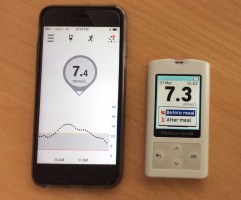
The other fancy-pants thing is the nifty (free) app that displays the CGM’s readings (via Bluetooth from the transmitter). So now, instead of needing to pull my pump from my bra to see what is going on with my glucose, I look at my iPhone. This took me a little while to get used to, but not needing to reach down my shirt, grope around and bring out my pump is actually quite nice.

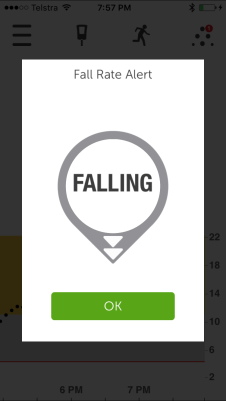
The app also shows lovely (sometimes) graphs and alarms (which you can customise) for low and high BGLs and also fall rate. It looks like this:

Ugh!


Or this:
Also, the app has the ‘Share’ function, which means that I can share my CGM data with anyone I want! (Well, up to five people.) At this stage, I am not using this functionality; however definitely will when I am travelling solo. It has a lot of appeal for parents of kids with diabetes, many of whom love the fact that they can see what their kids’ glucose levels are doing during school hours of when they are not together.

Because the ‘receiver’ is now my iPhone (rather than my Vibe pump), the G5 must be sold with a separate receiver. This definitely affects the price of the start up kit (which you can read all about here). I have never used a Dex receiver before – I started using a Dex at the same time as starting on the Vibe, so used the integrated system from day one. And technically, I don’t really need to use it now. But I have been throwing it in my bag in the morning in case my iPhone dies, gets lost, or is eaten by aliens. (Yay for contingency plans!)

The G5 uses the same sensors as the G4, so there was no real learning curve there for me, with sensor insertions being second nature these days.

All of this is great. The app looks wonderful, the data is easy to read, it’s convenient.

But none of this really matters unless the results are accurate – especially now that we can dose directly from those numbers.

So is it accurate? I have always found the G4 to be incredibly precise. I was actually blown away when I started using the device at just how accurate it was. And the G5 delivers the same accuracy and then some.

Habits are hard to break and even if I had been known to dose directly from G4 results, I still would frequently check my BGL throughout the day – other than for just the required calibrations. For the first week of using the G5, I continued to do that, just because I wanted to check the accuracy. (I was, however, only entering the two calibrations into the system.)

The biggest difference between the Dex and my meter was 0.3mmol/l. Yeah – it’s accurate.
So – are there any negatives? Making sure my phone was in ‘Bluetooth range’ at all times took some getting used to – and this is from someone who is ALWAYS on her phone for some reason or another! I was actually surprised at the number of times that I would hear the ‘signal loss’ alarm because I was out of range. I have become a lot better at making sure my phone is in my pocket or by my side all the time.

I did find that there were some other ‘signal loss’-es early on, which I found very frustrating, but, again, that was most frequently to do with positioning of my iPhone. Or not drinking enough water one day!

The cost of the G5 system is going to be more than the G4 and that will definitely factor into decision making about which device to use. The G5 transmitter has a three month battery-life, meaning that four transmitters will be required throughout the year. Deciding whether or not the extra cost of the G5 is worth it will be made in coming months when I need to purchase the next transmitter.

But overall, I have to say that I really do love this tech. I do love the convenience of the app and I do love the idea of the share capability. But mostly, I love the accuracy and the peace of mind that gives me.

DISCLOSURES

The Dexcom G5 Mobile is distributed in Australia by Australian Medical and Scientific Limited (AMSL). I was contacted in February by AMSL and offered product to trial the Dexcom G5. I was kindly provided (free of charge) with a G5 transmitter, a G5 receiver and four sensors. I have not been paid any money to use this product.

There was no expectation that I would write about my experience of using the G5. I’m just sharing ‘cause I’m the sharing type.

More information about the Dexcom G5 Mobile in Australia can be found here. 

We frequently say that diabetes is twenty-four hours, seven days a week, three hundred and sixty five days a year. And it’s true. It absolutely is.

But this year – a leap year – we have an extra day. I thought that the most wonderful way to celebrate it would be to take a day off – to have a day where I don’t think about it; don’t talk about it and don’t write about it.

But that’s not possible. Even if I decide to have a ‘low-diabetes-activity’ day, there is no way that I can’t take the day off completely. My pump is still attached to me, as is my CGM. I still need to eat food and that needs to be considered. My CGM needs calibrating, so I’ll need to do at least a couple of BGL checks. And I’ll need to respond to any highs or lows as they are thrown my way.

So, instead of ignoring, I decided that I needed to mark my diabetes in some special way and decided that an extra lancet change would be the way to do it. Actually, I’d be lying if I said that this was my choice. This morning, it took 8 stabs to actually draw blood (I know, I know…probably could have been changed sooner).

So, I replaced the lancet and have done a couple of lovely, easy checks with free-flowing, easily accessibly blood.

I was most pleased – and couldn’t stop laughing – to see that the team at Diabetes Mine were on the same page with this week’s Sunday Funnies cartoon.

So, there you go. That’s the way I am acknowledging this extra day of diabetes.

#LeapYearLancetChange


‘You’ll be pleased to know that I represented people with diabetes very well in the meeting that I attended yesterday.’

The meeting was all about people with diabetes; making decisions about people with diabetes; looking at processes and practices for people with diabetes; discussing how people with diabetes access healthcare.

And in the room? Not a single person with diabetes.

I looked at the healthcare professional who told me that she had so well represented ‘my people’ and shook my head.

And yet,’ I said. ‘You are not a person with diabetes. Can you imagine how much more powerful it would have been to actually have people affected by the things being discussed in the room?’

I was reminded of this conversation, which took place a few months ago, this morning when I saw this from the folks at T1 International. (I’ve written about them before, but please check them out. Their work is so important.)

12744462_954770537905005_5288436862619233048_n

T1 International is working towards adequate access to insulin and diabetes supplies, as well as healthcare for all people across the world living with type 1 diabetes. They are giving a voice to communities that are most often not heard by sharing their experiences and amplifying their stories.

But I wonder, what hope can there be for people in countries where diabetes is so tough if in places like Australia, where we have heavily subsidised medication and supplies (I know, I know – CGM is not subsidised), we are still not being given the microphone?

I never doubt the amazing advocacy initiatives that many healthcare professionals undertake for people with diabetes. It is important and necessary and I am so grateful for it.

However, there is an authenticity that can only be delivered by those walking the miles in our (diabetes-appropriate – pfft!) shoes; not those walking alongside us.

Bringing home the point again was this cartoon that has appeared frequently on my SoMe feeds this week.

Copyright - SocialMediaPearls

Copyright – SocialMediaPearls

Let us in the room. Don’t speak for us. We have voices. Hand us a microphone so we can be heard.

OzDoc tweetchats are fertile ground for posts on this blog! Often, as soon as the chat is over, I start to write because some that was discussed has triggered a wave of ideas, or thoughts or, as was the case after last night’s chat, wanting to know more.

This week’s chat was all about food – one of my favourite topics in the world, and one that I could, quite honestly, speak and write about full time. I think about food a lot. A. Lot. I have been known to ask the question ‘What will we have for dinner?’ as we sit down to start to eat lunch. I have rushed home, desperate to turn on the oven and bake a cake and then sit in front of the oven, watching it cook.

There is a lot to love about food. But clearly, from last night’s discussion and from many discussions with others, food is not all about bowls of cherries. (I am counting down until November when cherry season is upon us again….)

Guilt and food are two words that are frequently used in the same sentence. This is not only for people with diabetes. It is entrenched in our way of thinking.

We are almost conditioned to feel guilt when we eat certain things and this in turn forces us to think that what we are eating – and could be enjoying in the moment – is a bad, bad thing.

I’ve written about how language and food get intertwined and mixed up. But what I really want to know is where the guilt comes from. Why do we feel it? How did we learn to feel that way?

I don’t ever feel guilty about what I eat. Ever. I’ve no idea why – I just don’t. (There’s plenty of other stuff I feel guilty about, so I don’t feel guilty about not feeling guilty about food!)

Is it what we hear from those around us? Cutting comments from family members, shaming comments from friends or judgemental comments from health professionals can all take their toll.

I have heard them all. I have had family members comment on what I am eating (especially when I was younger and ate like a proverbial horse). I have been asked if I should be eating that. I have had healthcare professionals judge what I eat (when I bothered to tell them).

But besides annoying me, (and visualising hitting them on the head with a spoon I have recently been using to scoop Nutella directly from the jar), I’m not bothered. No long lasting effects and certainly no feelings of guilt.

That’s not the case for everyone. And that’s what I am interested in. Why is it that in some people guilt-inducing comments are like water off a duck’s back, yet for others, result in hours of anguish, hurt, tears and stress?

I watched the response to last night’s chat with great interest. The questions were all very thought provoking and generated a lot of discussion. But not once, was the word ‘guilt’ mentioned in the questions. And yet a lot of answers did.

It seems that the two just do go together for a lot of people. I know that is the case for people without diabetes. But undeniably, it is worse for many of us who do live with it.

Some mornings are tough. The alarm goes off and I hit the snooze button, for what I know full well will not be the first time. Eventually I tumble out of bed and make my way to the bathroom, only to stand under the shower-head forgetting what it is I am meant to be doing there. And then I stand in my underwear for ages unable to make the (what in my exhausted mind is a) critical decision of what to wear for the day.

By the time I walk out of the door – late – I am flustered, disorganised and completely unready to face the day.

Now add diabetes in there and you might understand why the day started so badly.

The hypo at 2am made the 7am alarm downright cruel and jumping out of bed very difficult.

The ripping out of the sensor because I wasn’t paying attention as I was drying myself after the shower was just frustrating. And I was running too late to even contemplate putting in another.

So the result of all of that is that today, for the first time in about 3 months, I am not wearing a sensor. And I feel like I am flying blind.

img_0477

Spent strips. Used since lunchtime. It’s now just before 3pm…

I have no concept of…well, anything. Melbourne is sweltering, so I am already at a loss with hypos, despite having lowered my basal rate and cautious blousing. I have been checking my BGL what feels like very ten minutes (slight – but only slight – exaggeration) to try to get some idea of what my glucose levels are doing, but the absence of alarms, alerts and arrows is making me feel very anxious. I am not sure if any feelings of light-headedness are due to needing a drink of water or impending low. And then, is the sudden thirst due to dehydration or an impending high?

I have become so reliant on my CGM and the information it gives me every second that I have no idea about the cues my body is sending out anymore.

I am not sure what to make of this. To begin with, I thought I should feel worried about the reliance that I have developed on this piece of tech. But how is dependence on a CGM any different to reliance on a BGL meter? Isn’t it just newer technology? We would never suggest someone who felt lost because they had left their BGL meter at home had an unhealthy reliance on that device, would we? We wouldn’t say that they should be expected to work out what was going on with their BGL with nothing more than stick to pee on, would we?

Perhaps it stems back to the thinking (by some) that CGM technology is a luxury, which it is not. It is a medical device that I use to manage my diabetes as best I can.

I am counting down the hours until I can get home and shove in a new sensor, wait for the two hour calibration period and then get back sense of knowing what the eff is going in. Because right now, I have no idea….

This morning as I was buzzing around getting ready for work, I suddenly stopped. I realised something that had obviously been creeping up on me so incrementally that I had not noticed it before.

I looked around the bedroom and saw empty cannula packaging from the line change I had done when I got out of the shower and the empty sensor pack with the date written on it so I would remember when it was inserted. I went back through my CGM trace and pump history, noticing where I had bolused for a high BGL, set a temp rate for an impending low and calibrated at the appropriate times. I checked the history on my BGL meter and saw that I have been checking regularly and that the numbers were not as crazy as they have been.

I looked in my bag and saw a spare bottle of strips, my fully stocked ‘emergency’ kit, and a juice box and a small container full of glucose tabs ready in case I needed them.

When I got into work, my desk was prepared for all contingencies – more glucose tabs on the desk, a couple of spare cannulas in the top draw, as well as a few syringes. And a few single portion packs of Nutella.

I was – I am – managing my diabetes – well and without any stress at the moment. The burnout fog that had enveloped me for a long, long time seems to have lifted without me even noticing, and the diabetes tasks that form part of my day and had been so, so difficult to manage, have become routine. I do them without thinking. Checking my BGL and calibrating my CGM just happens. Bolusing for meals or my morning milky coffee is done before I take that first taste rather than half an hour later because my CGM is blaring at me that I am high.

Am I feeling motivated? I’m not sure that is the right word. I don’t have a desire to do these things. I am not so focused on diabetes that I think about it all the time.

But I am doing what I need to. Routinely. Just like brushing my teeth, combing my hair and putting on a necklace in the morning.

Perhaps that’s the thing about managing diabetes well. It’s the balance between getting the things done and not panicking about them. Or feeling so anxious and guilty because they are not getting done.

I don’t know the secret to this change. I do think that a big part of it is wearing my CGM all the time. Once I managed to hurdle feeling overwhelmed by the data and just accepted the numbers for what they are and acting accordingly, I feel much more driven to ‘do diabetes’. And perhaps as I see that things are not as dire as I often imagine them to be, I feel that I can just get on with things.

This is the roller coaster of diabetes. The ebbing and flowing of motivation and being in the headspace to get things done. I’m in a good place for now. I just have to work out how to stay here.

Emergency stash at the office (for lows or as required….)


This week, I find that I have been using an insulin pump for fifteen years. That is just under 5,500 days and over a third of my life. I can’t imagine my life without this technology and the thought of not having an external pancreas is a little scary.

I have spent a bit of time in the last week or so thinking about how far technology has come in the last fifteen years.

Back in February 2001 when I was admitted as an overnight patient into the Epworth Hospital in Melbourne, there really wasn’t much choice when it came to insulin pumps. In fact, there were two and two only – the Medtronic 507C and the Disetronic D-Tron. There were pros and cons to both of them – I had done a lot of research – and I decided that the smaller size of the Medtronic would suit me more, so that is what I used.

This was before the advent of ‘smart pumps’. There was no such thing as a bolus calculator and there was no capacity to even enter BGLs into the pump. It was simply a device that delivered insulin. (Kind of like old mobile phones that did nothing other than make a phone call. Ah, they were the days…Life seemed so much simpler then…)

My second pump was a Deltec Cozmo and this was my first foray into the ‘smart pump’ zone. It was a great little pump and the new bolus wizard technology was terrific. Having said that, I was always pleased that I actually knew and completely understood how to count carbs, and this was particularly important to me at first, or at least until I trusted the technology.

Today, I use a sensor-augmented pump – it’s the latest technology available and it makes my diabetes manageable, more so than any other way I know.

In fifteen years, I’ve never taken a pump holiday. I’ve never even considered it. There have been maybe a couple of times that accommodating the pump has been a pain, but I have managed it with a little lateral thinking. It’s possible that the reason I haven’t switched back to injections when it may have been easier is because I am lazy and the thought of trying to work out long-acting insulin made me weep inside.

(Speaking of long-acting insulin, I have always had some in the fridge, or with me when travelling, in case of pump malfunction. This diligence has resulted in regularly having dispose out-of-date insulin.)

So, when I started on a pump, did I think that I would still be using the same technology – albeit a little more sophisticated – fifteen years later? Probably not. There was no cure back in 2001 and there isn’t one today in 2016. Am I upset about that? Well, I guess that I would really like to not have to think about diabetes as much as I do, (or at all). But no. And not really surprised either.

I see my pump as being as much a part of me as my arm or my leg. It is a pseudo-organ. It keeps me going, it keeps me alive. I’d be lost without it. Is it perfect? No, (as evidenced by my current CGM stream that resembles a rather scary mountain range). Is it what works for me? Yes. At least for now.

Happy pumpiversary!


It’s gloomy in Melbourne today. I have tights on for the first time in months and my hair is now frizzing thanks to the rain I was caught in as I ran next door for a coffee. (The silver lining in all of this is that there is fabulous coffee right next door to my new office. Also, extra silver lining is that I can see the weather out of my beautiful window. The not-so-silver-lining is that I am reminded that I am fool, because window = seeing rainy weather and yet I still forgot to take an umbrella…)

So here are some things that are keeping me either amused, happy, annoyed, interested, fascinated and heaps of other things too!

Roses spared and children saved

Today, the Spare A Rose Facebook page announced that 376 children would be benefitting from people’s generous donations this Valentine’s Day.

It’s not too late to make a donation, or even consider making a monthly donation throughout the year. AUD$6 each month equals a month of insulin for a kid who would otherwise not be able to afford it.

While this was the focus of our Valentine’s Day, there was still a lot of baking. Because I love a heart shaped cookie. Or giant brownie. And sprinkles.

IMG_0225

Still the wrong name for this week

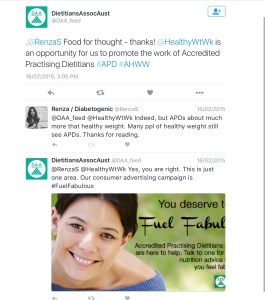
I said it last year and I maintain that the Dietitians Association of Australia have got it wrong naming this week ‘Healthy Weight Week’.

I think that the name misses the mark because it focuses on weight and not health. The overall aim of the week is to encourage people to cook more at home to achieve a healthy weight. Here’s just a little of the conversation with the DAA (after they read my post last year) on Twitter:

FullSizeRender

I think that this really does a disservice to the role of dietitians in healthcare. I am of a healthy weight, but have benefitted from the expertise of dietitians in the past.

The name of this week turns me off actually wanting to participate in any way, even though there are some terrific initiatives. What are your thoughts on this one?

In the genes

Why do some people develop diabetes-related complications and others don’t? We’re told that ‘control’ is the reason, but we also know that some people develop complications, despite years of what is considered ‘good control’ while others who struggle to reach targets don’t.

This study’s findings suggests that particular genetic variations are involved in the development of retinopathy and nephropathy.

Things I wish I knew

I learn new things about diabetes each and every day. But how much easier it would have been while navigating this annoying bloody path to have known stuff earlier on. Diabetes UK has released a new book, 100 THINGS I WISH I’D KNOWN ABOUT LIVING WITH DIABETES, which includes information collected from over 1,000 people with diabetes with input from clinicians. The final 100 were selected by people with diabetes, (nice engagement there!), who chose the tips they thought most useful.

Oh – and while talking about Diabetes UK: Happy Birthday! They turn 82 years old this week.

New (to Australia) Tech

Looks like Australia is about to catch up to our friends in the EU who have had access to Freestyle Libre Flash Monitoring. The Flash website went live this week. More details – such as cost and release date – are yet to come, but you can register your interest. Have a look and register your interest.

And while we’re talking new tech in Australia, a couple of weeks ago, the Aussie launch details of the Dexcom G5 were announced. You can download the app (iOS only) which is already available from the App Store, although you won’t be able to use it until you are hooked up to a G5. The App has the ‘Share’ capability which means that you can (just as it says!) share your data with others.

Rock on

Last week, I was sitting at the front of our house, enjoying the sunshine and my day off, and listening to Live Fast, Diabetes, the new song from Adelaide punk/rock band, Grenadiers.

A very crotchety woman walked by, stopped as she heard the music, and scolded me with this nugget of wisdom: ‘You’re too old to be listening to that noise.’

Yeah, we know

Science: ‘Apparently BGLs are lower in warm weather.’

PWD: ‘Ah, yeah. We know. We’ve known for ages….’

Love it when evidence catches up!

And finally….

It’s Tuesday. Do the #OzDOC tweet chat! Tonight at 8.30pm AEDT.

I produce a lot of waste. (There’s a lovely first sentence….) Perhaps I should clarify and say that diabetes produces a lot of waste. And as such, I am very conscious of reusing, recycling and reducing wherever I can, especially in a society where so much is so easily disposable.

Over the weekend, we found ourselves wandering the aisles of our local Officeworks store. The reason for our visit was to buy some cartridges for our (rather old) printer at home. We print virtually nothing. In fact, the only reason that we needed to buy cartridges was because the kidlet is back at school and it’s project time, which means printing things.

What we discovered was not only that the cartridges for our 10 year-old printer were no longer stocked (probably shouldn’t have really been all that surprised!), but that it would be cheaper to buy a whole new printer than it would have cost to replace the two cartridges we had planned to buy.

I was even more horrified when the very helpful sales staff told us that a lot of people simply buy a whole new printer instead of replacing the cartridges when they run out because it is cheaper.

‘But it’s so…so…wasteful,’ I said to him. He nodded. ‘Oh, but we recycle old printers, so you can bring your old one in to us. That’s what most people do.’

I didn’t want to point out that as wonderful as that may be, it still takes a lot of energy and resources to produce a printer in the first place – especially if it is to just be thrown out after a few months, or however long it takes to work through the ink.

I am very conscious of this as (as previously stated) someone who produces a lot of waste – waste that I can’t do anything about because the products with the waste are keeping me alive.

Between pump line and sensor changes, BGL strips that litter like glitter and empty juice boxes and jellybean packets, there is a lot of packaging and used product that winds up in the bin.

The only reason for all this stuff is diabetes. And it annoys me that a lot of it seems superfluous. Every time I open a pump line, there is a little round disc that is meant to be used whenever I disconnect the pump to cover the exposed knob of the infusion set. How many times do I use that disc? Never. As in: not once. In fact, most of the time, it winds up on the floor and the cat plays with it or the puppy chews on it or I step on it in my bare feet and swear. But it is in every single pack.

All this stuff creates (even more) diabetes guilt.

There are things I do try to recycle in some way. When I upgrade my pump, I donate my old pump to either someone who is interested in trying one out or to a clinic (although that is less likely to happen these days because of warranty issues). I don’t take endless BGL meters from device companies or HCPs, just because they are free. And I try to reuse where and when I can. (I refill cartridges in my pump a couple of times and refill strip cartridges with hypo portions and spent pump lines tie up plants in the garden.)

Yes, I know that we can refill the cartridges with ink ourselves. ‘You just need to use a syringe and ink. You’re good at that. You know, drawing things up with a needle and shooting them into things,’ said Aaron helpfully – a suggestion that was rewarded with a look that suggested that was one of those comments best kept to oneself. But no, we won’t be doing that, because: mess. I have, however, looked online to see where I can source cheaper cartridges and will order them.

I also just want to say that I am absolutely not guilt-free when it comes to using throwaway products. I more than happily, and without any shame, used only disposable nappies when the kidlet was little. When someone told me that each nappy took one hundred years to break down and I should consider using cloth nappies, I nodded and said cheerfully, ‘Yep, but if I start having to wash nappies, I reckon it will take me about five minutes to break down. And the baby is kind of expecting me to be functioning enough to feed her. She’s demanding like that. So, disposables it is!’

But somewhere in there, there has to be a happy medium between taking the easier route to save one’s sanity, and throwing out a printer when the ink runs out.

Stigma-definition2

I don’t get to take part in the OzDoc tweet chats as frequently as I would like to anymore, but when I do, I know that I am guaranteed an hour of thoughtful and engaging discussion about real life with diabetes.

This week, I popped in a little late, but in plenty of time to catch a terrific chat a out diabetes stigma – from both within and outside the diabetes community.

Diabetes stigma is real. Have I experienced it? You bet.

Stigma is unsettling, and it comes from a place of ignorance. Is there any real animosity or vitriol? I like to think no, but it pains me that when there have been times of nastiness, it has come from within the community.

I can honestly say that I have never been stigmatised about my diabetes from anyone inside the diabetes community. But then, I have the type of diabetes that I didn’t cause myself. You know, the one that has nothing to do with the sorts of foods that I ate. The one that has nothing to do with me being overweight or inactive or lazy. I have the one that cute kids get – kids who are innocent and have done nothing to ask for this. And I have the tough one – the one that is the worst, the one that can cause death in an instant, the one that no one understands.

These are words that people from within the diabetes community have used when talking about type 2 diabetes. That’s right – by others living with (or living with a child with) diabetes. Perhaps it was in a discussion about the hopeless and insensitive comments made by some silly comedian; or perhaps in response to a diabetes report that doesn’t separate type 1 and type 2 diabetes.

And I am not the only one to have noticed this. The Walk With D campaign was set up because there was a need to acknowledge that … ‘Even within the diabetes community, there are levels of misunderstanding, misrepresentation, and mistaken messaging, often creating a divide where there should be a bridge.’

There have been some studies that also reinforce the idea that there certainly is stigma from within the community.

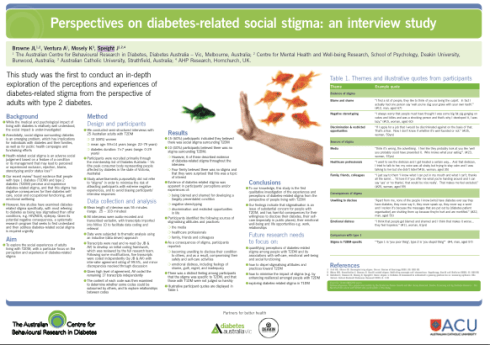
The ACBRD has been researching diabetes stigma for a couple of years now, starting with a project looking at the stigma experienced by people with type 2 diabetes and following up with a similar study about people with type 1 diabetes.

The second study discussed the perpetuation of type 2 diabetes stigma by people with type 1 diabetes and it’s interesting reading. You can read the full article here, but here are just some of the findings:

  • In general, participants expressed somewhat negative attitudes towards, and beliefs about, people with T2DM. This included stereotypes such as ‘lazy’, ‘fat’, ‘over-consume’, ‘sedentary’, ‘unfit’ and judgment about the intelligence and character of people with T2DM, and blame for ‘bringing it on themselves’.
  • These attitudes and beliefs served to perpetuate, and give voice to, the stigma surrounding T2DM and drove an in-group/out-group (or ‘us vs them’) mentality.
  • It was also evident that there was resentment among people with T1DM toward those with T2DM, which stemmed from two main factors: (1) the perception that people with T2DM are responsible for many of the negative connotations that surround diabetes, and (2) the perception that T2DM, as a largely preventable condition, attracts more attention and therefore gets more resources and support than T1DM.
  • Some participants believed that T1DM was the ‘real’ or ‘serious’ type of diabetes, and was more worthy of research attention and investment of societal resources than T2DM.

That sounds pretty stigmatising to me.

Let me be clear about my position here – there are different types of diabetes and people living with each of those types of diabetes has the right to find support and healthcare that is relevant and specific to their diabetes. A young person living with type 1 diabetes is, of course, going to have different needs to an older adult living with type 2 diabetes.

There are many times that we need to clearly define the different types of diabetes as this is important when it comes to getting the right treatment, seeing the right HCPs and ensuring the person living with diabetes has the right information.

I am not saying that there shouldn’t be specialised and tailored services and activities available to people depending on what they need, or relevant to the type of diabetes they have. I built a program from the ground up that was very specific and targeted in its approach to being only about and for people with type 1 diabetes. I get it!

And you absolute bet that people with type 1 diabetes should have access to support and peer opportunities that are specific. I know that for me the sense of ‘me too’ comes most strongly when I am speaking with other people with T1, usually women around the same age, who are working and have the same sort of technology, caffeine and boot addiction as I do – sometimes there does need to be a ‘sacred space’ for us to discuss the issues that are particular to the challenges presented by our brand of diabetes. And finding the perfect pair of knee-highs.

What I am saying is that I know that the stigma comes from a variety of places. And I believe that we should be advocating for diabetes messaging to be positive and beneficial to people living with diabetes. The challenge of getting that message across to people in the general community who have no idea about diabetes is difficult to manage and sometimes it has not been executed particularly elegantly.

But I am a firm believer in the strength of community and the support that it can offer. And to me, the diabetes community means everyone affected by diabetes – everyone. Stigmatising anyone inside that community does a great disservice to us all.

DISCLAIMERS ALL OVER THE PLACE!!

The ACBRD is a partnership between Diabetes Victoria and Deakin University and until very recently, Diabetes Victoria employed me. Since the ACBRD was established (6 years ago) I have worked with foundation director, Professor Jane Speight and her team on a number of different projects.  

I have not received any funding from the ACBRD for my work with them. I just like to write about them because the work they do is very important and is changing the way that diabetes is perceived. And their work in diabetes and stigma is ground breaking. (Really! The Washington Post published this article in 2014, quoting Dr Jessica Browne from the ACBRD.)

Now, I just happen to share an office with the ACBRD. And this is on my office wall. I have found myself reading it quite a lot this week!

Click for larger image

Click for larger image


Follow Diabetogenic on WordPress.com

Enter your email address to follow this blog and receive notifications of new posts by email.

Read about Renza

Archives