Following last week’s post about how my ADATS’ talk was received, several things happened. Firstly, I was contacted by a heap of people wanting to chat about the reaction. Secondly, I was sent several designs of logos and t-shirts with ‘deliberately non-compliant’ splashed across the front, which obviously I will now need to order and wear any time I do a talk (or am sitting opposite a diabetes healthcare professional). And thirdly, discussions started about how we manage our diabetes ‘off label’.

While off label generally refers to how drugs are used in ways other than as prescribed, it has also come to mean the way we tweak any aspect of treatment to try to find ways to make diabetes less tiresome, less burdensome, less annoying.

When it comes to making diabetes manageable and working out how to fit it into my life as easily and unobtrusively as possible, I am all about off label. And I learnt that very early on.

Change your pen tip after every use.’ I was told the day after I was diagnosed, meeting with a diabetes educator the first time. ‘Of course,’ I said earnestly, staring intently at the photos of magnified needles showing how blunt the needles become after repeated use. ‘Lancets are single use too.’ I nodded, promising to discard my lancets after each glucose check. ‘You must inject into your stomach, directly into the skin – never through clothes, and rotate injection sites every single time.’ I committed to memory the part of my stomach to use and visualised a circular chart to help remind me to move where I stabbed.

Fast forward about a week into diagnosis. Needle changed once a day (which then, in following weeks, became once every second day, every third day, once a week… or when ‘ouch – I really felt that’); I forgot that lancets could be changed; speared (reused) needles directly through jeans or tights into my thighs, having no idea which leg I’d used last time.

And then there were insulin doses. ‘You must take XX units of insulin with breakfast, XX with lunch and XX with dinner. That means you need XX grams of carbs with breakfast, XX with lunch and XX with dinner. These amounts are set and cannot be altered. You must eat snacks.’ I took notes and planned the weekly menu according to required carb contents. Within a week, I’d worked out that if I couldn’t eat the prescribed huge quantities of carbs, I could take less insulin and that all seemed to work out okay. And I worked out how I didn’t need to have the same doses each and every day. It was liberating!

I switched to an insulin pump and the instructions came again: ‘You must change your site every three days without fail.’ I promised to set alarms to remind me and write notes to myself. ‘Cartridges are single use,’ I was told and vowed to throw them away as soon as they were empty. Today, sometimes pump lines get changed every three days, sometimes three and a half, sometimes four and sometimes even five. Cartridges are reused at times…

I was also told to never change any of the settings in my pump unless I spoke with my HCP. But part of getting the most from a pump (and all diabetes technology) is about constantly reviewing, revising and making changes. I taught myself how to check and change basal rates – slowly and carefully but always with positive results. (For the record, my endo these days would not tell me to never change my pump settings.)

CGM came into my life with similar rules, and as I became familiar with the technology and how I interacted with it, I adapted the way I used it. Despite warnings of never, ever, ever bolusing from a CGM reading, I did. Of course I did. I restarted sensors, getting every last reading from them to save my bank balance. I sited sensors on my arms, despite warnings that the stomach was the only area approved for use. I started using the US Dex 5 App (after setting up a US iTunes account and downloading from the US App Store) because we still didn’t have it here in Australia, and I wanted to use my phone as a receiver, and seriously #WeAreNotWaiting.

And today…today I am Looping, which is possibly the extreme of using devices off label. But the reason for doing it is still the same: Trying to find the best ‘diabetes me’ for the least effort!

The push back to curating our diabetes treatment to fit in with our lives is often frowned upon by HCPs and I wonder why. Is it all about safety? Possibly, but I know that for me, I was able to always measure the risk of what I was doing off label and balance it with the benefit to and for me. I believe I have always remained as safe as possible while managing to make my diabetes a little more… well, manageable.

It can be viewed as rule breaking or ‘hacking’. It can be thought of as dangerous and something to be feared. But I think the concerns from HCPs go beyond that.

As is often the case, it comes down to control – not in the A1c sense of the word, but in the ‘who owns my diabetes’ way.

When we learn how things work, make changes and adapt our treatment to suit ourselves, we often find what works best is not the same as what we are told to do. And I think that some HCPs think that as we take that control – make our own decisions and changes to our treatment – we are making them redundant. But that’s not the case at all.

We need our HCPs because we need to be shown the rules in the first place. We have to know what the evidence shows, and we need to know how to do things the way the regulators want us to do them. We need to understand the basics, the guidelines, the fundamentals to what we are doing.

Because then we can experiment. Then we can push boundaries and see what is still safe. We can take risks within a framework that absolutely improves our care, but we still understand how to be safe. I understand the risks reusing lancets, or stretching out set changes by a day or two. Of course I do. I know them because I’ve had great HCPs who have explained it to me.

Going off label has only ever served to make me manage my diabetes better. It has made me less frustrated by the burden, less exasperated by the mundanity of it all.

And the thing that has made me feel better – physically and emotionally – about diabetes more than anything else is using Loop. So, use it I will!


It seems silly to have to say this, but I will anyway. Don’t take anything I write (today or ever) as advice. I’m not recommending that anyone do what I do and I never have.  

I get to meet some pretty awesome people with diabetes around the globe. At EASD I caught up with Cathy Van de Moortele who has lived with diabetes for fifteen years. She lives in Belgium and, according to her Instagram feed, spends a lot of time baking and cooking. Her photos of her culinary creations look straight out of a cookbook…She really should write one!

Cathy and I were messaging last week and she told me about an awful experience she had when she was in hospital recently. While she wasn’t the target of the unpleasantness, she took it upon herself to stand up to the hospital staff, in the hope that other people would not need to go through the same thing. She has kindly written it out for me to share here. Thanks, Cathy!

______________

‘Good day sir. Unfortunately we were not able to save your toes. There’s no need to worry though. We’ll bring you back into surgery tomorrow and we’ll amputate your foot. It won’t bother you much. We’ll put some sort of prosthetic in your shoe and you’ll barely notice…’

I’m shocked. Still waking up from my own surgery, I’m in the recovery room. Between myself and my neighbour, there’s no more than a curtain on a rail separating us. I feel his pain and anxiety. He is just waking up from a surgery that couldn’t save his toes. This man, who is facing surgery again, leaving him without his foot. How is he gonna get through this day? How will he have to go on?

The nurse besides my bed, is prepping me to go back to my room. I tell him I’m shocked. He doesn’t understand. I ask him if he didn’t hear the conversation? His reaction makes me burst into tears.

‘Oh well, it’s probably one of those type 2 diabetics, who could not care less about taking care of himself.’

I’m angry, disappointed, sad and confounded. I ask him if he knows this person. Does he know his background? Did this man get the education he deserves and does he have a doctor who has the best interest in his patient? Is he being provided with the right medication? Did he have bad luck? Does he, as a nurse, have any idea how hard diabetes is?

The nurse can tell I’m angry. He takes me upstairs in silence. My eyes are wet with tears and I can only feel for this man and for anyone who is facing prejudice day in day out. I’m afraid to face him when we pass his bed. All I can see is the white sheet over his feet. Over his foot, without toes. Over his foot, that will no longer be there tomorrow. I want to wish him all the best, but no words can express how I feel.

What am I supposed to do about this? Not care? Where did respect go? How is this even possible? Why do we accept this as normal? Have we become immune for other people’s misery?

I file a complaint against the policy of this hospital. A meeting is scheduled. They don’t understand how I feel about the lack of respect for this patient. They tell me to shake if off. Am I even sure this patient overheard the conversation? Well, I heard it… it was disrespectful and totally unacceptable.

Medical staff need to get the opportunity to vent, I totally agree. They have a hard job and they face misery and pain on a daily basis. They take care of their patients and do whatever is in their power to assist when needed. They need a way to vent in order to go home and relax. I get that. This was not the right place. It was wrong and it still is wrong. This is NOT OKAY!

Helen Edwards from Diabetes Can’t Stop Me has written a thoughtful piece today on her blog about why she has ‘broken up with CGM’.

I truly love this post, because it once again reinforces the ‘one size fits no one’ approach that I have always advocated when it comes to diabetes.

As I read Helen’s story, I realised I could have written this post. I was reminded of the long and very winding road that it took for me to get to a point where I could live comfortably with all the tech. Learning to love it took even longer. It certainly was not love at first sensor! For a long time, I felt overwhelmed by all the data, the alarms drove me to distraction and I struggled at times to live with an invisible condition when all my robot bits are on show.

I showed the below photo during my talk at ADATS last week. It’s from a few years ago (and accompanied this post) when I was really struggling to live alongside CGM. I had to work up to convince myself to put on a sensor and made all sorts of deals to try to limit the stress I was feeling. I turned off all the alarms except for the low alarm. I promised myself that I would rip the sensor out if I was starting to be paralysed with all the information being constantly thrown at me. And I reminded myself that the data was just numbers trying to retrain my brain to not feel judged by the electronic device.

This wasn’t the first time I made such a deal with myself. And it took this and many other attempts of starting to wear CGM before everything feel into place. There were times where I pulled sensors out after two days because I just couldn’t cope with it.

Learning to live alongside diabetes technology is not an easy decision. There is bargaining, sacrificing and trade-offs. The tech is brilliant, but it rarely, if ever, works as simply as the shiny brochures promise. It’s not perfect and the limitations of the technology should never be blamed on the person wearing it.

Also, it’s no good speaking to people like me, because I’m all evangelical about it and spend all my time telling people how much I love it – while conveniently forgetting how long it took to find that place.

The tech is not for everyone and no one should be made to feel bad if they choose a more analogue approach to diabetes management. This is another slide I showed at last week’s ADATS meeting (from this post):

Right device; right time; right person. The right device might actually be no device at all. And that is absolutely fine!

(Hat tip to Professor Tim Skinner for the title of today’s blog post.)

In an effort to terrify the bejeezus out of healthcare professionals get the word out about Loop and OpenAPS to a group of diabetes healthcare professionals, I decided to work my Loop story into my talk at last Friday’s #ADATS meeting. I was a little nervous about it, but being on the ADATS Committee, and recognising the name of the conference – Australasian Diabetes ADVANCEMENTS and TECHNOLOGIES Summit – I knew that there was no way I could talk about the latest diabetes tech advances and not talk about the DIY movement.

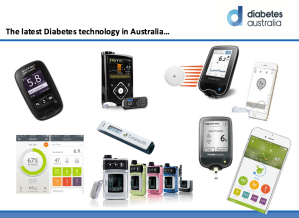
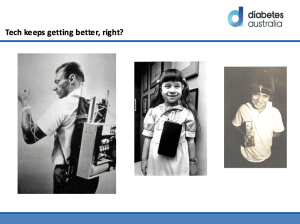
To set the scene, I started with the old chestnut of showing how far diabetes technology has come:

Then showed a slide with all our shiny new tech:

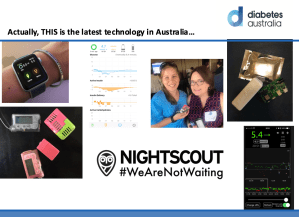
But then I stopped, and changed the slide a little, leaving the same photos, but altering the title to ask a question:

And then, I showed them what cutting edge diabetes tech really looks like:

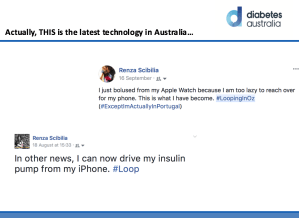
I used the next slide to explain how I drive my Dtech these days, and how my iPhone and Apple Watch are part of my diabetes tech arsenal.

‘So…How many of you know about OpenAPS or Loop,’ I asked. Very, very few hands went up.

What about Nightscout? How many of you know about, and understand,d Nightscout?’ A few more went up – but really not many.

I nodded my head, completely unsurprised.

Then I told the audience I’ve been using Loop for almost three months. I explained how I ‘hacked’ an insulin pump, ‘became an app developer and built an app’… and now, my basal insulin is fully automated. I showed a screenshot of the app, and pointed out the dozens and dozens of small basal rate adjustments automatically made every day.

I explained how much better I feel, how much more time my glucose levels are in range and how I simply wouldn’t be without this technology now. I told them how I now wake up feeling that I can move mountains because night after night after night my glucose levels remain in a flat, straight line thanks to those micro basal adjustments, and I wake to a number that ranges no more than between about 5mmol/l and 5.8mmol/l.

‘How many of you are a little scared by this?’ I asked and waited. Hands shot up; many heads nodded. I waited some more, shrugging my shoulders a little.

‘This isn’t the scary future,’ I said. ‘It’s not dangerous, futuristic or downright terrifying – which is what I’m sure some of you are thinking. This is happening here and now. There are two other people in this room using one of the two systems and there are probably around thirty people across Australia who have started using one of them.

‘And if you are a healthcare professional working with people with diabetes, it makes sense to be aware of these technologies. Also, Nightscout has been around for a number of years now. It’s really not okay if you are working with people with diabetes and you don’t know about Nightscout…’

I know that my talk received a mixed reception. There was a lot of nervousness from some of the device company reps in the room – especially the maker of Loop-able pumps. Some HCPs were simply aghast and did nothing to hide their feelings, one person telling me that I was being irresponsible doing such a thing and even more irresponsible talking about it.

But others were far more interested. The rep. with type 1 diabetes from a device company who announced at the end of the day that he was ‘going home to hack his insulin pump’ was obviously interested. As were a number of other people with diabetes in the room. A couple of HCPs spoke to me about my experience, and one told me that he knows someone in the process of setting up Loop.

But mostly, there was nervousness and shock that not only is this happening, but that there are step-by-step instructions online so that anyone can get onboard. ‘You mean that ANYONE can access the instructions? For free? So any of my patients could do this if they knew about it?’ asked one endocrinologist while a diabetes educator he works with stood behind him sharing his horror. ‘Yep!’ I said cheerfully. ‘It’s all open source. No one is trying to make a buck out of this. It’s for everyone. Isn’t that fantastic! They didn’t share my enthusiasm.

Here’s the thing…I wasn’t (and am not) for a moment suggesting that it is the role of HCPs to start recommending this technology to the PWD they see. But it is naive of them to deny it is happening, or that the only way people with diabetes will find out about it is if their HCP mentions it. Also, I’m not recommending that everyone with diabetes should find a suitable pump and start Looping. I’m simply sharing my story – which is what I have always done here on this blog, and elsewhere as a diabetes advocate.

The title of this blog post came about when I mentioned the mixed reception a little later on in the day. I was sitting with three others at ADATS (who I knew would be sympathetic), and psychologist Tim Skinner commented that one of the reasons that HCPs might be so uncomfortable is because I am going beyond simply not following their directions of how I should be managing my diabetes. ‘You’re actually being a deliberately non-compliant diabetic,’ he said cheekily (Tim was one of the authors on the Diabetes Australia Language Position Statement, so he knew the response he’d get from me using such terminology). ‘This is a lot more than simply being ‘non-compliant’. You have actively hacked a diabetes device and are using that to change the way you are managing your diabetes. Deliberately non-compliant!’

He’s right. I never thought I’d wear the term ‘non-compliant’ as a badge of honour, but right then and there, I kind of was.

Even my t-shirt is deliberately non-compliant. (You can get your own by clicking on the photo.)


LOOP!!! I know you want more info. You can read my last couple of posts about my experience here and here, but the full details, continually updated by the brilliant Loop and OpenAPS brains trust can be found here. Read them. Also, you may want to join the (closed) Looped Facebook group. And if you are in Australia, we have our own (closed) page dedicated to local issues at Aussie Aussie Aussie. Loop, Loop, Loop. (And just a reminder – no one can build your Loop system. You have to do it yourself, but it is actually super easy once you have all the components.)

Disclosure

My travel costs were covered by the National Association of Diabetes Centres, the organisers of ADATS. I was on the ADATS organising committee.

Are you an adult (aged 18 – 75 years) with type 1 or type 2 diabetes living in Australia or the UK?

No? Avert your eyes and go back to looking at pictures of of cats on the internet.

Yes? Stop right there…. You can go back to looking at pictures of cats later, ‘cause right now, you have better things to do.

Like THIS:

Click to take the survey.

YourSay (Self-management And You): Quality of Life Study needs people just like you to have your say about the impact of living with, and managing diabetes on your quality of life.

You only have until the end of the month to participate, so now is definitely the time to do it.

And to say thank you, I baked these and am virtually sending you a couple:

You’re welcome!

Click here to do the YourSAY survey.

Our kid has always enjoyed drawing. I’m someone who struggles to draw a stick figure, so I am frequently impressed by her ability to sketch and paint things that are actually quite good, and I’m able to easily identify.

The other day, I was tidying up the kitchen table when I came across one of her sketches. I picked it up and looked at it. ‘This is gorgeous, darling,’ I said to her as she sat at the table doing her homework. And then I stopped. ‘Wait…why are you drawing a woman pole dancing?’

Exhibit A

She looked at me with that expression that only a teenager-in-training can, and then started laughing. ‘Mum!’ She exclaimed, taking the drawing from my hands. She turned the paper ninety degrees, and held it up to me. ‘It’s a witch on a broomstick!’

Exhibit B

Ah, perspective!

On Friday last week, I spoke at the first Australasian Diabetes Advancements and Technologies Summit (#ADATS) in Sydney. My talk was ‘The consumer perspective on new technologies. So, as usual, I crowd sourced some ideas from Facebook friends. I do this for two reasons… one: it gives me the opportunity to share the thoughts of other PWD so that my voice is not the only one heard. And two: I’m lazy.

I centred my talk around the love/hate relationship I have with diabetes technology and asked others to give me a couple of dot points on what they love, and what they don’t really love (or hate) about diabetes tech.

In many cases, the things people love are also the things they hate, and that makes so much sense to me!

Our perspective of our diabetes devices can change all the time. Some days, I am so appreciative for all the information my diabetes technology offers; other days I want to ignore it as it just makes me want to cry. Sometimes I love the devices and I can’t imagine being without them; other days I long for my body to be free of them. Some days, I love the alerts and alarms, and respond to them promptly; other days, the noise is unbearable and I switch off everything I can so I don’t need aural reminders of just how hopeless I am at diabetes.

My perspective can spin on a coin, and often it takes very little for me to move from loving every piece of technology to wanting to bin it all.

The point of my talk was not to bitch and moan about the technology I know I am so fortunate and privileged to be able to afford and use. It was to try to explain that the bells and whistles, and data and information can truly be wonderful. But our feelings about the tech will change (often several times in the space of a day) and this does affect how we feel about our diabetes.

Disclosures

My travel costs were covered by the National Association of Diabetes Centres, the organisers of ADATS. I was on the ADATS organising committee.

Yesterday, I woke to the news that the American Diabetes Association – American Association of Diabetes Educators guidance paper on language had been published.

You can read the article here, and then check out this awesome two-pager that has been developed as a quick guide for anyone working with people with diabetes.

I love the four core principles that guided this work. How wonderful it would be if these principles were at the front of everyone’s mind anytime they were speaking about diabetes or to people with diabetes!

But that wasn’t the only exciting piece of #LanguageMatters to hit the interwebs yesterday.

#LanguageMatters superstar, Professor Jane Speight co-authored (with Professor Richard Holt) this editorial about the language of diabetes for Diabetic Medicine. (And yes, the irony of this piece being published in a journal with that name is not lost on me…)

We’re not done yet – there is still much to do. But I do think we are heading in the right direction and there certainly is evidence that the message is getting through.

I’m an invited speaker at a diabetes meeting tomorrow and as part of my speaker information pack, I was sent a link to the Diabetes Australia Language Position Statement, with instructions to use it as a guide for the language I use in my talk.

And the organising team of the Roche Educators Day back in August did the same thing.

But no one is resting yet… We need to keep pushing and keep insisting that anytime anyone is talking to or about people with diabetes it is done with complete and utter respect. When I say #LanguageMatters it is not about political correctness gone mad. It is about fundamentally understanding how the words used – and the way they are used – impact and affect people with diabetes.

So pleased to keep pushing the #LanguageMatters agenda with Jane Speight!

Last night, I attended an event at Parliament House in Canberra, acknowledging and celebrating two milestones: 60 years of Diabetes Australia and 30 years of the National Diabetes Services Scheme (NDSS).

I spent the night chasing down people who were instrumental in the establishment of the NDSS to thank them for their efforts and try to explain just how significant the Scheme has been in my diabetes life for the last (almost) 20 years.

I never knew diabetes before the NDSS. On the day following my diagnosis, after spending the morning seeing my new best friends (endo, CDE, dietitian…actually, the dietitian and I never hit it off), I took a couple of freshly-filled-in forms to 100 Collins Street in the city and took a creaky elevator to the third floor. It was there I was introduced to the NDSS. I handed over the registration form and then the order form. Box after box was piled onto the counter in front of me and I looked at the unfamiliar words on unfamiliar boxes wondering where I was going to put it all and how much it was going to cost.

A few boxes of needle tips for insulin pens and a few boxes of glucose strips and a box or two of urine strips. It was tallied up and I was surprised that it wasn’t a lot more expensive. I was given a card and told to bring it in any time I needed further supplies.

As I came to learn about diabetes in other countries, I realised just how unique the NDSS is and how fortunate we are in Australia to have it.

I proudly speak about the NDSS to diabetes friends from all over the world. Often, these friends are astounded that the NDSS is free to join and available to everyone with diabetes. They are astonished that the price of diabetes supplies is the same for everyone and not reliant on insurance. Often they can’t get their head around the idea that we can choose which strips to use for which meter we prefer, with no interference from an insurance provider. And they simply cannot believe that while there are some limitations to the quantities that we can purchase, the amount we can access is actually quite significant, and there are allowances and exemptions for people who need more than the limits determined by the government.

The NDSS is more than a diabetes supplies program. It is intrinsically linked with Diabetes Australia who was instrumental in the establishment and implementation of the NDSS back in 1987. Diabetes Australia continues to administer the NDSS and runs all the services associated with the Scheme – from diabetes camps, information events, information resources and support services.

But more than that, Diabetes Australia continues to lobby the government to extend the NDSS. More than five years of consistent lobbying resulted in the CGM initiative being announced and launched, and Diabetes Australia is actively urging the broadening of initiative to include other groups of people with diabetes who benefit from CGM (as outlined in the original joint submission from Diabetes Australia, JDRF, ADS, ADEA and APEG). Back in 2004, following a similarly consistent campaign, pump consumables were added to the Scheme. Recently, Diabetes Australia’s responded to the stakeholder engagement regarding the listing of Freestyle Libre on the NDSS with this submission. From the initial lobbying for the introduction of the NDSS to today, the link between Diabetes Australia and the NDSS has resulted in supporting people living with diabetes and making our lives easier.

The NDSS remains the only scheme of its kind in the world. It has enjoyed bipartisan support from consecutive governments.

Of course, our health system is not perfect here in Australia. I believe that there should be more funding and more subsidies on the NDSS. I don’t believe in restricting access to glucose strips for people with type 2 diabetes not using insulin. I know that a lot of people still find the cost of diabetes prohibitive and there is still a divide between those who can afford the latest technologies and those who cannot.

But the NDSS does go a long way towards lessening the burden in some ways and I certainly am glad – and proud – that we have it.

Disclosure

I have been an employee of Diabetes Australia (and Diabetes Victoria) since 2001. I cover all costs for all NDSS products I use.

Last week, a recipe was posted on the Medtronic Australia Facebook page. The recipe was for a Chocolate Tim Tam Cake, which looked rather gooey and very chocolate-y.

I was looking for something to bake over the weekend, but decided that this cake wasn’t really the sort of baking I was up to, so I scrolled on, searching for the right recipe for my baking adventures.

But for some reason, I kept seeing the recipe appear in my FB feed, a couple of times because it had been posted in some of the LCHF groups I follow.

And then I did what I know I shouldn’t do. I looked at the comments, and down the rabbit whole of the very angry LCHF brigade I tumbled.

I am always very wary when it comes to dietary advice. I don’t follow the Australian Dietary Guidelines because I find the quantity of carbs recommended is just simply too difficult for my non-functioning pancreas. Or rather, for my (frequently barely-functioning) brain which has to act like my non-functioning pancreas. Also, I just don’t really want to have to bolus large quantities of insulin in one go. But that’s just me.

Equally, I don’t follow a paleo diet or I Quit Sugar or Dr Bernstein because anything that is so prescriptive is never going to work for me. Instead, I pick and choose what I know will work for me and, more importantly, what I can manage sustainably. I couldn’t really care less what other people with diabetes (or people without diabetes) eat, because I’m far too concerned with my own diabetes existence. And being obsessed with the @TrumpGoogles Insta account

In exactly the same way I would never accept a HCP who judged what people eat or the tools people choose to manage their diabetes, I don’t take too kindly to other PWD (or anyone, really) suggesting that people who prefer to eat in a certain way are ‘killing themselves’. This is what was happening in the case of the recipe posted by Medtronic.

You can read the comments yourself (the post is here), or you can just assume that they all had to do with the criminality of a company daring to post the recipe while suggesting that people with diabetes might want a piece of cake. And varying versions of ‘you might as well just kill yourself’.

I’m not bagging the LCHF movement and anyone who fully subscribes to it. But I am calling out the frequent aggressive and belligerent rhetoric of some LCHF folk. I’ve had more than enough disrespectful and rude comments sent my way anytime I write about food or share recipes. Despite that, I’m not for a minute suggesting that the way you are choosing to eat is harmful, in fact, I completely agree that eating LCHF is one way for some people to best manage their diabetes. I know a significant number of people of have changed to this way of eating and they have found the results to be incredibly positive.

I also know a significant number of people who simply haven’t found it to be the right thing for them. Some say they have found it unsustainable, others say they found it boring. Others say they are simply not interested because they found it too restrictive, or too expensive. And some say the results they saw simply didn’t warrant the effort they needed to put in.

I know that for me, exclusively following a LCHF diet doesn’t work because I just don’t do food restriction. I’ve never dieted in my life and I don’t do well with being told what I can and can’t eat. I also know that I can quite easily manage to limit my carbs to around 50 grams per day and that the results I have seen since doing that have been worth the effort for me. I also know that all carbs are not created equal and I try to be smart about what I choose to make up those 50g (or so).

Oh – and mostly I know that sometimes…sometimes, those 50 grams of carbs are going to be a doughnut. I’m okay with that. Doughnuts are delicious and bolus-worthy.

As I firmly and resolutely believe, everyone has the right to manage their diabetes in a way that works for them. And they have a right to do that without being bothered by others. Being told that what you are eating is ‘poisoning your body’, or being told that the devices you are using are toxic helps no one.

Oh, and the personal attacks are also totally unnecessary. The person who sent me an aggressive FB message after seeing this profile photo can just pull their head in. I ate a few bites of chocolate cake (the best chocolate cake ever), not ‘poison’. And yes – even after eating those few bites, I still have both my legs, and my kidneys continue to work just fine. But thanks for asking.

Eat how you want. Let others eat how they want. It’s really not that hard.

For the record – this is what I made on Saturday evening. (This one went to the neighbours, but I also made a smaller one for home.) It’s a blueberry crostata. I added a little ricotta underneath the fruit and made a ridiculously buttery pastry to hold it all together. Super easy. Super delicious. (And my CGM trace peaked at 7.3mmol/l for anyone wondering…)

I’ve now been looping now for a couple of months. During that time, I’ve come to understand that I know far less about diabetes – my diabetes – than I actually realised. I’ve come to realise that diabetes is far more complex and difficult than I ever thought. I’ve come to see that the tools we have been using are so incapable of managing with the constant changes of diabetes. And I’ve come to realise that using tech off label is the only way to go anyway towards overcoming these challenges.

After my first couple of weeks of looping, I honestly thought that the whole thing was somehow tricking me. What was this ridiculousness of waking every single morning with numbers firmly between 5mmol/l and 5.5mmol/l? I’d look at my Loop app suspiciously, switching to my Dex app only to have the number confirmed, and a straight and steady glucose trace showing that I’d been there all night. How did THAT happen? I’d ask myself every. The Loop app had all the answers.

The automation is where the magic is. Prior to looping, I had about fourteen different basal rates sets for a 24-hour period. I had gone through times of extreme basal checking to try to tighten up those rates as much as possible, tweaking them here and there, and I thought that I had it pretty right. And insofar as basal rate settings on a pump, I suppose I did have it right.

But loop has taught me that while the overall shape of my basal rates was pretty spot on, there is only so much a pump can do with set, static rates programmed into a pump. There is nothing my pump could do to respond in real time if I needed more basal insulin unless I manually inserted a temporary basal rate.

On an average night for me now, my basal rates are automatically being adjusted dozens and dozens of times. Remember, this is during the night, when there is no need to contend with food or most other factors that affect glucose levels.

You know those mornings where you wake up, see a number in the double figures and wonder if it is at all possible that you sleep walked to the kitchen, sleep baked a pavlova and then sleep-ate the whole thing? Loop’s automation addresses that.

One morning I woke up to see that my basal rates over night had been more than double the set rate for three hours. I’d gone to sleep with a glucose level of 5mmol/l, but for some reason at about 1am, I had started climbing. Instead of waking high, the significant increase in basal insulin took care of it and I woke up in range.

Is looping the solution to all diabetes problems? Of course not and I’d be naïve to think that there was a silver bullet. But it is certainly a useful tool in my diabetes treatment arsenal, especially when combined with eating mostly lower carb. And thanks to the automation, it certainly does lift some of the burden. It also helps beautifully when I am ovulating or my period is about to start, when all bets are off and I just resigned myself to a couple of days of mayhem.

Undoubtedly it is not THE solution – in fact, if anything, it has made me despair more about what we are lacking in diabetes technology, because the increased understanding of diabetes that has come with using Loop makes me more desperate and impatient for tools that actually can manage more and more of the complexity of diabetes. I have a new found respect for that complexity.

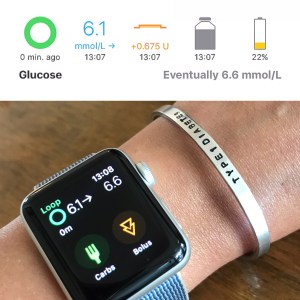
Real time; Loop and iPhone app.


Loop info is all here including how to get started. 

Follow Diabetogenic on WordPress.com

Enter your email address to follow this blog and receive notifications of new posts by email.

Read about Renza

Archives