
I am writing this quickly and won’t be editing it. Because when I stop and think about this I freak out and then want to curl up in a ball in a dark room. I don’t want to verbalise it, I don’t want to think about it. So, I apologise in advance for the typos, the grammatical errors and (Heaven-forbid!) the punctuation problems.

What I want to say is this: I am beyond terrified that my daughter will develop type 1 diabetes. It keeps me awake at night; it gives me nightmares in the day whilst I’m awake. I feel guilt for this thing that may happen. May never happen. But may happen. May. Happen.

I know a lot of women with diabetes who have children. Beautiful, smart, wonderful, fabulous, bright, gorgeous children. And I know statistics. And I know that possibly sooner or later one of our children may be diagnosed with type 1. Some of us speak about it regularly. Others keep it hidden –as if putting thoughts into words will make them come true.

For me, I continue to watch in wonder and amazement as the miracle I know as my daughter continues to grow and grow. But the moments where I think she has visited the bathroom an extra time, or is asking for a drink of water ‘because I’m soooo thirsty, mummy!’ will continue to terrify and paralyse me. And I will continue to fight the urge to do a quick finger prick check – something I’ve only done four times in her nearly-seven years.

For the first time I am starting to ask myself what it is that I fear. Of course, I don’t want her to develop diabetes, but if she did, we would deal with that. It wouldn’t be easy, it wouldn’t be fun. But we’d work through it and aim to surround ourselves with the best health professionals, the best treatment, the most information possible and peer networks to help us through.

I think the thing that I struggle with is how I will start to feel about myself.

Whilst I was pregnant, I worried about what my diabetes was doing to her as she developed from a pea to a person – even with an HbA1c of under 6.5% for the whole pregnancy.

And then when she was delivered amongst the euphoria of meeting my beautiful daughter, I wept with guilt as her heel was pricked repeatedly to check her blood sugar levels. An hour after she was delivered, her BGL plummeted and she was whisked away from me and taken to the Special Care Nursery where the paediatritian tried and tried and tried again to get an IV line into her. An hour into being a father, Aaron was doing all he could to not grab his precious newborn baby and protect her from the pain she was obviously feeling. Her wails could be heard throughout the Nursery. He told me about this weeks after her delivery – he knew the anguish and heart break I would feel.
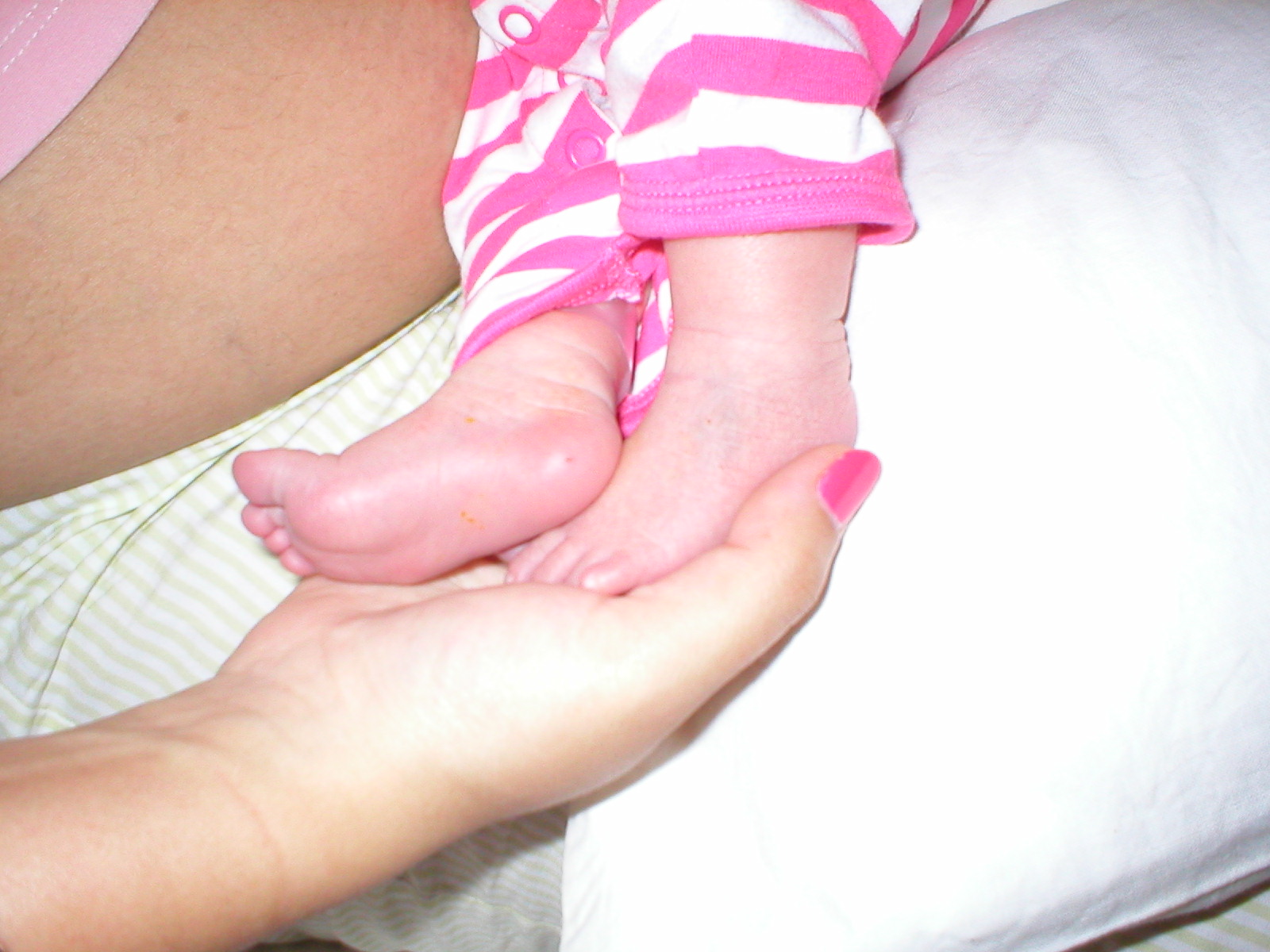
Tiny feet - a mere two days old.

And this was because her mother has diabetes. Mother guilt starts early with diabetes.

How do we move on from this? How do we be kind to ourselves about what may happen? How do we rationalise that we cannot be held to blame?
I can be a pretty emotional gal. I have been known to cry at Telco ads, and the other day found myself tearing up at my daughter’s school concert. Cute kids singing Aussie classics will do that to me! And I can’t watch the opening scene of Love Actually (the one in the airport) without reaching for a tissue.

So, when I walked into diabetes camp today, it’s not surprising that the warm glow of diabetes love swept over me. OK – I don’t even know what that means – diabetes love? Huh? Maybe diabetes camaraderie is a better term.

Anyway, in the room were about 60 kids aged 12 to 14 years, all with type 1 diabetes. Most hadn’t met before camp check-in three days earlier and for many, it was the first time they’d been away from home since being diagnosed with diabetes. The beyond-amazing volunteer staff, many with type 1 diabetes themselves, were doing a sterling job getting everyone excited about the day’s activities.

There is a connection that people with diabetes have. That doesn’t necessarily mean that we like everyone with diabetes. It isn’t that at all. In fact, I’ve met some people with type 1 that I don’t particularly get along with, and probably wouldn’t have a drink with. And I’m pretty sure that I’m not everyone’s cup of tea either! But undeniably there is something there that connects us.

I never went to diabetes camp. I was diagnosed as a 24 year old and here in Victoria our camps run for four to 17 year olds. This year we ran a camp of 18 to 25 year olds, but it was the first time that it’s been done here.

Whilst I haven’t organised my own camp, I do have regular catch up with friends with diabetes – FWD. I’ve met these people through work, at diabetes information events and in one case at the supermarket.

I know how lucky I am to have FWD. And even luckier that they live nearby, so we can have a quick coffee. I even manage school drop-off and pick up chats with my beautiful friend Jo. Sometimes –most of the time – we don’t talk about diabetes. Sometimes there’s a cursory curse at a late-night hypo or a comment about a recent HbA1c. Sometimes there’s not.

But the understanding, the knowing looks, the complete, utter, total lack of judgment that is there cannot be measured. I find myself drinking it in and leave all encounters with FWD feeling that diabetes is back in its place.

In the last couple of months, I’ve been getting to know more about the Diabetes Online Community (DOC). I have taken incredible delight in uncovering layer after layer of positive interaction and supportive people. My only previous use of an online diabetes forum was negative – it felt cliquey and exclusive and if anyone dared challenge what the core users of the site said, they were attacked. I backed away and decided it wasn’t worth the angst.

But what I have found in the predominantly American DOC is a welcoming and encouraging group who are prepared to reach out. The unselfconscious, frank honesty and sharing is refreshing. Blogs tell stories that are familiar, different and liberating; Facebook groups invite opinion, ask tough questions and provide refreshing answers; and Twitter allows rapid-fire discussions.

Peer support should be a part of diabetes care for everyone diagnosed with this condition. Those six to eight hours a year we get with our HCPs are incredibly important, but being able to share with other PWD provides unlimited possibilities. Unfortunately, a lot of people don’t recognise the value that peer support offers, which means that unless you go looking for it, you won’t have it handed to you.

So go looking! If you are not lucky enough to discover a group of people with diabetes in your suburb, you needn’t consider yourself alone on the diabetes road. Look online, call your local diabetes organisation and see if there is a support group nearby. You may need to do the legwork, but the benefits will be worth it!

My reality involves numbers. All the time. Carbohydrate content, insulin doses, blood sugar levels.

My reality is jabbing a lancet into my fingers several times a day and squeezing blood out.

My reality involves using a spring-loaded device to shoot a needle into me every three days.

My reality has me connected to a pump twenty four hours a day, seven days a week.

My reality means I scrutinise graphs, adjust medication doses and calculate ratios.

My reality has made me good at maths!

My reality is about 8 hours a year with health professionals and the rest of the time I figure it out on my own.

My reality includes times when I am unable to do anything other than shake; or cry; or giggle; or do all of these things at once.

My reality has me surrounded by amazing people who have been forced to learn far too much about a condition of which they would otherwise be ignorant.

My reality means a job where I meet inspirational people who have lived with my condition for decades. And they are still smiling, walking, seeing, loving. Living. Breathing.

My reality is the reason I have encountered incredibly, strong, smart, brilliant people who understand everything I say. Because it’s their reality, too.

My reality sometimes makes me want to curl up in a ball and cry. And not think about it ever again.

My reality makes me stand up in front of hundreds of people to tell them what it’s all about. And how we deserve to be respected, admired, trusted and valued.

My reality has made me an advocate for others sharing this reality. It has made me loud, proud and determined. And, at times, very, very angry.

My reality has made me an expert at something I knew nothing about a mere thirteen years ago.

My reality makes me incredibly proud of some achievements. And resolute to prove wrong people who say ‘you can’t do this’.

My reality makes me feel a part of something bigger than me.

My reality includes miracles.

My reality connects me to people all over the world who let me know they are there and they understand. Using only 140 characters.

My reality makes me celebrate the successes – mine and other peoples. And that makes be a better person.

My reality is only part of who I am.

My reality. Diabetes.

Hour one: 7.30pm – 8.30pm
Bed time reading with the kidlet finished – Oliver Jeffers new book Stuck
Bed time kisses and ritual of “I love you more, I love you most”
Kiss Aaron good bye as he heads out to a gig
Emails checked
Text message from best friend with photo of her two week old baby. Respond with: “gorgeous, gorgeous gorgeous”
BGL now – 5.2mmol/l
Put Poh’s Kitchen on in the background. She’s in Bright with our family friends Patrizia, George and Anthony from Simones
Homemade shortbread and a cup of tea
Bolus accordingly
Twitter, Facebook – up to date!
Feed Cherry (cat) – possibly for the second time
Let Jasper and Bella (dogs) inside for a play
Put Bella out – she’s way too puppy-crazy!
Look at the George Clooney bank ad on YouTube. Again. (Hey – the link has been emailed to me by about 439 friends!)
Set DVR for Gruen Transfer
Yay – Glee starts

Hour two: 3.00am – 4.00am
Wake up needing to pee. Try to locate pump…where is it? How the fruitcake did my pump become dislodged?
Get up, go to the bathroom
Nausea hits
BGL now – 19.4mmol/l
Line change
Correction bolus and temporary basal to 130%
Two glasses of water
Try to get back to sleep, but nausea overrides sleep
Lie on the couch so as to not disturb Aaron
Ice cubes to keep feelings of dehydration under control
BGL now – 19.4mmol/l What??
Bolus again
Start second guessing myself. Should I do another line change? Correct via syringe? Change insulin bottle?
Aaron gets up and sits with me. And gets a bucket – just in time
Glass of water and hope I can keep it down
Curse that I am out of Maxalon
Lie there with the cool face washer Aaron has brought me over my eyes
More ice
Yay – BGL now – 15.3mmol/l. Heading in the right direction

Sometimes, diabetes sits there quietly and….. and other times it doesn’t. Now, tell me how to be compliant?

Today, I write at the Diabetes Australia – Vic blog about the launch of the new position statement called ‘A new language for diabetes’ which now available online.

Today, Diabetes Australia is launching a new position statement about language and diabetes –specifically, how the language health professionals and the media use when talking to and about people with diabetes affects those of us with the condition.

This is exciting me on a number of levels – firstly, because it’s being held at the State Library, and the bookish nerd I am finds this extraordinarily electrifying. And secondly, because I have been asked to provide a consumer perspective on why words are important when speaking to people with diabetes….more

Diabetes is sometimes referred to as an ‘invisible illness’. In fact, yesterday marked the end of ‘Invisible Illness Week’ in the US. Here in Australia, the Chronic Illness Alliance has their Invisible Illness resource. This data base provides information about a variety of conditions (including type 1 diabetes). It has been designed for schools and offers insight into how the different conditions can impact children and young adults.

The invisible part refers to the fact that diabetes can be hidden. But just how invisible is my diabetes? If you saw me walking down the street, you wouldn’t know I had a medical condition. I don’t look sick. Most of the time, I look fairly OK – ignoring the times I’ve had a top inside out/dress tucked into tights/two different shoes etc. None of these things is related to anything other than my general klutziness.

Of course, there are times when it doesn’t feel invisible at all. In fact it feels like it’s right there, front and centre, waving maniacally at anyone and everyone nearby. But that’s not the reality. I certainly don’t have a big flashing neon sign above my head announcing to all and sundry that I have diabetes.

The other question is why is it invisible? And who makes it that way? Well, I don’t talk about it much. Of course people at work know I have diabetes (apart from the fact that I work at a diabetes organisation, I am often dragged out as the ‘here’s one we prepared earlier’ consumer rep), but it’s not discussed all the time. I don’t mention it much to my friends without diabetes and when I get together with my friends with diabetes we quickly sum up our ‘diabetes states of mind’ and then move on to much more important things.

The ’30 Things about my Chronic Illness Meme’ asks people to consider questions about life with an invisible illness and then blog them. I’m coming in late, but one of the reasons for that is that it took me a while to respond to some of the questions – especially the ones that focus on what I’d do if I didn’t have diabetes. Anyway, here are mine. And if you have time, you might want to fill them in too.

    30 Things About My Invisible Illness You May Not Know

1.The illness I live with is: Type 1 Diabetes
2.I was diagnosed with it in the year: 1998 (on 15 April for those playing at home)
3.But I had symptoms since: for only about 10 days prior
4.The biggest adjustment I’ve had to make is: thinking like a pancreas.
5.Most people assume: It’s a ‘set and forget’ condition: take your insulin and all will be good. If only! And so many more assumptions, which is why we developed the ‘Type 1 Essentials’ Card. Myth busting in your pocket!
6.The hardest part about mornings are: mornings full stop. (Always have been – that has nothing to do with diabetes, I just like a sleep in!)
7.My favorite medical TV show is: Right now, Monroe. James Nesbitt rocks!
8.A gadget I couldn’t live without is: Literally – my insulin pump and BGL meter. Figuratively, my iPad.
9.The hardest part about nights are: The middle of the night hypos. (And their corresponding two-hour-later highs.)
10.Each day I take 0 pills & vitamins. (No comments, please) But insulin is dripping into me constantly (and flowing in when I eat brownies!)
11.Regarding alternative treatments I: think – do whatever works for you!
12.If I had to choose between an invisible illness or visible I would choose: Probably invisible. I like that I can hide it from strangers (and non-strangers) when I want.
13.Regarding working and career: When I was diagnosed I was a musician and a teacher…. And trying to work out what I really wanted to do. Now I work for a diabetes NGO and I am passionate, committed and dedicated to the work we do.
14.People would be surprised to know: that as I type, my BGL is 2.7mmol/l.
15.The hardest thing to accept about my new reality has been: that I may have passed on some of my faulty genetic matter to my daughter. And I don’t know how I’ll be able to ever forgive myself if that has happened.
16.Something I never thought I could do with my illness that I did was: have a baby. A healthy, beautiful, gorgeous, wonderful baby who has grown into a delightful, intelligent, fabulous, stunning, caring nearly-seven-year old little girl.
17.The commercials about my illness: are amazing! Who knew that EVERY BGL could really be 4.8mmol/l? Or that stomachs don’t have tiny marks from previous pump sites (I’m looking at you Medtronic ads!)
18.Something I really miss doing since I was diagnosed is: running out the door without a huge handbag! The days of a tiny clutch containing lipstick, keys, and mobile phone are gone forever!
19.It was really hard to have to give up: dreams of wanting to be a commercial pilot. Not really, but I can’t think of anything I’ve had to give up.
20.A new hobby I have taken up since my diagnosis is: hunting for the perfect handbag and cute little purse to hold my BGL meter.
21.If I could have one day of feeling normal again I would: breathe. And just be.
22.My illness has taught me: about persistence and what it is like to really work at something because I wanted it so much. That something arrived in the shape of a perfectly formed baby girl in November 2004.
23.Want to know a secret? One thing people say that gets under my skin is: ‘should you be eating that?’
24.But I love it when people: pass me the biggest piece of cake first! (Greedy much?)
25.My favorite motto, scripture, quote that gets me through tough times is: ‘diabetes is not an illness, it’s an inconvenience.’ Spoken by a 70 year Kellion Medalist a few years ago. Legend!
26.When someone is diagnosed I’d like to tell them: This isn’t the end. It’s just the beginning and the stuff ahead is awesome! And you are not alone!
27.Something that has surprised me about living with an illness is: Diabetes means different things to every person living with the condition. Whenever I’ve made assumptions, I’ve been wrong!
28.The nicest thing someone did for me when I wasn’t feeling well was: not say ‘I know how you are feeling’ and then make it all about them.
29.I’m involved with Invisible Illness Week because: raising awareness is what I do. And I want other people to think about these questions too.
30.The fact that you read this list makes me feel: kinda special, really! And like you want to know more about what my invisible illness is like. And like I want to know about yours too!

*I am a Harry Potter tragic. And (tragically!) I try to find a Harry Potter link in lots of things. Invisible condition to invisibility cloak may be a stretch, but hey, it was the best I could do given current circumstances (see point 14 above)

There seem to be a lot of people who like to be the voice of people living with diabetes. Strangely enough, a lot of the time, these voices don’t actually have diabetes themselves.

As far as I am concerned, every single person out there who wants to advocate and support people living with diabetes is terrific. Continue doing it! But make sure that if you are speaking for us you have heard what we want to say first.

Any time an advisory panel or steering committee looking at anything to do with people living with diabetes is formed, the first people invited should be consumers. How can other people possibly advise or steer for us unless they hear what we need and what we want?

If government wants to improve our lot, ask us how to do it.

Experts in diabetes are not the people who care for us. I know how blunt and arrogant that sounds, but it’s true. I have a brilliant team of health professionals around me – I have written of this on several occasions; hell, I even named my daughter after one of them. But these outstanding, talented, exceptionally smart people do not speak for people with diabetes.

I struggle regularly with the way that we are not considered in the planning and development of new resources, activities, devices and technology designed to ‘help us’. When we pipe up and say ‘hey we’re here’, we often get told that we’ll be consulted ‘later’ – often too late when changes cannot, or will not, be made. That sort of consultation is, I’m afraid, tokenistic. It doesn’t count for anything and those doing this shouldn’t get to then say that they did work with the community.

The experts when it comes to making lives better for people with diabetes are us. The people with diabetes. We’re the ones who live with it, love with it, scream at it and want to turn our backs on it in disgust. We’re the ones who agonise, cry, laugh and celebrate it.

Don’t speak for us. Don’t assume. It should always be nothing about me without me. Always. Listen to us. Ask us. Take cues from what we say. Believe me, we’ll tell you what we need.

Am I being too harsh with this? I wonder what others with diabetes have to say and if they feel the same way.

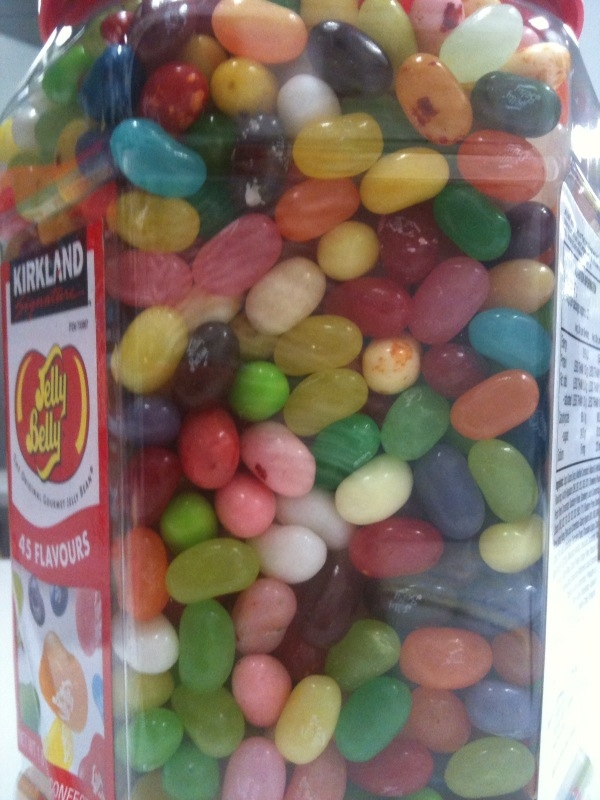
For some ridiculous reason, when I crack open a new jar of jelly beans I think ‘Mmmm, fresh’, as if I’ve just picked each and every last bean from a vegie patch. The reality is I picked up the jar at Costco.

A new jar

This is what sits on my desk, ostensibly for quick hypo pick-me-ups. But also for the 4pm sugar low that hits the non-pancreatically challenged people in the office too. I’m happy to share!

I’ve always thought of jelly beans as medicinal. I don’t really like them and would never eat them as a treat or if I felt like something sweet – that’s what chocolate’s for! But, I like that they are bright, colourful and easy to grab by the handful. And they fix up a low nice and quick.

“Are you having a hypo, mummy?” my six-year old daughter asked me the other day. This was in response to me asking her to please pick up the fifty or so books she had scattered on the floor. When I told her I didn’t believe she was reading ALL of them at once, she assumed my slightly snippy response was due to low blood sugar.

I wanted to tell her ‘Sometimes it’s not diabetes’, but instead, laughed. And told her to pick up her books.

What do our children understand about having a parent with type 1 diabetes?

I started wondering the answer to this question when my daughter was very young – less than 12 months old. Before she could even speak she knew things about mummy and diabetes. She knew that if she was looking for a feed and reached down my top, she would find a pump stashed there.

And yet if she reached down anyone else’s top – which she did, (she was always looking for a feed!), there wouldn’t be a pump. The one time that she actually did find another pump – reaching down my friend Jodie’s top – the look of complete astonishment and amazement was priceless!

As she fed, lying back contentedly, she would gently hold the pump line. Never pulling it out, just gripping on to it with her pudgy little paws.

The kidlet has always known that the jar of jelly snakes on the kitchen bench is for me and me alone, and she explains to her friends why, when they ask for one, it’s important that no one else eats them. When she was little, I referred to the jar as ‘mummy’s medicine’. Until, of course, she tasted one. Then the word ‘medicine’ was replaced with ‘hypo treatment’ and over time she came to understand what that means.

It’s a natural reaction to try to protect our children from bad stuff. I don’t want to scare my daughter, so the really nasty things get hidden. The fears and anxiety don’t get discussed around her. But I absolutely resent that diabetes intrudes into our life.

I hate that she knows that there are moments when I simply can’t read to or play with her because I am dealing with low blood sugar and right at that moment there is nothing more I can do.

And I hate that she sees me when my blood sugar is high and I am flaked out on the couch trying to keep the nausea at bay.

But I love the way she jumped at someone who said people with diabetes have an illness. ‘My mummy is not sick!’ she said indignantly. ‘She has type 1 diabetes’. And when I overheard her explaining to someone that ‘there is no cure for type 1 diabetes and there is nothing that mummy could have done to have stopped getting it’.

The other day when she asked me if she would get diabetes, I could barely breathe. I felt that my heart was being torn out of me as the terror that is hidden there made its way to the surface. I looked away to hide the tears, and wished with every cell of my being that I could promise her that of course she wouldn’t get diabetes.

Instead, I gulped in some fresh air, smiled brightly and said ‘I hope not’. And then stopped and said ‘But if you do, it won’t stop you from doing anything. And we’ll look after you to make sure that you are OK.’ And then I turned away again to blink away the tears.

Finding what and how we want to explain diabetes to children is a difficult and highly personal matter. I decided early on that I wanted to keep my diabetes away from our girl. Not because I am ashamed of living with this condition, but rather because I didn’t want to trouble her with it. But I soon realised that there are parts of living with diabetes that I do want to share with her and that there are ways to do it that are not a burden. Instead they show her my resilience and my ‘never give in’ attitude. Which is something I inherited from my mother who also lives with a chronic medical condition. I think of how proud I am of how she has lived with Lupus for the last 30 years; for the way that she hasn’t stopped doing all the things she has wanted to do and the way that she is a terrific advocate for and inspiration to people with her condition.

I want my girl to think of me with the same pride and admiration.

Our children needn’t think of us as broken because we have diabetes. For me, I want to show our daughter that diabetes is just one part of me – and to some degree makes me the person that I am. And that it doesn’t make me any less of a mother because I live with this condition.

It’s just about finding the way to explain things in an age-appropriate and relevant way. Earlier this month on Diabetes Art Day, I read the Six Until Me blog about how Kerri Morrone Sparling is using art to teacher her baby daughter about diabetes. What a perfect way to introduce the condition to her little one.

And for us, in our little home, even if the kidlet sees the bad days, she will be acutely aware that there are far more good days. And on those days, diabetes is kept in its rightful place.

This post is my September entry in the DSMA* Blog Carnival. If you’d like to participate too, you can get all of the information here.

I’ve blogged before that I have been accused of making diabetes look easy and fun. It’s neither of these things. And I’m not a very good actress either, so it surprises me that people think that. In some of my recent blogs at Diabetes Australia – Vic, I have delved into the darker side of my life with diabetes – specifically the way hypos are changing and how that’s making me feel.

But this week, when yet another person told me that by looking at and listening to me, diabetes can’t be all that difficult I started wondering why. And then I realised. It’s because the ugly truth gets hidden. And I laugh a lot about how hopeless I am at things instead of stopping and really pointing out how they affect me.

Because, if I didn’t laugh, then I would cry!

If I didn’t laugh about my constant dia-mistakes, I would spend every waking minute second guessing my diabetes decisions.

If I didn’t laugh about ‘splurters’ (you know – finger pricks that ‘splurt’ everywhere), I would never wear white tops (and I love white!).

If I didn’t laugh about all the diabetes paraphernalia I need to carry, then I wouldn’t have an excuse to keep searching for the perfect bag (and buying the not-quite-perfect-ones in the meantime).

If I didn’t laugh about (and cheer) the diabetes nirvana that is 5.5mmol/l, then I wouldn’t have an excuse to post pictures of my BGL meter (with said 5.5mmol/l) on Facebook and Twitter.

If I didn’t laugh about being the person with the largest jar of jelly beans and Chupa Chups on her desk, then I would probably feel guilty about the vast quantities of sugar sitting in one place.

If I didn’t laugh at sharing diabetes war stories with my pancreatically-challenged friends, then I wouldn’t feel the community, solidarity and love from these amazing people.

If I didn’t laugh (sarcastically) when people ask ‘Should you be eating that’, then I would probably hit people, (and would have a criminal record by now).

If I didn’t laugh (again, sarcastically) when people refer to me as a ‘diabetes sufferer’, then I would start to feel victimised.

And if I didn’t laugh, rejoice and celebrate at what I am learning from the DOC, then I would feel a lot more alone and isolated.

DSMA is Diabetes Social Media Advocacy. If you don’t know who they are, please have a look here. And follow on Twitter @DiabetesSocMed. For those of us in Australia it’s a way to feel linked to the wider diabetes community. And that, in my opinion, is a great thing!

Follow Diabetogenic on WordPress.com

Enter your email address to follow this blog and receive notifications of new posts by email.

Read about Renza

Archives
