There is a hushed feel to the room. Even as people walk in to register, they whisper their names and nervously ask if they can take copies of the resources from the tables. They usually come in pairs, and together they speak softly to each other and stand close. As the doors open to the lecture room, they walk in, sit down and look ahead. This isn’t one of our usual events where there’s lots of chatter and sharing of stories. This one is more personal, more urgent. This one is about babies.

It was our diabetes and pregnancy information evening. We started running these sessions almost 10 years ago. I can still remember the first session. As we planned the event, I was terrified that no one would show up. Over 100 people attended – women with diabetes and their partners or mums or sisters or friends. I spoke to a couple of women who didn’t have diabetes, but their teenage daughters did. Although their daughters didn’t come along, these mums wanted to have all the information they could get. What wonderful mums!

Now, all these years later, we still get a good number of people attending. We had over 80 booked in for this session and most showed up, eager to find out about diabetes, healthy pregnancies and healthy babies.

There is so much hope and anticipation in the room. And you can almost feel the rollercoaster of emotions in the room as the obstetrician and endocrinologist gently, but firmly, outline how diabetes can impact on a pregnancy and how pregnancy can impact on diabetes. There’s some scary information in there, but there is also a really positive message. And when I’m emceeing the event, I make sure that message is not lost. Here it is:

Can I expect a healthy baby?

Yes. Women with diabetes have an equal chance of having a healthy baby if they become pregnant at a time when their diabetes is controlled and general health is good. It is highly recommended that women with diabetes plan their pregnancies.

                                                                                                                                                   From ‘Can I Have a Healthy Baby?’

It’s good news, it’s positive news and I can feel the relief in the room when we focus on this for a moment. At that point we bring it all together and ask the women in the room (and their partners) to take a deep breath. Because we bring out our ‘case study’ – the good news that ties it all together!.

This year, my dear friend and colleague, Kim, stepped up and volunteered to share her story. Kim has two beautiful children. And when I say beautiful, I’m talking put-them-on-a-box-of-nappies gorgeous!  We keep using photos of them for our diabetes and pregnancy resources because we can’t get enough of them!

Kim’s story is wonderful. And her candidness and honesty about how her family came to being so perfectly complete is not all perfection. There were struggles, disappointments and the need to wait. But her children are here and they are a joy.

I’ve said before how much I love my job, and this event is one of the reasons. I love the fact that each year after we’ve run the event, I get calls from women who were there, and are now pregnant. And others who have attended send me photos of their beautiful, beautiful babies.

Pregnancy with diabetes is not easy. But it is absolutely achievable and even though whilst we’re in the middle of a pregnancy that we feel may never end, as we check our blood sugar for what seems the millionth time – just for that day!,  as we sit in the waiting room of yet another doctor’s office or hospital clinic, it is all worth it. And as we hold that precious baby in our arms for the first time – and every time after that we know that it was all worth it.

My own healthy baby; a day old and so precious.

Looking for information about diabetes and pregnancy? The ‘Can I Have a Healthy Baby?’ information booklet is a great place to start and can be downloaded for free here.

And call Diabetes Australia on 1300 156 588 for a free copy of the fabulous ‘Having a Healthy Baby’ DVD.

I’m feeling a little vulnerable after a few nasty overnight lows. Three times in the last week I’ve woken around 2.30am with the tell-tale ‘I’m low’ alarms screeching in my heads. I feel heavy. I feel like this.

It goes like this. The middle of the night, and I wake, but not really. I drift between sleep and awake, and whatever dream I am in the midst of starts to become real. I sleep some more, but now, my awake becomes part of my dream and I can’t tell where I begin and where I end.

I know that something is not right and I try to force myself to stir. My eyes are forced open. Legs and arms are heavy. All of me is heavy and thick and my head is muddled. I’m low and I know it, but I can’t remember how to respond.

I drift off to sleep again.

And wake.

‘Get up. Move!’ I tell myself. I try to call to Aaron, but there’s no sound. I reach over for the jar on the bedside table and prise open the lid. And sleep again.

When I wake, there are jellybeans in my hand, but none in my mouth. (I’m lucid right now as I write this, and think about how easy it would be if the glucose could be absorbed through my skin into my bloodstream!) Hand to mouth, tell myself to chew and feel the glucose running down my throat. I force myself not to drift to sleep again, now conscious enough to know that falling asleep with a mouthful of jellybeans is probably not a good idea.

And I’m awake – wide awake, heart pounding, drenched in sweat and starting to panic. Aaron sits up – sensing my terror. He passes me my meter after putting a strip into it. Click goes the lancet and five seconds counts down. 1.2mmol/l it says to me. The numbers don’t register to me, but I can see in Aaron’s face that it’s low. He gets up and grabs me a glass of juice and coaxes it down.

We wait, silently. Bella, our dog stirs in the bathroom, hearing us, thinking it’s morning. She gently scratches at the door, but goes back to sleep when she realised that no one is coming to get her and let her out.

Another BGL check and a 2.6mmol/l. Who would have thought that a number beginning with a two would make us feel better? Safer.

Aaron starts to fall asleep, but I can’t. I am now scared as I start to wonder what this hypo has done to my body. I try to remember recent hypos and how low I was. I lie awake, too scared to sleep. And now I start to count down the hours until the alarm goes off and the day begins.

Eventually, I sleep. But I’m unsettled and force myself awake every hour or so to check my BGL. Not reassured by any number. But I’m not low, so I allow myself to doze again.

The alarm sounds. My body feels like lead. I get up, face the day. It’s another night with diabetes. It’s another day.

So, I guess it’s time for some basal testing and maybe a visit to my lovely endocrinologist. What do others do to help deal with the fallout from hypos that leave you feeling overwhelmed?

In keeping with this week’s post to my sixteen-year-old self, and in light of the fact that today is my fourteen year diaversary, I thought I’d write a letter to my 24-and-a-half-year-old self. Because it was at that age that I was diagnosed with type 1 diabetes and I had no idea what that would mean. If only I could have known that things actually would be OK I think that the initial coping period would have been significantly easier.

Dear 24-and-a-half-year-old-me

Oh, sweetie. Diabetes sucks. You don’t know that yet, but let’s clear that up from the beginning. It sucks. It’s not fun and it is a pain in parts of you that you didn’t even know could hurt. But figuratively more that literally.

Right now, you are overwhelmed, stressed, anxious, scared and terrified. In a couple of weeks you’re going to get angry. Really angry! It’s OK to be feeling all these things.

You will be fluent in a new language within the next few weeks. Words that you’d never heard of become part of your vernacular, and you become incredibly conversant in anagrams. BGL, CSII, HbA1c, DA-Vic, ADEA…. And you will delight in the fun way mmol/l rolls of your tongue. (I promise – that will make sense!)

Believe it or not, you are going to be absolutely fine about sticking a needle into your skin four times a day. And you’ll find that actually, it doesn’t hurt. You won’t be quite as comfortable about the jabbing your fingers what feels like a million times a week to find out what your blood sugar is doing.

But things get better. The lancet device you have now is pretty horrendous and in a couple of years, you’ll get a new one that doesn’t make quite as nasty a clunking sound, and will hurt less. Also, the first meter you have will take 20 seconds to count down to tell you your BGL. Wait until you get one that takes five seconds! You won’t know what to do with all that extra time in your day!

Find out everything you can about insulin pumps. Speak with people using one. In three years you will have one and it will change your life. I want you to hold on to that over the next couple of years when things are not going as you’d like with your diabetes management and you think that you’ll never work it out. You do. And your pump is a huge help.

(Also, perhaps tone down the evangelical pump attitude you develop. You become a little zealot-like. Yes, it worked for you, but it may not be for everyone. BUT INSULIN PUMPS ROCK!!!!)

Can we just talk about guilt for a minute? Diabetes comes with a lot of it and you’re going to learn that really quickly. Here are some things that you absolutely should not feel guilty about:

  • The fact that you don’t change your lancet EVERY time you check your BGL
  • Ditto goes for pen needles, and after three years, pump changes
  • What you eat. Food does not have a moral compass.
  • When you feel overwhelmed and completely ‘over’ having diabetes
  • Not wanting to be a diabetes advocate ALL THE TIME
  • Accepting that saying ‘that’ll do‘ when it comes to your diabetes doesn’t make you a bad person; in fact, it makes the whole diabetes palaver more manageable!

As you are in the middle of your wedding plans, here are some things I want you to know about that day so you can relax a little. It is a fantastic day. Your dress is stunning, your hair looks fine and you find the shoes you have been searching for. Diabetes comes along for the ride, but it’s in the background and no one mentions it on the day except for your mum asking quietly if your BGL is OK.

(Also, the cars will be running late, but they’ll get there; and deliver you to the church inside Aaron’s ‘you’ve-got-fifteen-minutes-or-I’m-heading-to-the-pub’ timeframe.)

Oh, and when you meet your endocrinologist for the first time, he is going to tell you that diabetes will not stop you from having babies, as long as you have finished having your family by the time you are thirty. And you are going to wonder how it will be possible for you in the next five and a half years to fit in all the things you planned AS WELL as have a couple of kids. Don’t stress. Soon, you will find an endocrinologist who sets you straight. And when you are three days shy of thirty-one you will have a daughter. She’s a delight.

He will also show you some scary pictures of amputated limbs, kidney failure and tell you that you may go blind. Please, please, please don’t be shocked by what he says. The scare tactics that are used on you by him and other diabetes health professionals you will meet in the next couple of years will actually make you angry and determined. This is a good thing. As you seek out information, you will learn that complications are not inevitable and you will do everything possible to minimise your risk. And you will also come to understand that the guilt associated with complications is not fair.

You are going to meet some incredible people in the next few years – some of them become some of your best friends. Having a support network of people living with diabetes will inspire you, help you. Seek them out! And you have no idea what this means, but when, in 2011, you decide to get on Twitter, embrace it like there’s no tomorrow. Your mind will be opened up to a world of amazing, inspiring, caring, funny people all over the world who, like you, live and love with diabetes. You will call these people your friends and you will be part of a global community that makes you feel accepted and safe.

So 24-and-a-half-year-old me. The future isn’t as grim as you think it is right now.

With fondness,

38-year-old-me

P.S. I also wish that right now you would look back to last week. Remember when you didn’t need to consider the carb content of the food you are about to eat, or wonder how it will impact on your BGLs. And I want you to remember not having to give yourself a needle before you eat lunch. Really, really remember that time, maybe write about it. At 38, you won’t remember. It will be as if you have always had diabetes. Always.

There’s been a fun hashtag doing the rounds on Twitter in the last 24 hours or so: #dear16yearoldme.

It seems a long time ago that I was sixteen. It WAS a long time ago that I was sixteen! But with increased age comes increased wisdom. And this is what I’d like to tell my sixteen year old self:

  • You have a working pancreas. Don’t take that for granted. Right now, you have no idea what that means, but when you are 24 years old you will. So, if you’re going to eat that jam doughnut (and really – if you want it, go on and eat it), I want you to marvel at the fact that your pancreas will release insulin. ‘Cause it ain’t going to do that forever!
  • You are not fat. Seriously. Get over yourself! (So just eat the bloody doughnut!)
  • Keep playing the flute – because you will get into the Conservatorium of Music at Melbourne Uni and meet the most wonderful man. And you’ll marry him! (And dear 19 year old me, don’t hate him when you first meet him. Even If he is playing the saxophone loudly and you have a headache. Also, make sure you do buy that handkerchief skirt. It’s what you wore the day you met and he can still remember you in it!)
  • Don’t announce to anyone and everyone in a throw away voice ‘Oh, I don’t want children’. Because one day you will and it will take you a long time for it to happen. And your heart will break until you can. But when you do, you will have the most beautiful daughter. And your heart will sing every day because of her.
  • Listen to your father. He is right. Damn it!
  • And your wonderful relationship with your mum continues. Don’t take that – or her – for granted. She will be your rock in some really difficult times ahead. Also, admire the way she lives with her chronic health condition. She will become your inspiration in more ways than you can imagine in a few years’ time.
  • Maths is important. You’re going to need to use algebra to work out the carb content in food. So pay attention!
  • And also, your year 12 English teacher who tells you that, at some point, you’re going to want to be a writer is right. Listen to her. Learn from her. And read everything on her reading list.
  • Those white jeans. Throw them out. Now!
  • That ridiculously affected thing you and your friend do – you know, sitting in a coin laundry reading Beat poets and novelists? It’s pretentious. Just read the bloody books. And you don’t like black coffee – no matter how much you pretend you do!
  • The nerdy thing you are trying so hard to escape? Embrace it!  Seriously – you are a 16 year old flute player. And you sit in the laundromat reading Jack Kerouac. And you can recite Howl. The only way is geek!
  • Your life is not hard. No matter how much you think that it’s not fair, you’re wrong. You’re incredibly lucky.
  • You talk too much. But that’s OK and it will come in handy later on. As will debating, so keep doing that!
  • That guy on the Glenferrie Road tram. He’s just not that into you. Move on!
  • Two words: Harry Potter. You are going to LOVE IT!
  • Those girls from school who you think are your best friends? They are! And they continue to be your best friends as you grow up. Treasure this time with them. (And try to remember funny stories. And take lots of photos of bad hair and daggy clothes to torment each other as you get older!)
  • Wear a cardigan. It’s cold out there in Winter!
  • Thirty eight isn’t old! Really, it isn’t. And I promise you this. You are OK. In fact you are better than OK. And your life turns out really well. You continue to be incredibly lucky!

This topic is part of Health Activist Writer’s Month Challenge (#HAWMC) by Wego Health. The challenge is 30 days, 30 posts. I am a realist, and know that I am not going to be able to do the full 30 posts. But this one I absolutely had to do!  Here’s more information about the challenge.

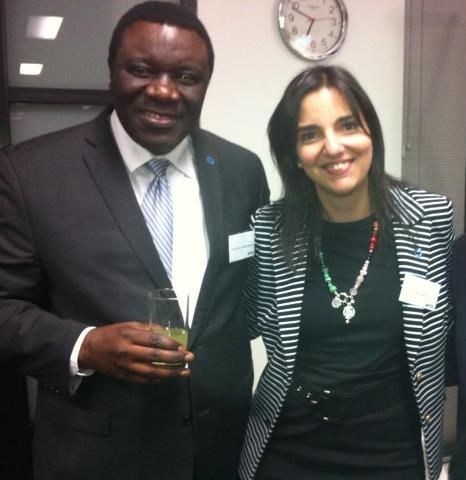
I had one of those weeks last week that makes me eternally grateful for my job! On Monday, International Diabetes Federation president, Professor Jean Claude Mbanya visited Diabetes Australia – Vic and gave two presentations to staff.

I was then lucky enough to interview Professor Mbanya and you can see the interview here.

Then on Wednesday, I visited our Autumn Camp. Fifty kids with diabetes were enjoying Victoria’s beautiful Autumn weather in an idyllic bush setting. We arrived at camp to see the kids playing frisbee, kicking around footballs, lazily lying around on the grass chatting and scaring me senseless as they launched themselves off the flying fox. (Not a single kid screamed. I, on the other hand, wanted to cover my eyes in terror.)

I am incredibly fortunate to have a job that I love. But even more than that, I have a job that gives me so much. I meet inspirational people – quite regularly, actually. I get to visit kids with diabetes at camp and see what an impact a few days away with other kids has on them – and then I speak with their parents about how their kids have returned home more confident, comfortable in themselves and fiercely independent.

Someone said to me that other day how it must be wonderful doing a job where I know that I’m ‘giving back’ to the community. Actually, when I really think about it, I think I’m the one who’s getting the good deal here. Eternally grateful and incredibly lucky!

Last night I sat in Melbourne’s beautiful Regent Theatre to hear Jamie Oliver in discussion with Matt Preston. There is a lot of chatter about food at the moment – Jamie’s visit coincides with the Melbourne Food and Wine Festival. But last night, he wasn’t throwing together a cheeky risotto. He was speaking about his project The Ministry of Food.

As Jamie explained, the Ministry of Food has its roots in a campaign from the Second World War. The British Government set up a team of cooking teachers whose role was to educate the public about food and teach people to use the available rations to produce healthy meals for their families. And ensure there was still cake at birthdays! (I liked that bit.)

Today, a lot of people don’t know how to cook. Fast food is easily and readily available. For every farmers’ market selling organic apples, there are a dozen supermarkets with weekly specials of cheaply-made biscuits. Throwing together a dinner of chops and three vegies has become too hard for some. And others simply don’t have the know-how. Some kids don’t know the difference between a turnip and a tomato.

I find this staggering, but then I love to cook. I want to know where my food has come from, and there is nothing I love more than baking a cake or a batch of cookies. And I am desperately trying to instil these values about food in my daughter.

Jamie Oliver says he doesn’t have all the answers. But he does make sense when he says that there are some simple things that can be done. Whilst acknowledging a previous business partnership with a supermarket chain, he believes that if a supermarket is going to have 100 items on a ‘buy one, get one free’ deal, then be fair and make sure that half of them are fresh foods. Make it as easy for us to choose the healthy option as the pre-packaged, not-so-healthy option.

He says that every child should be able to cook five meals by the time they leave school. Five meals. When I stopped to think about this, I remembered how I learnt to cook. On Friday nights, when there wasn’t the mad rush to get to bed early, read stories and pack our bags for school the following day, the kitchen was handed over to my sister and me.

With Mum watching and helping out as required, we would prepare dinner. We started with scrambled eggs – one of the simplest recipes possible. We learnt to make crepes, beef stroganoff (hey – it was the early ‘80s!) and pasta dishes. We learnt to throw together a salad to accompany all meals. By the time I left home at 21, I could cook. It wasn’t a big deal. It was just something I could do. My sister was the same – and I’m sure that if we’d had a brother he would have been in the same boat.

Jamie also believes that there needs to be some regulation in place, but he’s absolutely not the food police. I love the fact that he’s not militant (although I could sense members of the food police in attendance – there were numerous occasions of shock and horror gasps and judgey tsk-ing). Jamie eats chips! Jamie says it’s okay to eat pizza! Jamie says burgers are fine! But what he’s saying is don’t eat it every day. And add some vegies, for goodness sake!

None of what Jamie says is rocket science and he is the first person to admit this. He also knows that he has profile, he has a platform and he has the means to make a change. He has put these issues firmly on the social agenda through his television programs and his campaigns.

Jamie also believes in the importance of people power and consumer advocacy. His call to action last night was for every member of the audience to send a one line email to their local MP with the following: All children should learn to cook.

You think it sounds simplistic? You don’t think that you sending that one email will make a difference? What about if you, all your friends and family do? What about if you put it up on your Facebook page asking your friends to tell their friends?

Yes, this is a type 1 diabetes blog. But the reason that I went to see Jamie last night, and the reason I decided to blog about it today is because I know that for every child out there who has food knowledge, there are many who don’t. And I think we all have a responsibility in this. As individuals; of course. But also as a community.

Want to be part of an online community that can and does make a difference? Check out the Parents’ Jury website and become a member.

Getting my kid cooking!

I’ve been thinking a lot about interpretive dance lately. And how, if a dance company wanted to create and choreograph a routine about diabetes what it would look like.

There would be lots of silk scarves, head holding angst and flying. And maybe some Kate Bush-style running through a forest.* And somewhere, Stevie Nicks.

And if someone wanted to compose a concerto about diabetes, Richard Tognetti could perform it on his antique Guarneri. What a terrific opportunity to test out the strength and depth of the low notes (representing middle of the night lows) and the soaring ability of the high register (which would be the musical version of a person with diabetes screeching ‘Where did that freaking 31.5mmol/l come from’).

Getting the message out about diabetes can happen in many ways. In the olden days, it was health professionals who held all the information. We were told what they felt they wanted to tell us or what they thought we needed to hear and they could scare us with tales of what would happen if we didn’t listen to them. And so we made up numbers in logbooks and told them that we ate nothing but seeds and celery.

Then, someone brilliant and clever and shiny and bright got the good idea that people living with diabetes could share stories and we could learn from each other. In the early days, this was in the way of a support group, which, contrary to my initial phobias about diabetes support groups, is not about sitting around, holding hands and singing ‘how do you solve a problem like a dud pancreas?’ Actually, it was about dynamic people getting together and talking and listening and sharing. And about realising that we are not alone. I love that!

And then, another clever moppet invented the World Wide Webosphere and it was at that point we all met the most sharing health professional of all, Doctor Google. Dr G has no filter (even though he pretends to) and if you say to Dr Google, ‘Tell me about diabetes’, you will receive information about EVERYTHING EVER WRITTEN, including how cinnamon will cure your diabetes. (Which, incidentally, causes me great concern when I make one of my favourite late-night snacks – cinnamon toast. Do I bolus for the carbs in the bread and sugar, or not bother, because the cinnamon cancels it out?**)

Suddenly, we could all read things on this Webosphere and connect with each other. People started sharing their stories on blogs (like this little one you’re reading here) and on Mark Zuckerberg’s magic planet Facebook. And then came Twitter where we could share and tweet and connect and have chats where five billion people answer questions to ‘what would you like to say to your pancreas?’ (My favourite response to that was ‘get a job!’)

And there’s so much more! There are plays that tell stories about people with diabetes and there is even a musical. I kid you not! It’s called Diabetes – the Musical. There are songs and You Tube clips galore. Cartoons add humour, describe the frustration and provide insight to real-life situations.

Hearing about diabetes in a different format is refreshing. It gives you a different perspective and frequently, you’ll learn something new. Have a look out there and see what you can find. And let me know – especially if you find anything to do with interpretive dance.

*OK, now I have Wuthering Heights going through my head constantly. Don’t blame me if you do, too!

**Kidding! I know that cinnamon doesn’t cure diabetes. That’s what chromium supplements are for!

The Blue Circle

To me, the blue circle that is the symbol of World Diabetes Day is such a perfect representation of diabetes. It’s about diabetes awareness, diabetes unity and a symbol of hope. But the circle shape also represents some of the more difficult aspects of diabetes, too.

Diabetes is a cruel, cruel monster sometimes. There are many things about living with this condition that make me want to pick up my bat and ball and go home. (Or pick up my pump and BGL monitor, throw them in the bin and pretend I don’t have diabetes.)

For me, the cruellest, meanest, nastiest thing diabetes does is hypo unawareness as a result of a ‘great’ or in-range HbA1c. This is diabetes at its most mocking.

Many people who have lived with type 1 diabetes for some time will experience impaired hypoglycaemia awareness – for economy of language, let’s refer to it as we all do, hypo unawareness.

As someone who on occasion has experienced this, let me tell you that it’s terrifying beyond belief. It can be paralysing and makes me second guess every single diabetes decision I make. And those decisions add up to dozens each day.

So, how is hypo unawareness ‘fixed’? Well, it’s recommend that we remedy our unawareness by running our sugars a ‘little high – say 10 or 12’ for a few weeks and ‘avoid hypos’. I have always marvelled at this advice on a number of levels.

Firstly, the one thing I remember most about my diagnosis is the photos of amputated limbs, threats of blindness and dialysis, and being told I needed to have my kids before I turned thirty. Since that day, every time I see a double-digit number on my meter, I see an amputated foot. So, telling me to ‘run a little high – say 10 or 12’ isn’t a matter of accepting those numbers as just numbers. I see them as my toes falling off.

Also, surely, ‘running a little high – say 10 or 12’ is the same as saying ‘run your sugars a little perfectly – say 4 or 5’. If it’s as easy as picking a number and sticking to it, then surely we’d all just pick 5.5mmol/l and go with that all the time, posting each and every result to Facebook and Twitter.

And finally, the term ‘avoid hypos’ suggests that it’s an easy thing to do. Seriously, if it was that simple, I’m not sure too many people with diabetes would keep playing the blood sugar limbo that is ‘how low can you go?’

Often, the appearance of hypo unawareness coincides with periods of what is often termed ‘tight control’ – and often a ‘good’ HbA1c. Ah, the HbA1c – the number that manages to sum up a person with diabetes’ worth. How many people dread getting their A1c result? How many people avoid having their A1c checked because they are afraid of 1. the result and 2. the response this will elicit from their health professional?

My hand is waving highly in the air for all of those. I am terrified by that number. And I have an endocrinologist l who doesn’t attach a moral compass to numbers – to her, it’s a piece of information which we can work with. Nothing more, nothing less. (I do love her!)

But I have been trained to encapsulate my worth in that little number. When I was trying to get pregnant, it couldn’t be low enough for me; whilst I was pregnant it needed to be steady and unreasonably low, and now, to stop those images of complications flying into my head, it needs to be below 7%.

Is it? No, right now it’s not. The pat-me-on-the-back A1cs I achieved whilst pregnant were the result of extreme anxiety, checking my BGs around 15 times each day and responding to each and every number I saw. And seriously nasty hypo unawareness. Sure, I delivered a gorgeous healthy little girl, but for the whole pregnancy the number 11 not only meant ‘toe falling off’ but also ‘congenital deformity – bad mother!’

The frustration about diabetes is that the harder we work the more things we have to do. A great A1c often equals hypo unawareness which means ‘running a little high – say 10 or 12’ which means an increased A1c, which means complications….and so the circle of diabetes continues.

I know how this circle works, and what it means to me is that I can’t do ‘A’ (have a ‘good A1c) without it causing ‘B’ (hypo unawareness), the remedy of which is ‘C’ (run a little high) which will lead to ‘D’ (complications). When we are in the midst of learning about diabetes, the equation is never presented to us. Each letter is discussed in isolation, never as a result or cause of something else.

There has to be a better way. If only I knew what it was.

Oh, the judgement, sideways glances and assumptions I’ve encountered over the past week about the diabetes shortcuts I take. Seriously, if there was a diabetes heaven, St Peter wouldn’t be letting me in. Apparently, I am a ‘bad, bad diabetic’ in so many ways. The diabetes police have been making that very clear.

Interestingly – and not surprisingly – none of that judgement has come from other PWD. Instead, I’ve received understanding nods and similar tales. Extensive polling (N=4) has shown that my short cuts are pretty typical.

A discussion about lancet devices in a meeting the other day had me wondering whether I should curl up under the desk and hide, or admit to my reality. Which is this: I check my blood sugar somewhere between six and 12 times a day. I don’t change my lancet every time I check my BGL. I don’t change it every day. Damn, I don’t change it every week. I change it when the little pinch that usually accompanies the lancet going in turns into pain resulting in expletives.

When it comes to pump line changes, I am clearly not the model pump user. I don’t do a full line and cartridge change every three days. I refill my cartridge and sometimes reuse the same line when I’ve got a new cannula in. And sometimes the recommended three days stretches to four or five. I make an educated call based on the fact that there is no pain or redness around the site, and my BGLs are not climbing into the stratosphere.

I can explain in one sentence why I take these shortcuts: It makes things that little bit easier.

Don’t think for a minute that I don’t know that it is recommended that I change my lancet each and every time I check my BGL.

And I am very aware that it’s advised that I change the cartridge in my pump every time it runs out of insulin.

Diabetes is boring. It is tedious, dull, dreary, monotonous, mind-numbingly tiresome. The Groundhog Day that is diabetes never ends. And I live it every day – without Andy McDowell’s gorgeous curls.

I make no excuses for taking short cuts where I can. I make no apologies for saying ‘that’ll do’. Because I am actually doing a pretty damn fantastic job, really. Even if the numbers aren’t perfect, even if there are days when that number of BGL checks is below what I’d like, and even if there are days when I wish diabetes would just. Freaking. Go. AWAY.

It’s never enough. It seems that the positive things I do (regular BG checks, counting carbs, bolusing insulin, basal checking) get ignored by the judge(s) and jury because of the short cuts I take; the short cuts which really aren’t negatively affecting my diabetes management. I could argue that the short cuts are actually positively affecting my management, because the tiny steps I save make the monotony that little bit more bearable.

When is it enough? When does the judgement from others and the guilt from ourselves disappear? What does it take for ‘that’ll do’ to become ‘that’s brilliant’?

Over at the Diabetes Australia – Vic blog today I write about 11 years of being connected. It’s my pumpiversary. (Not a real word, but fun anyway!) Read about it here.

Follow Diabetogenic on WordPress.com

Enter your email address to follow this blog and receive notifications of new posts by email.

Read about Renza

Archives