
You are currently browsing the category archive for the ‘Uncategorized’ category.
I’m in beautiful Nijmegen in The Netherlands for a couple of days for the AGM of the HypoRESOLVE project. We’re in the midst of a very busy time of meetings, updates, sessions about data and statistics (my jet lagged brain is doing its best to keep up!) and discussions about just how significant hypoglycaemia is to people living with diabetes.
Here’s what I wrote after the kick off meeting twelve months ago. The project has made lots of progress and there will be more about that as it all comes to hand. But in the meantime, here’s what happened back in May last year in Copenhagen when the project was launched. (My disclosures remain as per the end of this post.)
I’m back from a very busy week in London and Copenhagen. I arrived back in the door at home exactly two minutes after Harry and Meghan got hitched, so I missed the whole happy occasion. If only we had some sort of magical way to see photos and videos and relive beautiful experiences like that. Oh well, never mind.
The main reason for my trip was for the kick-off meeting for Hypo-RESOLVE, a new four-year project focusing on better understanding hypoglycaemia. I’m there as part of the Patient Advisory Committee (PAC), which is made up of advocates from across Europe. Obviously, it is now legislated that an Australian also be included in any European diabetes advocate activities. I believe it’s called the Eurovision Law.
The project is made up of eight work packages, each led and staffed by leading European diabetes researchers and clinicians, and after seeing just who was going to be in the room, I suddenly was struck down by the worst case of Imposter Syndrome I have ever experienced. This didn’t get any better when I was told that the presentation I had been asked to give was not only for the PAC. No – it would be in front of all eighty project participants. I looked at the list of who I would be standing up and speaking to, and cursed the meme- and photo-filled presentation I had prepared, wondering if I could pretend to understand statistics and graphs, and add some to my slide deck to at least try to sound smart.
I decided to stick with what I knew (memes, cartoons, photos of weird hypo tales), and left the slide deck as it was, hoping against all hope that I would manage to keep myself nice, and sound as though I understood what I was speaking about.
I was asked to give a talk about the real life experiences of hypoglycaemia. Fortunately I have kept a pretty good record of the literal lows of my diabetes (which, incidentally, was the title of my talk). Thanks to the search function on Diabetogenic, I was able to easily pull together a number of stories about the lows I’ve had. This proved to be more useful than I realised because these days, lows are few and far between. Since I started Looping, I’ve not had the sort of low that has made me want to write about it and try to analyse what it all means in my diabetes life. In fact, I’ve not had any lows that have required anything more than a mouthful of juice or a couple of fruit pastilles to treat.
Reading back through my blog posts was actually really quite confronting, and I found myself getting emotional as I read details of terribly scary lows and how they had impacted on me – in the moment, and in the days following. As I read, I remembered the anxieties I felt about something happening while low that would seriously affect my family.
I’ve not asked them, but I wonder if the fact that I have so few hypos these days makes Aaron and the kidlet feel calmer about my diabetes. They still see me sucking on a juice box every now and then, but it is done without urgency, and without the look in my eyes that betrays the calm I used to try (and fail) to convey.
In my talk, I really tried to express just how significant hypos have been in my life with diabetes. I tried to explain that even once a low is ‘fixed’ there are often residual effects – effects far beyond just trying to work out what my glucose levels would do after playing the how-low-can-you-go-hypo-limbo.
I spoke about how the emotional fallout after a nasty hypo can be crippling, leading me to second guess every diabetes decision I made, wondering what I had done to cause the low in the first place – because that is the ongoing narrative of diabetes….we did something wrong to cause the hypo (or the complication, or the high, or the technology failure). And I really tried to explain how sometimes there are no answers, no matter how hard we look, or how desperate we are to find something to blame.
Of course I spoke about the language of lows and how the words we use impact on the way that hypos are considered. There is no doubt that ‘severe’ hypos are serious and need urgent attention and investigation, but so-called ‘mild’ hypos can be just as burdensome.
Obviously, everyone’s hypo stories will be different and I took great pains to clarify that I was speaking of my own experiences only. In the past, hypos have terrified, paralysed and alarmed me. I was afraid to sleep, I was afraid of lows when awake. I was scared I would have a particularly nasty low around my daughter and scare her. I am fortunate that my deliberate non-compliance has resulted in almost no lows, and feeling safer that I have ever felt before. My fear of hypoglycaemia is manageable these days, yet I don’t take for granted that it will always be like this. I still carry hypo food around with me – there is no point tempting the hypo gods by not being prepared!
I’ll be writing more about Hypo-RESOLVE in coming days. I’m so pleased to be involved in such an exciting and interesting project; I’m honoured to have been selected for the PAC. I’m beyond thrilled that PWD are included in the DNA of the project – right from the kick-off, not brought in at the last minute for comment when all the decisions have been made. And mostly, I am grateful that hypoglycaemia is being given the attention it deserves. I honesty hope that one day no one ever needs to feel the panic and fear that so many of us have come to know.

Kicking off the kick-off meeting
MORE:
You can read all about Hypo-RESOLVE in the Innovative Medicines Initiative media release from last week announcing the launch of the project.
DISCLOSURE
My flights and accommodation to attend the Hypo-RESOLVE kick off meetings were funded from within the project. PAC members are volunteers on this project.
I have some illuminating discussions with healthcare professionals. After I’ve had an in-depth conversation, I find myself going over things they have told me and discover that I have always learnt something new about what it means to work in a system that is, in many ways, broken. I learn how their approach to healthcare changes year by year as they try to do their best for the people they see each day. And I realise that I never, ever could do their job.
Other times, I shake my head a little because I wonder how their understanding of the day-to-day challenges of living with a chronic health condition is so far removed from reality. In these cases it’s almost as though we are speaking different languages.
Recently I spoke to a group of HCPs about those differences. I focused on how we manage to fit diabetes into our busy lives in ways that HCPs never can imagine and how the neat text book description of life with diabetes is very different from the mess that we are trying to tame each day. I spoke about how what they say can be read in a multitude of different ways by those of us on the other side of the consultation, and to think about words carefully. And I spoke about how although some education of HCPs about diabetes suggests that there is a one size that somehow fits us all, the truth is that we require our education to take into consideration every size and shape possible and for it to be delivered accordingly.
A doctor came up to me afterwards and thanked me for my talk. ‘Thanks for making me think differently about some things,’ she said. I loved that she said that, and I told her so. ‘Actually, that’s always one thing that I hope to get when I hear someone speak about diabetes – a new perspective or way of thinking about something that I think I have all worked out.’
We chatted a little about what she’d heard that had surprised her and would she would now be thinking about in other ways. I may have high fived her when she said that she would now be taking a lot more care with the language that she uses. ‘I had no idea that what I was saying had such stigma attached. I honestly thought I was saying the right things. I never meant for people to feel blamed, but I can see now how I could have come across that way.’
That’s been one of the challenges of the #LanguageMatters movement in diabetes. As we’ve tried to bring HCPs along for the ride, we’ve had to do it in a way that doesn’t make it sound like we are berating them. I do and will continue to call out language that impacts on PWD negatively because it does matter. Language has the power to make us feel like we can take on diabetes or be defeated by it; it can make us feel like we are doing all we can and that is enough, or that we are failing and will never do enough. Again, for those down the back – language does matter. But I truly have never believed that HCPs use language with any malice or intent of harm. It’s often just because they repeat the words and phrases that have always been used.
I explained this to the doctor and we spoke about how to get the message across in a way that highlights and promotes collaboration. After we’d been speaking for about 10 minutes, she said ‘I have a question for you,’ I nodded, eager to hear what she wanted to ask. ‘What’s the best kept secret in diabetes?’
I was startled. What an interesting – and frankly brilliant – question. I’d never been asked that before and I wanted to think about it a lot. Poor woman – I’m sure that she just wanted some sort of quippy response and to be done with it so we could go home and eat dinner.
‘Wow!’ I started, excitedly. ‘I love this. Are there any secrets to diabetes?’ I started a checklist, going through some ideas. ‘Is it peer support? For some reason, a lot of people don’t know just how widely available this is. Or maybe it’s how people can drive their own healthcare by setting the agenda. I frequently have people tell me that they just do what their doctor tells them (or rather, say they will) because they didn’t realise that healthcare could be an open and joint dialogue. In diabetes, maybe it’s all the clandestine DIY stuff that is going on which is so apparent to those of us who play on Facebook and Twitter, but maybe not to those who are not online as much. I know it’s NOT cinnamon. Actually – maybe it’s the whole thing about how when living with diabetes, or other chronic condition, our mental health is rarely taken into account, so perhaps understanding that and being referred to relevant services is the secret. It happens to so few of us…’
I stopped, because I could sense that there was so much I wanted to say, but I truly didn’t have an answer. ‘I don’t really know,’ I sighed. ‘I wish I did. I wish there was one…’
We said our good byes and I started to walk away before the doctor called after me: ‘You know what the best kept secret in diabetes is?’
I spun around. ‘What?’ I asked. I admit that I was hoping for a key that was going to unlock the mysteries of diabetes and suddenly make it a lot easier to live with.
‘You,’ she said. ‘And others like you. If only doctors like me took the time to listen to you all we would know a lot more and probably do a much better job.’
I smiled at her. ‘We’re not really a secret,’ I said. ‘We’re actually quite out there. You’re just not looking in the right places. Or asking the right questions.’
I gave her a little wave and left the room.

Under a month to Valentine’s Day and that means the Spare A Rose, Save a Child campaign is kicking off soon. #SpareARose is a DOC-led initiative encouraging people to make a small – or large – donation to support Life for a Child.
It’s really simple. In fact, as easy as… There will be more – lots more – in coming weeks, so stay tuned.
(By the way: the website you need for more info or to make a donation is THIS ONE.)
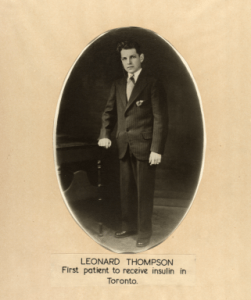
I wrote this post 2 years ago to commemorate an important date in diabetes history: the administration of the first insulin injection. Today, it’s 97 years since Leonard Thompson was given this life saving drug; the drug that keeps me and millions of others around the world alive each day.
And yet, 97 years later, insulin is not accessible to everyone who needs it and people continue to die because they cannot afford the same drug that those of us in Australia can easily and affordable find at any local pharmacy.
So today, as I remember Leonard and the significance of this date and reshare this (slightly edited) post, I’ll be making a donation to Life for a Child. Because no one – no one – should die because they cannot access a drug that has been around for 97 years.
___________________________
On 11 January in 1922, a 14-year-old boy in Toronto was given the first insulin injection to treat diabetes. His name was Leonard Thompson, and he lived for another 13 years, before dying of pneumonia when he was 27 years old.
Before he was given insulin for the first time, Leonard was on the only treatment available at the time for those diagnosed with type 1 diabetes. He was on a starvation diet, and he was close to death, drifting in and out of a coma because of diabetes-related ketoacidosis.
There are dates each year that trigger reminder lessons in the discovery of insulin. On those days, I say a silent thank you to Banting and Best for their work, grateful to them for my life and I peek into my refrigerator at the vials of insulin within easy reach for when they are needed.
But I also feel a great sense of sadness and frustration, because today, ninety-seven years after Leonard Thompson was given his first insulin injection, this miracle drug is still inaccessible to so many people with diabetes. And people are dying, suffering in the way that Leonard was before he was given the drug for the first time.
Yes, I said ‘suffering’. And I don’t use that word. I don’t suffer from diabetes – I live with it. But make no mistake, someone who cannot access insulin and is dying from diabetic ketoacidosis is suffering. They are in pain; their body is in distress. They are dying.
The playing field is so un-level and that is simply not fair. So if you are able to – if you are one of the fortunate ones with insulin in your fridge, please do consider donating to those who are not.
Around Valentine’s Day each year, Spare a Rose suggests sending 11 instead of 12 roses. The AUD$6 saved provides insulin for a month to child with diabetes through the IDF’s Life for a Child program.
Insulin for Life Global needs donations to fund transport costs for delivering insulin to those most in need. AUD$12.50 will cover the cost of sending two weeks’ worth of insulin.
 (Click image for source)
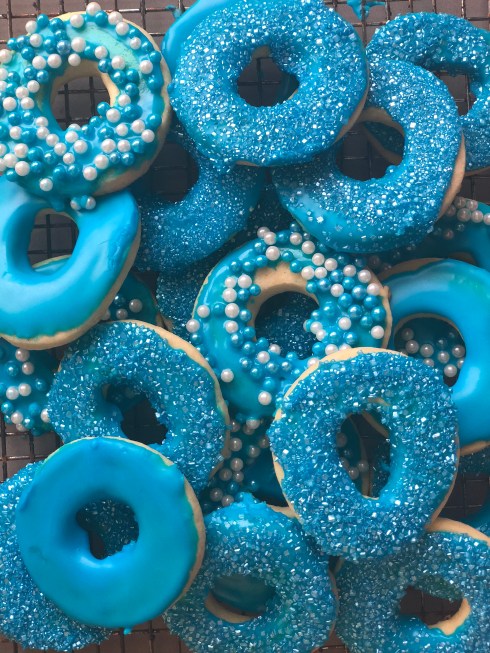
Happy World Diabetes Day. I made these. (Because of course I did.)
I’m revisiting this piece I wrote three years ago about why this date – 27 July – is important in the history of diabetes. The original post can be found here. And below is the 2018 (or 97 year) version.
_______________________
There has been lots of discussion about what happened 97 years ago today – on 27 July 1921. University of Toronto scientists Fredrick Banting and Charles Best successfully isolated the hormone insulin. Today, that means that I am alive and kicking, 20 years after my islets stopped making any.
It means that type 1 diabetes treatment moved from being a starvation diet and not much else, to injecting a drug that was life giving and life saving.
It means that I take a drug that while giving me life, is also lethal and if not dosed carefully and with great consideration can cause terrible side effects.
It means that people with diabetes don’t die terrible, agonising deaths simply because they were diagnosed with diabetes.
It means that I need to be able to do crazy calculations to ensure what I put into my body completely and utterly imperfectly mimics what those with functioning islet cells do completely and utterly perfectly.
It means that there is a treatment therapy that gives us hope and life and allows us to live – sometimes very long, long lives.
It means that each and every day I feel fortunate to have been born when I was and not 100 years earlier.
It means I take for granted that I have access to a drug that keeps me going.
It means that there are far too many people around the world who still do not have access to the drug I take for granted. And 97 years later, that is not good enough.
It means that it was 97 years ago – 97 years ago – since the discover of insulin to treat diabetes and we are still without a cure.
And it means that I wonder when there will be the next breakthrough that is as significant and meaningful and life changing and life saving as what those two Canadian scientists discovered 97 years ago.
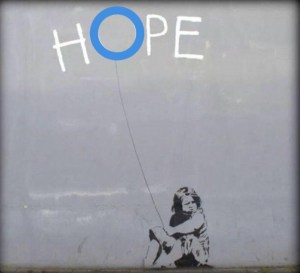
But mostly. It means that I live with hope. Hope that those scientists are somewhere working away, and perhaps – just perhaps – are about to find that next big breakthrough.
Another week, another opportunity to hang out with some Aussie diabetes bloggers and advocates. I’m back in Sydney for today and tomorrow, facilitating Abbott’s third Australian Diabetes Exchange meeting. You can follow along on Twitter, Facebook and Insta at #D2Sydney2018. (And you can read about previous DX events here and here.)

The timing of the event coincides with the launch of Abbott’s Freestyle LibreLink app, which allows Freestyle Libre users to use their mobile phone (Android or iPhone) as the scanner for their Libre sensor. That’s right, point phone at Libre sensor, swipe, glucose level appears on phone screen. This means no need to carry the reader with you.
Freestyle LibreLink launches in Australia on 5 June, so it won’t be available until then, but we’ve been able to have a little play today to see how it works. The app provides pretty much the same information as the reader, so as well as current glucose readings and the previous eight hours of data, there are screens that show averages, time in range, and predictive HbA1c. It’s easy to use, looks clean, and for anyone already familiar with the Libre reader, the transition to phone-as-scanner should be smooth.
I am all about making diabetes easier. I frequently say that I lament the days when I could run out the door with my phone, keys and wallet and nothing more. Diabetes doesn’t really allow us to do that, thanks to all the paraphernalia we need to carry with is. While we still will need to carry lots of kit, by doubling up our mobile phone as a sensor scanner, we are able to take one thing less with us in our (oversized) diabetes kit bag.
Now, I have been doing this for some time. I’ve been using Dexcom G5 since it was launched in Australia, and Loop since August last year, so my phone is as much a medical device as it is a Twitter machine. But I was paranoid at first that my phone battery would die and I would be unable to check my glucose levels. It’s happened maybe twice.
Some things to think about if you are new to the phone-as-receiver-of-glucose-data. Charge your battery to capacity before you leave the house. Have a charger with you at all times. (I have one in my car, one at work and one in my bag). Consider carrying a battery pack – and don’t forget you need to charge that too if you want it to be of any use. There are cases which double as a back-up battery. Consider investing in one of them. And if you are worried that you are going to be caught short, chuck the reader in your bag until you get the hang of having your phone charged at all times!
Some people may think this is a gimmick, but I firmly believe that is not the case. Having our current non-diabetes technologies become part of our diabetes gear makes sense. We want things to talk to each other, and this is exactly what this is doing. We’re seeing it more and more.
Reducing burden, making diabetes less a pain in the arse and finding ways to make things easier. I’m all for that!
Want more information about Freestyle LibreLink? Keep an eye out on the Abbott Diabetes Care website here.
Disclosure
Abbott Diabetes Care have paid for my travel, food and board while in Sydney. They provided me with one Freestyle Libre sensor and advanced access to the Freestyle LibreLink app. (However, I will be deleting it tomorrow at the end of the DX2Sydney 2018 event as it is not available for use until it is launched on 5 June 2018.)
As is always the case, I have not been paid, or asked, to write about product or this event. I’m just a caring, (over) sharing type of person.
My favourite app on my iPhone is Uber. I love it. All the issues of having to stand around on street corners, waiting for a taxi and flagging down empty cabs as they race by you are easily and conveniently eradicated with a simple few clicks of the app on my phone. No need to worry about having cash on you – or dealing with the frequently not-working credit card machine in the car. Get in, get to where you need to go, get out. And sometimes there are snacks!
I have used Uber around the world and I love that it doesn’t matter if I am in Stockholm, New Orleans, Melbourne or New York, it works the same.
I had the most delightful Uber drivers in New Orleans a few weeks ago, including one who picked me up from a burger place in the middle of nowhere (thanks to Fredrik for always finding the most obscure, out of the way local haunts!) and chatted happily with me for our 10-minute ride back to my hotel. She gave me some terrific tips for the city and asked me about Australia.
Another night, also in New Orleans, we were picked up in a red jeep by a funny and friendly guy called Kevin who, if we had said ‘You know, we’re not done yet; how about we go to another blues bar,’ would mostly likely have joined us. And shouted us beers.
When we got to New York, we collected our bags at JFK and walked out to grab a cab. We settled into the back seat for the hour long trip to our hotel and mindlessly watched the little screen on the back of the driver’s seat. And there, we saw that New York’s iconic yellow cabs had a new app, Arro, which allows passengers to hail a cab and pay for their ride using their smart phone.
This was clearly in response to Uber and the convenience and ease it has afforded users.
Uber is an example of disruption in an industry that previously had absolutely no competitors and was happily providing a rut of a service that users simply had to use. It came about because the system was broken.
Healthcare hasn’t had that disruption. And it needs it, because this system is broken.
One of the most interesting sessions I attended at the ADA was an out of hours event hosted by the innovative team at diaTribe. I know that we can always count on to get us thinking.
The Musings Under the Moon session was billed as a discussion on digital health. But it was much more than just a state of play update.
I sat down with some DOC friends at had a good look who was presenting. There in front of us, all together sharing one stage were absolute leaders in digital health and technology, including the CEO of Bigfoot Biomedical, the President of Medtronic Diabetes, the CEO of Dexcom and an Executive VP at Novo Nordisk. And outside the specifically diabetes space we also had the Chief Health Officer at IBM and the VP and Chief Medical Officer at Qualcomm Life. The panel was expertly moderated by diaTribe’s Adam Brown.
To assemble such a panel is one thing. To have them candidly talking about the what is going on in the digital health space – and being challenged on why it is not moving faster – is another.
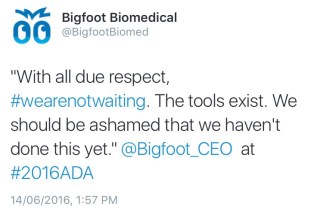
Perhaps the most candid and, for my money, the most interesting commentary came from Jeffrey Brewer from Bigfoot Biomedical. A couple of things he said have obviously resonated with many others in our community because they have been shared over and over on social media. Like this:

He is right and it is no wonder his words were met with such overwhelming support from people with diabetes. Brewer is not backwards in coming forwards and this comment also shared not only his, but many in the community’s, frustrations.
We have become conditioned to simply accept the status quo when it comes to developments in diabetes technology. We accept that the drivers of not only the developments, but the speed in which they arrive in our hands and attached to our bodies, are the companies whose skin in the game is, for the most part, is return on investment. I get that and, as is the case with any business, it to be expected. I also understand approval bodies and their debilitatingly slow processes.
Except it’s not really okay when the result is that we are not moving as fast as we should be. Or that we begin to believe that what we do have at our disposal is as good as it gets.
Today, we would never believe the idea of sharpening needles or checking urine is an adequate way to to manage our diabetes. Not when there are other tools available.
And yet, we think that it is perfectly acceptable to use BGL checking four times a day (or six or ten or twenty…) as a way to manage our diabetes. This is old technology that gives a snapshot with no more information – no arrows, no suggestions of where we are going or where we have been. How is that still okay when we have CGM and flash glucose monitoring available that we know provides more information, more data, better ability to make smart management decisions?
We do nothing because we can’t or we simply accept that we use what we have. This doesn’t for a moment take into consideration the trailblazing Open APS users (currently 88 people around the world according to this tweet from Dana Lewis), and movements such as #WeAreNotWaiting.
Healthcare needs disruption. The current situation is not okay; the system is broken and it needs fixing. Because right now, we are being shortchanged. And it’s not good enough.
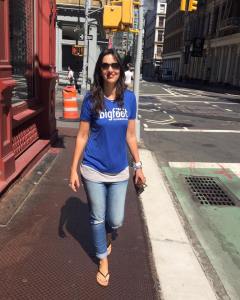
I have absolutely no connection to Bigfoot Biomedical other than I am very fortunate to be friends with Melissa Lee who works for them. But I did win one of their t-shirts in a competition at ADA and I proudly wore it on the streets of New York!
At the beginning of 2015 I wrote a post saying that while I don’t do resolutions, I would be focusing on three things: health, peace and happiness. I started off the year feeling that I had all three, and I ended the year feeling the same way.
Eschewing the plethora of ridiculous inspirational and motivational quotes filling all my SoMe feeds as 2015 drew to a close and 2016 started, I decided that if it ain’t broke, don’t fix it and that I would be going with the same three things throughout the new year.
A few things that have been occupying my wonderfully-blank holiday mind over the last couple of weeks:
Said inspirational quotes don’t work. It says so here.
American Girl, previously a place of fear and terror for our credit cards, has redeemed itself with the launch of the diabetes kit. Excited? Doesn’t even touch the sides!
There is a cure for diabetes and it is, of course, juice. Here you go! (Send cupcakes as gratitude.)

Woolies, it’s January. Put away the Hot Cross Buns!
My sister has been talking non-stop about her Veggeti. And she bought me one (yet to use it). Just me, or could the marketing people come up with a slightly better name? Anyway, Veggetti recipes to come.
I decided that I needed a mermaid. Isn’t she beautiful?

(Click on image for details.)
I am doing the #30DaysofDexcom (or any CGM) challenge because: a/ saw a bandwagon, so I jumped on it, and b/ my BGLs are better when I use CGM. It’s just an undeniable fact that for me when I am sensing, I pay more attention to my blood glucose and am more in tune with ‘doing diabetes’.
If you don’t wear CGM, but are looking to do something similar, the good folk at MySugr have a #30DLogging challenge. My mate, the wonderful Scott Johnson is one of the poster boys! Check it out here.
And that’s about it. I am still on holidays for the remainder of the week and continuing to do very little other than hang out around the house, occasionally venturing to a local café and working on eliminating my sleep debt. It has been what I would consider a very successful ‘nothing’ break!
I’ve spent the day in our nation’s capital for a meeting. And here are two things.
This one made me smile. Because whether it be designing seats on planes or health services, consumer engagement is key.
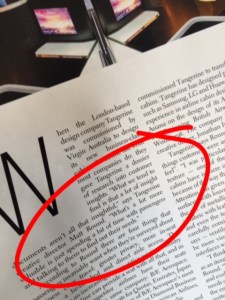
And then this. Which made me cringe.
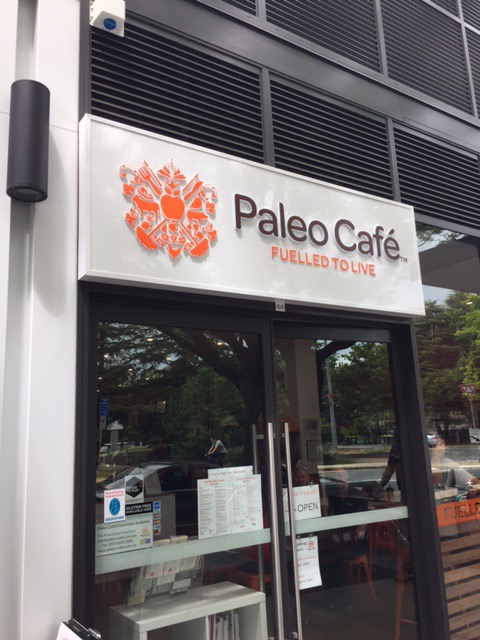
Why, Canberra, why?
Have a great weekend!




 Diabetogenic