You are currently browsing the category archive for the ‘Real life’ category.
Sometimes, I’m a lousy person with diabetes (PWD). I am thoughtless and unclear about what I need, have ridiculous expectations of others – and myself, and am lazy. But I’m not always like that. And I think I know what I need to do to be better.
Being a better PWD is about being true to myself. It is also about reflecting on exactly what I need and I hope to get it.
- I need to remember that diabetes is not going away
- I need to remember that the here and now is just as important as the future
- I need to remember that I don’t have to like diabetes, but I have to do diabetes
- I need to remember that the diabetes support teams around me really only have my best interest at heart, and to go easy on them when I am feeling crap
- I need to empty my bag of used glucose strips more frequently to stop the strip glitter effect that follows me wherever I go
- I need to remember that it is not anyone else’s job to understand what living with my brand of diabetes is all about
- I need to remember that the frustrating and tiresome nature of diabetes is part of the deal
- I need to be better at changing my pump line regularly
- I need my diabetes tasks to be more meaningful – quit the diabetes ennui and make smarter decisions
- And I need to own those decisions
- I need to see my endocrinologist
- I need to decide what I want to do with my current diabetes technology. There is nothing new coming onto the market that I want, but what about a DIY project to try something new? #OpenAPS anyone…?
- Or, I need to work out how to convince the people at TSlim to launch their pump here in Australia
- I need to check and adjust my basal rates
- I need to do more reading about LCHF and decide if I want to take a more committed approach or continue with the somewhat half-arsed, but manageable and satisfactory way I’m doing it now
- I need to remind myself that my tribe is always there and ask for help when I need it.
- I need to make these!
And being a better PWD is knowing what I need from my HCPs and working out how to be clear about it, rather than expecting them to just know. (I forget that Legilimency is not actually something taught at medical school. #HarryPotterDigression)
So, if I was to sit down with my HCPs (or if they were to read my blog), this is what I would say:
- I need you to listen
- I need you to tell me what you need from me as well. Even though this is my diabetes and I am setting the agenda, I do understand that you have some outcomes that you would like to see as well. Talk to me about how they may be relevant to what I am needing and how we can work together to achieve what we both need.
- I need you to be open to new ideas and suggestions. My care is driven by me because, quite simply, I know my diabetes best. I was the one who instigated pump therapy, CGM, changes to my diet and all the other things I do to help live with diabetes
- I need you to understand that you are but one piece of the puzzle that makes up my diabetes. It is certainly an important piece and the puzzle cannot be completed without you, but there are other pieces that are also important
- I need you to remember that diabetes is not who I am, even though it is the reason you and I have been brought together
- And to that – I need you to understand that I really wish we hadn’t been brought together because I hate living with diabetes
- I need you to remember that I set the rules to this diabetes game. And also, that there are no rules to this diabetes game
- I need you to understand that I feel very fortunate to have you involved in my care. I chose you because you are outstanding at what you, sparked an interest and are able to provide me what I need
- I need you to know that I really want to please you. I know that is not my job – and I know that you don’t expect it – but I genuinely don’t want to disappoint you and I am sorry when I do
- I want you to know that I respect and value your expertise and professionalism
- I need you to know that I hope you respect and value mine too.
And being a better PWD is being clear to my loved ones (who have the unfortunate and unpleasant experience of seeing me all the time – at my diabetes best and my diabetes worst) and helping them understand that:
- I need you to love me
- I need you to nod your heads when I say that diabetes sucks
- I need you to know I don’t need solutions when things are crap. But a back rub, an episode of Gilmore Girls or a trip to Brunetti will definitely make me feel better, even if they don’t actually fix the crapness
- Kid – I need you to stop borrowing my striped clothes. And make me a cup of tea every morning and keep an endless supply of your awesome chocolate brownies available in the kitchen
- Aaron – I like sparkly things and books. And somewhere, there is evidence proving that both these things have a positive impact on my diabetes. In lieu of such evidence, trust and indulge me!
- I need you to know I am sorry I have brought diabetes into our lives
- I need you to know how grateful I am to have you, even when I am grumpy and pissed because I am low, or grumpy and pissed because I am high, or grumpy and pissed because I am me.
Today is my first day back at work. I spent the weekend preparing for the day by sitting in the sunshine, drinking coffee, deadheading rose bushes and switching back on the part of my brain that thinks about work. And remembering how to walk in high heels.
The new year looms ahead. It’s huge. There are things to finish from last year and lots of new projects waiting to begin. And starting fresh with a clean slate and thinking strategically about how to get things done is important.
I don’t really do New Year’s resolutions. I’m lousy at committing to anything remotely healthy, so there is no point in trying to promise to do something that I’ll do for two days, then stop doing and then feel bad at myself for not doing it anymore.
I don’t really want to use the New Year to focus on diabetes by concentrating on particular tasks or specific measures. Outcomes seem to be organic and setting goals, while a noble gesture, often lead to disappointment. Feeling like a failure is not how I want to begin the year!
But I do like the idea of embracing the New Year and cracking open its spine, revealing clean pages and new beginnings.
Australian writer and publisher, Mia Freeman, shared that last year, she came up with a word that would help draw her attention to her plans for the year ahead, and has done the same for this year.
I like this idea – the thought of having some sort of directive that would be an overarching theme for decision making and planning, and would, hopefully, mean that I ended the year feeling a success rather than just a shattered and weary mess.
Because I have found myself pretty exhausted at the end of the last few years. I know everyone is – we get to a point where we are just done and need a break. I felt as though I was burnt out with life when I went on leave, and the much needed holiday was about getting back to a place where I felt I could tackle what lay ahead.
With this in mind, I wanted my word to help me avoid that burn out, so that come the end of the year, the exhaustion I felt was not so overwhelming.
So, I spent some of the time we were in New York auditioning words, trying them out, rolling them around on my tongue and hearing them in my mind, thinking what they could mean for me throughout 2017. As I walked around the snowy streets, I projected how I wanted to feel at the end of this year and what I would need to get there.
The word I have settled on is pause.
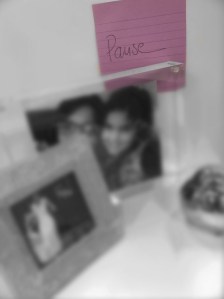
As soon as I said it, I knew it was the right word. I wrote it down, over and over, thinking about how it could shape and help plan my year. I wrote it on scraps of paper and shoved them into my purse and handbag to remind me. And the minute I walked into my office this morning, I wrote it on a post-it and stuck it to my wall.
Pause doesn’t mean that I will be stopping anything I’m doing. It doesn’t even necessarily mean I’ll be cutting back. But it does mean that before committing to anything new, continuing with something old or exploring different ways of doing things, I will pause and think about why and how I am doing it.
The tendency to simply say yes to everything serves no one – the results are me not doing things as well as I might like or feeling disappointed with the end result.
I also am seeing how I can adapt the word to suit my diabetes management. I think that too often, I am on autopilot, not really thinking about what it is that I am doing. To pause means giving meaning to actions, attention to decision making and focus to the way I choose to manage my diabetes. Jumping on a bandwagon because it has been written up in a few different diabetes magazines – without pausing to consider if it is right for me – really makes no sense. I am very guilty of wanting, needing the latest toy without necessarily stopping to think if it will serve any purpose.
There is already a lot in the calendar for 2017 – all the way through to its end with the IDF’s World Diabetes Congress rounding out the busy year in December. I’m the Deputy Stream Lead for the Living with Diabetes Stream, so there is no chance of slowing down as the year winds down.
So, with all this in mind, my word for the year is going to help shape how I approach things. I’ll have to see how it goes and I expect I’ll need to pull myself back at times, reminding myself to stop, think and, perhaps, wait. And then, as I pause, take the time to let things sink in, catch up and take shape.

My darling friend, Annie.
Once we remembered that there were other people on the street, we set to introducing our families to each other. Our husbands shook each other’s hands, and our girls shyly greeted each other with hugs. That was the last moment of shyness for the rest of the week.
Our families have had a week of being tourists in the most wonderful city in the world. We looked at the Manhattan skyline from across the Brooklyn Bridge; we soared to the top of the Rockefeller Building, gazing across the city as the sun started to set from dozens of stories above the ground; we sat in cafes, warming up on coffee and hot chocolate and wonderful conversation; we wandered through Central Park as snowflakes started to fall, the girls unable to believe their luck as they ran with their arms outstretched catching the snow; we saw in 2017 standing in Central Park with fireworks exploding over our heads with the promise of a new year. And throughout it all, diabetes was managed by those of us who wear our pancreas on the outside of our bodies – but didn’t for a moment affect the time we were having.

Annie and I know each other because of diabetes. She is mother to three extraordinary girls, one (Pumplette) who happens to have diabetes. I’ve linked to her blog many times here, and if you’ve not popped by yet, please do!
We often spoke about how wonderful it would be to introduce our families – although we did have some concerns at our girls actually being able to discuss their neglectful mothers who, it seems, abandon them at the drop of a hat to rush off to some diabetes conference or another.
We made it happen this week, and our girls barely paused for breath, chatting constantly, getting excited at all the city has to offer and amusing themselves with endless rounds of Banagram. Our kidlet was thrilled to have three new friends and couldn’t get enough of spending time with them.

Friends for life.
We closed our apartment door. Annie and her family headed for the elevator and I sat next to our kidlet on the couch as floods of tears started. I hugged her tight, promising that it would not be the last time that she saw the girls. I reminded her that Annie and I live on opposite sides of the world and are in contact all the time – that we speak and message and FaceTime frequently.
And I reminded her how wonderful it was that as 2016 ended and 2017 started she had made three wonderful new friends. She nodded and wiped away her tears. ‘I miss them already,’ she said. And I nodded too. Because I understand how that feels. I know the elation of seeing friends from far flung places and then, when saying farewell, not knowing when we will see each other again. But the beauty of it is that while it hurts to say goodbye, there is an endless promise of saying hello again. And I assured it that she would say hello and hug those girls again. Many, many times.
Happy New Year, everyone!

Seeing in the New Year.
There is so much around at the moment that I wanted to write about properly. But it’s holidays and there is champagne and my kid made brownies with toffee popcorn on top and the neighbours came over for drinks and didn’t leave and I need to pack to go to New York.
So here are some links for some holiday reading.
THIS piece
The title of this piece sure seems to have riled up some people, but bloody hell, just read it. Anna Floreen, who is pretty damn awesome, has written this fabulous piece, sharing her experiences of going through the teen years with diabetes. A must read for parents of kids with diabetes to get some insight into what young people think about dealing with diabetes.
THESE biscuits
These have become my holiday favourites this year and I’ve made about 4,326 batches of them! Four ingredients, super-dooper easy, delicious and look impressive. Plus, they are gluten free, so great as a gift for friends with coeliac disease. What more could you want?
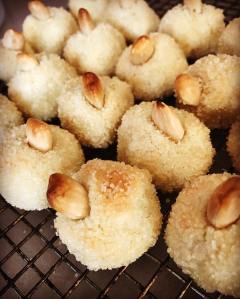
I’ve had the recipe for them scrawled in my recipe book for years – I can’t remember where I first copied it down from – and this from the New York Times is pretty much how I have been making them.
THIS news
Great update about the work Ed Damiano is doing on the Bionic Pancreas just published in The Lancet. The study has shown some pretty exciting results. It’s getting close – really close – and that is just so damn exciting! Maybe we can out one on our Xmas lists next year…
THIS study
If you are a young woman (aged between 16 and 25 years) living in Victoria, Australia, you can take part in a women’s health study, which is looking at the relationships between lifestyle behaviour, physical health and mental wellbeing.
You’ll be reimbursed for your time, so get involved! All the details are here.
THIS poorly worded sign
For the love of all that is good: proof read, people. Please, proof read!

THIS good news
Great news from the Australia Diabetes Society who has just released a new position statement about scuba diving and diabetes, recognising that motivated individuals with well-controlled diabetes (both insulin-requiring and non-insulin requiring), may be able to safely participate in recreational diving.
THIS story
You know, there are some people in the DOC world who are worth their weight in gold. Lou Vickers is one of them. Read her story here.
THIS (slightly old) article
This piece, from Dr Katherine Barnard and Dr Jill Weissberg-Benchell, was published just after ATTD this year (back in Feb) and provides comment on the relationship between diabetes technology and psychosocial aspects of diabetes. A very interesting read, especially considering the way DTech is moving!
THIS position statement
The National Health and Medical Research Council and the Consumer Health Forum of Australia have released a revised statement about the involvement of consumers in health and medical research.
THIS time of year
So, we’re heading off for a couple of weeks and I’ll occasionally be checking in, but probably not much as we’ll be spending a lot of time trying to keep warm on the cold streets of New York.
Thank you so much for reading, commenting and sharing Diabetogenic this year. The love and support I constantly am afforded by people who read posts here is astounding and makes living with diabetes that little bit easier. I wish I could adequately say just how grateful I am.
I’m looking forward to an exciting 2017 – there is already so much on the horizon with exciting projects, collaborations, activities and plans being hatched. It’s shaping up to be a very busy year, so I’m looking forward to a little downtime over the holiday time.
Season’s greetings to you all. I hope you manage some rest, relaxation and quiet reflection in the coming weeks. I’ll see you in the New Year.

Season’s greetings from my clan to yours.
It’s day four of holidays for me. Already lazy mornings, easy days and gentle plans to meet up with friends and family are clearing my mind, and I can feel the backlog of stress and exhaustion – the things that are part of everyday life – start to make way for sharp thinking and smarter decision making.
And in terms of diabetes this means more attention paid to alarms and alerts on my various devices: the calibration alert on my phone for my CGM gets attended to immediately, the low cartridge reminder on my pump is heeded at the first warning. I stop and think before blindly acting, and calmly troubleshoot as I go along.
My head is clearing. I am starting to think about diabetes the way I like, at a level that feels safe and sensible and manageable. I make rational decisions; I take the time to fine tune what I am doing. Diabetes has a place that is comfortable, I feel better overall and far more capable of ‘doing diabetes’.
 Earlier this week, the findings from the Diabetes MILES-2 study were launched. (Quick catch-up: MILES stands for Management and Impact for Long-term Empowerment and Success and is the work of the Australian Centre for Behavioural Research in Diabetes (ACBRD). The first MILES survey was conducted back in 2011, with over 3,300 Australians with diabetes taking part. The MILES Youth Report was launched in 2015, reporting the experiences of 781 young people with type 1 diabetes and 826 of their parents. This study formed part of the NDSS Young People with Diabetes Project for which I am the National Program Manager.)
The MILES reboot (Diabetes MILES-2) once again provides a snapshot of the emotional wellbeing and psychosocial needs of Australian adults living with diabetes. Over 2,300 people participated in this study and the results are comparable to those from the first MILES study. The Diabetes MILES-2 survey included the addition of some issues that had not been investigated in MILES, such as diabetes stigma.
Some key findings from the report include:
- 17% of survey respondents had been diagnosed with a mental health problem at some point of their life
- The respondents most likely to experience moderate-to-severe depression and anxiety were those with insulin treated type 2 diabetes
- The respondents most likely to experience severe diabetes distress were those with type 1 diabetes
- The aspects of life reported by all respondents as being negatively impacted by diabetes included emotional well-being (for those with type 1 diabetes) and dietary freedom (for those with type 2 diabetes)
- More stigma was experienced by people with type 2 diabetes using insulin as compared with people with type 2 diabetes not using insulin
Anyone affected by diabetes knows that the psychological and emotional side of diabetes is as much a part of the game as the clinical tasks. In fact, for me, it is the most difficult to deal with. What’s going on in my head directly affects how the I am able to manage the practical side of the condition.
When my head is clear – the way it is slowly, but surely becoming as I settle into holiday mode – and I have time and space to rationally think about, and focus on diabetes, the routine tasks seem manageable. The numbers present as nothing more than pieces of information: they allow me to make decisions, act, or not act. I am able to be practical and seem to have my act far more together.
But for the most part, diabetes is not like that for me. I don’t manage my diabetes the way I want and that is mostly because I am simply unable to due to the distress and anxiety I feel about living with a chronic health condition that terrifies me a lot of the time. I feel overwhelmed and, in the mess of life, diabetes becomes impossible. I am not proud of this – but I am honest about it.
If I am perfectly truthful, there is nothing in this report that surprises me. But it does provide validation for how I am feeling – and how many others with diabetes are feeling too. And I am so pleased that there is evidence to support what so many of us who live with diabetes feel.
It’s no secret that I am a very big fan of the ACBRD’s work. Diabetes MILES-2 once again shines a light on the ‘other side’ of diabetes and serves as a reminder that unless the psychosocial side of living with this condition is addressed, we simply can’t manage well the physical side. And it forces those who want to believe that diabetes is a matter of nothing more than numbers and mathematical equations to consider the emotional wellbeing of those of us living with diabetes each and every day.
The MILES 2 report can be read online here.
You may not have noticed, but the festive season is upon us. (Actually, according to Woolies, the festive season has been upon us since the first week of September which was when I first saw mince pies on their shelves. And as Louden Wainwright III says ‘It’s a season, it’s a marathon….’ Sorry; digression.)
Anyway, it’s the festive season and with it comes lots of messaging about eating with diabetes during this time of the year. Now, I’d like to leave my diabetes behind whilst eating during the holidays, but I’ve come to learn that diabetes is a shit and doesn’t work that way. Because, diabetes IS for Christmas….and every other bloody day of the year as well. Happy holidays!
I saw an article this morning about how to keep your eating and drinking in check during Xmas and other parties, and by the time I finished reading, I was weeping uncontrollably and wanted to shoot myself. (Except not really because I’m a huge supporter of gun control and don’t own a gun.) I also wanted a drink, but it was 6.45am and I was feeling the judge-y eyes of the writer staring at me and the Moscow Mule I was about to make for breakfast.
All articles about diabetes and festive-season-eating demand limiting everything – alcohol, food, happiness. Quite frankly, limiting alcohol at family gatherings is not an option for many people, which seems to be lost in the horrific and laughable suggestion of taking your own water to water down drinks. (I lost the will to live at that suggestion.)
Obviously, a blow-out is best avoided, but that is wise even if you don’t have diabetes. There is nothing worse than feeling as though you literally cannot move from the sofa – mostly because it means you could be stuck sitting next to a distant relative who wants to tell you, in detail, about their recent adventure in passing kidney stones, or (worse) about their neighbour who died from diabetes complications. Diabetes – the gift that keeps on giving.
So, here are some of the things I’ll be doing to survive the next few weeks.
- Acknowledge that this time of year is about food and that is okay. This is definitely the case for my family, and I am already counting down the days until I gorge myself on my mother’s freshly made zippoli.
- Throw any thoughts of guilt out the window (along with suggestions of BYO H2O).
- Make a game out of my CGM by seeing if I can spell out any swear words in the ain’t no mountain high enough/valley low enough trace.
- Remember that even though I have diabetes, I have every right to enjoy whatever I feel like eating. Or don’t feel like eating. The low(er) carb thing may or may not stick over the festive period. Obviously, my mother’s zippoli are carb- and fat-laden parcels of perfection, so the low(er) carb thing can fuck right off once they are set down in front of me, but I probably will still avoid other carb-y things because dealing with high glucose levels or inadvertently overdosing on insulin does not a festive occasion make.
- Seriously, give me a huge bowl of cherries for dessert and I am a happy chicken. (The non-watered-down alcohol has probably helped get me to that state, but cherries also make me undeniably happy.)
- Brush up on my responses to ’Should you be eating that?’, which (thankfully) I probably won’t need to use anyway. Funny how I only ever needed to hit someone once over the head with a spoon after they asked me that…
- Find red and green Sharpies and write ‘My Diabetes; My Rules’ in festive script on the inside of my hand to remind me to do whatever works for me. And to shove in the face of anyone who does actually ask ‘Should you be eating that?’
- Thank the Xmas angels that Brunetti in Carlton is open on Xmas morning, meaning that we can make the ten-minute dash there, drink coffee and eat pastries before the onslaught of family, food and festivities.
- Make a donation to a diabetes-related charity because not everyone gets to decide if they will use extra insulin to cover the second slice of passionfruit pav. Here are three ideas:
This blog is not about giving advice, but I am going to give some now as I believe this is possibly one of the best ways to survive until the end of the year:
Don’t read any articles telling you to eat nothing but cardboard or watered-down grog. Or suggesting you take your own plate of crudités to parties. I don’t care that it’s a French word, it just means carrot sticks. And having spent the festive season in France, I can tell you no one was serving carrot sticks for the family Xmas dinner. Plus, if I’d taken my own, I probably would have been mocked in French, and not been allowed to drink any of the delicious non-watered-down red wine or bûche de Noël for dessert.
Here’s some Louden Wainwright III. He makes everything better. (Bonus points if you know his character in M*A*S*H…without consulting Dr Google for the answer!)
I’m reading a fabulous book at the moment. It’s called In Other Words, written by one of my favourite writers, Jhumpa Lahiri. My sister introduced me to her writings a couple of years ago, and I have read most of what she has written now.
The backstory to the book is quite lovely: the writer wanted to learn Italian – really learn Italian – and after years of study, moved her family to Rome. While there, she started writing only in Italian, retraining her brain to speak and think in Italian first.
The book is presented in both Italian and English. When the book is open, the left-hand page is in the original Italian and the right-hand side is in the translated English. As someone with basic Italian, I’ve been enjoying reading the Italian words, saying some of them out loud to feel them roll around on my tongue.
I start by reading the Italian side and work my way through, understanding as much as I can. What I find is that I get the general gist of what is going on, but there are gaps. The detail is completely lost at times, but I am able to piece the story together and understand what is going on. When I read the translation, all the gaps are filled in, the detail is there – adjectives provide description and narrative and help round out the story.
I cover up the English page so that I can only read the Italian, but try as I might – as I rack my brain to remember what a word means – there ends up being a lot missing from the story. But there is the safety net of being able to remove the paper hiding the translation when I simply can’t work out the holes in the story, resulting in a satisfying – and full – understanding of the beautiful story.
Yesterday, I spent the whole day feeling like I was living in the Italian side of my book. I trudged through, with a general idea of what had happened overnight, but there was a lot missing. I’d had a hypo in the middle of the night – a terrible, terrible low. I can’t really say much more because I don’t know what happened. Parts of it are really clear, but a lot of the particulars are completely missing.
Aaron has filled in some of the gaps – how he knew I was low from the way I was moving around in my sleep; how he managed to get me to drink some juice, and then some more before I was fully able to understand him and the situation; how when he reached out to me I was drenched in sweat.
I’ve filled in the gap of the no sensor alarm – problems with the Dexcom app at the moment meant that when I grabbed my phone, angry that we had both missed the alarms, I was greeted with the message ‘Transmitter not found’. That explained why I’d not been alerted to the impending low, allowing me to treat before things turned nasty.
Because of the app problems, there is no data showing how long I’d been low, or the trajectory of my glucose levels. I know that I was sitting in range when I went to bed, and had been for some time. But that was at 10.30pm and this was three hours later. A lot can happen in three hours.
My bedside table was littered with three empty juice boxes and a couple of other wrappers in the morning, letting me know exactly what was consumed until I felt safe again.
I have a pain in my ribs. When I stood up and felt the painful twinge, I thought perhaps I’d had a seizure during the hypo, but Aaron was able to assure me that didn’t happen. The reason for the pain is a mystery, but I know it wasn’t there when I went to bed, yet was when I stood up to change out of my sweat-soaked t-shirt.
I’ve spent the last couple of days trying to piece together what I do know as I endeavour to search for the missing parts of the story. I close my eyes, desperately searching in my mind for a little hint as to what happened before Aaron realised I was low and sprang into action. Or the way I moved that now means it hurts when I breathe. I wish I could pull away a curtain – or piece of paper – and that would expose the full story.
But there is no safety net here. All I have is what I can remember and what Aaron has been able to tell me. The gaps cannot be filled in; the detail is completely lost. I feel incredibly unsatisfied, and the uncertainty also means that I am feeling very vulnerable and exposed. If I don’t have the full story, how do I understand it all?
And how can I possibly stop it from happening again?

On Saturday, we gathered the family for an afternoon tea to celebrate the kidlet’s twelfth birthday.
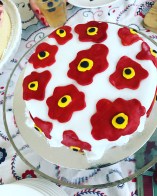 My sister arrived with the most beautiful and delicious cake. She always makes my kid’s birthday cake – has done for pretty much every party. Now, Toots has come up with some amazing cake creations over the years – 3D representations of Mary Poppins, Wizard of Oz, fairies under toadstools, teddy bear picnics, beachside parties. This year, the cake was decorated simply with the Marimekko poppy pattern – my daughter’s (and my) favourite design ever. It was the simplest, least elaborate cake Toots had ever made. But it was, in my mind, the most beautiful.
As I laid the cake on a platter, I was reminded that simple, most basic, things can have a huge impact.
Once, during a tough time, someone asked me if I was sleeping and eating, and I looked at them and shook my head. ‘Not much,’ I said. ‘It’s on the list, but there are two things ahead of it – I need to breathe and I need to hug my kid. I know that she is getting plenty of hugs so I feel that I am getting that right. And most of the time I don’t have to remind myself to breathe, although there are times that I find myself staring into space, holding my breath and I have to concentrate on exhaling. I eat a little; I sleep a little. But I breathe. And I hug her and that has to be enough. That is enough. There is no space for more.’
I have come to learn about finding space for the basics and not beating up myself for things that don’t get done. Of course, sleeping and eating matter, but I worked out that doing the minimum of those things got me through. I did what I could until I was at my limit. And then: there is no space for more. Six words of permission accepting I was full. Nothing fancy – just do the basics.
Understanding this has become essential to my survival – even when not going through a crisis period. I focus on what there is space for and that is usual the most basic and simple things. There is space for love and the people who support and value and encourage me. They understand the ebb and flow of what can be managed.
I have space for work that is fulfilling and enjoyable and challenging and I am fortunate that, almost twelve months into what I am still calling my new job, my work is all of these things; the decision to jump without a safety net is justified each and every day.
I have space for small things that bring great joy, remembering that it’s not necessarily the grand gestures or big events that necessarily have the greatest impact.
It was my birthday on Sunday and it was, quite possibly, one of the best birthdays I’ve ever had. It involved a sleep in, breakfast at our favourite place, a late lunch of dumplings, wandering around with my family and then sitting at home watching Gilmore Girls. It could not have been simpler or quieter. And it was perfect because it was exactly what I had space for.
Our beautiful girl turns twelve years old today. It’s both a lifetime and a minute in time and I sometimes look at her and still cannot believe that she is here.
When I was pregnant, I kept an online diary for a diabetes website. That site is no longer there, but I still have the diary and have been waiting for the right moment to publish it here on my blog.
Today is that day. It’s a long read – a short entry for each week of the pregnancy – but it takes me back to exactly how I was feeling and coping throughout the pregnancy. My favourite part is the last part – our baby’s arrival – which I wrote when she had been home for only days and my head was in a new-parent fog and I was desperate to try to put in words what had happened and how I felt on the day. It’s funny, because it was starting to get murky then, but today, I can remember everything about it.
We tell our daughter her birth story occasionally – often around her birthday. And in there amongst the way we felt when we first heard her cry and saw her face for the first time, is the story of how much she is wanted and the path we took to actually make that happen.
It’s all here, so please have a read if you’d like. Yesterday, when giving my talk to some healthcare professionals one of them asked if I would mind sharing how I felt when pregnant and what a diabetes pregnancy is like.
And I said: It was the most difficult thing I have ever done emotionally. It was the most intensive time of diabetes care I have ever experienced. I saw my healthcare professionals more frequently than I saw my friends and family. I was checking my BGL over 20 times a day – there was no CGM here then. I had never felt such anxiety or fear as I did at that time. But equally, it was the most magical time because in amongst all the diabetes stuff, was my daughter and now – now all I think about is how it was the best thing I could ever have done.
Twelve years old and growing up into such an amazing young woman. I could only have hoped on the day she was born that she would be as wonderful as she is today. Happy birthday to our magical girl. I never thought I would be able to love her more than I did the day she was born and yet, somehow, that love just keeps growing. We’re so excited to see what you do next darling. And we’ll be right there alongside you, continuing to cheer you on.




 Diabetogenic