
You are currently browsing the category archive for the ‘Loop’ category.
Two years ago, I walked off the stage at the inaugural ADATS event feeling very shaken. I’m an experienced speaker, and regularly have presented topics that make the audience feel a little uncomfortable. I challenge the status quo and ask people to not accept the idea that something must be right just because ‘that’s how it’s always been done’. Pushing the envelope is something that I am more than happy to do.
But after that very brief talk I gave back in 2017, a mere three months after I started Looping, I swore I would never speak in front of a healthcare professional audience again.
That lasted all of about two months.
In hindsight, I was more than a little naïve at how my enthusiasm about user-led technologies would be received. I can still remember the look of outright horror on the face of one endo when I cheerfully confirmed:‘Yes! Any PWD can access the open source information about how to build their very own system. And isn’t that brilliant?!
Fast forward to last Friday, and what a different two years makes! The level of discomfort was far less, partly because more than just a couple of people in the room knew about DIYAPS. In the intervening years, there have been more talks, interviews and articles about this tech, and I suspect that a number of HCPs now have actually met real-life-walking-talking loopers. Plus, Diabetes Australia launched a position statement over a year ago, which I know has helped shape discussions between HCPs and PWDs.
I’ve gotten smarter too. I have rejigged the words I use, because apparently, #LanguageMatters (who knew?!), and the word ‘hack’ scares the shit out of people, so I don’t use it anymore. (Plus, it’s not really accurate.) And, to protect myself, I’ve added a disclaimer at the beginning of my talk – a slide to reinforce the sentiment that I always express when giving a talk about my own life with diabetes, accentuating that I am speaking about my own personal experiences only and that I don’t in any way, shape or form recommend this for anyone else. (And neither does my employer!)
I framed my talk this time – which had the fabulously alliterative title ‘Benefits, Barriers and Burdens of Diabetes Tech’ by explaining how I had wanted to provide more than just my own perspective of the ‘three B’s’. I am but one voice, so I’d crowd sourced on SoMe for some ideas to accompany my own. Here’s just some of the responses.
 (Click to enlarge)
And this:

One of the recurring themes was people’s frustrations at having to wade through the options, keep up with the tech and customise (as much as possible) systems to work. And that is different for all of us. One person’s burden is another person’s benefit. For every person who reported information overload, another celebrated the data.
What’s just right for me is not going to be just right for the next person with diabetes. So, I used this slide:
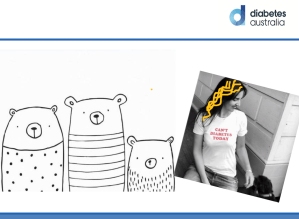
I felt that the story of Goldilocks and the Three Bears was actually a really great analogy for diabetes tech. Unfortunately, my locks are anything but golden, so I needed a little (basic and pathetic) Photoshop help with that.
In this fairy tale, Goldilocks is presented with things that are meant to help her: porridge for her hunger, a seat to relieve her aching legs and then a bed to rest her head after her busy day. But she has to work through options, dealing with things that are not what she wants, until she finds the one that is just right.
Welcome to diabetes technology.
On top of working out what is just right for us, we have to contend with promises on the box that are rarely what is delivered to us. Hence, this slide:

Apart from the Dex add circled in red, all the other offerings are ‘perfect’ numbers, smack bang in the middle of that 4-8 target that we are urged to stay between. These perfect numbers, obviously belonging to perfect PWD with their perfect BGLs, were always completely alien to me.
A selection of my own glucose levels showed my reality.
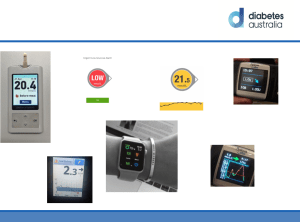
I explained that in my search for finding what was ‘just right’, I had to actually look outside the box. In fact, for me to get those numbers promised on the box, I had to build something that didn’t come in one. (Hashtag: irony)
Welcome to Loop! And my next slide.

And that brings us back to two years ago and the first time I spoke about my Looping experience in front of healthcare professionals. It was after that talk, during a debrief with some of my favourite people, that this term was coined:

Funny thing is, that I am now actually the very definition of a ‘compliant’ PWD. I attend all my medical visits; I have an in-range A1c with hardly any hypos; I am not burnt out. And I have adopted a Goldilocks approach in the way I do diabetes: not too much (lest I be called obsessive) and not too little (lest I be called disengaged), but just right.
It turns out that for me to meet all those expectations placed on us by guidelines and our HCPs, I had to do it by moving right away from the things there meant to help us. The best thing I ever did was start Loop. And I will continue to wear my deliberate non-compliance as a badge of honour and explain how it is absolutely just right for me!
I was speaking with someone who is thinking about starting to Loop the other day. I explained my own experiences – how simple the set-up had been (even after I’d delayed it for six months because I thought I wouldn’t be able to do it), how it is completely changed the way I think about diabetes, how much less time I have to dedicate to dealing with the daily frustrations of diabetes, how the highs and lows have been evened out and how glucose rollercoasters are a thing of the past.
‘So, you never have highs and lows? Ever?’ he asked me.
‘No; that’s not completely true,’ I said. I am frequently guilty of being evangelical about diabetes technology, and wanted to be sure that I wasn’t overselling DIYAPS. ‘After all, I still have diabetes!’
I have my range set to 4mmol/l – 8.0mml/l. It’s the mythical range that was presented to me as the ultimate goal the day I was diagnosed. It’s quite a tight range – I know that – and I probably could afford to ease up on that upper range. My target is 5.0mmol/l (it used to be 5.5mmol/l – another mythical number).
The reality is that for the very vast majority of the time, I am within that range, and hovering around that target number. If I was to check my Dex as soon as I woke up each morning, it would be boringly somewhere between about 4.8mmol/l and 5.3mmol/l.
But I still do spent time outside of the target range. The thing about Loop is that in most cases, I can explain the reasons when that happens.
I had a hypo the other night. A pretty terrible one, actually. I can’t remember the last time my Dex read LOW, but that was what I was staring at when I checked the app after my phone started screaming at me. I double checked with a finger prick and sure enough I was low. Really low. I treated (over treated) and was fine a short time later, albeit with a rebound leading to numbers I’ve not seen in a very long time.
How did that happen? Well, let’s start with the double bolus I gave myself. For some reason, I decided that the chicken soup with noodles I was eating for dinner needed not one, but two boluses. That was mistake number one. Mistake number two was not eating as much as I thought I was going to because I had a teleconference starting, so I left about half of my dinner in the bowl. Mistake number three was not realising mistake number one. And mistake number four was not doing anything to address mistake number two.
Following? Diabetes is fun!
The low resulted in an ‘eat-the-kitchen’ hypo that saw me eat six jelly beans, wait fifteen minutes and then recheck my glucose levels. Just kidding. I drank half a litre of juice, ate three bowls of breakfast cereal, chomped on a tube of fruit pastilles and then started attacking a homemade fruit bun my mum had delivered earlier in the day.
Because I was dying and all the carbs in the kitchen were the only way to prevent that happening.
The high that followed could be easily explained (see: juice, cereal, pastilles, fruit bun).
Other highs on Loop can usually also be explained quite simply. If I under bolus, I know pretty quickly, and Loop has already started doing its thing anyway to remedy that.
Stubborn highs generally mean one thing and one thing only: Renza, change your cannula. And as soon as I do, numbers come back into range fairly quickly.
Out of range numbers these days aren’t due to the unpredictability of diabetes. These days, they come down to one thing and one thing only: human error. My human error.
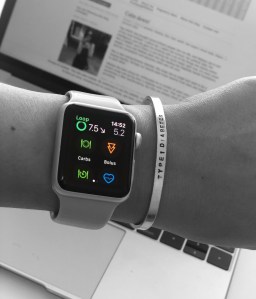
I trust Loop more than I trust myself. It is way smarter, completely and utterly unemotional, and an absolute workhorse, making adjustments every five minutes as required. It doesn’t get tired or busy or distracted. It understands numbers better than I ever will.
This is the cool tech I need to help me keep my diabetes moving. Of course, I still need the warm touch – the human connection – to help me make sense of my life with diabetes. But not having to think or do the diabetes numbers nearly as much gives me time and headspace I didn’t know I had. It keeps my numbers in range for the vast, vast majority of each day. And it means far fewer errors. Errors that I used to make all the time.
I am, after all, only human. Loop, on the other hand, is not.
One of the many highlights for me at last week’s EASD meeting was the satellite event about DIYAPS. It was a Hacking Health event, co-organised by the OPEN Project consortium and promised to highlight the perspective of the #WeAreNotWaiting movement through the eyes of people with diabetes, researchers and clinicians.
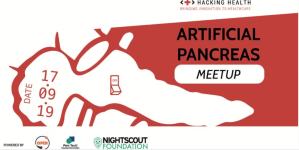
It was standing room only, with the event having sold out a few days earlier. I was a little late (I had to present at an event involving early researchers and PWD) so unfortunately missed the always brilliant Dana Lewis kick off the event.
If you ever need someone to warm up an audience and set the scene about the DIYAPS movement, Dana is your person! I have seen her present a number of times now, and always pity anyone who shares the stage with her. Her presentations are always enthusiastic, articulate and engaging, and leave the audience wanting more.
I followed her talk on Twitter as I was in the cab from the EASD conference centre to the Centre Cívic Sagrada Família (bonus of offsite events is actually seeing some of the tourist attractions the city has to offer!) and could see that the audience was enchanted and galvanised with her talk.
The program was packed – and provided a balanced view of not only people using the tech (because honestly, sometimes it can sound like we have all drunk the Kool-Aid!), but also about DIYAPS in clinical practice, and research settings, as well as a session on medical ethics.
There were many stand out moments for me, but perhaps the one that stands out the most was from paediatric endo, and fellow Looper, Katarina Braune where she was able to distil DIYAPS into this single sentence (as tweeted by another Looper, Andrea Limbourg):
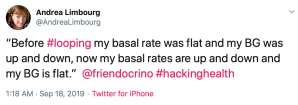
Perfect, perfect summary of looping!
We also heard from Roman Hovorka who presented on the experience of developing the Cambridge closed loop system (CamAPS). Anyone who has been following artificial pancreas technologies and research would know of Roman. I’ve heard him speak a number of times at conferences around the world and have always been grateful for his passion and dedication to advancing technologies to benefit people living with diabetes. So, it was a little surprising that I found his talk a little challenging.
One of the things that I have always admired about the DIYAPS movement is that there is a strong sense that our chosen DIY path sits neatly alongside commercial systems and regulatory bodies. While we may not choose or want to use a commercial system (and, of course, are not waiting for them), that doesn’t mean that there is disdain or derision of other options. In fact, there is admiration and gratitude for industry working to provide this technology to a broader audience. We know that not everyone wants to build their own system, and many ARE happy to wait for a system that will be in warranty, and comes straight out of a box, rather than cobbled together.
I say this knowing that same courtesy is not always afforded to the DIY world from industry, and I can point to every single time someone from a company developing a commercial automated system claims their systems are safe – implying that those of us in the #WeAreNotWaiting world are all cowboys not concerned with safety.
I would so have loved to have heard Roman really highlight all that his system has to offer, and what sets it apart from DIY systems, and how it is one more choice that will be available to PWD, rather than put down the DIY movement. I am all – ALL – about choice and love the idea that with this choice comes a better chance for us to find the tech that works best for our personal circumstances.
We don’t need to be defensive about ‘the other’ in diabetes technology. We need to acknowledge that there is no one right, perfect choice. DIY is certainly one of those choices, and as we heard sprinkled throughout the day, has been life changing for many people. But it is not the only option out there, and few people in the DIYAPS world would even suggest that it is. I guess perhaps that is what challenged me about Roman’s talk – he did seem to throw DIYAPS under the bus a little when it would have been far better to suggest it was just another bus route people may like to take.
So how could this event have been better? Well, I wish it had been part of the official EASD program. There is a lot of opportunity for HCPs to learn from the user-led tech community, and this extends to technologies and treatment options beyond DIYAPS. Reinforcing what is an overarching fact of life with diabetes – that all diabetes is DIY – is important for all working in diabetes to remember.
While DIYAPS technology may be at a far spectrum of the whole DIY diabetes idea, having HCPs and researchers listen to just how diabetes impacts on daily life, and the decisions we need to make is critical in their approach working with us.

Panel session to finish the day.
DISCLOSURES
My airfare and part of my accommodation to attend EASD was covered by Lilly Diabetes so that I could participate in the DOCLab advisory group meeting which took place all of Monday. Another night’s accommodation was covered by Novo Nordisk as I attended their advocate meeting on Digital Health Technologies.
I am part of the OPEN Project Consortium. I did not receive payment for my involvement in the Hacking Health event.
While my travel and some of my accommodation costs have been covered, my words remain all my own and I have not been asked to write or speak about any of the activities I attended, or anything I have seen at the conference. As ever, profanities are also all mine.
‘I’m bored with diabetes. So, so bored.’That was how I opened last week’s appointment with my endocrinologist.
She nodded at me. I’m sure it wasn’t the first time someone had commented on the boring nature of diabetes. It’s programmed into the DNA of the health condition we live with. She waited for me to go on (she really is the master of not filling silences).
‘What can I do to shake things up? What should I be doing?’
It was a repeat performance of my last appointment back in February. I walked in with this need to shake things up; do more; be more proactive; add stuff to my routine.
My endocrinologist, thoughtful as ever, waited some more for me to finish my brain dump. So, off I went…
‘I am doing so little to manage my diabetes these days. I’m not burnt out – that’s not what I am saying at all. I’m not doing that thing where I pretend I don’t have diabetes. I am doing everything I need to do, except these days, it seems I don’t really do much. Loop keeps Looping and I really feel that my only input is making sure there is insulin in my pump and a working cannula and sensor in place. I bolus as required.
‘But it doesn’t seem enough. There was time each day that I had set aside for diabetes that I don’t need anymore because managing rollercoaster glucose levels, or responding to countless alarms, or managing those hypos that resulted in multiple lost hours…these things just don’t happen anymore. Or if they do, they take so little time to address that it almost seems insignificant.
‘I feel like I am not doing enough. So…what can I do?’
When she knew I had finished sharing my stream of consciousness, she looked straight at me and said: ‘You do exactly what you are doing. There is nothing more that I would suggest or recommend that you do. You asked last time about adding some different therapies to your current management, but there is nothing that would suggest any benefit to that.
‘If you were not looping and doing what you used to have to do and all that entailed and telling me what you are telling me: that you are feeling well, you feel your diabetes is in a good place, you are not feeling burnt out and that you are happy with how and where your diabetes was tracking right now…and if that was accompanied by the A1c you are running, I don’t think we would be having this conversation. I doubt that you would be asking what more you could do. You would know that you are meeting all the targets you want to and are feeling overall great about your diabetes.’
Of course, she was right. That was my situation two years ago: I was feeling fine about my diabetes (or as fine as I ever was going to) and was thrilled with my A1c (which wasn’t as low as it is now). And I certainly wasn’t thinking that I needed to do more. I accepted that I was putting in the effort and for once was seeing the outcomes I liked. The idea of adding more tasks to my diabetes life would never have entered my mind!
‘I know you are right,’ I said to her and then mentioned the talk I’d heard at #DData last year when fellow DIY-er, Justin Walker, said that since using OpenAPS he saved himself about an hour a day. ‘An hour a day. That’s a lot of extra time I didn’t have before. I don’t know what to do with it,’ I paused. ‘Maybe I should take up knitting.’
‘You could learn a language in that time,’ she suggested, helpfully.
It has me wondering if this is a thing for others who have embraced the DIYAPS way of life. Have you all just embraced this renewed freedom and extra time and run with it, or are you too wondering what to do with your hands?
Nineteen years of constantly focusing on the minutiae of diabetes, and second guessing myself and having to DO SO MUCH diabetes is a really hard thing for me to unlearn. The last two years have been really, really different. Who knew that my response to finally getting that break that I so desperately wanted would be to not know what to do with myself and want to do more?!
Since Looping, diabetes has taken a back seat in my life because the daily demands are far fewer. Sure, the emotional toll is still somewhat there – especially when it comes to the fears I have about the future. But the daily frustrations and intrusions are not there. And that means that as well as having to physically do less, I think about it less. I had no idea just how much that all took until I stopped doing it.
I get that this is coming from a position of extraordinary privilege, and feel free to file it away under not only first world, but also first-class problems. And ignore me. (Seriously, I thought of myself as insufferable when I was having conversation last week.)
Or send me knitting patterns. In the meantime, I’ll be over in the corner conjugating irregular verbs.

I’m back on deck at work today after a whirlwind ten days in Europe for meetings and a conference. I started in Amsterdam, then flew to Florence and finally flew to Copenhagen (via Pisa). Those ten days were busy, long and interesting. And, perhaps best of all, packed full of others from the diabetes community.
Spending time with others living with or around diabetes is restorative. I know I get jaded at times, and burnout – in all its forms – takes its toll. I’ve been feeling a little advocacy burnout lately, and that has the tendency to make me feel that I need to step away from diabetes for a bit. Plus, I wasn’t sure if I could be bothered with the inevitable onslaught that comes when these sorts of activities happen.
Instead of hiding away (which is what I half wanted to do), I got on a crowded plane to Europe to spend almost two weeks ‘doing’ diabetes advocacy in different forms. By the time I got to Nijmegen – an hour and a half out of Amsterdam – for HypoRESOLVE I was already feeling better. I felt the darkness of burnout slip away as I sat in meetings, speaking up and providing PWD input into the project. And there, alongside me, were others living with diabetes. We leaned into each other, stepped back so another could take their turn, and supported each other to feel comfortable and relaxed. We reminded each other that there was a reason we were there – because people with diabetes must have a seat at the table and that we must be heard. We lived, breathed and ate ‘Nothing about us without us’ throughout that meeting and by the time I boarded a hideously early flight to Florence for the next meeting, I was raring to go – further boosted by a diabetes in the wild encounter.
Two days of meeting in Florence with friends and peers from the diabetes community talking about our experiences in the diabetes community continued to see my mojo return. We spoke about difficult topics, how the community works best and the place everyone has in there. I was reminded that the community ebbs and flows, and that it is not static. Sometimes, that rut that I find myself in means I forget that all communities change and grow and develop. This is actually a positive, because as it shifts, more people come in, some people step away (for good or just a bit), we reconfigure how it fits us, and diabetes makes sense in new ways.
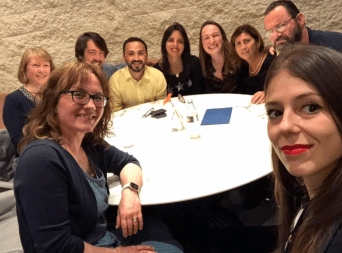
Some much needed downtime meant that I could reconnect with peers and feel myself being completely and utterly filled up in a way that only comes when surrounded by people who get diabetes and this weird diabetes space. We don’t all have diabetes – we represent different corners of the community, but we know diabetes in a way that is particular to those who live close to or with it. Our dinner after the second day of the meeting saw us finally able to breathe and take some time out of diabetes speak, and instead revert to a steady flow of laughs (shrieks, actually).
The next day, a friend from Italy just happened to be in Florence. We met up and I met her family, including her son who has diabetes. As we drank coffee just over the Ponte Vecchio, diabetes was spoken about a bit, but mostly, I got to learn about this young man who is clearly going to take on the world. He is smart, funny, delightful and inquisitive. His questions about Loop were intelligent – far more so than anything I would have thought to ask before I started using the tech! I hugged his mum as we said good bye, noting that she had just introduced someone else to our tribe.
By the time I arrived in Copenhagen (at 2.30am thanks to high winds in Florence, a bus ride to Pisa to take a diverted flight and some first-rate Italian disorganisation), I was exhausted, but at the same time felt more enthusiastic about the diabetes space than I had in some time. The next morning when I arrived at the conference venue, I was ready for a packed day of speakers, and to do my own presentation in the afternoon. I looked around and saw that there were a number of people living with and around diabetes that I knew, as well as a whole lot of new faces in there. The event was for HCPs, but as always, those of us with a truly personal connection to diabetes searched each other out. I met members of a support group known as ‘Diabetes Dads’ who meet regularly to speak about their kids with diabetes. They were there to support their friend who was speaking about his Looping son.
At lunch, I sat at a table with two PWD I knew. Two other people joined us and we quickly found out they too have type 1 diabetes. The conversation flowed – we understood each other, and our shorthand of diabetes speak easily fitted into our stories. We nodded as we heard stories that sounded familiar, even though they were being told by someone from another country who, until we sat down with our overflowing lunch plates, we had never met before. One of the women at the table had asked during an earlier session about how to wear the devices required for Loop, and I pulled out my RileyLink and showed it to her. She held it and weighed it in her hands. She’d wanted to know how to wear it with a fitted dress and I was able to show just how easily I could tuck away everything, even with the straight dress I was wearing for the day.
We may have all been there because of an interest or curiosity in DIY diabetes, but there is far more than that to draw us together. Just like as at the earlier meetings. As always, diabetes brings us together, but it’s far more that keeps us that way.
By the time I boarded the Dreamliner at Heathrow, all traces of burnout, and questions about how to manage in the sometimes tricky maze of diabetes community had completely subsided and were replaced with the reminder that when we find out tribe and surround ourselves with them, the burnout is replaced by feeling supported. And that’s how and why we show up. We do what we do, we show up, we speak up and we try to get stuff done. Ten days of that and I feel so much better. Which is good. Because as it turns out, those ten days are just the start …
DISCLOSURES
My flights to Amsterdam and accommodation while in the Netherlands was covered by HypoRESOLVE. I am on the Patient Advisory Committee for this project. My flight to Florence and two nights’ accommodation were covered by Lilly. I was in Florence for a DOCLab Advisory Meeting. My accommodation in, and flight home from Copenhagen was covered by the Danish Diabetes Academy. The Academy invited me to speak at their Diabetes DIY Movement conference.
Hi, my name is Renza and I never update software, operating systems, apps or anything that needs updating on anything. If I needed some sort of personal software update each year upon my birthday, I’d still be running whatever I was using when I was seventeen. I don’t have auto updates set up because 1. I’m an idiot and, 2. I used to, and once that caused problems with…something. Can’t even remember what, but obviously it left some deep scar somewhere and now I won’t do it again.
Most days, this apathy makes no difference to anything at all. I eventually get around to updating and on I go. No big deal.
Except for when it becomes a big deal. Because then I find myself #LooplessInMelbourne.
On the morning of Good Friday, my Riley Link died. Let me set the scene here by saying my RL had been dying for some time. This was not something that ‘just happened’. It had started needing a charge around mid-afternoon as well as the overnight charge it had been getting since I started using it in August 2017.
But on Good Friday, it decided that was it. No more charging. My Loop turned red and that was it. RL dead. Done. Gone. Finished. Just as it had been warning me was likely to happen for a few weeks.
Now, someone smart would have thought this through as soon as the RL started to need extra charging, and understood the following: 1. RL needs replacing, 2. make sure back up is available, 3. double check Loop docs for how to swap out old RL for new one, 4. follow instructions.
I got as far as step 2, and that was it. I was supercilious in my back-up planning skills and took my spare RL out of my diabetes cupboard, leaving it on my desk as though that was enough to miraculously sort everything. Idiot, thy name is Renza.
On that (not so Good) Friday I put all thoughts of sorting it out of my mind and set about my day. It was a public holiday, so I figured I’d fix it all later. I also thought it would be just a matter of switching RLs over.
Not so much.
Around midday, I sat down and read the Loop docs and immediately realised that I needed to update my Loop app to use the new RL. I’ve rebuilt the app before and I know it is a simple process.
I scanned through the docs and saw that I needed to make sure that all operating systems and apps were up to date. Suddenly every single update notification that had popped up in the last year flashed before me. So did every post, plea, warning to update everything from Katie DiSimone on the Looped Facebook page.
I set to updating my Macbook, iPhone and Apple Watch. Easily done. Then, I came to Xcode. And the wheels fell off. (Xcode is an app and needed to build Loop.)

I don’t think I’ve updated Xcode since I loaded it onto my Macbook, back when I first built Loop. I do remember it taking FOREVER to upload and install. The update took longer. The first time I tried to update, it took almost three hours to not work. The second time, it took four. By this stage it was late on Friday. Clearly, I was paying no attention to what was going on because when I saw that it had finished updating, I assumed that all was good and off I went to rebuild my Loop app.
Building Loop is simple because the instructions have been written for people like me in mind. Technologically hopeless, but eager to understand. They are step by step and, honestly, if you follow every step as laid out, you cannot go wrong.
So, off I went. Step by step. And then…
Red error message.
I read the errors page and tried all the suggestions, but the same error message came up. It was getting late and I was exhausted, so at 1 am, I went to bed. I was over it and figured that fresh eyes in the morning would do the trick.
I woke on Saturday and with those fresh eyes I realised straight away that Xcode had not updated. That’s right – the second attempt had failed too, and I had been trying to rebuild Loop using an outdated version.
As it turns out, third time’s a charm and while eating Easter lamb at my in-laws, Xcode updated successfully.
After lunch, I opened the new version of Xcode and followed the instructions to build Loop. That took under 5 minutes and no brain power or tech know-how (from me, that is – a lot of people had used a lot of brain power and tech know-how to make it so easy for me).
Shortly after, the Loop app appeared on my phone. I entered all my relevant info (another 3 minutes work from me) and then almost straight away my Loop turned green.
And I’ve been happily Looping ever since.
So, here’s the take home: Keep everything updated. If I had done that, the rebuild of Loop would have taken a total of 15 minutes. And most of that would have been sitting and waiting for Loop to re-install on my phone.
I was telling someone about this whole (actually rather boring) story the other day and a little smugly they said ‘That’s why I won’t use a DIY system. Sounds like a nightmare. They can’t be relied upon.’
But actually, that’s not the case at all. What is unreliable is me and my inability to do the basic updates that all our devices require. Our commercially available apps (such as Dexcom) require us to update occasionally. In twenty months of using Loop, I’ve updated the app once (when I got a new iPhone).
Being #LooplessInMelbourne wasn’t really a big deal. It did, however, remind me why I am a huge fan of DIYAPS as the right tool for me right now. And it also reminded me that I really am not much of a fan of DIYDiabetes. That’s really not for me at all!

Loop’s back, baby!





 Diabetogenic