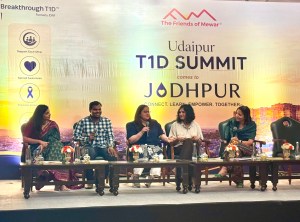
I’ve been in India this week for the annual Udaipur T1D Summit. This year, we took the summit to Jodhpur and once again, brought together dozens of people with diabetes, clinicians, researchers, industry stakeholders and policy makers.
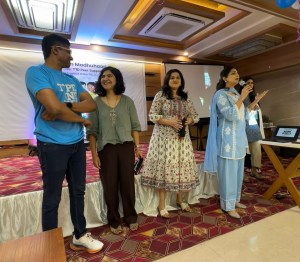
One day, we all travelled to Nagaur, a city about three hours out of Jodhpur. We visited a T1D clinic in a district hospital, and attended a day camp for children and adolescents with T1D and their parents. This was for me, undoubtedly, the highlight of this visit to India.
The vast majority of the discussions were in Hindi and the local language. I understood nothing of the presentations other than the occasional words in English that cropped up from time to time. Afterwards, many of the people in the room spoke with me in English, and I had some lovely conversations with children and teens with diabetes, and their parents. I spoke with two young girls and they told me what they liked doing, about school and what annoys them about diabetes. A tiny toddler sat next to me and she was far more interested in the beaded bracelets on my arm than diabetes and really, who can blame her? Diabetes doesn’t compare to bright friendship bracelets! And I spoke with a remarkable young woman who I truly believe is going to change the world. She told me she wants to be a polo player, and I have no doubt that at some point I will find out that she is competing on national and international stages. She told me about how she feels about living with diabetes and her optimism and hope have stayed with me for the last few days. If only every newly diagnosed child with diabetes could connect with someone like her!
Parents spoke with each other, always keeping an eye on their children, but secure in the knowledge that in this room, everyone was looking out for each other.
I watched advocates who have become friends lead the activities, and I was in awe as they managed to show just how much peer support can mean. Jyotsana needs her own TV show – her enthusiasm and spark as she rallied the children was infectious. And Nupur and Snehal, ever calm and grounded, know exactly when to step in and when to step back. And then Prashanth rallied the children to do their injections together before they ate lunch, watching over each of them, and offering words of encouragement and words of reassurance. Worlds frequently collide in the diabetes advocacy space, and these incredible advocates are also #dedoc° voices. They are as confident and comfortable standing on stages at international professional diabetes conferences and in front of community groups. This is community at its best and most powerful.
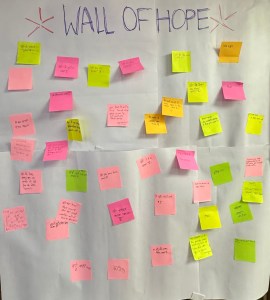
One of the activities during the day is a ‘Wall of Hope’. I asked one of the event organisers translate the words on the post it notes. It came as no surprise to me that in the wishes and hopes and dreams of these young people, diabetes didn’t feature. They wrote about wanting to be doctors and teachers and work for the government. Many wrote about wanting to have happy lives. One said ‘I want to be strong like my mother and then I want to be a doctor’. I got a bit wobbly with that one!
There are some universal truths about T1D. I’ve come to learn that after decades of working in the diabetes space and spending time with others with diabetes. We are all different and we all carry diabetes in different ways. Our experiences vary based on diverse, complex and multiple factors. There absolutely is no one size fits all for diabetes.
But there is one constant that I have seen and continue to see ant that is the power of peer support. Spending time with others living with diabetes is life changing. The shared language of diabetes connects people in ways that make sense only to those of walking our own diabetes path.
One of the organisers of the event told me that me being there was important for the families and for the kids with diabetes. She looked surprised when I told her that it was important for me to see them. I learn from each and every other person with diabetes I come across and feel energised and connected. We all leave with out batteries recharged from the energy in the room.
Living with diabetes was never meant to be a solitary endeavour. It makes it so much easier when we have others who ‘get it’ because they’re living it too. That’s the superpower of community.
Disclosure
The Udaipur T1D Summit is a collaboration between Friends of Mewar (a charity run by Princess Padmaja Kumari Parmar who lives with T1D), the William J Clinton Foundation and Breakthrough T1D. I work at Breakthrough T1D as Senior Director, Global Responsibility.




 Diabetogenic
Leave a comment
Comments feed for this article