
You are currently browsing the monthly archive for August 2019.
Jeez, burnout sucks. And boy, was I feeling it last week. My blog post from last Friday accurately summed up the exhaustion, stress, feelings of defeat and the heaviness I was feeling as I flew back home. I didn’t even have the energy to yell ‘Bullshit!’ during the part of the safety video when the guy claims lies that there is great coffee to be had on the aircraft. That is just not true, Qantas.
Thanks to everyone who reached out – to everyone who Tweeted, Facebooked, Instagrammed, commented, texted and emailed. I did take a few days off SoMe, but when I logged back on, I read absolutely everything that was sent to me, and I am overwhelmed (but in a really good way) by everyone’s support.
I participated in yesterday’s #DSMA chat because the awesome Cherise thought that a community chat about advocacy burnout was a good idea, and as is Cherise’s way, she was right. I learnt a heap about how others manage the inevitable feelings of overwhelm that affect so many of us at one time or another.
I am incredibly fortunate to work in a place that truly values the lived experience. As I wrote in this piece after the Ascenisa #OzDSMS, my CEO has always not only valued my role in the organisations he has led, but has championed the importance of lived experience. I’m really glad he was able to speak to some of Australia’s most impressive advocates (all of whom he already knew) to continue to explain just how important the work they/we all are doing truly is. I held on to that for a lot of last week and over the weekend too.
But it was the support of those with diabetes that helped me dig deep to find the way out of the dark space; those who understand that special brand of burnout that we feel when not only has our own body done its best to undermine us, but others and circumstances around us pile on, making things just so damn hard.
There is an ever-increasing body of evidence that shows peer support is helpful to people living with health conditions. But there is so much more to why we become parts of these communities than to just improve our health and wellbeing, or to connect with others who ‘get it’.
In these communities, those advocacy efforts we are working on in our own little corners of the world become real and big. Heather Gabel wrote this awesome Twitter thread about frustrations I share with her about how we need to focus on the social change our communities create. I will always need the tea and sympathy, but I also need the connections with those world-changing folks whose drive, determination and dedication help me thrive.
I would be naïve to suggest for a moment that the devastating and crushing burnout I was feeling last week has disappeared. It’s still there, and I suspect it will be for some time, and I’m going to keep taking time out, and stepping back for a little bit longer. But I am far more motivated now, and the crappy things that culminated in feeling overwhelmed are starting to look like blips rather than insurmountable peaks. Thanks to everyone who helped me step back and refocus.
Window seat on a Qantas flight back to Melbourne after a busy few days at #ADC19 and to say that I am exhausted doesn’t touch the sides of how I am really feeling. It’s been a busy conference, but then, when are conferences not busy? I’ve spoken to a lot of people, sat in a lot of meetings, heard a lot of sessions. But that’s just the usual way conferences go.
My exhaustion started before I even got in a cab to the airport on Monday. And really, that exhaustion isn’t just about the sore legs, the lack of sleep or the mental overload of trying to digest stats and presentations, or wandering around a huge conference centre.
I’m so burnt out right now. Not diabetes-wise; advocacy wise. I’m weary. And I feel so, so beaten that I almost ache. I feel like I am at the edge of tears a lot of the time because everything feels like such an effort.
This is a challenge when working in, while living with, diabetes. Even when my diabetes is impacting as minimally as I could ever hope it to (thanks to the Loop god/esses again), the big world of diabetes is there in a way that, at times, crushes me. I used to feel like this a lot more when I had to spend so much time justifying to co-workers the value and importance of the work I and my team were doing. That’s not the case now, but there are still times that it all does feel like it is too much.
And when I feel like this, things that usually would barely be a blip on the radar are weighing me down. I usually am ready to take on whatever is thrown at me, or whatever I see that needs the PWD voice to interject, but right now that actually feels like a burden. A relentless burden where my efforts are misfiring or yielding hardly any benefit. The fire that is usually ignited in my belly feels like instead of fuelling my enthusiasm and passion is instead giving me heartburn.
Right now, being in this advocacy space is making me feel hopeless. I know that there are always allies that truly do believe in what I believe in – the value of the PWD, the need for us to be heard, the value and vastness of our experience and expertise.
But the voices of those who don’t necessarily feel that way are especially loud at the moment. It’s the HCPs who still (STILL?) question the right for PWD to be wandering around and on the stage at diabetes conferences, the comments about how the value our lived experience doesn’t equal the weight of scientific evidence, the messaging that I keep seeing everywhere I turn that misrepresents diabetes and actually does PWD a disservice. It’s the idea that others think they can dictate to PWD how we need to see the safe places we have created, or tell us that because they can’t back up with data when we say a technology, or a service or a program helps us, it is not valid or deserves funding. It is being confronted constantly online and offline and at every opportunity, when really, if we say we feel a certain way about living with diabetes, we actually do have the right to have that unchallenged.
And right now, I don’t seem to have the energy to try to counter that.
I tried to explain to someone the other day why I rarely let something that I see as being negative towards PWD go by. I know that it would be easier to ignore a lot of the crap and let it just slip by. I know that being angry is tiring. But that isn’t enough for me to not respond.
Usually, I have the resilience and robustness to address whatever the issue, and then whatever gets thrown back at me. I don’t think that I am the only one who can do this, but I do know that often I am one of the few people who actually is at the table while it is happening. Once, where I was the only PWD in a meeting of HCPs someone told me that I didn’t need to have an opinion on everything and I pointed out that actually, as the only PWD in the room when others were making negative comments, I actually do. And that it was in my position description, so I was simply doing my job.
I am tired. I really am.
Having my tribe around me this week has helped – it always does. But even with this support, and the laughs and the knowing looks and the understanding, I’m feeling beaten. (I am so grateful to have had them around this week…I’m not sure how I would have otherwise coped…)
I know it’s a phase but this time I don’t know how to locate the strength I need to get back to where I like to be. Or to push down the doubt and imposter syndrome that shoots up alongside this sort of advocacy burnout. That’s what happens – just as with diabetes burnout – we start to second guess out efforts and wonder if what we are doing is enough or really has any point. There is a point – I know that. There has to be. Because the personal investment is vast and really, there is no other choice but to keep on keeping on.

Grateful for my tribe.
It’s day one of the Australasian Diabetes Congress (#19ADC) which is being held in beautifully sunny and shiny Sydney over the rest of this week. Once again Diabetes Australia has brought together a team of diabetes advocates and bloggers to provide real time, on the ground updates from the Congress, which is a brilliant way for people with diabetes not here to keep updated on the sessions, latest research and new tech that is on display.
I have spent a lot of my advocacy life talking about the value of having people with diabetes at this sorts of healthcare professional events. I’ve defended our right to be here until I have turned blue in the face. I have said the words ‘Nothing about us without us’ so frequently that people have asked me if I coined the phrase (of course I didn’t – others have been saying this for years longer than I have). I have challenged people who have said that this conferences are a safe place for HCPs to talk amongst each other without concern that PWD might misinterpret what they are saying. We belong here – it is as much a place for those of us living with diabetes as it is for those working in diabetes.
Yesterday I was involved in two events – I gave a talk with Grumps at the Roche Educators Day (#RED2019), and then we co-facilitated the Ascensia Social Media Summit (#OzDSMS) – and there was a lot of talk about the importance of people with diabetes at events like this. I’ll be writing about both these sessions later on, but for now, I want to share a comment that came out of the Ascensia event when we were talking about what advocacy means and why we need to be present in all diabetes discussions. Kim Henshaw spoke about the importance of PWD being advocates and I think this just nails it.
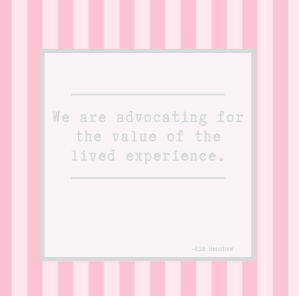
The lived experience is critical for people to understand what diabetes is all about. It was so refreshing to hear Diabetes Australia CEO, Greg Johnson, say ‘I’m a real believer in the power of the person with diabetes telling their story. It’s not just about organisations doing it, it’s about individuals doing it in all sorts of ways.’
This is why it makes sense to have us at these conferences. Our insights, ideas, thoughts and knowledge and expertise is valuable. That’s why we’re here.
Disclosures
My flights to attend ADC were covered by Roche Diabetes Care Australia. Thanks to the Australian Diabetes Society and the Australian Diabetes Educators Association for providing me (and the other #DAPeoplesVoices) with a complimentary press pass. My accommodation and all other costs have been covered by Diabetes Australia (which is where I work). My words here and in all my tweets and other social media activity are mine and mine alone. I’m trying really hard to not be sweary and these efforts should be rewarded with chocolate.
‘I’m bored with diabetes. So, so bored.’That was how I opened last week’s appointment with my endocrinologist.
She nodded at me. I’m sure it wasn’t the first time someone had commented on the boring nature of diabetes. It’s programmed into the DNA of the health condition we live with. She waited for me to go on (she really is the master of not filling silences).
‘What can I do to shake things up? What should I be doing?’
It was a repeat performance of my last appointment back in February. I walked in with this need to shake things up; do more; be more proactive; add stuff to my routine.
My endocrinologist, thoughtful as ever, waited some more for me to finish my brain dump. So, off I went…
‘I am doing so little to manage my diabetes these days. I’m not burnt out – that’s not what I am saying at all. I’m not doing that thing where I pretend I don’t have diabetes. I am doing everything I need to do, except these days, it seems I don’t really do much. Loop keeps Looping and I really feel that my only input is making sure there is insulin in my pump and a working cannula and sensor in place. I bolus as required.
‘But it doesn’t seem enough. There was time each day that I had set aside for diabetes that I don’t need anymore because managing rollercoaster glucose levels, or responding to countless alarms, or managing those hypos that resulted in multiple lost hours…these things just don’t happen anymore. Or if they do, they take so little time to address that it almost seems insignificant.
‘I feel like I am not doing enough. So…what can I do?’
When she knew I had finished sharing my stream of consciousness, she looked straight at me and said: ‘You do exactly what you are doing. There is nothing more that I would suggest or recommend that you do. You asked last time about adding some different therapies to your current management, but there is nothing that would suggest any benefit to that.
‘If you were not looping and doing what you used to have to do and all that entailed and telling me what you are telling me: that you are feeling well, you feel your diabetes is in a good place, you are not feeling burnt out and that you are happy with how and where your diabetes was tracking right now…and if that was accompanied by the A1c you are running, I don’t think we would be having this conversation. I doubt that you would be asking what more you could do. You would know that you are meeting all the targets you want to and are feeling overall great about your diabetes.’
Of course, she was right. That was my situation two years ago: I was feeling fine about my diabetes (or as fine as I ever was going to) and was thrilled with my A1c (which wasn’t as low as it is now). And I certainly wasn’t thinking that I needed to do more. I accepted that I was putting in the effort and for once was seeing the outcomes I liked. The idea of adding more tasks to my diabetes life would never have entered my mind!
‘I know you are right,’ I said to her and then mentioned the talk I’d heard at #DData last year when fellow DIY-er, Justin Walker, said that since using OpenAPS he saved himself about an hour a day. ‘An hour a day. That’s a lot of extra time I didn’t have before. I don’t know what to do with it,’ I paused. ‘Maybe I should take up knitting.’
‘You could learn a language in that time,’ she suggested, helpfully.
It has me wondering if this is a thing for others who have embraced the DIYAPS way of life. Have you all just embraced this renewed freedom and extra time and run with it, or are you too wondering what to do with your hands?
Nineteen years of constantly focusing on the minutiae of diabetes, and second guessing myself and having to DO SO MUCH diabetes is a really hard thing for me to unlearn. The last two years have been really, really different. Who knew that my response to finally getting that break that I so desperately wanted would be to not know what to do with myself and want to do more?!
Since Looping, diabetes has taken a back seat in my life because the daily demands are far fewer. Sure, the emotional toll is still somewhat there – especially when it comes to the fears I have about the future. But the daily frustrations and intrusions are not there. And that means that as well as having to physically do less, I think about it less. I had no idea just how much that all took until I stopped doing it.
I get that this is coming from a position of extraordinary privilege, and feel free to file it away under not only first world, but also first-class problems. And ignore me. (Seriously, I thought of myself as insufferable when I was having conversation last week.)
Or send me knitting patterns. In the meantime, I’ll be over in the corner conjugating irregular verbs.

I so love it when New Yorker cartoonists are able to provide me with a beautifully succinct explanation for something that seems to confuse people.
Sure, we can talk about prevention and what we can do to reduce risk. But sometimes, there are things way out of our control. Being able to explain that particular side of the diabetes coin may just go some way to reducing a little of the blame and shame that gets thrown in our direction…

(Click cartoon for details.)
As part of my role at Diabetes Australia, I am often a media spokesperson for the organisation and will do radio or television interviews to talk about … well … diabetes. I usually step in when our CEO, Greg Johnson, is unable to do the spot, or if it is more in-line with the lived experience work that I do.
In the lead up to National Diabetes Week, I was interviewed on a program on commercial TV that airs in the middle of the day over the weekend. I spoke about NDW, gave a quick diabetes 101, answered a few questions. And responded to a segment they’d run the week earlier where they had interviewed Dr Michael Mosley, where he had spoken about intermittent fasting, the 5:2 diet, and low calorie eating for rapid weight loss as management tools for type 2 diabetes.
When asked about Mosley, I started by saying there is a growing body of evidence suggesting that rapid weight loss and/or intermittent fasting is a way that some people with type 2 diabetes have found is useful in managing their condition. (You can read my thoughts on using words such as reverse, remission or cure here.) Building on this evidence is important – and so is seeing how people are going 5, 10, 15 years down the track. Plus, it is fantastic that this is a treatment option that works for somepeople with type 2 diabetes.
I added that we need to caution suggestions this treatment is something that will work for everyonewith type 2 diabetes. Some people won’t respond to these methods, and will need other options for how to manage their own brand of diabetes. They should not be made to feel that they have failed if one treatment does not work for them.
I said all of this in about 45 seconds, and didn’t think any more of it. I walked out of the studio, climbed into the back of a cab and got on a plane to Brisbane, settling in for a week or NDW-prep and then NDW itself. I completely forgot about the segment airing until a few people had mentioned seeing it.
I still haven’t watched the whole interview, but I honestly can’t remember anything that I said that was especially offensive. The hosts and the segment producer said it had gone really well.
But clearly, there were some viewers who took objection to what I said. I know this, because my inbox and socials DMs were infiltrated with quite a few comments from people who were more than happy to tell me that I was wrong. They told me that following a similar program to Mosley had worked for them, (I am always, always happy when people find what helps), and that perhaps I should be more open minded, (I am – I just don’t believe that there is a one size fits all solution to diabetes). I was told that low carb is the only way to go and that my comments about there being no such thing as a ‘diabetic diet’ were wrong and that I was a shill for Big Food (yawn).
And then, a few people took the discussion in a direction I’d not had to deal with before, with these choice comments:
‘It’s obvious you could do with some intermittent fasting.’
‘Stop believing food companies and your own organisation and start eating low carb to manage your own diabetes because at your weight you are doing yourself harm.’
‘You are an example that dietary guidelines don’t work. If you ate low carb and fasted, you’d lose some of that excess weight.’
‘Stop listening to your dietitian and eat low carb, high fat. You’ll lose weight and won’t get all the complications that are in your future.’
‘Do you add sugar to your coffee? You mention baking cupcakes and brownies. Do you add sugar to them? Do you eat all normal foods which have sugar in them?’
There were others. They were equally tedious, misguided and, at times, laughable. (For example, ‘my dietitian’? As if!)
Now, I didn’t at any point during the interview say that I live with diabetes. I didn’t say anything about the type of food I eat or how I manage my condition. I didn’t mention baking or drinking coffee. If you know me, you would know that I do have diabetes, bake and drink coffee. And if you don’t know me, you can find that out quiet easily. If you went looking.
It seemed that some people went looking. I didn’t know any of the names that accompanied their useful and not-asked-for counsel. I assume they didn’t come from people I know, because I don’t know too many people who would send me this sort of advice.
But these folk (there weren’t many – maybe a dozen or so) took the time to find out who I was, how to message me and then tell me that I needed to lose weight and manage my health condition differently.
Please understand that I’m not asking for positive comments or reassurance about my body or my size. I don’t want anyone telling me I am a healthy weight, that I look fine and that I didn’t deserve what I got. NO ONE – whatever their size or shape – deserves this sort of unsolicited commentary from complete and utter strangers. Or people they know, for that matter.
This is about the idea that there are people out there who, if they disagree with something someone says, or if they hear someone suggesting that people manage their diabetes in a different way, get online and insult a person they have never met before by telling them to lose weight.
I know that this is a really tiny incident. And it’s the first time it has ever happened to me. I know that there are some people who face this sort of bullshit regularly.
It is not okay. Body shaming or commenting on someone’s weight or how they look is never, ever acceptable. And tying it up by telling them they are harming their health does not make it any better.

I totally had coffee and lemon cake I baked last night for breakfast. There was sugar in both.
Sometimes, something happens at a diabetes conference that I need to sit on for a while before I can write or talk about it. At ADA this year (almost six weeks ago now), there was a moment that has stuck with me and I think it’s time to talk about it.
I was sitting in the front row of the language session – because, of course I was – eager to hear from the all-star panel that was going to be looking at the language issues from the perspective of the PWD and HCP, as well as look at the role HCPs play in addressing diabetes stigma and how they can improve communication. I loved the well-rounded approach the session was taking, and settled in for a couple of hours of discussion.
The line-up was a veritable A-list of the best voices in the space. We had ‘Jane squared’, with Dickinson and Speight book-ending the program, Joe Solowiejczyk giving the consumer side and Kevin Joiner providing strategies for dismantling stigma.
Jane Dickinson has been an absolute champion of the diabetes #LanguageMatters movement in the US. And it was in her introductory session that the moment of today’s post happened. Jane was speaking about how HCPs see diabetes and people living with the condition. And she showed this slide:

I can’t remember if Jane read out the quotes. But I do remember how I felt as I read them and took in what they meant. I felt beaten.
As people living with diabetes, so many of us have firsthand experience of hearing these sorts of comments directed to us. Or we have had friends with diabetes tell us their tales. Or we have heard passing comments from HCPs expressing similar sentiments. The idea that we don’t care, have brought it all on ourselves, deserve what we have coming – and conversely, don’t deserve care – us pervasive through the diabetes landscape.
This is how diabetes and those of us are living with it are perceived. And it is heartbreaking.
There is no consistency as to who is making these comments – healthcare professionals from all different disciplines, at different stages of their careers, with different experiences. Some work in tax-funded settings, others in private settings. They are considered the best in their field, they are held up as examples of excellent care. Other HCPs refer PWD to them.
Often, I hear people say that these attitudes are really only ever the thoughts of ’old school’ HCPs who have been around for a long time; it’s a throwback to the patriarchal attitudes of healthcare – to days when doctor or nurse knows best and ‘patient’ does what they are told, and if they don’t, they get told off, while being written off as not caring for themselves.
But that assessment is actually not true at all. Some of the most sensitive and tuned-in HCPs I know have been working in diabetes for many, many years.
And some are yet to have even started their career. In exactly the same way that diabetes doesn’t discriminate, it seems that these horrid attitudes and stigmatising comments can come from people at every stage of their career.
Here is the whole slide.

That’s right. These comments came from future nurses. They hadn’t even set foot on the wards yet as qualified HCPs. But somehow, their perceptions of people with diabetes were already negative, and so full of bias. Already, they have a seed planted that is going to grow into a huge tree of blaming and shaming. And the people they are trusted to help will be made to feel at fault and as though they deserve whatever comes their way.
This – THIS – is why I am not stopping banging on about language and diabetes. THIS is why I get frustrated when someone responds to – and reduces – a discussion about this issue with ‘But I/my kid is happy to be called (a) diabetic’. THIS is why I constantly highlight when people or organisations or people in the media are using stigmatising or negative language.
The words we use shape the attitudes we have, and the attitudes held by many about diabetes are disgraceful. Imagine if instead of mindsets like this, HCPs came out of their training with the idea that people with diabetes need support, education, information, compassion and skills to best manage a condition that no one, but no one, ever asked for Just think about how different – and better – that could be.
The ADA session ended perfectly – with Jane Speight (my personal diabetes #LanguageMatters hero) playing the Mytonomy ‘Changing the Conversation’ video. So, here’s that video again. Watch it. Share it.





 Diabetogenic