Being allergic to gluten is the new black. Apparently. Just about everywhere I go, I hear people say they ‘can’t eat gluten. It makes me feel bloated’.

My favourite bit is when they next say ‘I know EXACTLY how it feels to have diabetes and not be able to eat sugar. When I eat a piece of bread containing gluten I get bloated. I feel really uncomfortable.’ Usually I ignore them whilst I mentally picture myself strangling them until they admit they’re stupid.

The other day I forgot. I snapped ‘actually you don’t know AT ALL what it’s like to have diabetes. I do. I have it. And I can eat sugar. And your perceived little bit of discomfort when you eat bread? Believe me; it’s NOTHING like living with diabetes’.

A couple of years ago, we held a diabetes and coeliac information session as part of Diabetes Australia – Vic’s World Diabetes Day activities. Prior to this event, I had only a basic understanding of coeliac disease which basically consisted of me dutifully having a screening blood test every couple of years which, fortunately for me, has always come back negative. I was fascinated to hear about just how meticulous people with diagnosed coeliac disease have to be in their avoidance of gluten. Different toasters…different tubs of margarine. A crumb of gluten-containing bread can cause symptoms.

After this information session, my tolerance of people being ‘gluten intolerant’ went from about 1.2 out of 10 to, oh, I don’t know, minus one squillion.

At Christmas last year, I sat at a table laden with the most incredible, delectable food imaginable. Everyone in the family had contributed their specialty. A veritable feast! ‘Where’s the gluten free bread?’ someone asked. My head snapped around to hear who had asked that question.

Now, my family collects autoimmune conditions as others collect china cats, so I thought that perhaps someone had been diagnosed with coeliac disease. ‘I’ll have some of that when you’re done’, said someone else. ‘Me too. I get bloated when I eat wheat,’ said another. ‘Does everyone here coeliac disease all of a sudden?’ I asked, trying desperately to keep the contempt out of my voice. I don’t think I succeeded, judging by the sideways glance my sister threw my way. ‘Yeah. Maybe. Well, not diagnosed, but you know, I feel bloated when I eat gluten,’ said one.

There were general sounds of agreement from three others at the table. “Oh yes,” said another. “I never eat bread with gluten.” I noticed, however, that she ate more than a few of my mother’s amazing zippoli (Italian donuts). Ah – so it’s an intolerance that chooses what it can eat. I want that! I want diabetes that reacts by sending my BGL out of range for no apparent reason only when I eat spinach. On a Tuesday. In months ending with an ‘e’. It would be great to pick and choose like that!

Here’s the thing. If people really, legitimately feel that eating something upsets their digestive system, see a doctor and have it tested. Swanning around claiming to be allergic to things or being intolerant of certain food groups minimises the seriousness of those who have life-threatening allergies and those who have conditions where food really is a consideration.

First world, bourgeoisie problems! (Grumpy rant over.)

Information about Coeliac Disease can be found here.

In October last year, I went to my twenty-year school reunion. I have no idea where the last twenty years have gone. If you ask me, I’ll still try to convince you that I’m really 23 (not fooling anyone, really!), but the truth is, it was twenty years ago that I last donned the Smurf-blue uniform that I wore for six of my teenage years.

I walked into the room where about fifty of my former classmates stood – chatting, catching up, squealing ‘you look exactly the same’ (liars – the lot of us!) and giggling at forgotten stories of mischief and misadventure.
I was greeted in one of two ways:

  1. ‘Do you still play the flute?’ (Followed by admonishment when I cheerfully answered ‘nope’!)
  2. ‘You are so brave!’ Huh? Then I realised that it was Facebook friends who commented on my apparent braveness. They’d been reading my blogs.

I tried to dismiss the diabetes chatter and change the subject. Because that time is my life BD – before diabetes. It’s a time where I didn’t jab my finger ten times a day, where I didn’t do super-smart calculations to work out the carb content of food (although thanks Mr Tossilini – your maths classes paid off after all!) and where I didn’t know what an endocrinologist was. It was a time where visiting a doctor was because I had a throat infection and I visited the pharmacy to buy lipstick, not insulin.

School days were filled with complaining about homework, stressing about essays, and growing up and through those awkward teenage years. It was when I was trying to get an idea of who I was, who I could be, who I wanted to be. Including diabetes to that time in my life would have added a complexity that would have been one more thing to fumble my way through.

Of course when I am at work, it’s all about diabetes. I get wheeled out as the consumer (or as I refer to it, the ‘here’s one we prepared earlier’). And that’s fine. It’s part of the job and I am beyond honoured to be asked to speak from a living-with-it perspective. I take it very seriously.

But in a room full of people who know me as the nerdy flute player, I don’t want to be known as the diabetes advocate.

I had such a great night with my schoolmates. Six years of shared history, shared detentions, shared being yelled at for daring to walk on the Convent lawn, shared laughing at one teacher who showed up to school one day with only one peacock-blue eye made up makes for a fun night.

My life BD was a different life. I know that the carefree and blithe nature of that time was partly because I was a teenager. The most pressing issue was whether the cute boy on the Glenferrie Rd tram did or didn’t notice that I was wearing my hair differently.

It was fun, so fun going back to that time. At the reunion, as I caught up with my friends and giggled like a teenage girl I forgot. About the pancreas that stopped working; the pump I was wearing, hidden down my top; and that as I ate, it was because I wanted to, not to stop me going low. The time BD seems like a long time ago. But I caught a glimpse of it that night. And I realised how much I miss it.

Strength and Kindliness


This weekend, my daughter was invited to a birthday party at an aquatic centre. It was one of those annoying kids’ parties where the parents are expected to stay (rather than do the drop off and then bolt to a local cafe with the other parents for a couple of hours of either latte or wine sipping – no judging, please).

“Got your bathers? Are you getting in?” someone asked me.

“Ha! No. I don’t own a pair of bathers!” was my response.

And it’s true – I don’t own a pair of bathers. I can’t remember the last time I got into a pool. The thought of being in bathers around others gives me nightmares. There are parts of my body that I take great lengths to cover up, and lumps and bumps are definitely not for public viewing. I see it as a community service – no one needs to see my knees!

I know this is ridiculous. My body does all it’s meant to do – it gets me up and about; it conceived, grew and produced a child; it allows me to work, play and live and it supports me as I teeter around on ridiculously high heels. It does everything it’s meant to do.

And yet, when I think about my body, all I can see is the problem areas. I spend a lot of time sucking in my stomach and being beyond critical.

I am also conscious of the fact that there is a seven year old girl in my house and I am already hearing stories of her friends commenting on their bodies. Positive role modelling is important and I try to do that by never complaining about my body in front of her, only ever referring to her body in terms of health and strength, and never commenting negatively or positively on other people’s bodies. We don’t have trashy magazines in the house, we don’t watch TV shows about weight loss and there is no praise or discussion of celebs that shed their baby weight in three minutes flat.

A couple of years ago, I joined a women’s only gym. There was the ‘inspiration wall’ where we were meant to put a photo of how we wanted to look after we ‘got in shape’. There was photo after photo of size 6 models in bikinis.

Each time I swiped my card at the gym, one of the perky assistants would look up and say “Where’s your inspiration photo, Renza? Who do you want to look like when you reach your goals?” I can still remember the looks of disbelief when I brought in my photo, a picture of a healthy cardiovascular system. “That’s my goal,” I said. “Health.” My photo never made it up on the wall.

Generally, conversations about bodies are about beauty. It’s rarely about health. How do we change the parameters for these conversations?

I don’t have the answers to this issue. It is so complex and my own personal situation is fraught. I am not happy with my body. Does this mean I have body image issues? I worry about putting on weight for shallow-I-want-to-wear-that-dress reasons, but also for health reasons. I know how extra weight affects my diabetes. I know how diabetes affects my weight. I also struggle with the fact that when I do try to exercise, I hypo. And need to eat. It frustrates me beyond belief!

There is some great information out there about diabetes and body image. But I think it focuses on the extremes. And whilst it’s incredibly important to provide information for those living with both diabetes and an eating disorder, we need to find ways to speak about how we feel about bodies when the situation isn’t so extreme. We need to speak about these issues without being judged, told to ‘just get over it’ or given a pop-psychology lecture about taking control of our destinies (I may have lifted that last line from The Biggest Loser website. Or not.)

Does the first step for me involve biting the bullet, buying a pair of bathers, putting them on and heading to the local pool with my daughter and splashing around with her? Trying, desperately trying not to feel self-conscious. And I need acknowledge the great things my body has done and continues to do. And somewhere in there find acceptance.

More information?

Read the National Diabetes Services Scheme Eating Disorders and Diabetes information booklet here.

Eating Disorders Foundation of Victoria.

This post is my January entry in the DSMA Blog Carnival. If you’d like to participate too, you can get all of the information here.

This month, the topic is: What is the one thing you are looking forward to in 2012? (diabetes related)

Who makes New Year’s resolutions? And who makes them expecting to keep them? Certainly not me!

Diabetes-related resolutions are all-too easy to make:

‘This year, my A1c will get to below 5.5%.’

‘I will check my BGLs six times a day. Every day. For the whole year. And track the results on an Excel spreadsheet.’

‘No more chocolate cake for breakfast.’

Well, they’re all great. But if your A1c is sitting at 11.9%, getting under 6% is a huge ask. And if you are currently using the same box of strips you cracked open on 1 January 2010, increasing to six checks a day is a giant leap. OK – the no chocolate cake for breakfast is probably a good one. For everyone. Just saying.

We all know why resolutions fail. When we expect too much, it’s too easy to give up.

I don’t make diabetes-related resolutions (or any sort of resolutions), but what I do love about the beginning of the year is the possibility, the optimism and the opportunity to wipe the slate clean.

And I look forward. I have a lot to look forward to this year and diabetes-wise, for me it’s all about expanding networks and horizons. I am looking forward to building on the networks I started developing in 2011. I am looking forward to the planning of the 2013 International Diabetes Federation World Diabetes Congress which is in my home town, Melbourne and I am looking forward to the choir of the DOC voices getting louder, more in tune and being heard more broadly.

Looking forward. It’s a good thing to do. And it allows you to look back a little and see how far you’ve come.

Jump over to the Diabetes Australia – Vic blog to read about how my holiday in New York City (and red velvet cupcakes) cured by diabetes. Read all about it here.

*Disclaimer – contains outrageous and misleading claims. And cupcakes. Lots of cupcakes.

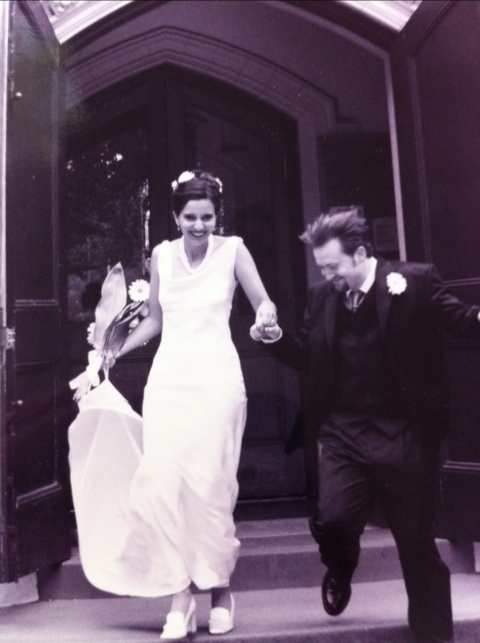
We did it! Running from the church

Today I am celebrating my thirteenth wedding anniversary. And for the first time, I won’t be spending the day with the bloke in the photo. (That would be my husband.) I am in Dubai for the International Diabetes Federation’s world Diabetes Congress. He is not.

This photo is of us running out of the church after we’d said our ‘I dos’. Throughout the brief ceremony, various friends performed gorgeous music including ‘One Hand, One Heart’ and ‘I Have a Love’ from Westside Story and the stunning ‘The Wedding‘ by Abdullah Ibrahim – a song that can take me back to each and every step I took as, on my father’s arm, I walked down the aisle to Aaron.

As this photo was taken, the remnants of a tango written by Aaron was being played. Yep – we tangoed down the aisle before sprinting out into the late afternoon.

It was a blissfully happy day and I love the looks on our faces in this photo. All I see is joy.

Not even ten months prior to our wedding day, I was told I had type 1 diabetes. It rocked my very being and made me change a few key things in my life. For a while it made me wonder if anything that I had been, anything that I had known would ever be the same. And I wondered if Aaron would still want to marry me now that I was so broken; would he still want to come along for the ride that was our life together?

In this photo, it looks like we’re ready to take on anything. And thirteen years later, that’s exactly how we’ve approached things. The ride may have been occasionally difficult (and most of those tough times are because of diabetes) but it’s been a fun ride, too. And we picked up a gorgeous little girl along the way to keep us company and share the love!

Last week, Australian (so-called) comedian Dave ‘Hughsey’ Hughes attracted the wrath of some of the diabetes community with an off-hand joke posted on his Facebook page and Twitter stream. Here is what he said:

@DHughesy I wanna give my mate one of those personalized Coke cans. His name is Diabetes.

A short time later he followed up with:

@DHughesy Should have mentioned his last name is Type 2.

Before long, Hughes’ Facebook page was inundated with comments – a lot from parents of kids with type 1 diabetes.

As soon as I saw the response, I tweeted the following:

@RenzaS Wanna know what happens when @DHughesy gets people with #diabetes mad? Have a look at his FB page.

The reaction from some in the wider diabetes community was swift, angry and, in some cases, aggressive. This was followed by confusion from people outside the diabetes community as to why there was so much anger. From both sides, there was finger pointing, swearing, hostility and opposition. And it got ugly. Very ugly. Five days later, it’s still going on.

But are there are two sides to every argument? Hughes’ comment is in bad taste. But was he being deliberately antagonistic towards the diabetes community?

Personally, I don’t think so. But that actually doesn’t matter. The reason that many within the diabetes community got angry is not because they are humourless and can’t appreciate a joke. It’s because they saw it as yet another incorrect and misinformed comment about diabetes; another time they l need to clarify misinformation. Another comment that is more ammunition for the food police to say ‘should you be eating that?’

Dave Hughes has a huge following – 110,000 plus ‘like’ his Facebook page, and almost 150,000 Twitter followers. That’s a lot of people reading something that isn’t true about diabetes.

There were some brilliant first responses – explanations about why the comment could be damaging. Some with diabetes even offered Hughes first-hand experience of what a ‘day in the life’ looks like by inviting him into their homes.

Of course, for some, one comment wasn’t enough. But do we – the broader diabetes community – do ourselves any favours when we react so aggressively? Because that’s where the accusations started, suggesting that some  people started sounding like the joke police. “Should you be joking about that?”

How often have I said to a friend with diabetes ‘Should you be eating that?’ in jest as I, or a friend with diabetes, dive into our second, third, fourth cupcake? Lots. But I will defend my right as one of the pancreatically-challenged to be  able to laugh about this condition. I spend a lot of time laughing at diabetes. If I didn’t laugh, I’d cry!

I knew what Hughes was trying to do with his thoughtless tweet, and thought he misfired completely. But then,  Hughes’ humour often lacks sophistication and dexterity which, some may consider, is part of its (and his) charm.

So – five days into this, I am looking at it as an opportunity to do some diabetes advocacy. A lot of people on Facebook have been talking about diabetes and that’s a good thing! Advocacy comes in many forms, and perhaps all Hughes really wanted was to do put diabetes on his followers’ radar. I hope so.

Can we laugh at diabetes? When, if ever, is the line crossed and who gets to make that call?

Firstly, a disclaimer. This is my blog and what I say only refers to me. I am putting in this disclaimer because what you are about to read may be against what some of you believe. And that’s fine. But this is my blog. And it’s what I believe.

I love my endocrinologist. There. I’ve said it. Not in an inappropriate way, mind. Just in a ‘she rocks’ kind of way. And I gave my daughter her middle name to show her just how much I ‘she rocks’ love her.

I love her because when I go to her for diabetes information, she gives me what I ask for. About diabetes. If I needed information about how to repair the transmission in my car, she’d send me to my mechanic.

Here’s what I don’t love. People who tell me I should see their naturopath, faith healer, reiki therapist, personal trainer, tarot card reader to help me manage my diabetes. It’s not that I don’t believe these people have a place in the world. Their place, however, is not in curing my diabetes. Just like my endocrinologist’s is not in giving me advice about my car’s transmission.

I don’t care how much I run around a field, how many herbs I take, how hot the yoga room gets, how aligned my chakra becomes. My beta cells are not going to fix themselves. Ever!

So don’t. Don’t tell me that your personal trainer can fix me if only I’d eat three protein bars a day, eschew carbs for the rest of my life and never ever again eat a chocolate bar.

I have a special shout out to a celebrity Australian personal trainer here. I’m not going to name this person, but I’ll refer to them as APT. Here is what I want to say to them: “You are great at what you do – and that is showing people how to exercise. But your pop psychology stuff is crap. You don’t cure people, you are not a dietitian, and when you tell people that they should ‘Just. Stop. Eating. Crap.’ you are not helping. And when you think that you sound smart because you know about non-communicable diseases, but then see fit to claim that ‘diabetes’ is a lifestyle disease that can be stopped if people just lost weight, you get me mad.”

And while I’m at it, can I please send out a direct scream to the people involved in the misleadingly-named Australian Vaccination Network, which is actually an anti-vaccination group. This is not about whether I am pro- or anti-vaccination (pro – for those of you playing at home). But what this is about is the lies, and unsubstantiated and outright wrong claims that some of you are sprouting.

Recently, on the Mamamia website, the very wise (and classy in the way she dealt with the comments after her post was published) Dr Rachael Dunlop wrote a terrific piece called ‘Nine Vaccination Myths Busted. With Science!’ Her writing was brilliant – all facts backed up with evidence and any myth she busted was also supported by medical research, peer reviewed journal articles and, you know, science. Then the nutters came out. And seriously, I don’t have any qualms about using that term. I am all for people having their own opinion (read: disclaimer at beginning of this post), but I was particularly horrified to read many of the over 1,400 comments; especially this one:

I believe the body is complete. ‘Propping it up’ with medications throughout our life – vitamin K, vaccinations, antibiotics, bonjello, blood pressure tablets, anti-inflammatories and cholesterol lowering drugs. Has our body over the last million plus years got it wrong and is modern science the only thing that will save us???? Surely not!!!

It fascinates me that no one has bothered to study our immune systems. And it is not luck, it is good management and a belief in the body’s innate ability to grow, repair and fight disease by giving it real food and without interference. This is the philosophy of Vitalism it is an ancient philosophy.

There is so much wrong with this comment (apart from the ridiculous punctuating, poor grammar and failure to understand basic sentence structure). I was so horrified, I needed to respond:

That has to be some of the most incorrect and downright offensive rhetoric I have ever read. I’m sorry, but the body does not always have an ‘innate ability to grow, repair and fight disease by giving it real food without interference’. Without hourly – actually every minute – ‘interference’ where a pump infuses insulin into my body I would die. A very slow, painful, terrible, horrific death. My own body attacked the insulin-producing cells in my pancreas and the result, 13 years ago, was type 1 diabetes. Nothing I could have done to prevent it and nothing that my body can do to ‘repair’ it.

I am all for people having their own opinions and making decisions for themselves, but you are outright lying to people if you say that there is no need for medication.

Mad? Yep, I really am. Because as long as people subscribe to this ridiculous thinking they will be disappointed. Or even worse, think they can stop medication because they can be healed with a herb, an exercise plan, wearing coloured beads on the second Tuesday of a full moon.

So, here’s what I want (and yes, I know I don’t get everything I want. Otherwise I’d have a pony).

• I want people to stop misrepresenting themselves.
• I want people to stop offering false hope to others.
• I want to stop having to let people down because they got their hopes up seeing some miracle cure sprouted by a faith healer living in the mountains of some remote island.
• I want personal trainers to shout ‘no pain to gain’ to people running around a field – but not promise to fix everything with pop psychology sound bites.

And , I want my mechanic to continue doing the brilliant thing he does. The transmission in my car is dreamlike. (Actually, I have no idea what the transmission is, but my mechanic is brilliant. I love him. And if I’d had a son, I’d have called him Jimmy!)

When someone asks me if I will be doing something I don’t enjoy – say: going for a run, going to the gym, going for a walk, going for…OK, doing anything that has to do with exercise – I often respond with “No – I’d rather stick pins in my eyes”. Well, today I am off to have an eye check. Quite frankly, I’d rather stick pins in my eyes – which is actually why I am terrified of the ophthalmologist.

I’ve written before about how nervous I get when it comes to visiting the ophthalmologist. And here I am again sitting at my desk stressing out because in exactly 3 hours and 14 minutes I will be having my eyes dilated and the pressure tested. Which is done by pushing a pen-like device into my open eye. La-la-la-not-thinking-about-it-la-la-la. And then the back of my eyes will be examined for tell-tale signs of nasty retinopathy caused by even nastier diabetes.

It’s been six months since my last eye check and in that time my eyes seem to be exactly the same. I went out and bought some magnifying glasses from the chemist because, you know, I’m getting older – as my ophthalmologist indelicately put it. But everything else is the same.

The reason that I am on six-monthly visits is because of the two huge, scary cataracts that started forming when I was a mere 28 years old. Yes, for the last almost 10 years, I have what I always considered a nanna eye condition. My grandparents had cataracts removed when they were in their seventies, so how does a 28 year old (and now 37 year old) have them? Just lucky, I guess.

I have a routine now for when I have eye checks. My dad takes me. Yep – like I am a ten year old, I have a parent take me to the doctor. This started under the guise of me not being sure how well I’d be able to see once the dilating drops are put in, but really, apart from some horrific sun glare, I could get on the tram to go home. But, I’ve kept up the charade with dad, asking him to be chauffeur.

The truth – I need him there because he calms me down! On the way to the doctor’s rooms, he promises me that everything will be OK – even though he doesn’t know that for sure. And when we are sitting in the waiting room he tells me I’m brave. And when I walk out of the doctor’s office with a big smile on my face, he says “See, I told you there was nothing to worry about”.

My dad doesn’t have diabetes. He has no idea about what the day-to-day existence of someone living with a chronic condition is all about. But he knows that the eye doctor terrifies me. He knows that telling me I’m being ridiculous and to get over myself is not the way to deal with me in this particular moment. He knows that he needs to accept the drama queen behaviour in this instance and play along.

And I know how lucky I am. I have diabetes support networks coming from everywhere. And my dad, who frustrates me beyond measure when he considers my diabetes as an ‘illness’, no matter how many times I yell “I’m. Not. Sick.” is my hero when it comes to doing the eye stuff. The nasty. Scary. Terrifying. Drama Queen-inducing eye stuff.

My dad. Getting me to the eye doctor on time! (Actually, here he's sitting in a cafe.)

Today I write at the Diabetes Australia – Vic blog about diabetes advocacy during the month of November – in particular the Diabetes Social Media Advocacy Blue Fridays campaign.

Those of us in the diabetes world living in Australia probably know that 14 November is World Diabetes Day. This year marks the twentieth World Diabetes Day, a campaign led by the International Diabetes Federation.

In 2007, World Diabetes Day became an official United Nations Day – diabetes being only the second medical condition to be recognised in this way.

Over the next month you’ll hear and read about what’s going on here in Melbourne and more broadly in Australia. But make sure you also tune into what’s going on globally.   In the US, the whole of November is Diabetes Awareness Month. And as such there are a lot of exciting things happening to raise awareness and advocate for people living with diabetes and their families, and also to promote the importance of type 2 diabetes prevention…..more

Follow Diabetogenic on WordPress.com

Enter your email address to follow this blog and receive notifications of new posts by email.

Read about Renza

Archives