
You are currently browsing the category archive for the ‘Uncategorized’ category.
The mind grows sicker than the body in contemplation of its suffering.
Ovid, (43 BC – 17 AD), Roman Poet
There are many things about life with diabetes that get me ranting (see: well, pretty much everything on this blog). But I think the thing that makes me see red more than anything else is the language used when talking about diabetes.
Yesterday, there was an article in The Age newspaper about type 1 diabetes. The article was focusing on an important fundraising initiative that I support 100 per cent.
I love it when type 1 diabetes is in the media – and not just as an adjunct to an article on the diabetes epidemic. But what I don’t love is the way that diabetes (type 1 or type 2) is reported. There are very few cases of accurate coverage about diabetes and this gets me frustrated beyond belief.
So what was it that got me irritated? It was the use of the words ‘suffer’ and ‘sufferer’, which appeared three times in the very short article. As in: people who ‘suffer from type 1 diabetes’. Now in all honesty, this was a piece of pretty average reporting and the laziness illustrated by using the same terminology three times is evidence of this. However, it got me angry. Really angry.
Let me say this here and now and in capitals. I LIVE WITH DIABETES. And I will add to that that I LIVE WELL with diabetes.
That doesn’t mean that living with diabetes is all fun and games. I know it isn’t and I write about that frequently. But equally, it’s not all doom and gloom.
Here is what I think about when I see the word suffer: I think helplessness, I think powerlessness and I think a lack of ability to take control and responsibility of a situation. I think that others will see it as an excuse to discriminate and as a reason to pity.
I am not helpless, I am not powerless and whilst diabetes doesn’t play by the rules, I take responsibility for and control of the way I live with this condition. Discriminating against me because I have diabetes is not an option and don’t you dare pity me.
Clearly, this has really upset me. More so than usual. I suspect that’s because actually, I am having a tough time with diabetes at the moment. I’m slipping into a sense of burning out. But even when I’m doin’ it tough, I still don’t consider myself as a ‘sufferer’.
Last year, Diabetes Australia released a position statement about the language used when speaking to and about people with diabetes. I don’t think that it’s been particularly widely read by journalists (obviously, the writer of this particular article hadn’t seen it). When we released the statement, a lot of people rolled their eyes and dismissed it as political correctness gone mad.
But it’s not. And while you may not agree with everything outlined in the position statement, it is important to understand the reason for such resources. Language is important. When we were getting ready to launch the statement, I did a little exercise and asked those nearest and dearest to me to use a word (or a couple) to describe me. No one said ‘sufferer’. Is that how you would like people to describe you?
I understand that not everyone with diabetes agrees with me – and that’s fine (although it would be easier if everyone did!). Some people do feel like they are suffering. I did what I always do when I want to get a gauge on how others feel – I put it out on social media and I annoyed the poor people who I work with.
The responses were mixed with some saying we need strong language to illustrate what our conditions are all about. They felt that by tiptoeing around language we are dismissing the seriousness of what we live with. Others agreed with my feelings. Of course, there is no simple answer. But for me, just for once, I’d like to see diabetes reported in an accurate way and people living with diabetes represented truthfully. Just once!
So, is it just me? Are you bothered by the words ‘suffer’ and ‘sufferer’? Or is there other language used about diabetes that drives you nuts?
Generally, I ‘m pretty fashion-illiterate. I have no idea what jeggings are (please comment a description in the space provided below) and couldn’t tell you what length skirt is ‘in’ this year. Apart from a boot collection that would have Imelda Marcos wanting a second look, I have limited knowledge of what the cool kids are wearing. (But I hope it’s stripes. I own and wear a lot of stripes!)
I can live with this.
What I can’t live with is the ugliness that is diabetes paraphernalia. It drives me nuts! Why, oh why is everything black, blue and grey?
Which brings me to the cases that come with BGL meters. Sure, black is the new black and all that, but something a little funkier than a black mesh case would be a nice change. Yes, something that is neutral for the days that we don’t want to scream “diabetes, here and now” is a lovely idea too. But given that this little object comes everywhere with me – every minute of every day – and is often on my desk, my kitchen bench, the table at the café, it would be just lovely if it was a little bit pretty on the eye.
I have spent hours looking through design and craft markets for cute little pouches that comfortably house my meter, strips and lancet device. At the moment I’m using a Marimekko purse I bought at Crate and Barrel in NYC. I love it because it is bright pink and red and is in their signature Unniko design. Unniko means poppy in Finnish, so when I pull the case out of my bag I not only think ‘nice and bright’ but I also smile because I think of my little girl!

My current meter case. Bright, pink and red with poppies on it. Now that makes me smile!
When I decided to write this post, I had a look in the ‘diabetes cupboard’ (technically, the cupboard doesn’t have diabetes, but it contains all my diabetes supplies) I counted 15 little purses. One is a made from a gorgeous red and cream vintage print with Eiffel Towers all over it. Another favourite is a stunning green with an apple pattern – a good one for when I feel I need to be eating more fruit! I have retro prints in pinks and purples, red and pink polka dots and a red, blue and white zigzag pattern that makes my eyes go funny if I stare at it for too long.
I haven’t found a case with cupcakes on it yet, but I’m almost at the stage where I’m ready to get something made up for me!
Are any guys out there cursing at the black mesh and wishing they had something in a nice pattern? Footy team colours? Pictures of their kids screen printed onto it? Or is this a girl thing? (Or, is this just a me thing?)
So – here is my call to meter companies. Please, please, please make my life a little bit happier by providing cute little meter cases. Or perhaps you could have a competition asking people with diabetes – you know, the people who actually USE your products – to come up with a pattern for you. Just an idea. But one I think would go down a treat! (And think cupcakes. CUPCAKES, I tells ya!)
What would you like to see on your meter case?
Did you know that if you exactly measure your carbohydrate content, dose your insulin accordingly, take into account the exercise you are doing and consider your stress levels your BGL will always be 5.5mmol/l?
Seriously. That’s what we’re to believe if we read ‘the diabetes rule books’.
And when you manage to do all this and your HbA1c remains steady at 6.9 per cent, you will not develop complications. The diabetes gods promise this. (Actually, between you and me, I think they’d be the diabetes demons, but let’s move on.)
I love that there are so many diabetes rules. Because I like rules. I’m a little nerdy-nerd in real life, so give me a rule book and I’ll not only follow it, but memorise it and hand out detentions to anyone who needs to smarten up or dares step outside the school without their blazer on. Ahem….sorry. We’re talking about diabetes.
If there was such a thing as a diabetes monitor, I’d be it. Because I’d have all the rules memorised – as well as the sub-rules and special rules, and I’d be following them to the letter. Or the number. Whatever!

So, imagine my constant disbelief that although I do play by the rules – sometimes brain-numbingly so – and yet when I scroll through my BGL meter, the results are not one 5.5mmol/l after another. How is it that even though I know I counted the carbs right in my lunch and know I entered my BGL correctly into my pump that I, for some reason, am 19.3mmol/l. Right now.
And riddle me this. How is it that one person with diabetes who has always had an HbA1c sitting around 10 per cent is living complications free, when another whose HbA1c has never been above 7 per cent is now going through laser surgery to treat retinopathy?
The thing about rule books is that they work when the game is simple, straightforward and doesn’t have variables. Diabetes is all about the variables.
And yet, when I ‘break’ the rules (see: current BGL 19.3mmol/l) it is me who feels like I’m off to the principal’s office to write ‘I will be nice to diabetes’ one hundred times.
So, I’ve decided that I’m turning things around. I am sick of feeling bad because, even though I followed the rules, diabetes is not playing by them. I am tired of apologising to myself and my body when I am following the rules, but still end up having horrible lows and I am stopping – STOPPING – feeling responsible and guilty when I don’t want to play anymore and am feeling completely and utterly burnt out.
Burn out is creeping into my life and I’m getting better and better at identifying it early. Right now, even though I really am playing by the rules, my diabetes is making up things as it goes along. And I can’t seem to work out what to do. Actually, I can’t be bothered working out what to do.
So, here and now I am acknowledging that diabetes sucks more than usual. I am saying ‘I’m not coping right now’ and I am saying ‘I’m beyond pissed that despite my best efforts I’m getting crap results’.
I’m not throwing in the towel. But I’m changing the game. I’m rewriting the rules. And I’m the one handing out detentions, so, diabetes, you’d better bloody well smarten up!
Need some information about diabetes burnout? Have a look at the Behavioural Diabetes Institute’s website here.
I’m grouchy. Grouchy and phlegmy and feverish and shivery and did I mention grouchy? I am, to borrow from the delightful Kerri Sparling, ‘real-people-sick’ and I’m not managing very well. I don’t do sick. I don’t do invalid and I certainly don’t do lie-on-the-couch-and-relax-for-a-couple-of-days-and-step-away-from-the-phone-emails-computers-etc. This advice handed out by my GP. For $76. Thanks! Everyone at work was telling me the same thing. For free.
I’m not sure if having diabetes has given me a ‘sick threshold’ higher than the average bear. I’m sure that before my pancreas gave up its day (and night) job I used to take advantage of every sniffle and beg to stay home from school. Actually, I was a nerd at school, so that probably wasn’t the case. But I’m sure that I wasn’t so stupidly dogmatic about being stoic and valiant and all those other words that basically mean, in this case, trying to prove a stupid point. And that point is that I don’t get real-people-sick.
So, I’m sitting up in bed right now – which means that I’m following doctor’s orders – except for the bit about disconnecting. I have my i products (i.e. Phone, Pad, Book) all open and I’m looking at a million different things.
Which leads me to the next point in this irrelevant and boringly meandering story of which, really there is no point. I can’t switch off. I tried climbing into bed with nothing more than a book, but then I remembered that I’d missed yesterday’s Epicure in the Age newspaper. So I grabbed my iPad and opened the Age app and read restaurant reviews and recipes. And then I started thinking about baking, so I then checked out a couple of foodie sites, found a great recipe for lemon curd cupcakes and wrote a shopping list on my iPhone. Then I opened something else on my iPad and then grabbed my MacBook and here I am typing away. Not resting. Not sleeping. Not reading.
The thing is, even if I put a ban on all electronic iGadgets (which, let’s face it – Never. Gonna. Happen.) I still have my diabetes buzzing-and-beeping gadgets that I, you know, rely on. To live. I’ve been checking my freaking blood sugar every fifteen minutes and making teeny-tiny boluses on my pump and tweaking basal rates because this real-people-sick thing is making my sugars want to play in the teens.
At no point of the day – ever – am I not using some sort of battery-operated machine.
The other day I was speaking with a friend who had just returned from a weekend-retreat of healthy and quiet living. There were many rules for the retreat and these included: no mobile phones (or landlines for that matter), no processed foods, no meat products, no coffee (I stopped listening at this point and possibly started hyperventilating at the thought), no electronics of any description, no smoking and no recreational drugs. And no talking. Seriously – forty-eight hours of no talking – so, I guess no need for the phones.
I reckon I would have lasted about…oh…. I don’t know…thirty-three seconds. At which point, I would have asked a question; probably, ‘Can I have my mobile phone back, please?’
Of course, I’m sure the ban on electrics would not have extended to medically necessary devices. But it did get me thinking about how it would be impossible for me to actually have any time where I could completely switch off and be ‘at one with nature’.
I’d be lying if I said that all the technology (diabetes-related or not) around me annoys me. It doesn’t. It makes me feel connected and up-to-date. And the access I have to a pump, BGL meter and CGM gives me access to information, which helps me make informed diabetes decisions dozens of times a day.
So I’m not turning off. Resting to get over this real-people-sick: sure. But disconnecting? Not so much. In any sense of the word!
In keeping with this week’s post to my sixteen-year-old self, and in light of the fact that today is my fourteen year diaversary, I thought I’d write a letter to my 24-and-a-half-year-old self. Because it was at that age that I was diagnosed with type 1 diabetes and I had no idea what that would mean. If only I could have known that things actually would be OK I think that the initial coping period would have been significantly easier.
Dear 24-and-a-half-year-old-me
Oh, sweetie. Diabetes sucks. You don’t know that yet, but let’s clear that up from the beginning. It sucks. It’s not fun and it is a pain in parts of you that you didn’t even know could hurt. But figuratively more that literally.
Right now, you are overwhelmed, stressed, anxious, scared and terrified. In a couple of weeks you’re going to get angry. Really angry! It’s OK to be feeling all these things.
You will be fluent in a new language within the next few weeks. Words that you’d never heard of become part of your vernacular, and you become incredibly conversant in anagrams. BGL, CSII, HbA1c, DA-Vic, ADEA…. And you will delight in the fun way mmol/l rolls of your tongue. (I promise – that will make sense!)
Believe it or not, you are going to be absolutely fine about sticking a needle into your skin four times a day. And you’ll find that actually, it doesn’t hurt. You won’t be quite as comfortable about the jabbing your fingers what feels like a million times a week to find out what your blood sugar is doing.
But things get better. The lancet device you have now is pretty horrendous and in a couple of years, you’ll get a new one that doesn’t make quite as nasty a clunking sound, and will hurt less. Also, the first meter you have will take 20 seconds to count down to tell you your BGL. Wait until you get one that takes five seconds! You won’t know what to do with all that extra time in your day!
Find out everything you can about insulin pumps. Speak with people using one. In three years you will have one and it will change your life. I want you to hold on to that over the next couple of years when things are not going as you’d like with your diabetes management and you think that you’ll never work it out. You do. And your pump is a huge help.
(Also, perhaps tone down the evangelical pump attitude you develop. You become a little zealot-like. Yes, it worked for you, but it may not be for everyone. BUT INSULIN PUMPS ROCK!!!!)
Can we just talk about guilt for a minute? Diabetes comes with a lot of it and you’re going to learn that really quickly. Here are some things that you absolutely should not feel guilty about:
- The fact that you don’t change your lancet EVERY time you check your BGL
- Ditto goes for pen needles, and after three years, pump changes
- What you eat. Food does not have a moral compass.
- When you feel overwhelmed and completely ‘over’ having diabetes
- Not wanting to be a diabetes advocate ALL THE TIME
- Accepting that saying ‘that’ll do‘ when it comes to your diabetes doesn’t make you a bad person; in fact, it makes the whole diabetes palaver more manageable!
As you are in the middle of your wedding plans, here are some things I want you to know about that day so you can relax a little. It is a fantastic day. Your dress is stunning, your hair looks fine and you find the shoes you have been searching for. Diabetes comes along for the ride, but it’s in the background and no one mentions it on the day except for your mum asking quietly if your BGL is OK.
(Also, the cars will be running late, but they’ll get there; and deliver you to the church inside Aaron’s ‘you’ve-got-fifteen-minutes-or-I’m-heading-to-the-pub’ timeframe.)
Oh, and when you meet your endocrinologist for the first time, he is going to tell you that diabetes will not stop you from having babies, as long as you have finished having your family by the time you are thirty. And you are going to wonder how it will be possible for you in the next five and a half years to fit in all the things you planned AS WELL as have a couple of kids. Don’t stress. Soon, you will find an endocrinologist who sets you straight. And when you are three days shy of thirty-one you will have a daughter. She’s a delight.
He will also show you some scary pictures of amputated limbs, kidney failure and tell you that you may go blind. Please, please, please don’t be shocked by what he says. The scare tactics that are used on you by him and other diabetes health professionals you will meet in the next couple of years will actually make you angry and determined. This is a good thing. As you seek out information, you will learn that complications are not inevitable and you will do everything possible to minimise your risk. And you will also come to understand that the guilt associated with complications is not fair.
You are going to meet some incredible people in the next few years – some of them become some of your best friends. Having a support network of people living with diabetes will inspire you, help you. Seek them out! And you have no idea what this means, but when, in 2011, you decide to get on Twitter, embrace it like there’s no tomorrow. Your mind will be opened up to a world of amazing, inspiring, caring, funny people all over the world who, like you, live and love with diabetes. You will call these people your friends and you will be part of a global community that makes you feel accepted and safe.
So 24-and-a-half-year-old me. The future isn’t as grim as you think it is right now.
With fondness,
38-year-old-me
P.S. I also wish that right now you would look back to last week. Remember when you didn’t need to consider the carb content of the food you are about to eat, or wonder how it will impact on your BGLs. And I want you to remember not having to give yourself a needle before you eat lunch. Really, really remember that time, maybe write about it. At 38, you won’t remember. It will be as if you have always had diabetes. Always.
There’s been a fun hashtag doing the rounds on Twitter in the last 24 hours or so: #dear16yearoldme.
It seems a long time ago that I was sixteen. It WAS a long time ago that I was sixteen! But with increased age comes increased wisdom. And this is what I’d like to tell my sixteen year old self:
- You have a working pancreas. Don’t take that for granted. Right now, you have no idea what that means, but when you are 24 years old you will. So, if you’re going to eat that jam doughnut (and really – if you want it, go on and eat it), I want you to marvel at the fact that your pancreas will release insulin. ‘Cause it ain’t going to do that forever!
- You are not fat. Seriously. Get over yourself! (So just eat the bloody doughnut!)
- Keep playing the flute – because you will get into the Conservatorium of Music at Melbourne Uni and meet the most wonderful man. And you’ll marry him! (And dear 19 year old me, don’t hate him when you first meet him. Even If he is playing the saxophone loudly and you have a headache. Also, make sure you do buy that handkerchief skirt. It’s what you wore the day you met and he can still remember you in it!)
- Don’t announce to anyone and everyone in a throw away voice ‘Oh, I don’t want children’. Because one day you will and it will take you a long time for it to happen. And your heart will break until you can. But when you do, you will have the most beautiful daughter. And your heart will sing every day because of her.
- Listen to your father. He is right. Damn it!
- And your wonderful relationship with your mum continues. Don’t take that – or her – for granted. She will be your rock in some really difficult times ahead. Also, admire the way she lives with her chronic health condition. She will become your inspiration in more ways than you can imagine in a few years’ time.
- Maths is important. You’re going to need to use algebra to work out the carb content in food. So pay attention!
- And also, your year 12 English teacher who tells you that, at some point, you’re going to want to be a writer is right. Listen to her. Learn from her. And read everything on her reading list.
- Those white jeans. Throw them out. Now!
- That ridiculously affected thing you and your friend do – you know, sitting in a coin laundry reading Beat poets and novelists? It’s pretentious. Just read the bloody books. And you don’t like black coffee – no matter how much you pretend you do!
- The nerdy thing you are trying so hard to escape? Embrace it! Seriously – you are a 16 year old flute player. And you sit in the laundromat reading Jack Kerouac. And you can recite Howl. The only way is geek!
- Your life is not hard. No matter how much you think that it’s not fair, you’re wrong. You’re incredibly lucky.
- You talk too much. But that’s OK and it will come in handy later on. As will debating, so keep doing that!
- That guy on the Glenferrie Road tram. He’s just not that into you. Move on!
- Two words: Harry Potter. You are going to LOVE IT!
- Those girls from school who you think are your best friends? They are! And they continue to be your best friends as you grow up. Treasure this time with them. (And try to remember funny stories. And take lots of photos of bad hair and daggy clothes to torment each other as you get older!)
- Wear a cardigan. It’s cold out there in Winter!
- Thirty eight isn’t old! Really, it isn’t. And I promise you this. You are OK. In fact you are better than OK. And your life turns out really well. You continue to be incredibly lucky!
This topic is part of Health Activist Writer’s Month Challenge (#HAWMC) by Wego Health. The challenge is 30 days, 30 posts. I am a realist, and know that I am not going to be able to do the full 30 posts. But this one I absolutely had to do! Here’s more information about the challenge.
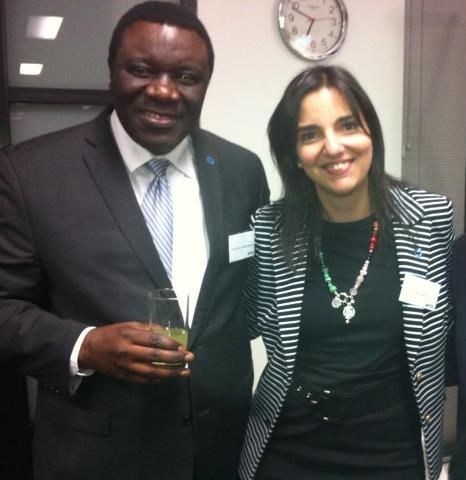
I had one of those weeks last week that makes me eternally grateful for my job! On Monday, International Diabetes Federation president, Professor Jean Claude Mbanya visited Diabetes Australia – Vic and gave two presentations to staff.
I was then lucky enough to interview Professor Mbanya and you can see the interview here.
Then on Wednesday, I visited our Autumn Camp. Fifty kids with diabetes were enjoying Victoria’s beautiful Autumn weather in an idyllic bush setting. We arrived at camp to see the kids playing frisbee, kicking around footballs, lazily lying around on the grass chatting and scaring me senseless as they launched themselves off the flying fox. (Not a single kid screamed. I, on the other hand, wanted to cover my eyes in terror.)
I am incredibly fortunate to have a job that I love. But even more than that, I have a job that gives me so much. I meet inspirational people – quite regularly, actually. I get to visit kids with diabetes at camp and see what an impact a few days away with other kids has on them – and then I speak with their parents about how their kids have returned home more confident, comfortable in themselves and fiercely independent.
Someone said to me that other day how it must be wonderful doing a job where I know that I’m ‘giving back’ to the community. Actually, when I really think about it, I think I’m the one who’s getting the good deal here. Eternally grateful and incredibly lucky!
Last night I sat in Melbourne’s beautiful Regent Theatre to hear Jamie Oliver in discussion with Matt Preston. There is a lot of chatter about food at the moment – Jamie’s visit coincides with the Melbourne Food and Wine Festival. But last night, he wasn’t throwing together a cheeky risotto. He was speaking about his project The Ministry of Food.
As Jamie explained, the Ministry of Food has its roots in a campaign from the Second World War. The British Government set up a team of cooking teachers whose role was to educate the public about food and teach people to use the available rations to produce healthy meals for their families. And ensure there was still cake at birthdays! (I liked that bit.)
Today, a lot of people don’t know how to cook. Fast food is easily and readily available. For every farmers’ market selling organic apples, there are a dozen supermarkets with weekly specials of cheaply-made biscuits. Throwing together a dinner of chops and three vegies has become too hard for some. And others simply don’t have the know-how. Some kids don’t know the difference between a turnip and a tomato.
I find this staggering, but then I love to cook. I want to know where my food has come from, and there is nothing I love more than baking a cake or a batch of cookies. And I am desperately trying to instil these values about food in my daughter.
Jamie Oliver says he doesn’t have all the answers. But he does make sense when he says that there are some simple things that can be done. Whilst acknowledging a previous business partnership with a supermarket chain, he believes that if a supermarket is going to have 100 items on a ‘buy one, get one free’ deal, then be fair and make sure that half of them are fresh foods. Make it as easy for us to choose the healthy option as the pre-packaged, not-so-healthy option.
He says that every child should be able to cook five meals by the time they leave school. Five meals. When I stopped to think about this, I remembered how I learnt to cook. On Friday nights, when there wasn’t the mad rush to get to bed early, read stories and pack our bags for school the following day, the kitchen was handed over to my sister and me.
With Mum watching and helping out as required, we would prepare dinner. We started with scrambled eggs – one of the simplest recipes possible. We learnt to make crepes, beef stroganoff (hey – it was the early ‘80s!) and pasta dishes. We learnt to throw together a salad to accompany all meals. By the time I left home at 21, I could cook. It wasn’t a big deal. It was just something I could do. My sister was the same – and I’m sure that if we’d had a brother he would have been in the same boat.
Jamie also believes that there needs to be some regulation in place, but he’s absolutely not the food police. I love the fact that he’s not militant (although I could sense members of the food police in attendance – there were numerous occasions of shock and horror gasps and judgey tsk-ing). Jamie eats chips! Jamie says it’s okay to eat pizza! Jamie says burgers are fine! But what he’s saying is don’t eat it every day. And add some vegies, for goodness sake!
None of what Jamie says is rocket science and he is the first person to admit this. He also knows that he has profile, he has a platform and he has the means to make a change. He has put these issues firmly on the social agenda through his television programs and his campaigns.
Jamie also believes in the importance of people power and consumer advocacy. His call to action last night was for every member of the audience to send a one line email to their local MP with the following: All children should learn to cook.
You think it sounds simplistic? You don’t think that you sending that one email will make a difference? What about if you, all your friends and family do? What about if you put it up on your Facebook page asking your friends to tell their friends?
Yes, this is a type 1 diabetes blog. But the reason that I went to see Jamie last night, and the reason I decided to blog about it today is because I know that for every child out there who has food knowledge, there are many who don’t. And I think we all have a responsibility in this. As individuals; of course. But also as a community.
Want to be part of an online community that can and does make a difference? Check out the Parents’ Jury website and become a member.

Getting my kid cooking!
I’ve been thinking a lot about interpretive dance lately. And how, if a dance company wanted to create and choreograph a routine about diabetes what it would look like.
There would be lots of silk scarves, head holding angst and flying. And maybe some Kate Bush-style running through a forest.* And somewhere, Stevie Nicks.
And if someone wanted to compose a concerto about diabetes, Richard Tognetti could perform it on his antique Guarneri. What a terrific opportunity to test out the strength and depth of the low notes (representing middle of the night lows) and the soaring ability of the high register (which would be the musical version of a person with diabetes screeching ‘Where did that freaking 31.5mmol/l come from’).
Getting the message out about diabetes can happen in many ways. In the olden days, it was health professionals who held all the information. We were told what they felt they wanted to tell us or what they thought we needed to hear and they could scare us with tales of what would happen if we didn’t listen to them. And so we made up numbers in logbooks and told them that we ate nothing but seeds and celery.
Then, someone brilliant and clever and shiny and bright got the good idea that people living with diabetes could share stories and we could learn from each other. In the early days, this was in the way of a support group, which, contrary to my initial phobias about diabetes support groups, is not about sitting around, holding hands and singing ‘how do you solve a problem like a dud pancreas?’ Actually, it was about dynamic people getting together and talking and listening and sharing. And about realising that we are not alone. I love that!
And then, another clever moppet invented the World Wide Webosphere and it was at that point we all met the most sharing health professional of all, Doctor Google. Dr G has no filter (even though he pretends to) and if you say to Dr Google, ‘Tell me about diabetes’, you will receive information about EVERYTHING EVER WRITTEN, including how cinnamon will cure your diabetes. (Which, incidentally, causes me great concern when I make one of my favourite late-night snacks – cinnamon toast. Do I bolus for the carbs in the bread and sugar, or not bother, because the cinnamon cancels it out?**)
Suddenly, we could all read things on this Webosphere and connect with each other. People started sharing their stories on blogs (like this little one you’re reading here) and on Mark Zuckerberg’s magic planet Facebook. And then came Twitter where we could share and tweet and connect and have chats where five billion people answer questions to ‘what would you like to say to your pancreas?’ (My favourite response to that was ‘get a job!’)
And there’s so much more! There are plays that tell stories about people with diabetes and there is even a musical. I kid you not! It’s called Diabetes – the Musical. There are songs and You Tube clips galore. Cartoons add humour, describe the frustration and provide insight to real-life situations.
Hearing about diabetes in a different format is refreshing. It gives you a different perspective and frequently, you’ll learn something new. Have a look out there and see what you can find. And let me know – especially if you find anything to do with interpretive dance.
*OK, now I have Wuthering Heights going through my head constantly. Don’t blame me if you do, too!
**Kidding! I know that cinnamon doesn’t cure diabetes. That’s what chromium supplements are for!

The Blue Circle
To me, the blue circle that is the symbol of World Diabetes Day is such a perfect representation of diabetes. It’s about diabetes awareness, diabetes unity and a symbol of hope. But the circle shape also represents some of the more difficult aspects of diabetes, too.
Diabetes is a cruel, cruel monster sometimes. There are many things about living with this condition that make me want to pick up my bat and ball and go home. (Or pick up my pump and BGL monitor, throw them in the bin and pretend I don’t have diabetes.)
For me, the cruellest, meanest, nastiest thing diabetes does is hypo unawareness as a result of a ‘great’ or in-range HbA1c. This is diabetes at its most mocking.
Many people who have lived with type 1 diabetes for some time will experience impaired hypoglycaemia awareness – for economy of language, let’s refer to it as we all do, hypo unawareness.
As someone who on occasion has experienced this, let me tell you that it’s terrifying beyond belief. It can be paralysing and makes me second guess every single diabetes decision I make. And those decisions add up to dozens each day.
So, how is hypo unawareness ‘fixed’? Well, it’s recommend that we remedy our unawareness by running our sugars a ‘little high – say 10 or 12’ for a few weeks and ‘avoid hypos’. I have always marvelled at this advice on a number of levels.
Firstly, the one thing I remember most about my diagnosis is the photos of amputated limbs, threats of blindness and dialysis, and being told I needed to have my kids before I turned thirty. Since that day, every time I see a double-digit number on my meter, I see an amputated foot. So, telling me to ‘run a little high – say 10 or 12’ isn’t a matter of accepting those numbers as just numbers. I see them as my toes falling off.
Also, surely, ‘running a little high – say 10 or 12’ is the same as saying ‘run your sugars a little perfectly – say 4 or 5’. If it’s as easy as picking a number and sticking to it, then surely we’d all just pick 5.5mmol/l and go with that all the time, posting each and every result to Facebook and Twitter.
And finally, the term ‘avoid hypos’ suggests that it’s an easy thing to do. Seriously, if it was that simple, I’m not sure too many people with diabetes would keep playing the blood sugar limbo that is ‘how low can you go?’
Often, the appearance of hypo unawareness coincides with periods of what is often termed ‘tight control’ – and often a ‘good’ HbA1c. Ah, the HbA1c – the number that manages to sum up a person with diabetes’ worth. How many people dread getting their A1c result? How many people avoid having their A1c checked because they are afraid of 1. the result and 2. the response this will elicit from their health professional?
My hand is waving highly in the air for all of those. I am terrified by that number. And I have an endocrinologist l who doesn’t attach a moral compass to numbers – to her, it’s a piece of information which we can work with. Nothing more, nothing less. (I do love her!)
But I have been trained to encapsulate my worth in that little number. When I was trying to get pregnant, it couldn’t be low enough for me; whilst I was pregnant it needed to be steady and unreasonably low, and now, to stop those images of complications flying into my head, it needs to be below 7%.
Is it? No, right now it’s not. The pat-me-on-the-back A1cs I achieved whilst pregnant were the result of extreme anxiety, checking my BGs around 15 times each day and responding to each and every number I saw. And seriously nasty hypo unawareness. Sure, I delivered a gorgeous healthy little girl, but for the whole pregnancy the number 11 not only meant ‘toe falling off’ but also ‘congenital deformity – bad mother!’
The frustration about diabetes is that the harder we work the more things we have to do. A great A1c often equals hypo unawareness which means ‘running a little high – say 10 or 12’ which means an increased A1c, which means complications….and so the circle of diabetes continues.
I know how this circle works, and what it means to me is that I can’t do ‘A’ (have a ‘good A1c) without it causing ‘B’ (hypo unawareness), the remedy of which is ‘C’ (run a little high) which will lead to ‘D’ (complications). When we are in the midst of learning about diabetes, the equation is never presented to us. Each letter is discussed in isolation, never as a result or cause of something else.
There has to be a better way. If only I knew what it was.





 Diabetogenic