
You are currently browsing the category archive for the ‘Research’ category.
I went to TV Land today to do an interview on a morning show about the artificial pancreas. I am always excited to see type 1 diabetes in the spotlight. Actually, I am always excited and pleased to see any diabetes in the spotlight, provided the reporting is accurate and the information devoid of any myths. And they don’t use the word ‘sufferer’.
I was a little anxious to speak about the artificial pancreas. It was being hailed as a ‘diabetes breakthrough’, which is a little misleading given that the trials for this technology have been underway for some time now. I am always very careful when talking about research and emerging technologies, making sure whatever I say is in context – I don’t ever want to be accused of promising something will be here, available for all, in ‘five years time’. In fact, I had made it really clear when speaking with the producer prior to the interview that this is NOT a cure and that it would probably be better that the word ‘cure’ not even be mentioned.
So, I was asked about how the AP would change things for people and what it would mean and gently speculated (based on a few things I’d read recently about current trials) as to when it would be available. I was a little hesitant at the ‘and what will it cost?’ question, because 1. Who knows? and 2. The answer is most likely ‘Out of reach for most people. Which sucks!’ and I didn’t think that would be a good thing to say on TV when I was doing my best to sound professional.
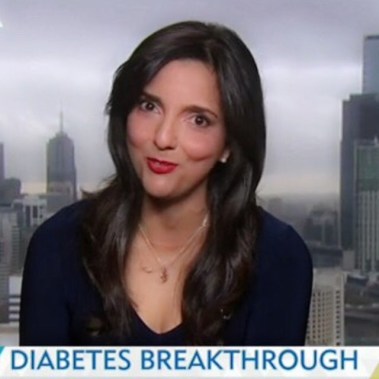
Big hair. Big make up!
I’ve not seen the clip from this morning yet. Trying to focus on a camera, and listen to people I can’t actually see (they were in Sydney, I was in a dingy box of a room in Melbourne) and not wipe my Bold and the Beautiful-esque make up off whilst flattening my big hair was really not ideal for coming across as poised and professional. But I didn’t giggle uncontrollably. And managed not to swear. So, I think (hope) it was okay!
I got into a cab outside the studio when it was all over and the driver asked me if I was famous. (I would suggest the need to ask that question would also provide the answer, but whatever.) ‘Ha! Ah, no. Really. No,’ I said to him. ‘I was interviewed about diabetes research.’
‘About a cure? My son has type 1 diabetes,’ he turned around to look at me.
I looked back at him. I looked at the desperate look on his face. I know that look – I’ve seen it thousands of time. I’ve worn it thousands of time.
‘No. I’m sorry.’ I said. ‘It was about a potential breakthrough in technology – a new device that may be available in coming years. It will make things easier. But it’s not a cure.’
He looked away, disheartened.
‘I’m sorry. Really. I’m sorry.’
I looked out the window as the cab sped through the city, the buildings all shiny from the rain. And right at that moment, I felt as despondent as my cab driver looked.
UPDATE – You can watch here.
We know there are many factors that come into play when it comes to managing life with a chronic health condition. Our attitude, outlook, strength and mindset all play an important role.
But what about our personality? Do our personality traits affect the way we deal with living with diabetes?
Well, of course!
If our personality defines the sort of person we are then it stands to reason that our personality traits will play a part in how we view and respond to everything – including the day to day living with diabetes.
The Big Five personality traits in psychology are openness (to experience), conscientiousness, extraversion, agreeableness and neuroticism, all of which I believe, in my very non-scientific approach, impact on our attitude to and way we live with diabetes.
I consider myself to be pretty open to experience, not especially conscientious (I have so little self-discipline it’s not funny…pass me another doughnut. Thank you.), extraverted, agreeable and not particularly neurotic or anxious (unless talking about eye complications and a worry that the world Nutella supply may be in threat).
The way the cards have fallen to determine my personality is not necessarily useful when it comes to managing diabetes. Surely having a high level of conscientiousness is king when it comes to managing something like diabetes! (I’ll use this as the reason that I have never, ever kept a regular BGL diary….)
However, being open to new ideas has definitely been of use when it comes to being an early adopter of diabetes technology or considering an out of the box way to manage a difficult diabetes problem. And extraversion and seeking the company of others to crowd source information and learn about others’ experiences and learnings with diabetes has been nothing but positive in my diabetes management. Being secure and confident in my decision making and abilities rather than neurotic and second guessing myself definitely helps in making decisions, sticking to them and owning how I choose to manage things.
These traits determine how I see and how I live with diabetes each and every day.
But could our personality have something to do with actually developing health conditions? (No – this has nothing to do with lack of self-love causing auto-immune conditions. ‘Cause that’s a load of C R A P.)
This study looked into a link between personality and health, specifically how different personality traits impacted biological immune responses. (This article breaks it down nicely for simpleton folk like yours truly to understand.)
One of the findings of the study is that people defined as have an extroverted personality have more pro-inflammatory genes which means that we may be better at fighting off illness. The negative side of this is that ‘over-alert’ pro-inflammatory genes can also result in an increased incidence of autoimmune conditions.
In my highly non-scientific study of n=1, this rings true. I am overall pretty healthy and manage to avoid catching (most) everyday viruses. Good work, autoimmune system!
I also collect autoimmune conditions (last count – I have three). Not such great work, immune system!
As with many studies, there are still lots of questions to be answered. In a chicken/egg type scenario, there is no answer to what is causing what? Is it our personality that determines our immune system or is it the other way around?
Trying to piece together the puzzle of autoimmune conditions is a long road. I will never ever understand how it is that I developed diabetes at the exact point that I did. Whist I understand the genetic predisposition component, the trigger aspect has me scratching my head to this day.
But this is another little piece slotted into place in what is looking to be a one bazillion piece puzzle.
Last week, Australian social and mainstream media was abuzz with exciting news of a diabetes breakthrough. This filtered through to international media.
Labelled as an artificial pancreas, the new device was covered in online and print newspapers, as well as television news bulletins. The reason for the excitement at home was because Australia is the launch market for this new technology.
Exciting stuff!
Well, yes and no.
The device in question was not really an artificial pancreas. Rather, it is the next generation integrated pump/CGM system to be launched globally.
Technology advances are really important and we should get excited about them, and their promise of improving the lives of people with diabetes.
But reporting honestly and correctly is also really important.
Let’s be clear about the device that was launched last week. It is a pump with a CGM. The real advance is that together they have the potential to predict hypos and turn off insulin delivery, thus (hopefully) preventing hypos.
This is, indeed, an advance in technology.
This is not, however, an artificial pancreas.
There are a number of problems when diabetes advancements are not communicated effectively and correctly. Firstly, the way the reports read last week, this technology would eradicate hypos completely. As far as hopes for diabetes go, living hypo-free is surely something we would all dearly love.
But while this tech MAY help in reducing hypos, it’s certainly not going to eradicate them.
There are still problems with sensor accuracy that need to be addressed before we can be comfortable in saying that CGM technology (whether purely as a ‘warning system’ for impending hypos or being combined with a pump that will switch of insulin administration) removes the risk (and associated fear) of low blood sugar.
Whilst this technology is a step in the right direction, it is not an artificial pancreas. It is not the holy grail.
Diabetes still needs attention, still needs research, still needs funding, still needs donations. We are not there yet, and any report that even suggests that is, I believe, detrimental to continued efforts looking to further improve diabetes management.
All of us who are communicating in any way about diabetes have a responsibility to be truthful, honest and, as much as possible, devoid of sensationalism.
Get it right when we are taking about it and hopefully the mainstream media – who, let’s be honest, have an incredibly rudimentary knowledge base when it comes to diabetes – will hopefully follow suit.
I am really excited about the potential of this new pump and GGM combination and I am fully aware that it may be of significant benefit to many people living with diabetes. I know just how beneficial CGM technology is.
But tell it like it is. Report responsibly. And keep the understanding of what living with diabetes – and the technology we use – real.
This is just so beautiful! Enjoy for your Friday and have a great weekend.
Diabetes research funding – simply not enough
Last Friday, the successful National Health and Medical Research Council (NHMRC) grant recipients were announced.
Let’s start with the good news.
Funding for 848 grants was announced, totalling over $580 million across a wide range of health conditions. This includes project grants, partnership projects, Centres of Research Excellence and other Fellowships and grants.
This is great stuff. Medical research is essential and we should be encouraging more dollars being delivered to the very clever clinicians, researchers and scientists carrying out this important work. ‘Cures not Cuts’ is a motto we should be thinking about all the time – not only when there is a real or perceived threat to funding dollars.
Diabetes received $54 million in grants for 60 research projects.
Here is the not so good news.
Diabetes received $54 million in grants for 60 research projects.
That’s right. The good news is also the bad news. Whilst it is terrific that 60 research projects received funding and $54 million is not to be sneezed at, I do not believe that it is enough.
Cancer received funding of $89.9 million for 156 projects, and cardiovascular disease $82.4 million across 106 grants. All of these are worthy and should be funded. Make no mistake – I am not saying that money should not be given to cancer or CVD research. Of course I am not.
I am told that when funding announcements are made, there is also dissatisfaction amongst the cancer community, with many ‘lower profile’ cancers often being overlooked. Ovarian, pancreatic and lung cancer are frequently considered the poor cousins of the cancer world, despite significant numbers of people being affected by – and dying from – these cancers.
Of course, we can argue that the money is never enough. We can argue that we are all self-interested and only care about our own condition or the condition affecting our family and friends and to a degree, that is absolutely true.
Please understand, I am not saying that diabetes is worse than any other disease or health condition. Any regular readers of this blog will know that I absolutely do not subscribe to the ‘my condition is worse than yours’ arguments.
But if we are to believe that the magnitude of the ‘diabetes problem’ – and there is some pretty compelling evidence to support that it will indeed be the largest health burden in Australia by 2017 – then surely we need to see a bigger investment into diabetes research. We need diabetes to be’ top of mind’ as the number one health concern.
The results of last Friday’s funding announcements reinforce what I wrote here about diabetes having an image problem when it comes to funding – and fundraising. With more and more people affected, surely this should be reflected in increased funding for research, programs and services.
We’re not seeing that.
DISCLAIMER
At the risk of this outing me as someone with a case of sour grapes, I should acknowledge that I am listed as an Associate Investigator on a grant application that was not successful. Yes, I am disappointed. But this certainly was not the only diabetes grant that was unsuccessful. Many other very worthwhile applications faced a similar fate.
Congratulations to all the successful applicants.
We need hope. I know that every day I live in great hope.
- Hope that I will find the perfect pair of jeans in the perfect blue colour that make my legs look long and slender, my backside look perfect and that fit comfortably around the waist.
- Hope that I will walk into my office one day to find a Nutella vending machine.
- Hope that I will never again be served bad coffee.
- Hope that my daughter will grow up in a world of equality for all.
- Hope that when I get home today all the washing from our recent overseas trip will have been done, folded and put away.
- Hope that I will walk into a vintage store and find an original (non-replica) Eames arm chair and ottoman for $150.
- Hope that the whole cast of West Wing will come together for a movie. Please. Please, please, please, please.
- And hope that diabetes will be cured.
You may have read over the weekend that type 1 diabetes has been cured. This article irresponsibly said the cure is ‘imminent’
I am possibly the world’s greatest cynic when it comes to reading about cures for diabetes. There is much eye rolling, exasperated sighing and sarcastic comments about being unemployed and shutting down this blog because no one will care about type 1 diabetes anymore because it won’t exist.
I simply don’t believe that the cure is ‘just around the corner’ or ‘five years away’.
But let me be really clear about this. I want a cure. I want diabetes to not be a part of my – or anyone’s – life anymore. And I am really, really pleased and eternally grateful that there are people far, far smarter than I working to find the way to a cure.
Having said that, I get concerned about the false hope that eventuates every time there are reports of research breakthroughs. 
Feeling hope gives us a reason to believe and sometimes that is all we have to get us through the day.
But equally, I find I can’t put all my faith into believing that there will be a cure for diabetes because if there is not, what happens then?
I understand the need for the hype – it helps with funding and interest and gets people talking. And we need people talking about and funding research into diabetes. More and more and more.
And I do like to hear about the research and breakthroughs that are getting us a step closer to finding a cure.
But I believe that even if we are a step closer, there is still a very long way to go.
So, I take it all with a grain of salt. I read it and file it away. And then I move on. Hopeful. But realistic as well.





 Diabetogenic