
You are currently browsing the category archive for the ‘Food’ category.
The trend of people without diabetes obsessing over their glucose levels has become increasingly common (and increasingly annoying). Remember when some journo hack likened wearing a CGM to a polygraph test? And that time CGMs were hailed as a weight-loss tool? These days, spotting a Libre sensor on an upper arm no longer guarantees a diabetes in the wild encounter at the local farmers’ market. It could just be a bloke tracking his perfectly in range glucose levels after devouring a steak. With butter. For breakfast.
But just when we thought we’d reached peak glucose obsession, in steps Jessie Inchauspé, who smugly calls herself ‘the Glucose Goddess’, peddling her ‘Anti-Glucose Spike’ capsules with the zeal of a medieval alchemist. Her evangelical followers are behaving as if she’s just unearthed the holy grail of endocrinology, but in reality, it’s a flask of nostrum, a concoction containing a mishmash of herbs. And cinnamon. Because of course it does.
It’s not hard to realise that this is less miracle cure, and more nonsense without any semblance of scientific backing. Looking for peer-reviewed studies or clinical trials to understand the influencer-led hype? Sorry, there are none. What you will find is a masterclass in marketing to those in pursuit of eternal ‘wellness’.
But dig deeper and Inchauspé’s potion becomes more than just an ineffective supplement; it’s a symbol of the insidious ways in which diet culture infiltrates our perceptions of health and wellbeing. By suggesting that normal glucose fluctuations are something to fear and fix, Inchauspé is not just selling a product; she’s selling a problem. She is capitalising on the anxiety many feel about their eating habits, offering a solution to a non-existent issue for those without diabetes. And she is exploiting a fundamental misunderstanding about how the body works, turning the natural process of glucose regulation into something to be feared and needing a cure. Oh, and look! She has the cure! It’s a classic case of creating a problem to sell the solution – a solution that, in reality, does nothing but lighten wallets and propagate myths.
There’s a reason I get so furious when I see these sorts of scams. Inchauspé isn’t just misleading the wellness crowd. The ripple effect is that the misconceptions she’s peddling are harmful to people with diabetes.
People without diabetes, I urge you: Please stop misusing the term ‘spike’ in reference to your glucose levels when what you mean is a perfectly normal, healthy bodily responses to food. Your bodies handle these variations seamlessly. Seriously, it’s magic. Instead of throwing a pointless pill at it, marvel at the brilliance. I only wish that my body did that all on its own.
The word ‘spike’ has a very different, often challenging, reality for people like me. It represents the balancing act of wearing devices that talk to each other and respond based on an algorithm (still don’t know what that word means) while my brain goes into overdrive as I attempt fail to correctly count carbs, wonder if the walk to the café needs to be factored into how much insulin I need for my latte, consider my stress levels, contemplate if it’s likely that I could possibly be getting my period (unlikely, hello peri!), check the humidity level, and do the hokey pokey. That’s what it’s all about (to us)!
The problematic narrative that ‘spikes’ need to be ‘cured’ or ‘controlled’ with a monthly subscription of a herb cocktail trivialises the complexities of necessary glucose management. And it suggests that managing glucose levels is as simple as popping a pill, ignoring the intricate and often unpredictable nature of diabetes.
Even with the most advanced AID and exceptional tech brain, those of us with diabetes still experience fluctuations in our glucose graphs. When scammers like the Glucose Grinch sensationalise these fluctuations, it adds unnecessary alarm and misunderstanding about how diabetes works.
And it gives people buying into the hype a false sense of their own expertise in glucose management. Everyone becomes an authority on glucose. Everyone must fixate on their glucose levels. And so, everyone becomes an expert in the issue. Respectfully, that expertise is completely unfounded! You know who are experts in glucose management? Those of us who have to actually manage our own glucose every single day. You know, the people actually living with diabetes!
P.S. I seriously love the take that diabetes advocate from Netherlands, Eline, took when Anti-Glucose Spike was launched. She immediately took back the name ‘Glucose Goddess’, giving it to people who deserve it: people with diabetes! Find Eline on Instagram (@typisch_ein) and add your Glucose Goddess image using the template she’s provided in her GG highlight reel.

Do yourself a favour this Christmas and holiday period and do a detox. And by that, I mean cleanse and purge anything that suggests people with diabetes need to change our behaviour or feel guilty for daring to enjoy sharing a meal with family and friends.
There are a lot of those stories out there and annoyingly, social media algorithms keep pushing ‘How to be a responsible person with diabetes at Christmas’ articles to me. I wouldn’t be worried if being responsible included making sure I ate enough of my mum’s divine zippoli or kept the Bellinis flowing, but instead, it seems to be all about restricting portions and sipping flavourless drinks (water), and making sure I don’t throw diabetes or weight management plans out the window. Apparently, Christmas is as good a time as any to reinforce diet culture, demand food restriction and push punitive portion policing on PWD. Such tidings of comfort and joy!
People with diabetes have every right to celebrate festive meal without being made to feel judged or that our choices are being scrutinised. Our diabetes; our rules including what and how much we eat (or don’t eat). If I want to eat panettone for breakfast every day for the next month, it’s no one else’s business. What I don’t want is suggestions such as: ‘Overcome the urge for a candy cane, by brushing your teeth with peppermint toothpaste. Twice!’. Or ‘101 Ways to Enjoy Ice Chips: The Ultimate Low-Carb Snack’. Or ‘Chew on a cinnamon stick. It’s all the flavour of a spiced cookie without the enjoyment!’ Good tidings…unless you have diabetes.
Another theme that I see is the patronising reassurance that it’s okay for people with diabetes to ‘overindulge’. Cloaking assurances in passive aggressive pats on the head about how we’re allowed a ‘day off’ is unhelpful and perpetuates guilt. How about instead we accept and recognise that people (ALL people!) may eat more when celebrations are centred around food, and normalise it rather than make us feel bad for doing what everyone else is doing?
If we must be forced to read articles about surviving the silly season, it would be great if there was some merriment in there. It is possible! I did it here. And also in the article I’m sharing below that I wrote for Circle Magazine a few years back. Just some authentic musings about real life with diabetes, embracing the season with comfort and joy.

Christmas Giving
Insulin for Life is once again running their Secret Santa campaign. All donations go to support the charities efforts in supporting people with diabetes in under-resourced counties. If you’re able to donate, please do so here.
Is it really all that radical an idea to suggest that there is no one size fits all when it comes to people with diabetes and what they choose to eat? Surely any reasonably minded person would say that no one should be forced to follow a specific diet, in much the same way as no one should be told which diabetes tech they must use.
But in the last couple of weeks, and after a couple of different incidents, I’m realising that reasonable doesn’t play into the attitudes of many people when it comes to what can only be termed as diet wars. I don’t bait anyone with tweets about food. I really don’t. I’ve no interest in defending what I eat. It’s my business and mine alone.
My position is very clear on this, but I’ll state it again. I genuinely believe that people with diabetes should be able to eat the way they want. I also believe that it is incredibly privileged to get all preachy about what people should be eating when there is a lot that goes into how that decision is made. For some people, that decision is made for them in a lot of ways. It’s pretty ridiculous – and showing just how out of touch you are – to demand someone eat specific foods if they live in a food desert, can’t afford whatever they are being told to eat or if those foods are not culturally considered.
But let’s, just for a moment, pretend that we are living in some utopia, and everyone has access to, and can afford to buy, whatever food they choose to eat. We’ve taken out the factors that may make it difficult to afford and access the widest, freshest, healthiest variety of foods. Let’s now add to that and say that everyone is fully informed and has a high level of understanding about the different types of diets and earing plans available. This is as level a playing field as we can get.
Guess what? People will still make different choices and decide what works for them.
And that’s because there is no one way that works for every single person. That’s the bottom line. I think that’s a balanced starting point – understanding that not everyone is the same, not everyone wants to eat the same, and different things work for different people. That’s the way I think.
I want to make this position clear, because what comes next is perhaps not quite so generous.
After some pretty boring encounters in the online diet space, (I say boring, because haven’t we done this all before?), I decided to do something that I shouldn’t really do. But jet lag, too many long-haul flights on WIFI-enabled planes and, well, some sort of desire for self-sabotage, made me do a bit of a deep dive into the some of the people offering the more aggressive and downright nasty comments.
It will come as no surprise to anyone that the comments came from people who are very vocal about following a low carb diet because isn’t that where these comments usually come from? In my experience, the only people who have been critical of comments I’ve made online about food are those who are deep into the low carb community. I am not in any way tarring all those who eat low carb with the same brush. Of course I’m not. But there are ratbags in that community (as there are in all communities) who seem to take pleasure in seeking out and coming at those who have decided to eat a certain way, or comment about food in a certain way. And come at them they do. It gets personal, nasty, and downright horrid.
It is one thing to suggest people eat in a certain way. It’s another thing to refer to someone’s weight and fat shame them. A reply to one of my tweets that dared suggest that people with diabetes eat how they want, included a reference to ‘an obese nurse’. That tweet was followed by another low carb advocate (a physician) naming and adding a video of a diabetes educator and asking if she was the nurse. In what situation is this kind of behaviour okay?
Who are these people? I skimmed through the feeds of some of the people who commented on it being their low carb way or the high (but obviously not high carb) way, and it was unsettling. There was a lot of anti-vax sentiment. Along with anti-mask sentiments. One of two of them had an unhealthy obsession with Anthony Fauci, and wishing something terrible would happen to him. The Aussies in the mix had the same pre-occupation with Dan Andrews. I want to be clear – not everyone had these pretty extreme views, but a significant number did. It does the low carb movement no favours when so many of its members hold these types of views. It makes it easier to dismiss the whole community as being ‘cookers’ or anti-science, and I actually don’t believe that to be the case.
There are people who regularly comment on my posts and share balanced experiences about eating low carb and why it works for them. I always, always welcome discussions like this. It’s a great opportunity for me to learn, and I have adopted some of what folks like this have shared into my own diabetes management. I have also come to understand the frustration among some low-carbers because they feel that keto is not readily highlighted as an option and how many of them have been met with resistance by their HCPs when they’ve said they want to eat low carb.
But you know who else has been met with resistance? People using DIY automated insulin delivery systems. In fact, some people using a DIY system have been told what they are doing is dangerous and have consequently been ‘sacked’ by their HCP. But I am yet to see a single person from the #WeAreNotWaiting community shame anyone who has decided to not use a DIY system. Or ‘tech shame’ them. Or tell parents of kids not using a DIY system that they are the reason their kid will develop diabetes-related complications.
I’ll break this down again, by saying that I think low carb is a great option for people with diabetes. But it’s just that – an option. I know and see people with diabetes absolutely thriving, sharing in range A1cs and high percentage time in range each and every day on low carb, high carb, moderate carb and moderate-to-low carb (that’s generally where I fit in), vegan, vegetarian, carnivore, keto, Mediterranean, and every single other diet you can imagine.
I have a really simple wish and that is for people who are doing low carb do be left to do that in peace, and at the same time, they afford others the same respect and courtesy. It’s really not that radical an idea at all!

Want more on this topic? Here’s heaps I prepared (i.e. wrote) earlier.
The one where I was fat shamed after a TV interview.
The one where a fundraiser for kids in under-resourced countries was almost cancelled because of Easter eggs. (Still makes no sense!)
The one where a bloke hijacked an online discussion about menopause by demanding I explain why I don’t advocate low carb.
The one that was a plea for respecting choice.
The one that was in response to the storm after a chocolate cake recipe was shared.
The one where I shared the start of my own experiences of eating low(er) carb. And a follow up post.
Trawling Instagram today, this jumped out at me:

This is a fact. No correspondence will be entered into. It doesn’t matter if you like it some other way. There is no ‘But I like it with parsley’ or ‘I substituted chicken for the guanciale’, or ‘It tastes better with cream’. Because no. No, it does not. Or, if you believe it does, that’s fine, but what you have cooked is not carbonara. You’ve made up something different. Enjoy. Just don’t call it carbonara.
Italians are very strict with their food rules. Which is hysterical, because in my experience (from, you know, my own family), Italians generally don’t really like rules all that much. I remember hearing about a time when there was a lucrative cottage industry in Italy of tee-shirts with diagonal black lines across the front for people to wear instead of buckling up when seatbelts became mandatory. I am, in equal measure, amused, astonished and appalled at the audacity of it all (and alliterative too).
Anyway, back to carbonara. The ingredients for the recipe are not open to negotiation. If you want to make it for dinner tonight, you need eggs, guanciale, pecorino, black pepper and bucatini. È tutto!
Thank fuck diabetes isn’t that rigid!
I break rules, ignore rules and make up rules all the live-long day. Because that’s how I do it. Diabetes is an opinion. Work out yours, change it as you like, add different things, or change change them out. And go for it. And don’t let anyone – even loud, passionate Italians – tell you otherwise.
Totally irrelevant postscript of my favourite ever story of Italians breaking rules (which, by the way, I think would make a brilliant series)
Years ago, while in a very long queue at the Santa Maria de Monserrat monastery, Aaron and I got chatting to a nonna-aged Italian woman. After five minutes, she’d had enough, announced that Italians don’t queue and pushed her way to the front, ignoring the stern rules that were clear to everyone else. She returned ten minutes later to tell us the statue was a gorgeous sight, and that we were stupid for not following her. Two hours later, while still diligently lining up, we realised she was right.
There have been a number of times here on this blog and in other online platforms that I have been critical about the low carb community. Actually, let me be more specific. I have been critical of the response from certain corners of that community, particularly the corners that are free with their fat shaming, and accusing people with diabetes who choose not to eat low carb as not caring about their health, and attacking others for daring to suggest that there could possibly be more than one way to eat. This has come from a long list of incidents I’ve either seen or have been involved in, such as the time I was fat shamed for saying that intermittent fasting is great for some, but not for everyone, and the time that people in the LC community got angry at the idea of saving the lives of children with diabetes from developing countries.
I guess I shouldn’t have been surprised really at what happened earlier this week just before I published a post on diabetes and menopause. As I often do, I look to the community for others’ experiences. And so, I tweeted (and shared on Facebook) this:

The responses were many and great. One aspect of the generosity of the DOC is the willingness and openness to share not only experiences, but to offer tips and tricks for what has worked for them. I’ve always found that so amazing, especially when addressing issues that are considered a little taboo. Menopause is one of those issues. But even so, there were so many replies from people who have either gone through menopause, or started to think about it.
And then, out of the blue, came a reply from a nutritionist. A nutritionist I have never encountered before. I don’t follow him on Twitter, I have no idea who he is. Which is all fine. My Twitter is public and if I ask a question everyone is free to offer their input. Here is his reply:
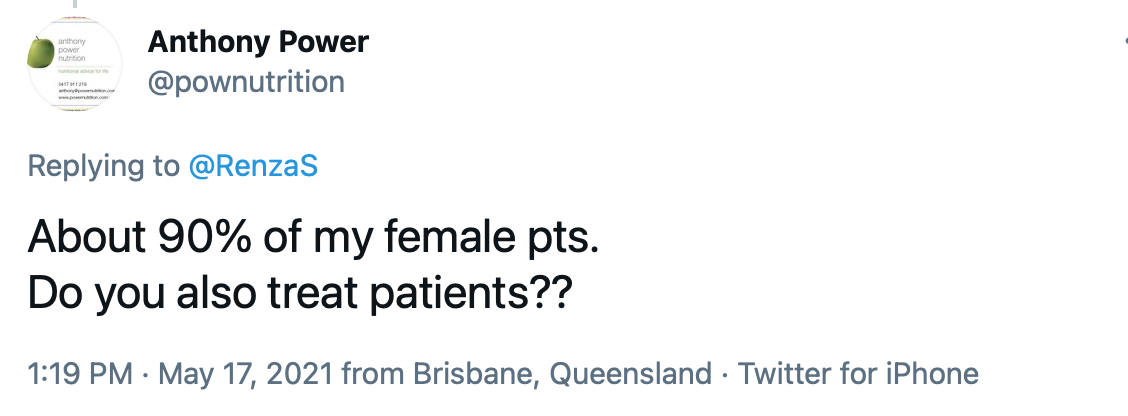
I replied that I am not a healthcare professional. And then came this:
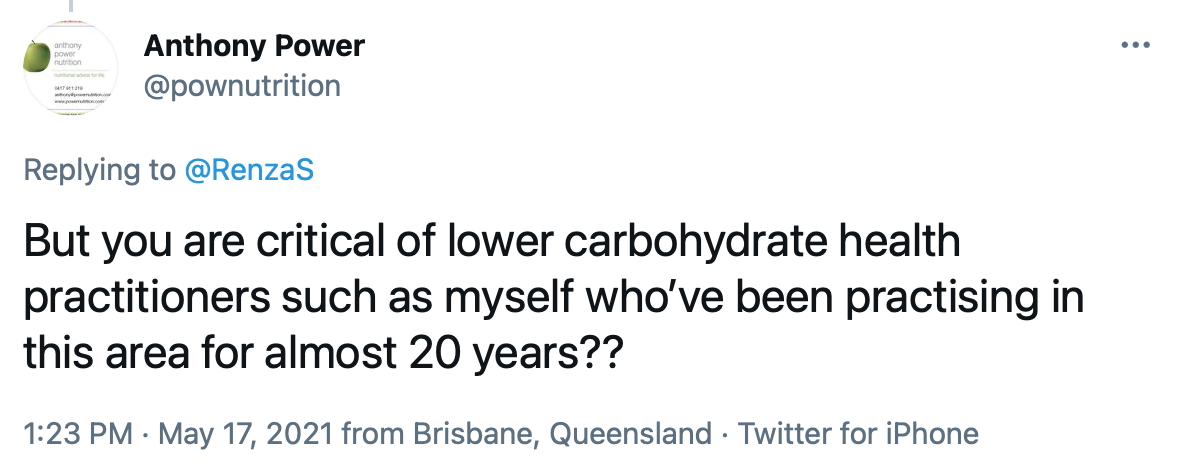
Followed by this from me:

(I’m not going to share anymore of the tweets in what turned out to be a rather long back and forward thread, but if you click on any of the tweets above you will be able to find the whole mess.)
He kept going, demanding to know why I am critical of low carb diets and health professionals who promote them (which he apparently had deduced from reading through my Twitter feed). I’m not. Which is what I repeatedly tweeted to him in responses to his continued demands that I explain my stance on diets and diabetes, and, as a healthcare professional, I must stop giving ‘personality-driven healthcare advice’. I reminded him that, a) I am not a HCP (which I had already stated), and, b) I share my experiences, not give advice. He helpfully suggested that my blog posts read that way.
I had asked about menopause. I asked people with diabetes who had either been through menopause, were going through it now, or thinking about going through it. I asked whether it had been a topic of conversation with their HCPs.
This bloke – who doesn’t have diabetes and has never experienced menopause – had nothing to offer, other than attacking me for my choices. And my choice is that I believe in choice.
It’s not okay for a healthcare professional to enter into a discussion with a person with diabetes seeking peer support, and telling them what it is that they do and don’t do in that community. I am so over this sort of paternalism in healthcare. I’m over HCPs bullying their way into our community and trying to shape it into what they want.
I’d also add that a man hijacking a conversation started by a woman about menopause is pretty shitty behaviour. I’m also over misogyny and the way male healthcare professionals centre themselves in discussions that are not about them. It happens all the time. It happened on Monday.
A tweet about menopause. And not even about food and menopause! It sounds somewhat ridiculous really. I don’t look for this sort of reaction, and I certainly have never baited anyone from the LC community. I don’t post photos of high carb meals accompanied by a ‘dare you to say something’ comment. (But I should say, that even if people are doing that, there is still no valid reason to criticise what another person is eating** or criticise the way they choose to eat.)
I understand that there will always be difficult people in any community. Unfortunately, it is people like this who are often the most seen from the LC community. And it’s why I am critical. But be clear – I am not critical for the advice they are giving, or the eating plan they are following. I am critical of, and will continue to call out, this sort of behaviour.
**Okay, I know that I said that there is no valid reason to criticise what another person is eating. But I am adding a caveat to that because I do (and probably will continue to) criticise anyone who wants to drink flavoured coffee. Or instant coffee. Or coffee from a bag. I fully acknowledge and accept my status as a Melbourne coffee snob and will not be entering into any discussions that caramel, pumpkin spice or unicorn flavourings are okay. They are not. Don’t @ me.
Imagine if the only emotion we felt when we ate something was joy. How different that would be.
A more detailed post about language a food can be found here.
I wrote this piece six years ago today when one of the most well-known, and one of my whole family’s long-time favourites – turned 28. Today, Marios is still going strong and has hit thirty-four years of operation. We are still frequent visitors to this cafe. It has become our kid’s choice for weekend brunch – she and I have a standing date their every second Saturday when Aaron is at a rehearsal. And at least one weekend day will see the three of us eating together. And drinking coffee. Yes, Marios is where my kid together with one of the cafe’s namesakes, ganged up on me and broke my ‘no coffee until you are eighteen’ rule, and started drinking coffee when she was just a teenager.

Marios at home.
During this time of COVID-19 we have been desperately missing Marios. Even though it’s only ten minutes from where we live, it’s outside the zone of where we have comfortably been travelling for our daily caffeine hits. But last weekend, we decided we needed a meal of pasta from there – the ultimate in comfort food – so called in an order and went to pick it up. I teared up as I walked into the cafe and was greeted by the gorgeous staff. It had been six weeks since I had last walked in that door and I can’t remember another time (unless travelling) where I have gone that long without paying them a visit.
As have many other small business, Marios has adapted to the new rules about dining. Takeaway and delivery is available, and they have turned the front of the store into a provedore with tables of dried and fresh (made in house) pasta, sauces, jams, coffee and fresh fruit and veggies. I loaded up a bag with the pantry staples as I chatted with the staff waiting for my pasta to be ready.
Marios will always – always – have a special place in our heart. And will be back as soon as this is over, making up for lost time. But until then, we’ll get takeaway and support them as we can. I’m sharing this post today (with a couple of edits) because it feels the only thing to do.

With one of the Marios a couple of weeks ago when I picked up dinner.
Today, my all-time favourite café turns 28 34 years old. Marios café (named for its two owners, Mario Maccarone and Mario De Pasquale, hence no apostrophe) is celebrating its birthday and remains the ultimate in Melbourne café culture. It’s unapologetic (still doesn’t serve skim milk, although did succumb a couple of years ago and started to offer soy) and reliable (never had a bad coffee!).
I’ve been going to Marios for pretty much all of its 28 34 years – first with my parents and then with friends. Once I left school, meeting up with people at Marios was the epitome of cool! Great jazz on the stereo, a gorgeous changing art display showcasing local talent, and the best coffee in Melbourne. Plus tablecloths on the tables, smartly dressed waiters and breakfast served all day. There have been many times that I’ve ordered scrambled eggs or a blueberry bagel at 10pm!
Back in my uni days, it was the location for many first dates and I could always tell if there would be a second date by whether or not the guy knew of Marios when I suggested we meet there. Aaron and I had our first date there, eating cheesecake late at night after seeing a movie. He knew about Marios; there was a second date! In any relationship break up in the division of cafes and pubs and places we’d hung out, I always got Marios!
Marios is where I take overseas friends when I want them to have a truly Melbourne café experience. DOC friends from home and abroad have been taken there and just a couple months ago, a group of us got together to catch up. It’s where I meet up with friends who have moved overseas when they come home for a visit. My beautiful friend Shannon who moved from Melbourne to Hong Kong and then the UK over 15 years ago and I have a standing date any time she’s in town so she can get a fix of Marios lasagne! Recently, I caught up with a long-lost friend and there was no doubt about where we would meet.
There have been many memorable visits to Marios including the night before my daughter was born, where I checked my watch every ten minutes, counting down until the time I would meet her. The day we brought her home from hospital, we took a pit stop to Marios to show her off to the waiters and introduce her to the place she would be spending a lot of time.
I’ve laughed, cried, and had some of the most serious conversations of my life in Marios. I’ve said goodbye to friends and welcomed them back into my life. I’ve met up with people for difficult, heartbreaking chats because it’s always felt safe.
I can still remember my first trip to Marios after I was diagnosed with diabetes. It was only a week or two later and it was the first time I was eating out. It was where I did my first ‘public injection’ and I can remember my heart racing as I pulled my insulin pen out of my bag and tried to jab my stomach secretly. I was sure everyone was watching me, judging me, waiting to jump on me and tell me to put it away. No one noticed and if they did, said nothing. I searched the menu for food that the ridiculously old-school dietitian I had seen would approve of and I wondered if it would be okay for me have chocolate sprinkled on top of my cappuccino. I fought back tears as I asked the waiter for sugar substitute and then explained why I was asking. My coffee was on the house that day.
Now, I don’t hide away my BGL checks or pulling my pump out from under my clothes when I am out, and it was at Marios that I realised that I had nothing to be ashamed about when it came to ‘public displays of diabetes’. Marios normalised eating out with diabetes – the new reality of my life.
I felt safe there. I knew I would not be questioned. I knew that I would still be the old me there and Marios would never change. It felt like it always did. It felt like home.

Shortbread with Smarties. (Time lapse at end of post.)
Every Sunday, I spend an hour or so doing one of my favourite things. I bake cookies, cakes, brownies or anything else that takes my fancy. I make a time lapse video of it and then share it to my Instagram and Facebook, along with some photos of the delicious finished product and the hashtag #AndOnSundaysWeBake. My friends and family frequently comment on my creations. Some ask for recipes; some ask if they can have some delivered to them; some are perplexed as to why I feel the need to add veggies to my cakes. (The answer is THIS ZUCCHINI BREAD RECIPE!!!!)
The other day, someone who had just started following me on Instagram asked me if these baked goods are my guilty pleasure.
‘Of course not,’ I said to them shaking my head. ‘Why should I feel guilty?’
‘Because they have sugar in them. And butter. Lots of carbs and fat. And you have diabetes. I thought you would steer clear of those kinds of foods.’
I sighed and thought that I could explain how as long as I cover the carbs with insulin, I am dealing with the diabetes side of things. And how I try to eat a balanced diet which mostly is made up of freshly cooked meals containing protein, in season vegetables and some carbs. I thought I could point to how I generally follow a low-ish carb diet because that works for me, and that my weekend (and week day too at times!) baking is a fabulous way for me to de-stress, and feel creative. I was going to point to how there is no such thing as a ‘diabetic diet’ and that people with diabetes can eat whatever we want and that it’s kinda not okay to ask us about what we are eating because it’s none of anyone else’s business. I started to tally up what I’d eaten for the day to highlight just how healthful my day’s food had been (so far) and was going to explain how I would be eating sashimi for lunch, and that has no carbs.
But instead, I just said ‘I don’t do guilty when it comes to food. And I try really hard not to do guilty when it comes to diabetes. Suggesting that we should feel guilty or shame when we eat something delicious that we enjoy – whether or not we’ve made it ourselves – just feeds into bullshit diet culture. My moral value has nothing to do with what I put in my mouth, or restricting food groups, or my weight.
‘So, to answer your question: No. What I bake on Sundays is not my guilty pleasure. But I do take great pleasure in baking and sharing the spoils with friends and family. And eating them. Because I am an amazing baker, and they taste absolutely delicious. Pleasure? You bet. Guilty? No fucking way!’
More?
My go to ‘smash diet culture’ SoMe sites are BodyPosiBetes and Feel Good Eating. Follow them for no-nonsense, no bullshit, no-diet-culture brilliance.
I love working out of the same office as Jane Speight. It means that I have a friend just down the corridor, plus I have this idea that being around her and the ACBRD team makes me smarter. (Admittedly, I am the only one who thinks that.)
Jane may not be quite as excited by the working arrangements, especially on the not rare occasions where I appear at her door and go on some rant that she didn’t ask for. (‘Jane! Have you seen <insert latest thing that is pissing me off>? Let me tell you all my thoughts about it right now.’)
So, the other day, when Jane appeared at my door wanting to talk (rant) about hemp kombucha, I was more than ready to sit back and listen. For a change.
Yes…
Hemp kombucha.
There is a television show on SBS in Australia called Medicine or Myth. I’d never seen it, however I did know that Dr Charlie Teo is one of the hosts. Charlie is a well-known and controversial neurosurgeon. He is joined by GP, Dr Ginni Mansberg and associate professor in immunology, Dr Ashraful Haque. They are the trio directing the show, which sees Aussie pitching home-grown treatments for treating all that ails them.
I had not ever come across the other two hosts before, but a Twitter search showed that Ashraful is interested in host-parasite interactions (and guitars). The first bit made no sense, but I like guitars. Ginni also hosts (the horribly named) Embarrassing Bodies Down Under, and is a ‘passionate anti-aging skincare geek’. I don’t know about you, but I generally don’t go to my GP for advice on how to reduce fine lines and wrinkles, but maybe I’m being narrow-minded.
The episode that screened this week featured John Leith who was diagnosed with type 2 diabetes a couple of years ago. And that brings us to hemp kombucha.
Within about thirty seconds of watching the segment I had already dismissed it as complete and utter rubbish. In fact, the second that John referred to hemp as a ‘superfood’ I rolled my eyes so far back into my head that I almost blacked out.
I then grabbed a piece of paper and started making notes of all the misconceptions about diabetes that were being thrown around. I’m not going to list them all here, because I have more important coffee to drink, but if Ginni Mansberg is your GP, find another one now. Her statement that ‘Poorly controlled diabetes will [….] destroy your feet’ followed by saying that an A1c of under 10% is what ‘diabetics should aim for’ was enough to set me off yelling at the computer screen.
But back to John and his magical mystery kombucha. Apparently, it cured his diabetes. That’s right, after five or six weeks of drinking this glucose busting elixir, his glucose levels were back in range. The three experts – and I am now using this term loosely – were astounded, and to make sure we knew that, made acceptable TV astounded noises. In fact, they were so caught up also making acceptable TV astounded faces that not one of them asked if the corresponding reduction of food portions, increased fresh food or boosted exercise plan could have contributed (i.e. caused) the improved glucose numbers John was seeing.
In fact, John’s claims were enough for this merry band of HCPs to send the hemp kombucha off to trial – another term I am now using very loosely. According to the voice-over person narrating the program in a serious voice, trials are run by an independent scientific team experienced in clinical research who recruit carefully selected participants.
According to the next segment, those carefully selected participants included three people: two with type 2 diabetes and one with ‘pre-diabetes’. They all drank 100ml of hemp kombucha a day and then recorded their BGL on day 1, 3 and 7 of the week-long trial.
I know. Robust.
The results were astonishing. Apparently, blood glucose results came down on average 0.8mmol/l, with 75% of participants (out of a total of 3?) reporting improvement in glucose results.
I have so.many.questions.
We were not told if the participants were doing any else to manage their diabetes. Were they taking medication? Were they on a specific eating plan? Were they exercising? Had any of them lost any weight during that week? Why did the trial (really? trial??) only run a week? Is it reasonable to suggest that three data points is really enough to confirm that a treatment is successful?
I can’t answer any of these because none of this was revealed in the program.
However, it was enough for the hosts to claim that they were excited about this as a treatment for type 2 diabetes.
Let’s just think about that for a moment. This ridiculously shambolic and hopeless experiment was enough for three healthcare professionals to suggest that hemp kombucha is something people with diabetes should consider…and that the scientific community should sit up and pay attention. All this without a glance to the fact that John and his n=1 claims are also associated with a hemp kombucha business, and the least vigorous trial I have ever heard.
You know, this really could work for some people. Complementary therapies do have a place in modern medicine. Many have been studied extensively to see how they can augment science-based treatments. However, before any HCP even thinks about mentioning them, they need to be able to point to some evidence. Three people and three blood glucose checks is not evidence. It’s a twenty-minute segment in a sensationalist crappy television program.
Look, I don’t really want to link to this train wreck of a story, but I think that you need to watch it yourself to appreciate just how ridiculous it is. So here you go. (I’m sorry.)





 Diabetogenic