
You are currently browsing the category archive for the ‘Communication’ category.
This morning, I drove my car straight into the tyre shop across the road from work. By the time I had turned off the ignition and stepped out of the car, a kind looking mechanic was standing next to me.
‘Morning, what can we do for you today?’
‘I haven’t made a booking, but I was wondering if you could help out. I need a tyre replaced and, while it’s in here a wheel alignment. Any chance you could do it today?’
‘Not a problem,’ he said. He walked around the car slowly. ‘You know, both those front tyres could do with replacing. Would you be happy for us to do that?’
We had a chat about options – he showed me photos of all the different tyres that would work on the car (all looked the same to me) and discussed the pros and cons of each. After I decided, I walked out of the shop, with the mechanic promising to call if there were any problems.
Service with a smile!
As a customer/client/stakeholder/friend/’insert latest buzz word here’ I like to feel that I am somewhat valued. I like to feel that I am not inconveniencing the person offering the service and I like to feel like my custom is appreciated.
Which was how I felt this morning as I walked out of the tyre shop.
And it’s exactly the opposite of how healthcare frequently makes us feel. It’s a system that is set up to be customer-unfriendly. And it’s what we – the users of the services – have come to expect. And sometimes, to accept.
From trying to get an appointment, to actually walking in the door, to collecting test results, the process can be difficult, convoluted and confusing, with roadblocks at every turn. Here are just a few things that you may come across as a user of healthcare.
- You need to see a new specialist, so you call to make an appointment. Most likely, the first thing you are told is that there will be a wait before the specialist can get you in. Possibly a long wait. A very long wait. Sometimes, you are told that new patients are not even welcome at this point in time. Sometimes you are told that you cannot actually make an appointment until your referring doctor has faxed (yes, seriously, FAXED!!!) across a referral.
- If you are lucky enough to actually get an appointment, a barrage of Things You Must Do are read out to you: Referral letter (if you have been allowed to make the appointment without one); get there early to fill in the forms; bring test results; bring x-rays etc. etc.
- You may be warned that if you do not show up or call within 24 hours (once I was told within a week!), you will still be charged for the service.
- If you have managed to get through all of that and still decide to go, then once you arrive, you are faced with a frequently unfriendly and unwelcoming receptionist who is there to basically act as a buffer between you and the doctor.
(Side note: I am going to say that I know that this is a thankless job at times. Many people think they are the most important person in the world and these same people think that the doctor should be bending over backwards to accommodate them. However, in my experience, most people do not think that way. I know I certainly don’t. Also, I have had many experiences of wonderful support staff greeting me when I have an appointment. The staff at my endo’s office are friendly, polite and delightful. At my GP, it is touch and go – some are lovely, one in particular makes me start to sweat in fear!)
- At first-time visits, you are given a clipboard with a wad over a paperwork and told to fill it all in. (This is where I weep a little and just wish that a centralised electronic medical system that worked was available and easily accessible so that I could simply write down my details and pass that over and all my information could be magically brought up on a magic computer.)
- Eventually, after having filled out the forms and provided information about every aspect of my life, the file gets returned to the reception desk and is often greeted with the words: ‘The doctor is running late. About 30 minutes.’ At this point, I sigh and possibly ask (as politely as I can) why I wasn’t told this when I called before going in to make sure that the doctor was running on time – a call that I made only 30 minutes earlier. Steely silence. No answer.
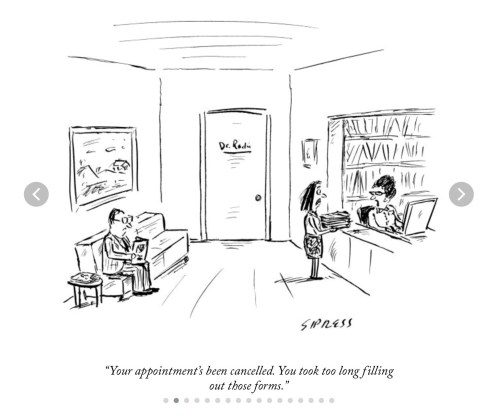
(From this week’s New Yorker’)
So, let’s just recap. It has taken months to get into see this doctor and I wasn’t even granted an appointment until I had jumped through so many hoops that I now also needed to see a physiotherapist because I had put my back out; when I eventually get there, I spend ages filling in information that I know is hardly going to be relevant. And now I am told that after having arrived early so that I could fill in the forms that the doctor is running about 30 minutes late and that I just have to deal with it.
(I’m not going to write about the actual doctor experience, because we know it can be good, it can be bad, it can be disastrous ‘This isn’t going to work, but thanks for your time. I’ll just go pay my bill…..’ which is something that happened when I was interviewing endos a few years back.)
- You leave with another ream of paper – prescriptions, test requests, perhaps another referral letter and are told to call back in a week’s time to get the results.
- But a week later when you call, a new dance starts. ‘No, you can’t speak with the doctor,’ you are told, when you say that you are calling – as requested – to get results. ‘The doctor speaks to people between 1 and 1.15 Monday and Thursday. You’ll need to call back then.’
- You ask if the doctor could either call you back or even email me the results, which gets a response of horror, ‘No we do not correspond via email. The internet is not safe.’ (I at this point, do not say what is going through my head – ‘I do all my banking on the internet and I am not concerned about privacy there. And I am certainly not likely to care who knows what my hand X-ray shows.’ Because there is no point.
- After about four attempts, you eventually get to speak with the doctor who will probably (hopefully) tell you that all is clear and to make another appointment for 12 months’ time.
- It seems that every part of the system is designed to keep apart the two people who actually need to be in the same room, looking at each other and truly engaging.
And this is deemed okay?
It’s not. How many of us would return to a shop if we were treated this way. Even if the people we are speaking with are lovely – which is usually the case – the system is ridiculous. It’s broken, seemingly beyond repair. And I can’t think of any other service where the customer is considered an annoyance. Can you think of any other service where the customer is treated this way?
I just had a call from my friendly tyre mechanic. My car is going to be ready an hour later than he thought and he wanted to let me know. I thanked him and commented on how much I appreciated the phone call. I was probably a bit gushy as I am when impressed with the service I’m receiving. ‘Not a problem at all,’ he said. ‘We like happy customers.’
And I like to be a happy customer!
A couple of weeks ago, I sat in a packed Melbourne Town Hall. And there, on the stage, was Nigella Lawson. It is possible that I have never been so excited in all my life – the original and greatest domestic goddess in all the lands was sitting about five metres from me, sharing the same air! She is every bit as poised and elegant in person as she is on screen and her beauty is startling. I certainly squealed when she walked onto the stage!
So, was the hour or so that Nigella was sitting on the stage worth the time and money? Well yes. And no.
I have been to a number of these ‘in conversation’ events before and they can be hit and miss. Largely their success is dependent on the person asking the questions, or rather, guiding the conversation. And that was the frustration with Nigella’s session. Food writer and restaurant critic, Jill Dupleix, was a little clumsy in her attempts to steer the conversation. It probably didn’t help that she started with a dud question that I am sure was meant to break the ice, but had the complete opposite reaction. Nigella looked positively uncomfortable. Perhaps asking someone who has recently gone through a very public and awful relationship breakup about her sex life wasn’t very well considered.
But even after that, I felt that Dupleix was not a great choice of interviewer. She interrupted and gave her opinion about the audience questions. She was clearly afraid of silences!
Everyone in the room had come to hear from Nigella. We wanted to hear the secrets to her success and about her every day life. For me, I wanted to hear about how she had turned something she was so passionate about into a successful career. I had the kidlet with me, and she was enthralled as Nigella shared stories of how she got her start as a journalist and how she built an empire as a food writer.
When given the chance, the Domestic Goddess, using language in a way that was both beautiful and mesmerising, shared snippets into her life that were amusing and telling. (She keeps condiments such as mustard and soy sauce in little jars on her bedside table for when she is eating in bed so she doesn’t need to climb down the stairs, back to the kitchen, for them. Brilliant!)
Where the discussion worked was when Jill shut up and Nigella could speak, uninterrupted. Unfortunately, too often she was cut off, or the silences – probably where Nigella was trying to formulate her next thought – were cut short and we never got to hear the titbit of information that she was finding the right words to disclose.
I left feeling elated that I had been in the same room as Nigella, but disappointed that I had not heard more. Several people I spoke with afterwards said the same thing.
This is the power of effective communication. Whether it is in a room like that, or as a one on one consultation, the most important person in the room is the one who needs to be heard most, be given the most time to speak, and have the opportunity to set the agenda and direct the conversation. And this is the case in a formal interview, health appointment or even a conversation with a loved one at the kitchen table.
I have really kept this in mind recently. Yesterday was the first day of school and over the last week or so I have frequently checked in with the kidlet about how she is feeling as the holidays come to an end. As with any eleven year old, she moved between being excited and nervous. Some of the things taking up her attention were hilarious (how will I wear my hair on the first day, mum?) but as they were her concerns, they are legitimate. It wasn’t my place to tell her that no one would care if she was wearing a high or low ponytail, and she should be concentrating on important things like revising her times table.
No, my job is to shush and listen and ask gentle questions to get more out of her and then try to make her feel as calm and happy as I can.
It’s the same with the way that diabetes consultations are very frequently criticised for not allowing the PWD the opportunity to use the forum for what they need, instead, going through a tick-box exercise of what the HCP needs and wants. Surely the HCP should shush and listen.
I think that often we like to think that we are the most important person in the room; the our opinions count for more; that our voice should be the loudest; that anything we don’t like should be defended. But most of the time, unless we really are the most important person in the room (i.e. in the case of a HCP consultation, or if we are Nigella in a Town Hall full of people), we need to just shush and listen.
Because if we did that, just imagine how much more we would hear and learn.

Nigella Lawson in Melbourne last week.





 Diabetogenic