
You are currently browsing the category archive for the ‘Babies’ category.
In the lead up to our daughter being born, I was told that it was most likely that she would need to go to the special care nursery immediately after she was delivered because of low blood sugar. This had been the case for most of the dozens of other women with type 1 I’d spoken to beforehand, and I was resigned to the fact that there would not be many cuddles for a day or two.
The reality was a little different. As soon as she was delivered, her heel was pricked and her blood glucose was checked. ‘She’s good to go straight to your room,’ said the paediatrician charged with making sure our precious baby was all okay. He placed her in my arms so I could drink in the beautiful little munchkin
‘No; wait. She needs to go to special care. I have diabetes, remember?’ I said, as I lay on the table being stitched up after the C-section, looking in awe at the wriggling, full-cheeked munchkin who had just been lifted from my body.
‘Her blood sugar is fine,’ the paediatrician smiled at me. ‘Aaron can take her to your room and as soon as you are out of recovery you can join them. Lots of cuddles this morning – skin to skin contact is good for you both! We’ll keep an eye on her and do hourly BG checks to make sure she is okay.’
An hour later, I was stitched up, out of recovery and wheeled back into my room where Aaron was sitting holding our new daughter. He stood up and brought her over to me, positioning her on my chest and I pulled away my hospital gown and her swaddling so I could feel her against me.
With the help of a wonderful nurse, we started to learn how to breastfeed. There in my arms was our daughter. I couldn’t stop staring at her and couldn’t believe she was finally with us.
My endo walked into the room to meet her, and see how I was doing at the same moment another nurse walked in to do the first BGL check. As I held our baby, I cringed at the lancet going into her tiny, tiny heel and the tiny, tiny whimper she made.
I looked at the nurse and saw her turn white. “She needs to go to special care. Now. Her BGL is really low.’
My ever-calm endo, looked at the result. ‘I don’t think that is right. Can you check again? Maybe using Renza’s meter?’
‘No!’ said the nurse, starting to panic. ‘She needs to go right now.’ And she snatched the baby from my arms, put her back in her crib and headed quickly out of the room.
‘Go with her!’ I said to Aaron, but he was already on his feet scurrying after our baby girl.
I was in shock. What had just happened? Our baby had been peacefully snuggling with me, drinking in some of the tiny bits of colostrum she could manage. What was the problem?
In the special care nursery, Aaron watched as the doctors and nurses tried and tried and tried to get an IV line into our tiny newborn baby before they finally decided to just give her some formula.
As it turns out, her BGL was fine. They needn’t have bothered trying with the IV. The meter used on the ward was probably faulty. She could have stayed with me and all would have been okay.
But I wasn’t upset – or surprised – because I understood exactly what I was seeing. This was hypo anxiety from healthcare professionals and I’d seen it before.
When in hospital having my appendix out, a nurse walked in when I was checking my BGL. When she saw the 4.2mmol/l on the meter, she insisted a drink two glasses of juice and eat a sandwich, despite my protestations that I was fine and a few jelly beans would more than do the trick to keep me in the safe zone. She stood there watching me as I forced the juice and food down my throat.
In A&E once, an emergency doctor wanted me to disconnect my pump, because it was sending me low, even though my BGL had been sitting pretty in the 5s for most of the time I was there.
Another time, at work, a diabetes educator jumped up to grab me juice and almost shoved a straw in my mouth when she noticed by CGM trace heading downwards, even though my BGL was still 6 and I had plenty of time to treat before going low.
And it’s not just HCPs. In a meeting once, a senior staffer I’d worked with for over two years asked me if I needed a nurse to ‘help me’ after I excused myself for eating a couple of jelly beans because I was preventing a low. ‘A nurse,’ I said. ‘Why?’ I was confused at what was going on. ‘Because you are hypo. To make sure you are okay.’ And then I was more confused because what possible would have ever suggested that this very easy-to-treat hypo would need the assistance of a nurse?
There is a lot of anxiety around hypoglycaemia. Fear of hypos in people living with diabetes and their loved ones can be paralysing. I know that after a particularly nasty or sticky hypo, I get anxious about lows and I see my loved ones watching me more closely.
But I also work really hard to try to keep some perspective about managing them. And those around me know that keeping calm while I’m low and gently asking if they can do anything is helpful, but panicking is not. Interestingly, no one with diabetes has ever been flustered when they see me going low (nor I when around one of my friends having a hypo).
In each of the situations I described above, I needed to do a lot more to settle and reassure the person panicking than to manage my own low blood sugar. Having to calm down the anxieties of others is not really what I want to do while low.
Unfortunately, low blood sugar is a reality of diabetes for many people. I see it as a short term complication – something I do all I can to minimise, and treat as well as possible – that just needs to be managed. Of course, it can be scary. But doing all I can to keep calm yields far better results: I tend to not over treat and eat the whole kitchen when I am calm.
But what I want to know is why so much anxiety from those around us? If we know that the best way to manage a hypo is calmly, rationally and with measured treatment, why the panic? What are HCPs being told about hypos that send them into a spin so they overreact? And what could be done better to ensure those around us help rather than make things worse when we are low?

Calmly. Quietly.
On Sunday, I pottered around the front garden, doing a bit of weeding and tidying up and decided to cut a couple of small branches from the beautiful Little Gem magnolia trees we have along the fence-line, doing their best to hide us from the bluestone lane that runs along the side of our house.
I took them inside and arranged them in the largest vase in the house, setting it in the middle of the table in the kitchen. They looked magnificent – the leaves are the most beautiful glossy dark green on one side and a matte brown on the other.
Standing in the kitchen later that day, I said to Aaron ‘Aren’t the magnolia leaves gorgeous?’ ‘Yep,’ he answered. And then added ‘Are they steel magnolias?’
The term steel magnolia is a term used in the US South and refers to a woman who is traditional and feminine (that’s the magnolia part) and strong (that’s the steel part). I didn’t know this until quite recently – it isn’t a term we use here in Australia and for me, it was just the name of a film.
I can remember first watching the film years and years ago when I was babysitting. I can’t remember who I was babysitting, but I know that the kid was in bed and I was looking through the families VHS collection (I said it was a long time ago!) and there on the shelf was Steel Magnolias. I popped the tape in and watched it, and was a completely dishevelled mess of tears by the end of it.
There was no comprehension of what it meant in terms of someone living with diabetes – I had no idea. And yet, a little seed was planted: women with diabetes shouldn’t have babies or they will die. From somewhere, the seed became a huge tree the day I was diagnosed with diabetes, because one of the first questions I asked the endo treating me on 15 April 1998 was ‘Does this mean I can’t have children?’
On Sunday night, as I was flicking through the TV channels, there in front of me was the scene in the hair salon from Steel Magnolias. It was early on in the movie, and the women were discussing Shelby’s wedding (‘My colours are blush and bashful’).
I snapped a photo and snapped off the TV quickly, because I knew watching Julia Roberts have a hypo in a hair salon, and then two hours later die after having just had her beautiful baby was not going to be a good way to end the weekend.
I joke about this movie, I quote this movie, (frequently a juice is accompanied with the comment ‘Drink your juice Shelby’), and I shake my head at how ridiculous it is and how untrue – or at least old-fashioned – it is in its portrayal of diabetes and pregnancy. Most women with diabetes I know have a Steel Magnolias story.
I may mock it. But there is no way that I can watch it. Which is what I said on Facebook when I posted the photo I had just snapped of the TV.

The comments after my photo (and in some private messages) were from friends around the world with diabetes. The impact and consequences of this movie for women with diabetes – many of them having seen it for the first time as children or teens – is far reaching and actually did shape their decisions about having babies.
Yesterday, as I was standing in the kitchen making dinner, I walked over to the leaves on the table and gently rubbed one between my fingers. I thought of how in a few months’ time the trees out the front would be covered in beautiful white flowers that last for days before their beautiful petals drop to the ground. ‘White flowers‘, I thought, and shook my head because I always connect them with babies – my babies – lost.
And then my kid ran into the kitchen to tell me about something that had happened that day. I listened to her and watched her unstack the dishwasher, barely pausing for breath as she told me her funny story. We giggled together and I reached out and gave her a quick hug. And as I do more and more often, I marvelled at her just being there. That movie terrifies me. But not as much as the thought of not having had my baby girl.

Perfect start to Mother’s Day. Just need to work out how to make this happen every day!
I had a gorgeous Mother’s Day yesterday, which included, amongst other things, breakfast in bed, a big family lunch at our place and, after everyone had gone home, an afternoon nap. It was quite glorious and I felt incredibly spoilt by my little family and fortunate to be surrounded by our extended family.
So it is with some guilt that I admit that in with all the happiness and celebrations and gifts and cards and flowers that I had moments of quiet sadness – both yesterday and in the lead up to the day.
Mother’s Day for me is about celebrating my mother who is, quite simply, the best mother in all the lands. There is no doubt about that in my mind.
It is also about being a mother and thinking about how much I love that. But in there, mixed up with the loveliness of it all, I feel pain and sadness.
I feel guilty about it because I do feel so lucky. I have a daughter and she is wonderful. I am a mother and I am so grateful. But I feel that I am missing something – or someone.
In the lead up to Mother’s Day, I was talking with a friend about how I felt and she said to me ‘At least you have your beautiful girl. A lot of people would be so thrilled with that.’ And I am thrilled with my daughter – of course I am. Feeling sad about the babies I lost does not mean that I don’t celebrate what I do have.
I ache sometimes for what could have been. I feel ungrateful even writing this, because I know and try to understand how difficult it is for women who do not have children. I read the stories about how hard Mother’s Day and other occasions are for people who don’t celebrate – for whatever reason and know that it sounds like I am ignoring how lucky I am and being greedy for wanting more.
Those quiet moments of wonder don’t stop hurting. I think about the baby that would have come before my daughter, but mostly, I think of the little ones that would have come after. I think of the one I lost two years after out little girl was born and think about how different our daughter’s childhood would have been if she had a sibling so close in age to her.
And still with so much rawness, I think of the one who would have been three now and how our family would have been turned completely on its head with the arrival of a new baby only a couple of years ago and we would still be muddling through the toddler years.
I had a dream the other night of Mother’s Day morning with Aaron and our daughter, and another little child – a three year old. I couldn’t see if it was a boy or a girl, but there was a bundling little kid also jumping on the bed, helping me unwrap my gifts and bringing me my carefully made breakfast. I kept trying to reach out for the child so I could hug him or her, but I couldn’t. The little one kept wriggling just out of reach, not showing me his or her face.
 I don’t understand these feelings. I don’t understand how I can move – almost in a heartbeat – from feeling like the luckiest mum in the world to feeling pain. But it happens and it especially happens on these days.
I hugged my girl very tightly yesterday. She is the one that my body decided to hold on to and keep; the one I was able to nourish and embrace and watch grow up. She is the reason I am someone’s mother on Mother’s Day. I truly do believe that she is so very much enough. But that doesn’t stop me from wondering ‘What if…?’
Ten years ago, I was waiting very impatiently for an arrival. My little girl was only three days from being delivered and I was counting the hours with a mixture of fear and excitement.
Her arrival would be the culmination of years of planning, hard work, heartbreak and promise. And her arrival would mean that beautiful sentiment ‘First we had each other. Then we had you. Now we have everything’ was coming true for our little family.
Pregnancy was also the time where I came to fully understand the concept of diabetes adding a degree of difficulty to a situation. The planning prior to even thinking about getting pregnant, and then the maintenance of impossibly near-perfect BGLs was relentless. For those years – and it was years for me – my life was all about numbers and charts and graphs.
Of course, I was lucky and all the planning and hard work was all worth it. The moment I first held our baby in our arms and looked into her perfect little face with her full cheeks and tiny button nose I knew that I would do it again in a heartbeat for her. All the planning meant that I had the best chance for a healthy pregnancy and baby.
This year, I have been on the Expert Reference Group for the NDSS Diabetes in Pregnancy Program. This program is looking to improve and develop resources for women with type 1 or type 2 diabetes planning to have a baby.
 At the moment, a survey is being conducted to better understand the kind of information currently available and provided to women with diabetes about contraception, pregnancy and women’s health.
If you are an Australian woman aged between 18 and 50 years with type 1 or type 2 diabetes, you can take place – and go into the draw to win an iPad Air! The survey will take you about 20 minutes to complete and is completely anonymous.
Click here to take the survey. You have until 30 November.
Women with diabetes deserve to have the best chance of having a healthy pregnancy and this work will go towards providing information and resources to help.
Want more?
Years ago, I was involved in the development of Can I Have a Healthy Baby? a booklet about diabetes and pregnancy. In subsequent years, I was involved in the review of this resource. This year, the Diabetes and Pregnancy program has reviewed, revised and rewritten this booklet. It will be relaunched as Having a Healthy Baby and will be specifically for women with type 1 diabetes. The Type 2 diabetes version will be developed and launched in coming years. The new resource will be available electronically from 3 December 2014. Keep an eye out for it!
DISCLAIMER
The Diabetes and Pregnancy National Develop Program is funded by the NDSS. I am a member of the Expert Reference Group. I do not receive any payment for sitting on this group, however it is part of my role at Diabetes Australia.

It’s Diabetes Blog Week thanks to Bitter~Sweet Diabetes. This week, over 150 diabetes bloggers from all over the world are taking part and sharing stories about their lives with diabetes. This is the second year I’ve participated and I can’t wait to read what everyone else is up to. So, here we go with Wednesday‘s topic……
They may be few and far between, but there have been days where I feel that I have conquered diabetes and none more so than the day my daughter was born. Even though it was eight-and-a-half years ago, I can still remember every detail of her delivery and first day in my arms so clearly.
Even though the day was all about meeting her, diabetes was prominent. It was because of diabetes that she was delivered at just under 38 weeks. It was because of diabetes that I decided to have a caesarean delivery. It was because of diabetes that the operating theatre was full of medics including a paediatrician. It was because of diabetes that the moment she was lifted from my body and briefly held up for me to see, she was whisked off to have her heal pricked to check her BGL. It was because of diabetes that she was later taken to the Special Care Nursery because her BGLs had dropped.
But despite diabetes – despite all the things I’d been warned about and the things I read – I had a beautiful healthy baby girl. She is my greatest achievement and these memories are my most precious. Despite diabetes, I was up by the afternoon visiting her in the nursery and breastfeeding her as I muddled my way through my own low blood sugars.
I wonder if I will ever forget the details of the day. The way Aaron and I looked at each and gasped when we heard her voice for the first sound; the way I tore away at her swaddling so I could feel her skin against mine when I first held her in the minutes after she was delivered; the way her hands opened and closed around my finger; the way that Aaron looked as he held her when I was wheeled back into my room after recovery. Everything seemed right – our much wanted baby was with us and she was healthy.
I don’t think of this day as a ‘diabetes day’. It’s the day of my daughter’s birth. But as with all my days, diabetes is there. This particular day makes me so proud because of the way I was able to manage my diabetes; deal with it in a way that worked and then get on with the important things. The most important thing ever – meeting my daughter.
Follow Diabetes Blog Week on Twitter by searching the #DBlogWeek tag.
There is a hushed feel to the room. Even as people walk in to register, they whisper their names and nervously ask if they can take copies of the resources from the tables. They usually come in pairs, and together they speak softly to each other and stand close. As the doors open to the lecture room, they walk in, sit down and look ahead. This isn’t one of our usual events where there’s lots of chatter and sharing of stories. This one is more personal, more urgent. This one is about babies.
It was our diabetes and pregnancy information evening. We started running these sessions almost 10 years ago. I can still remember the first session. As we planned the event, I was terrified that no one would show up. Over 100 people attended – women with diabetes and their partners or mums or sisters or friends. I spoke to a couple of women who didn’t have diabetes, but their teenage daughters did. Although their daughters didn’t come along, these mums wanted to have all the information they could get. What wonderful mums!
Now, all these years later, we still get a good number of people attending. We had over 80 booked in for this session and most showed up, eager to find out about diabetes, healthy pregnancies and healthy babies.
There is so much hope and anticipation in the room. And you can almost feel the rollercoaster of emotions in the room as the obstetrician and endocrinologist gently, but firmly, outline how diabetes can impact on a pregnancy and how pregnancy can impact on diabetes. There’s some scary information in there, but there is also a really positive message. And when I’m emceeing the event, I make sure that message is not lost. Here it is:
Can I expect a healthy baby?
Yes. Women with diabetes have an equal chance of having a healthy baby if they become pregnant at a time when their diabetes is controlled and general health is good. It is highly recommended that women with diabetes plan their pregnancies.
From ‘Can I Have a Healthy Baby?’
It’s good news, it’s positive news and I can feel the relief in the room when we focus on this for a moment. At that point we bring it all together and ask the women in the room (and their partners) to take a deep breath. Because we bring out our ‘case study’ – the good news that ties it all together!.
This year, my dear friend and colleague, Kim, stepped up and volunteered to share her story. Kim has two beautiful children. And when I say beautiful, I’m talking put-them-on-a-box-of-nappies gorgeous! We keep using photos of them for our diabetes and pregnancy resources because we can’t get enough of them!
Kim’s story is wonderful. And her candidness and honesty about how her family came to being so perfectly complete is not all perfection. There were struggles, disappointments and the need to wait. But her children are here and they are a joy.
I’ve said before how much I love my job, and this event is one of the reasons. I love the fact that each year after we’ve run the event, I get calls from women who were there, and are now pregnant. And others who have attended send me photos of their beautiful, beautiful babies.
Pregnancy with diabetes is not easy. But it is absolutely achievable and even though whilst we’re in the middle of a pregnancy that we feel may never end, as we check our blood sugar for what seems the millionth time – just for that day!, as we sit in the waiting room of yet another doctor’s office or hospital clinic, it is all worth it. And as we hold that precious baby in our arms for the first time – and every time after that we know that it was all worth it.
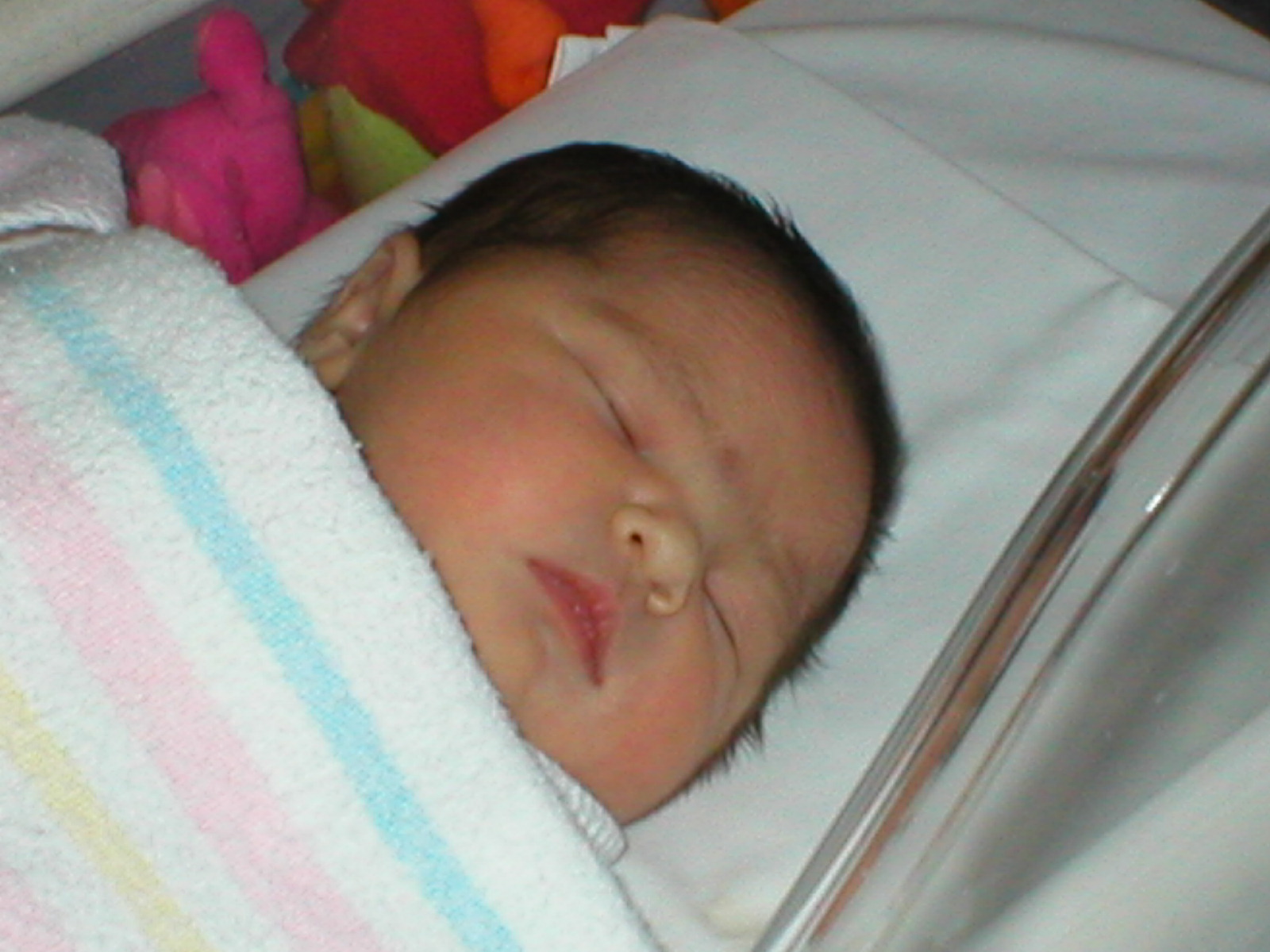
My own healthy baby; a day old and so precious.
Looking for information about diabetes and pregnancy? The ‘Can I Have a Healthy Baby?’ information booklet is a great place to start and can be downloaded for free here.
And call Diabetes Australia on 1300 156 588 for a free copy of the fabulous ‘Having a Healthy Baby’ DVD.





 Diabetogenic